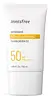
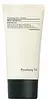
innisfree Intensive Long Lasting Sunscreen SPF50+ PA++++ Versus Pyunkang Yul Calming Sun Cream SPF 50+ PA++++
This hybrid sunscreen covers the full UV range and blocks ~98% of UVB at SPF 50.
This chemical sunscreen covers the full UV range and blocks ~98% of UVB at SPF 50.

What's inside
What's inside
 Key Ingredients
Benefits
Concerns
Ingredients Side-by-side
Ethylhexyl Methoxycinnamate 6.8%
UV Absorber


Ethylhexyl Salicylate 4.5%
UV Absorber
Titanium Dioxide
Cosmetic Colorant
Zinc Oxide 12.662%
Cosmetic Colorant
Water
Skin ConditioningCyclopentasiloxane
Emollient
PEG-10 Dimethicone
Skin Conditioning
Dipropylene Glycol
HumectantButyloctyl Salicylate
Skin Conditioning
Glycerin
Humectant


Dicaprylyl Carbonate
EmollientCaprylyl Methicone
Skin Conditioning
Mica
Cosmetic ColorantDisteardimonium Hectorite
StabilisingSilica
Abrasive

Vinyl Dimethicone/Methicone Silsesquioxane Crosspolymer
Magnesium Sulfate
Aluminum Hydroxide
EmollientStearic Acid
Cleansing


Phenoxyethanol
Preservative
Triethoxycaprylylsilane
Parfum
Masking


Propanediol
Solvent
Polyglyceryl-3 Polydimethylsiloxyethyl Dimethicone
Skin Conditioning
Sorbitan Caprylate
EmulsifyingOctyldodecanol
Emollient
Phenyl Trimethicone
Skin Conditioning
Dimethicone Crosspolymer
Emulsion Stabilising
Glyceryl Caprylate
EmollientEthylhexylglycerin
Skin ConditioningCI 77492
Cosmetic ColorantCentella Asiatica Extract
Cleansing



Portulaca Oleracea Extract
Skin Conditioning
Echium Plantagineum Seed Oil
Skin Conditioning
CI 77491
Cosmetic ColorantButylene Glycol
Humectant
CI 77499
Cosmetic ColorantCamellia Sinensis Leaf Extract
Antimicrobial

Helianthus Annuus Seed Oil Unsaponifiables
Emollient
Cardiospermum Halicacabum Flower/Leaf/Vine Extract
Skin ConditioningTocopherol
Antioxidant

Helianthus Annuus Seed Oil
Emollient
Hamamelis Virginiana Leaf Extract
Skin Conditioning
Citrus Unshiu Peel Extract
MaskingOpuntia Coccinellifera Fruit Extract
Skin ConditioningOrchid Extract
Skin ConditioningCamellia Japonica Leaf Extract
Skin ConditioningCitric Acid
Buffering
Sodium Benzoate
Masking
Potassium Sorbate
Preservative
Ethylhexyl Methoxycinnamate 6.8%, Ethylhexyl Salicylate 4.5%, Titanium Dioxide, Zinc Oxide 12.662%, Water, Cyclopentasiloxane, PEG-10 Dimethicone, Dipropylene Glycol, Butyloctyl Salicylate, Glycerin, Dicaprylyl Carbonate, Caprylyl Methicone, Mica, Disteardimonium Hectorite, Silica, Vinyl Dimethicone/Methicone Silsesquioxane Crosspolymer, Magnesium Sulfate, Aluminum Hydroxide, Stearic Acid, Phenoxyethanol, Triethoxycaprylylsilane, Parfum, Propanediol, Polyglyceryl-3 Polydimethylsiloxyethyl Dimethicone, Sorbitan Caprylate, Octyldodecanol, Phenyl Trimethicone, Dimethicone Crosspolymer, Glyceryl Caprylate, Ethylhexylglycerin, CI 77492, Centella Asiatica Extract, Portulaca Oleracea Extract, Echium Plantagineum Seed Oil, CI 77491, Butylene Glycol, CI 77499, Camellia Sinensis Leaf Extract, Helianthus Annuus Seed Oil Unsaponifiables, Cardiospermum Halicacabum Flower/Leaf/Vine Extract, Tocopherol, Helianthus Annuus Seed Oil, Hamamelis Virginiana Leaf Extract, Citrus Unshiu Peel Extract, Opuntia Coccinellifera Fruit Extract, Orchid Extract, Camellia Japonica Leaf Extract, Citric Acid, Sodium Benzoate, Potassium Sorbate
Water
Skin ConditioningDipropylene Glycol
HumectantEthylhexyl Methoxycinnamate
UV Absorber
Homosalate
Skin Conditioning
Bis-Ethylhexyloxyphenol Methoxyphenyl Triazine
UV Absorber
Ethylhexyl Salicylate
UV Absorber
Glycerin
Humectant
Niacinamide
Smoothing

Polyglyceryl-3 Distearate
Emulsifying
Cetyl Alcohol
Emollient
Butyloctyl Salicylate
Skin Conditioning
Aluminum Starch Octenylsuccinate
Absorbent
Allantoin
Skin Conditioning
Panthenol
Skin Conditioning
Lecithin
Emollient
Hydroxyacetophenone
Antioxidant
Pentylene Glycol
Skin Conditioning
Caprylyl Glycol
Emollient
Citric Acid
Buffering
Centella Asiatica Extract
Cleansing
Gluconolactone
Chelating
Lonicera Japonica Flower Extract
Skin ConditioningSodium Hyaluronate
Humectant
Salvia Officinalis Leaf Extract
CleansingMelaleuca Alternifolia Leaf Extract
Perfuming
Camellia Japonica Flower Extract
EmollientCentella Asiatica Leaf Extract
Skin Conditioning
Caprylic/Capric Triglyceride
Masking
Cetyl Ethylhexanoate
EmollientEthylhexyl Palmitate
Emollient
Arginine
Masking
Hydrolyzed Hyaluronic Acid
Humectant
Hydroxypropyltrimonium Hyaluronate
Ceramide NP
Skin Conditioning
Dipotassium Glycyrrhizate
Humectant
Sodium Hyaluronate Crosspolymer
Humectant
Madecassoside
Antioxidant
Madecassic Acid
Skin Conditioning
Sodium Acetylated Hyaluronate
Humectant
Asiaticoside
Antioxidant
Asiatic Acid
Skin Conditioning
Dimethicone/Vinyl Dimethicone Crosspolymer
Skin Conditioning
Glyceryl Stearate
Emollient
Glyceryl Caprylate
EmollientTrehalose
Humectant
Sorbitan Sesquioleate
Emulsifying
Potassium Cetyl Phosphate
EmulsifyingTromethamine
BufferingAcrylates/C10-30 Alkyl Acrylate Crosspolymer
Emulsion StabilisingCarbomer
Emulsion StabilisingGlyceryl Stearate Citrate
Emollient
Butylene Glycol
Humectant
Polyglyceryl-10 Myristate
Skin Conditioning
Ethylhexylglycerin
Skin ConditioningAdenosine
Skin Conditioning
Disodium EDTA
ChelatingTocopheryl Acetate
Antioxidant
1,2-Hexanediol
Skin Conditioning
Water, Dipropylene Glycol, Ethylhexyl Methoxycinnamate, Homosalate, Bis-Ethylhexyloxyphenol Methoxyphenyl Triazine, Ethylhexyl Salicylate, Glycerin, Niacinamide, Polyglyceryl-3 Distearate, Cetyl Alcohol, Butyloctyl Salicylate, Aluminum Starch Octenylsuccinate, Allantoin, Panthenol, Lecithin, Hydroxyacetophenone, Pentylene Glycol, Caprylyl Glycol, Citric Acid, Centella Asiatica Extract, Gluconolactone, Lonicera Japonica Flower Extract, Sodium Hyaluronate, Salvia Officinalis Leaf Extract, Melaleuca Alternifolia Leaf Extract, Camellia Japonica Flower Extract, Centella Asiatica Leaf Extract, Caprylic/Capric Triglyceride, Cetyl Ethylhexanoate, Ethylhexyl Palmitate, Arginine, Hydrolyzed Hyaluronic Acid, Hydroxypropyltrimonium Hyaluronate, Ceramide NP, Dipotassium Glycyrrhizate, Sodium Hyaluronate Crosspolymer, Madecassoside, Madecassic Acid, Sodium Acetylated Hyaluronate, Asiaticoside, Asiatic Acid, Dimethicone/Vinyl Dimethicone Crosspolymer, Glyceryl Stearate, Glyceryl Caprylate, Trehalose, Sorbitan Sesquioleate, Potassium Cetyl Phosphate, Tromethamine, Acrylates/C10-30 Alkyl Acrylate Crosspolymer, Carbomer, Glyceryl Stearate Citrate, Butylene Glycol, Polyglyceryl-10 Myristate, Ethylhexylglycerin, Adenosine, Disodium EDTA, Tocopheryl Acetate, 1,2-Hexanediol
Reviews
Ingredients Explained
These ingredients are found in both products.
Ingredients higher up in an ingredient list are typically present in a larger amount.
Butylene Glycol (or BG) is used within cosmetic products for a few different reasons:
Overall, Butylene Glycol is a safe and well-rounded ingredient that works well with other ingredients.
Though this ingredient works well with most skin types, some people with sensitive skin may experience a reaction such as allergic rashes, closed comedones, or itchiness.
Learn more about Butylene GlycolButyloctyl Salicylate is a chemical UV filter structurally similar to octisalate. It is a photostabilizer, SPF booster, emollient and solvent. This ingredient helps evenly spread out ingredients.
According to a manufacturer, it is suitable for pairing with micro Titanium Dioxide, Zinc Oxide, and pigments.
Photostabilizers help stabilize UV-filters and prevents them from degrading quickly.
Learn more about Butyloctyl SalicylateCentella Asiatica Extract (Centella) is one of the most researched botanical extracts in skincare with decades of studies backing its effects on inflammation, collagen, and the skin barrier.
That research keeps pointing back to the same four triterpenoid saponins: Asiaticoside, Madecassoside, Asiatic Acid, and Madecassic Acid.
These compounds allow centella to dial back inflammation, encourage the skin to build and hold onto collagen, support the barrier and hydration, and bring solid antioxidant activity to protect against signs of aging.
Centella also carries a nice supporting cast of Vitamin A, vitamin C, several B vitamins, and amino acids. Put it all together and you get an ingredient that soothes, hydrates, and protects, all at once.
Most of centella's magic comes from the four big compounds (Asiaticoside, Madecassoside, Asiatic Acid, and Madecassic Acid). These are the actives doing the heavy lifting in almost every centella study.
Here is the short version of what they do in the skin:
So it is not just soothing for the sake of soothing. Centella calms the skin AND helps it rebuild.
Just FYI, not all centella on an ingredient list is the same. What you are getting actually depends on the extract:
Fun fact on the ratios: the leaves tend to be richest in Madecassoside and Asiaticoside, and lower in the two acids. The exact amounts shift with where the plant is grown and how it is processed. This means purity really does vary brand to brand.
Centella is one of the most easygoing actives out there.
It layers well with basically everything: niacinamide, hyaluronic acid, peptides, and vitamin C, and also pairs nicely with stronger actives like retinoids and exfoliating acids where it can help take the edge off irritation.
On the safety side, centella and its triterpenes are classified as weak sensitizers, meaning allergic reactions are possible but uncommon.
Patch tests at 1% and 5% came back negative in test panels, and creams at typical use levels did not cause allergic reactions across large groups of people.
But as with any new active, a patch test is still a smart move for very reactive skin.
Centella is widely used because it is effective at low percentages. For context, human safety testing found no meaningful irritation from creams containing centella extract at everyday use levels (the tested amounts were well under 1%).
The irritancy threshold in animal testing was also above 30% (so real-world formulas sit far below anything concerning).
In collagen lab studies, higher concentrations drove more collagen synthesis, so serums built around centella tend to feature it more prominently.
Bottom line: you will find centella working nicely anywhere from a fraction of a percent up to hero-ingredient levels depending on whether it is a supporting soother or the main event.
Fun fact: Centella has been used as a medicine and in food for many centuries. As a medicine, it is used to treat burns, scratches, and wounds.
Learn more about Centella Asiatica ExtractCitric Acid is an alpha hydroxy acid (AHA) naturally found in citrus fruits like oranges, lemons, and limes.
Like other AHAs, citric acid can exfoliate skin by breaking down the bonds that hold dead skin cells together. This helps reveal smoother and brighter skin underneath.
However, this exfoliating effect only happens at high concentrations (20%) which can be hard to find in cosmetic products.
Due to this, citric acid is usually included in small amounts as a pH adjuster. This helps keep products slightly more acidic and compatible with skin's natural pH.
In skincare formulas, citric acid can:
While it can provide some skin benefits, research shows lactic acid and glycolic acid are generally more effective and less irritating exfoliants.
Most citric acid used in skincare today is made by fermenting sugars (usually from molasses). This synthetic version is identical to the natural citrus form but easier to stabilize and use in formulations.
Rosacea skin has a lower threshold for acids generally, with 62.5% of rosacea subjects in one study reacting to lactic acid in a sting test. This is why we mark citric acid as a potential rosacea trigger.
However, this ingredient shows up as a pH adjuster or chelator at roughly 0.1-1% in many products. These low levels are unlikely to be an issue for rosacea skin and becomes a potential trigger at exfoliating concentrations (20%). Because everybody's skin is unique, we recommend a patch test if you are unsure.
Learn more about Citric AcidDipropylene Glycol is a synthetically created humectant, stabilizer, and solvent.
This ingredient helps:
Dipropylene glycol is technically an alcohol, but it belongs to the glycol family (often considered part of the ‘good’ alcohols). This means it is hydrating and gentle on skin unlike drying solvent alcohols like denatured alcohol.
As a masking agent, Dipropylene Glycol can be used to cover the smell of other ingredients. However, it does not have a scent.
Studies show Dipropylene Glycol is considered safe to use in skincare.
Learn more about Dipropylene GlycolThis ingredient is also known as Octinoxate and is one of the oldest and most widely used chemical UV filters in skincare.
It has a simple job: soap up UVB radiation (290-320 nm), the wavelengths responsible for sunburn and a big chunk of long-term sun damage.
In formulas, it's always paired with a separate UVA filter because octinoxate solely protects skin from UVB.
Because it's an oil-soluble liquid, it's easy to blend into the oil phase of lotions/creams and gives a cosmetically elegant feel.
The one quirk about formulating this ingredient is photostability; the molecule slowly changes shape into a less effective version when sunlight hits it. So the longer you're in the sun, the weaker its protection gets. The drop can be more than 30% in some formulas.
It also doesn't play nice with Avobenzone (the common UVA filter) since avobenzone destabilizes octinoxate and the two degrade each other. But don't worry: brands have solved this issue by adding photostabilizers like Tinosorb S to prevent degradation and keep SPF stable under heavy UV exposure.
The maximum allowed level is 10% in the EU and Australia, 7.5% in the US and Canada, and 20% in Japan.
The Cosmetic Ingredient Review Panel has concluded this ingredient to be safe in cosmetics up to 10%.
One last thing worth knowing for context:
Octinoxate has been the subject of ongoing review in Europe where the Scientific Committee on Consumer Safety's (SCCS) 2025 final opinion is that this ingredient is an endocrine-active substance.
Lab and animal studies suggest it can act a bit like a hormone in the body (mildly mimicking estrogen and slightly blocking male hormones). It's important to know this hasn't really been shown to happen in everyday human use.
This ingredient is also banned in Hawaii over coral reef concerns.
Learn more about Ethylhexyl MethoxycinnamateEthylhexyl Salicylate (also called Octisalate or Octyl Salicylate) is an oil-soluble organic UV filter that's been used in sunscreen since the 1950's.
It absorbs UVB light in the 280-320 nm range with a peak absorbance around 306 nm.
You'll often see it paired with other UV filters to boost overall SPF because octisalate is a fairly week filter on its own.
The reason you'll see it so often is because it can help solubilize and stabilize the trickier filters like oxybenzone and avobenzone.
Unlike these filters, octisalate has pretty good photostability and doesn't create skin-damaging free radicals when exposed to sunlight.
The fatty-alcohol part of the molecule also gives it a light, emollient feel so it doubles as a nice texture enhancer.
Usage levels vary around the world:
Safety-wise, this ingredient has a pretty reassuring track record. The EU's Scientific Committee on Consumer Products (SCCP) found very low skin penetration in human skin tests and negative results for irritation, phototoxicity, and photoallergy.
The real-world allergy risk is pretty low too; a 2012 European study of 1,031 people recorded only 2 reactions to it (a rate of 0.19%).
You might have seen scary headlines about sunscreen getting into your blood.
In 2019, the FDA found that several chemical filters can absorb through the skin and show up in the bloodstream at small but measurable levels.
Here's the important part: these tiny levels are just a cutoff the FDA uses to decide which ingredients need more testing and doesn't mean anything harmful was found.
The researchers were clear that the results are no reason to stop wearing sunscreen.
Learn more about Ethylhexyl SalicylateEthylhexylglycerin is created from glycerin. It is a multitasker ingredient that:
The CIR Expert Panel found minimal skin absorption or sensitization of any kind in a safety assessment. Though this ingredient is considered well-tolerated, a small number of cases of allergic dermatitis have been published since 2002. Just be sure to patch test if you are unsure.
Industry-reported use ranges from 8% in rinse-off products and 2% in leave-on formulations.
Learn more about EthylhexylglycerinGlycerin (or glycerol) is a compound naturally found in your skin. It's a powerhouse humectant that pulls water into the stratum corneum.
Topically, glycerin does several things at once:
Your skin makes glycerin on its own (mostly from sebaceous oil breakdown) and shuttles it to your outermost layer of skin, or your epidermis, via aquaporin-3.
Aquaporin-3 is a transporter that is essential for normal skin hydration, elasticity, and repair. Interestingly, mice lacking in AQP3 have dry and less elastic skin that can be fully corrected with glycerin.
This ingredient is non-irritating, plays well with almost every ingredient, and works across all skin types. Typical use is anywhere between 3-10% but can go up to 79% in some leave-on products.
Just know very high concentrations (>40%) can feel tacky in low humidity.
Glycerin is the name for this ingredient in American English. British English uses Glycerol/Glycerine.
Learn more about GlycerinGlyceryl Caprylate comes from glycerin and caprylic acid. It is an emollient, co-emulsifier, and preservative booster.
Its short C8 fatty acid chain makes it behave differently from its longer-chain emollient cousins like Glyceryl Stearate. It feels more lightweight, fast-absorbing, and silky instead of rich and waxy.
As a co-emulsifier, its "head" and "tail" sit at the oil-water interface. But overall, the short C8 tail and not being water soluble means it doesn't really have the muscle to emulsify a formula on its own. That's why you'll often see it paired with a primary emulsifier like Cetearyl Glucoside.
Interestingly, Glyceryl Caprylate acts as a preservative booster. This is because its fatty-acid backbone disrupts microbial lipid membranes. It shows excellent activity against bacteria and yeast but is weaker against mold.
Typical concentrations range from 0.5-1% and this ingredient is generally non-irritating.
Because this ingredient has a C8 fatty acid chain, it is outside the range that the Malassezia yeast metabolizes (making it fungal acne safe).
Learn more about Glyceryl CaprylateWater. It's the most common cosmetic ingredient of all. You'll usually see it at the top of ingredient lists, meaning that it makes up the largest part of the product.
So why is it so popular? Water most often acts as a solvent - this means that it helps dissolve other ingredients into the formulation.
You'll also recognize water as that liquid we all need to stay alive. If you see this, drink a glass of water. Remember to stay hydrated!
Learn more about Water

