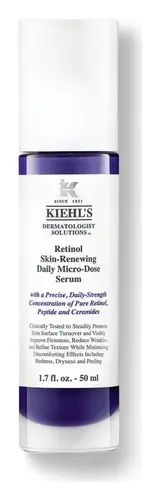
Kiehl's Retinol Skin-Renewing Daily Micro-Dose Serum Versus SkinBetter Science AlphaRet Overnight Cream
This anti-aging serum is formulated around Retinol and Niacinamide to soften the look of wrinkles and refine skin texture.
This anti-aging night moisturizer is formulated around Glycolic Acid and Niacinamide to soften the look of wrinkles and refine skin texture.

What's inside
What's inside
 Key Ingredients
Benefits
Concerns
Ingredients Side-by-side
Water
Skin ConditioningGlycerin
Humectant


Butylene Glycol
Humectant
Pentylene Glycol
Skin Conditioning
Niacinamide
Smoothing









Cetyl Alcohol
Emollient



Isohexadecane
EmollientIsononyl Isononanoate
EmollientDiisopropyl Sebacate
Emollient2-Oleamido-1,3-Octadecanediol
Skin Conditioning4-T-Butylcyclohexanol
Masking

Acetyl Dipeptide-1 Cetyl Ester
Skin Conditioning
Adenosine
Skin Conditioning
Ceramide NP
Skin Conditioning
Hydroxypalmitoyl Sphinganine
Skin Conditioning
Lauroyl Lysine
Skin Conditioning
Octyldodecanol
Emollient
Pentaerythrityl Tetra-Di-T-Butyl Hydroxyhydrocinnamate
Antioxidant
Sodium Chloride
MaskingSodium Hyaluronate
Humectant
Sodium Hydroxide
BufferingTrisodium Ethylenediamine Disuccinate
ChelatingRetinol
Skin Conditioning

Tocopherol
Antioxidant
Dicaprylyl Ether
Emollient
Ammonium Polyacryloyldimethyl Taurate
Emulsion StabilisingBehenyl Alcohol
Emollient
Caprylyl Glycol
Emollient
Carbomer
Emulsion StabilisingCetearyl Alcohol
Emollient


Cetearyl Glucoside
Emulsifying
Glycine Soja Oil
Emollient
Helianthus Annuus Seed Oil
Emollient
Hydroxyethylcellulose
Emulsion StabilisingLecithin
Emollient
Phenethyl Alcohol
MaskingPoloxamer 188
EmulsifyingPolycaprolactone
StabilisingSorbitan Laurate
Emulsifying
Steareth-100
Gel FormingCI 40800
Cosmetic ColorantChlorphenesin
Antimicrobial
Phenoxyethanol
Preservative
Water, Glycerin, Butylene Glycol, Pentylene Glycol, Niacinamide, Cetyl Alcohol, Isohexadecane, Isononyl Isononanoate, Diisopropyl Sebacate, 2-Oleamido-1,3-Octadecanediol, 4-T-Butylcyclohexanol, Acetyl Dipeptide-1 Cetyl Ester, Adenosine, Ceramide NP, Hydroxypalmitoyl Sphinganine, Lauroyl Lysine, Octyldodecanol, Pentaerythrityl Tetra-Di-T-Butyl Hydroxyhydrocinnamate, Sodium Chloride, Sodium Hyaluronate, Sodium Hydroxide, Trisodium Ethylenediamine Disuccinate, Retinol, Tocopherol, Dicaprylyl Ether, Ammonium Polyacryloyldimethyl Taurate, Behenyl Alcohol, Caprylyl Glycol, Carbomer, Cetearyl Alcohol, Cetearyl Glucoside, Glycine Soja Oil, Helianthus Annuus Seed Oil, Hydroxyethylcellulose, Lecithin, Phenethyl Alcohol, Poloxamer 188, Polycaprolactone, Sorbitan Laurate, Steareth-100, CI 40800, Chlorphenesin, Phenoxyethanol
Water
Skin ConditioningSodium Glycolate
BufferingGlycolic Acid
Buffering

Cetearyl Olivate
Pentylene Glycol
Skin Conditioning
Cyclopentasiloxane
Emollient
Isohexadecane
EmollientSorbitan Olivate
Emulsifying
Tetrahexyldecyl Ascorbate
Antioxidant
Glycerin
Humectant
Ceresin
Emulsion StabilisingGlycol Palmitate
Emulsifying
Butylene Glycol
Humectant
Niacinamide
Smoothing
Squalane
Emollient
Methyl Gluceth-20
Humectant
Ethyl Lactyl Retinoate
Abrasive
Palmitoyl Tripeptide-1
Skin Conditioning
Palmitoyl Tetrapeptide-7
Skin Conditioning
Ceramide NP
Skin Conditioning
Hyaluronic Acid
Humectant
Ubiquinone
Antioxidant
Tocopherol
Antioxidant
Bisabolol
Antioxidant
Tocopheryl Acetate
Antioxidant
Superoxide Dismutase
Antioxidant
Butyrospermum Parkii Butter
Skin Conditioning
Allantoin Glycyrrhetinic Acid
Skin ProtectingSodium PCA
Humectant
Panthenol
Skin Conditioning
Camellia Sinensis Leaf Extract
Antimicrobial
Portulaca Oleracea Extract
Skin Conditioning
Linoleic Acid
Cleansing
Cholesterol
Emollient
Linolenic Acid
Cleansing
Magnesium Aluminum Silicate
Absorbent
Dimethyl Isosorbide
SolventDimethicone
Emollient
Glyceryl Stearate
Emollient
PEG-100 Stearate
Surfactant
Steareth-2
EmulsifyingHydroxyethylcellulose
Emulsion StabilisingAcacia Senegal Gum
MaskingXanthan Gum
EmulsifyingHydrated Silica
Abrasive
Carbomer
Emulsion StabilisingPolysorbate 20
Emulsifying
Tromethamine
BufferingDisodium EDTA
ChelatingEthylhexylglycerin
Skin ConditioningPhenoxyethanol
Preservative
CI 77891
Cosmetic ColorantWater, Sodium Glycolate, Glycolic Acid, Cetearyl Olivate, Pentylene Glycol, Cyclopentasiloxane, Isohexadecane, Sorbitan Olivate, Tetrahexyldecyl Ascorbate, Glycerin, Ceresin, Glycol Palmitate, Butylene Glycol, Niacinamide, Squalane, Methyl Gluceth-20, Ethyl Lactyl Retinoate, Palmitoyl Tripeptide-1, Palmitoyl Tetrapeptide-7, Ceramide NP, Hyaluronic Acid, Ubiquinone, Tocopherol, Bisabolol, Tocopheryl Acetate, Superoxide Dismutase, Butyrospermum Parkii Butter, Allantoin Glycyrrhetinic Acid, Sodium PCA, Panthenol, Camellia Sinensis Leaf Extract, Portulaca Oleracea Extract, Linoleic Acid, Cholesterol, Linolenic Acid, Magnesium Aluminum Silicate, Dimethyl Isosorbide, Dimethicone, Glyceryl Stearate, PEG-100 Stearate, Steareth-2, Hydroxyethylcellulose, Acacia Senegal Gum, Xanthan Gum, Hydrated Silica, Carbomer, Polysorbate 20, Tromethamine, Disodium EDTA, Ethylhexylglycerin, Phenoxyethanol, CI 77891
Reviews
Ingredients Explained
These ingredients are found in both products.
Ingredients higher up in an ingredient list are typically present in a larger amount.
Butylene Glycol (or BG) is used within cosmetic products for a few different reasons:
Overall, Butylene Glycol is a safe and well-rounded ingredient that works well with other ingredients.
Though this ingredient works well with most skin types, some people with sensitive skin may experience a reaction such as allergic rashes, closed comedones, or itchiness.
Learn more about Butylene GlycolCarbomer is a synthetic thickening and gelling agent. It's basically the ingredient that gives a lot of serums, gels, creams, and sunscreens their smooth, non-sticky texture.
Although legally permitted at very high levels, carbomers are normally used at concentrations below 1%.
It also needs to be neutralized to actually thicken, and because it is a large molecule, it doesn't really penetrate the skin barrier.
Allergy-wise, the risk is very low. Clinical studies show carbomers have low potential for skin irritation/sensitization even at concentrations up to 100%.
A 2024 UK study patch-tested 1,302 patients and found true allergy to the parent group of carbomer to be rare with no confirmed relevant reactions.
Learn more about CarbomerCeramide NP (formerly known as Ceramide 3) is one of the skin's naturally occurring lipids.
Since ceramides are the major lipid components of the skin, they are crucial for maintaining skin barrier and hydration. Ceramide NP most closely mirrors the dominant kind in human skin amongst ceramide subtypes.
This ceramide works by slotting into gaps within the stratum corneum's lipid matrix to limit trans-epidermal water loss (TEWL) and shield the skin against external irritants.
A study with 312 patients found that using a ceramide-containing routine for 4 weeks reduced the severity of atopic dermatitis by over 61%.
Another clinical study in subjects aged 60 and older found that a ceramide body wash and moisturizer improved skin dryness and itchy skin in 15 days.
Overall, ceramides are considered non-irritating and safety tests have found little to no observable adverse effects from using this ingredient.
Ceramide NP is usually sourced from plants (like soybean or rice bran), or produced synthetically.
Learn more about Ceramide NPGlycerin (or glycerol) is a compound naturally found in your skin. It's a powerhouse humectant that pulls water into the stratum corneum.
Topically, glycerin does several things at once:
Your skin makes glycerin on its own (mostly from sebaceous oil breakdown) and shuttles it to your outermost layer of skin, or your epidermis, via aquaporin-3.
Aquaporin-3 is a transporter that is essential for normal skin hydration, elasticity, and repair. Interestingly, mice lacking in AQP3 have dry and less elastic skin that can be fully corrected with glycerin.
This ingredient is non-irritating, plays well with almost every ingredient, and works across all skin types. Typical use is anywhere between 3-10% but can go up to 79% in some leave-on products.
Just know very high concentrations (>40%) can feel tacky in low humidity.
Glycerin is the name for this ingredient in American English. British English uses Glycerol/Glycerine.
Learn more about GlycerinHydroxyethylcellulose is used to improve the texture of products. It is created from a chemical reaction involving ethylene oxide and alkali-cellulose. Cellulose is a sugar found in plant cell walls and help give plants structure.
This ingredient helps stabilize products by preventing ingredients from separating. It can also help thicken the texture of a product.
This ingredient can also be found in pill medicines to help our bodies digest other ingredients.
Learn more about HydroxyethylcelluloseIsohexadecane is added to enhance texture, emulsify, and to help cleanse. It is an isoparrafin. It is a component of petrolatum.
Due to its large size, Isohexadecane is not absorbed by the skin. Instead, it sits on top and acts as an emollient. Emollients help keep your skin soft and smooth by trapping moisture within.
Isohexadecane is often used in products designed to help oily skin. It is lightweight and non-greasy while helping to moisturize. When mixed with silicones, it gives a product a silky feel.
Learn more about IsohexadecaneNiacinamide is a multitasking form of vitamin B3 that strengthens the skin barrier, reduces pores and dark spots, regulates oil, and improves signs of aging.
And the best part? It's gentle and well-tolerated by most skin types, including sensitive and reactive skin.
You might have heard of "niacin flush", or the reddening of skin that causes itchiness. Niacinamide has not been found to cause this.
In very rare cases, some individuals may not be able to tolerate niacinamide at all or experience an allergic reaction to it.
If you are experiencing flaking, irritation, and dryness with this ingredient, be sure to double check all your products as this ingredient can be found in all categories of skincare.
When incorporating niacinamide into your routine, look out for concentration amounts. Typically, 5% niacinamide provides benefits such as fading dark spots. However, if you have sensitive skin, it is better to begin with a smaller concentration.
When you apply niacinamide to your skin, your body converts it into nicotinamide adenine dinucleotide (NAD). NAD is an essential coenzyme that is already found in your cells as "fuel" and powers countless biological processes.
In your skin, NAD helps repair cell damage, produce new healthy cells, support collagen production, strengthen the skin barrier, and fight environmental stressors (like UV and pollution).
Our natural NAD levels start to decline with age, leading to slower skin repair, visible aging, and a weaker skin barrier. By providing your skin niacinamide, you're recharging your skin's NAD levels. This leads to stronger, healthier, and younger looking skin.
Another name for vitamin B3 is nicotinamide. This vitamin is water-soluble and our bodies don't store it. We obtain Vitamin B3 from either food or skincare. Meat, fish, wheat, yeast, and leafy greens contain vitamin B3.
The type of niacinamide used in skincare is synthetically created.
Learn more about NiacinamidePentylene Glycol (1,2-pentanediol) is a multitasking little diol with three main roles in a formula:
Research on alkanediols (the family pentylene glycol belongs to) show they work by disrupting microbial cell membranes. This disruption helps the primary preservative system in a product work more effectively at lower doses.
On the safety side, the Cosmetic Ingredient Review Expert Panel has concluded this ingredient to be safe as used in current cosmetic practices + concentrations.
Typical use levels in a formula run about 1-5%.
Learn more about Pentylene GlycolPhenoxyethanol is one of the most widely used preservatives in skincare (and for good reason!).
It has a large spectrum of antimicrobial activity and especially effective bacteria, yeast, and mold while only having a weak effect on your skin's natural microbiome.
On a cellular level, it disrupts the cell membranes of microbes by poking holes that make the cell leak. This shuts down the chemical reactions the microbe needs to make energy so it can no longer survive.
Another perk of this ingredient is that it stays functional across a wide pH range (3-10).
You'll often see it paired with boosters like Ethylhexylglycerin; one study showed that a 1:9 ratio of Ethylhexylglycerin to Phenoxyethanol damages bacterial membranes as effectively as doubling the Phenoxyethanol concentration on its own.
Typical use concentrations range from 0.3-1% depending on the formula, and this ingredient is capped at 1% int the EU.
Safety-wise, the fear mongering does not hold up to the evidence. The EU's Scientific Committee on Consumer Safety and FDA consider it safe as a preservative at up to 1%, including for children of all ages.
Adverse systemic effects only showed up in animal studies at exposures roughly 200x higher than what people get from cosmetics. And despite its very widespread use, this ingredient is a rare sensitizer and allergic reactions are uncommon.
Learn more about PhenoxyethanolTocopherol is a fat-soluble antioxidant known as Vitamin E.
You'll find this ingredient in the vast majority of skincare (for good reason). It works to neutralize free radicals, or unstable molecules generated by UV exposure, pollution, and other environmental stressors, before they can cause oxidative damage to your skin cells.
Topically applied tocopherol has been shown to protect against UV damage by ramping up the skin's own natural defense enzymes.
It also acts as a skin conditioning agent; some studies show that regular topical use can improve the skin's water-binding capacity over 2-4 weeks.
This ingredient is especially loved for being a team player. When combined with Vitamin C, the photoprotective effect of both ingredients roughly doubles and the combo also helps reduce UV-induced DNA damage.
This ingredient has some brightening potential but it's more of a prevention ingredient than spot-fader. Cell studies show it can slow down melanin production but it's worth noting that it's not the most powerful brightener out there.
In formulations, it also serves as a stabilizer that helps protect other oxidation-prone ingredients from degrading.
Concentrations usually range from 0.1-1% in most leave-on products.
Learn more about TocopherolWater. It's the most common cosmetic ingredient of all. You'll usually see it at the top of ingredient lists, meaning that it makes up the largest part of the product.
So why is it so popular? Water most often acts as a solvent - this means that it helps dissolve other ingredients into the formulation.
You'll also recognize water as that liquid we all need to stay alive. If you see this, drink a glass of water. Remember to stay hydrated!
Learn more about Water

