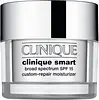
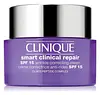
Clinique Smart Broad Spectrum SPF 15 Versus Clinique Smart Clinical Repair SPF 15 Wrinkle Correcting Cream

What's inside
What's inside
 Key Ingredients
Benefits
Concerns
Ingredients Side-by-side
Butyl Methoxydibenzoylmethane 3%
UV Absorber
Ethylhexyl Salicylate 5%
UV Absorber
Water
Skin ConditioningGlycerin
Humectant


Butyloctyl Salicylate
Skin Conditioning
Polyester-8
Skin Conditioning
Octyldodecyl Neopentanoate
EmollientBehenyl Alcohol
Emollient
Butylene Glycol
Humectant
Myristyl Myristate
Emollient


Cetyl Esters
Emollient
Ammonium Acryloyldimethyltaurate/Vp Copolymer
Tamarindus Indica Seed Extract
EmollientPlankton Extract
Skin ConditioningCentaurium Erythraea Extract
Skin ConditioningSigesbeckia Orientalis Extract
Skin ConditioningGlyceryl Stearate
Emollient
Algae Extract
EmollientCaffeine
Skin Conditioning

Camellia Sinensis Leaf Extract
Antimicrobial




Saccharomyces Ferment Filtrate
Humectant
Whey Protein
Skin ConditioningNylon-12
Acetyl Hexapeptide-8
Humectant
Sucrose
Humectant
Biotin
AntiseborrhoeicErgothioneine
Antioxidant
Myristyl Laurate
Lauryl PEG-9 Polydimethylsiloxyethyl Dimethicone
Skin Conditioning
Polyethylene
Abrasive
Aminopropyl Ascorbyl Phosphate
Antioxidant

Glycine Soja Protein
EmulsifyingPEG-100 Stearate
Steareth-21
CleansingDimethicone
Emollient
Acetyl Glucosamine
Skin Conditioning
Astrocaryum Murumuru Seed Butter
Emollient
Trisiloxane
Skin Conditioning
Caprylyl Glycol
Emollient
Tocopheryl Acetate
Antioxidant
Myristyl Alcohol
Emollient
Sodium Hyaluronate
Humectant
Hexylene Glycol
EmulsifyingHydroxyethylcellulose
Emulsion StabilisingSodium Benzoate
Masking
Sodium Citrate
BufferingLecithin
Emollient
Disodium EDTA
Phenoxyethanol
Preservative
CI 19140
Cosmetic ColorantCI 14700
Cosmetic ColorantButyl Methoxydibenzoylmethane 3%, Ethylhexyl Salicylate 5%, Water, Glycerin, Butyloctyl Salicylate, Polyester-8, Octyldodecyl Neopentanoate, Behenyl Alcohol, Butylene Glycol, Myristyl Myristate, Cetyl Esters, Ammonium Acryloyldimethyltaurate/Vp Copolymer, Tamarindus Indica Seed Extract, Plankton Extract, Centaurium Erythraea Extract, Sigesbeckia Orientalis Extract, Glyceryl Stearate, Algae Extract, Caffeine, Camellia Sinensis Leaf Extract, Saccharomyces Ferment Filtrate, Whey Protein, Nylon-12, Acetyl Hexapeptide-8, Sucrose, Biotin, Ergothioneine, Myristyl Laurate, Lauryl PEG-9 Polydimethylsiloxyethyl Dimethicone, Polyethylene, Aminopropyl Ascorbyl Phosphate, Glycine Soja Protein, PEG-100 Stearate, Steareth-21, Dimethicone, Acetyl Glucosamine, Astrocaryum Murumuru Seed Butter, Trisiloxane, Caprylyl Glycol, Tocopheryl Acetate, Myristyl Alcohol, Sodium Hyaluronate, Hexylene Glycol, Hydroxyethylcellulose, Sodium Benzoate, Sodium Citrate, Lecithin, Disodium EDTA, Phenoxyethanol, CI 19140, CI 14700
Water
Skin ConditioningHomosalate
Skin Conditioning
Ethylhexyl Salicylate
UV Absorber
Glycerin
Humectant
Ethylhexyl Methoxycinnamate
UV Absorber
Butylene Glycol
Humectant
Coco-Caprylate/Caprate
Emollient
Butyl Methoxydibenzoylmethane
UV Absorber
Polyester-8
Skin Conditioning
Ethylhexyl Methoxycrylene
Skin Conditioning
Butyloctyl Salicylate
Skin Conditioning
Acrylates Copolymer
Dextrin Palmitate
Emulsifying
PEG-100 Stearate
Sigesbeckia Orientalis Extract
Skin ConditioningSodium Hyaluronate
Humectant
7-Dehydrocholesterol
Emulsion StabilisingBiosaccharide Gum-1
Humectant
Caffeine
Skin Conditioning
Caprylyl Glycol
Emollient
Palmitoyl Tripeptide-1
Skin Conditioning
Palmitoyl Tetrapeptide-7
Skin Conditioning
Palmitoyl Hexapeptide-12
Skin Conditioning
Acetyl Hexapeptide-8
Humectant
Lauroyl Lysine
Skin Conditioning
Saccharomyces Ferment
Skin Conditioning
Lactis Proteinum
Skin ConditioningAlgae Extract
EmollientPlankton Extract
Skin ConditioningPolyglyceryl-2 Stearate
Emulsifying
Silica
Abrasive
Pentylene Glycol
Skin Conditioning
Hexylene Glycol
EmulsifyingAcrylates/C10-30 Alkyl Acrylate Crosspolymer
Emulsion StabilisingGlyceryl Stearate
Emollient
Lecithin
Emollient
Polysorbate 20
Emulsifying
PPG-8-Ceteth-20
EmulsifyingSorbitan Sesquiisostearate
Emulsifying
Sorbeth-30 Tetraisostearate
Emulsifying
PEG-8
HumectantCarbomer
Emulsion StabilisingDehydroxanthan Gum
Emulsion StabilisingDipropylene Glycol
HumectantPotassium Hydroxide
BufferingSodium Polyacryloyldimethyl Taurate
Emulsion StabilisingStearyl Alcohol
Emollient
Acrylates/Beheneth-25 Methacrylate Copolymer
Glyceryl Polymethacrylate
Tocopheryl Acetate
Antioxidant
BHT
Antioxidant
Sodium Citrate
BufferingDisodium EDTA
Phenoxyethanol
Preservative
Potassium Sorbate
Preservative
Sodium Benzoate
Masking
Water, Homosalate, Ethylhexyl Salicylate, Glycerin, Ethylhexyl Methoxycinnamate, Butylene Glycol, Coco-Caprylate/Caprate, Butyl Methoxydibenzoylmethane, Polyester-8, Ethylhexyl Methoxycrylene, Butyloctyl Salicylate, Acrylates Copolymer, Dextrin Palmitate, PEG-100 Stearate, Sigesbeckia Orientalis Extract, Sodium Hyaluronate, 7-Dehydrocholesterol, Biosaccharide Gum-1, Caffeine, Caprylyl Glycol, Palmitoyl Tripeptide-1, Palmitoyl Tetrapeptide-7, Palmitoyl Hexapeptide-12, Acetyl Hexapeptide-8, Lauroyl Lysine, Saccharomyces Ferment, Lactis Proteinum, Algae Extract, Plankton Extract, Polyglyceryl-2 Stearate, Silica, Pentylene Glycol, Hexylene Glycol, Acrylates/C10-30 Alkyl Acrylate Crosspolymer, Glyceryl Stearate, Lecithin, Polysorbate 20, PPG-8-Ceteth-20, Sorbitan Sesquiisostearate, Sorbeth-30 Tetraisostearate, PEG-8, Carbomer, Dehydroxanthan Gum, Dipropylene Glycol, Potassium Hydroxide, Sodium Polyacryloyldimethyl Taurate, Stearyl Alcohol, Acrylates/Beheneth-25 Methacrylate Copolymer, Glyceryl Polymethacrylate, Tocopheryl Acetate, BHT, Sodium Citrate, Disodium EDTA, Phenoxyethanol, Potassium Sorbate, Sodium Benzoate
Reviews
Ingredients Explained
These ingredients are found in both products.
Ingredients higher up in an ingredient list are typically present in a larger amount.
Acetyl Hexapeptide-8, commonly known as Argireline or Acetyl Hexapeptide-3, is a popular peptide in skincare. It’s often referred to as a “Botox-like” ingredient because it helps reduce muscle movement.
By relaxing these micro-movements, Argireline may help minimize the appearance of fine lines and wrinkles. That said, it’s not as powerful as Botox, and research on its long-term effectiveness is still limited.
Beyond smoothing, Argireline may also support collagen production. Collagen is the protein that helps keep your skin firm, bouncy, and well-hydrated by strengthening the skin barrier.
So while Argireline isn’t a miracle fix, it can be a helpful addition to a routine focused on both prevention and skin health.
Read more about other common types of peptides here:
Learn more about Acetyl Hexapeptide-8Algae Extract is a confusing name. This is because algae is an informal term for a group of 30,000 aquatic organisms that can photosynthesize.
The term 'algae extract' can refer to any one, or a blend of, the 30,000 types.
Algae is rich in antioxidants. Antioxidants help fight free-radicals. Free-radicals are molecules that may damage your skin cells, such as pollution.
Algae can also help with soothing and hydrating skin.
Many different types of algae have different benefits.
Learn more about Algae ExtractAlso known as Avobenzone, this ingredient is a chemical sunscreen filter that provides protection in the UV-A range.
Avobenzone is globally approved and is the most commonly used UV-A filter in the world.
Studies have found that avobenzone becomes ineffective when exposed to UV light (it is not photostable; meaning that it breaks down in sunlight). Because of this, formulations that include avobenzone will usually contain stabilizers such as octocrylene.
However, some modern formulations (looking at you, EU!) are able to stabilize avobenzone by coating the molecules.
Avobenzone does not protect against the UV-B range, so it's important to check that the sunscreen you're using contains other UV filters that do!
The highest concentration of avobenzone permitted is 3% in the US, and 5% in the EU.
Learn more about Butyl MethoxydibenzoylmethaneButylene Glycol (or BG) is used within cosmetic products for a few different reasons:
Overall, Butylene Glycol is a safe and well-rounded ingredient that works well with other ingredients.
Though this ingredient works well with most skin types, some people with sensitive skin may experience a reaction such as allergic rashes, closed comedones, or itchiness.
Learn more about Butylene GlycolButyloctyl Salicylate is a chemical UV filter structurally similar to octisalate. It is a photostabilizer, SPF booster, emollient and solvent. This ingredient helps evenly spread out ingredients.
According to a manufacturer, it is suitable for pairing with micro Titanium Dioxide, Zinc Oxide, and pigments.
Photostabilizers help stabilize UV-filters and prevents them from degrading quickly.
Learn more about Butyloctyl SalicylateCaffeine is a naturally occurring plant compound found in coffee beans, tea leaves, cocoa pods, and guarana.
As an antioxidant, caffeine protects your skin from free radical damage caused by UV exposure and envionrmnetal stressors.
Early research also shows that caffeine can help calm redness, soothe irritated skin, and support hair growth by stimulating microcirculation in the scalp.
You might have seen eye creams marketing caffeine as a depuffing ingredient. This is because it is a vasoconstrictor meaning it can temporarily constrict blood vessels, though clinical evidence for this specific use is still limited.
Most skincare products contain this ingredient at concentrations between 1-6%. It is able to penetrate skin easily regardless of skin type or thickness.
Just so you know, a very small number of case reports describe caffeine-induced allergy. This ingredient is generally well-tolerated, non-irritating, and non-sensitizing for the majority of people.
Learn more about CaffeineCaprylyl Glycol is a humectant, skin conditioner, emollient, and preservative booster derived from either caprylic acid or synthetically created.
Typical use levels vary from 0.3-1% as a preservative booster and go up to 2% to condition skin.
Because it is not a free-fatty acid or alcohol, this ingredient is fungal acne safe (there's nothing for Malassezia to feed on).
Learn more about Caprylyl GlycolDisodium EDTA is a chelating agent. It grabs onto and deactivates metal ions that sneak into your products from water, packaging, or air.
This ingredient mainly works behind the scenes and helps with:
On top of that, this ingredient can counteract the effects of hard water by binding to the minerals in it.
One thing worth knowing is that Disodium EDTA has been shown to be a mild penetration enhancer. It can help other ingredients absorb into skin more effectively which can be a double-edged sword (great for actives, but can also make the active too strong if you have sensitive skin).
Clinical patch testing showed no significant skin irritation at typical use concentrations and minimal dermal absorption.
You'll most likely see this ingredient near the end of an ingredient list. It's typically found in concentrations less than 1%.
Learn more about Disodium EDTAEthylhexyl Salicylate is an organic compound used to block UV rays. It primarily absorbs UVB rays but offers a small amount of UVA protection as well.
Commonly found in sunscreens, Ethylhexyl Salicylate is created from salicylic acid and 2-ethylhexanol. You might know salicylic acid as the effective acne fighter ingredient and BHA.
The ethylhexanol in this ingredient is a fatty alcohol and helps hydrate your skin, similar to oils. It is an emollient, which means it traps moisture into the skin.
According to manufacturers, Ethylhexyl Salicylate absorbs UV wavelength of 295-315 nm, with a peak absorption at 307-310 nm. UVA rays are linked to long term skin damage, such as hyperpigmentation. UVB rays emit more energy and are capable of damaging our DNA. UVB rays cause sunburn.
Learn more about Ethylhexyl SalicylateGlycerin (or glycerol) is a compound naturally found in your skin. It's a powerhouse humectant that pulls water into the stratum corneum.
Topically, glycerin does several things at once:
Your skin makes glycerin on its own (mostly from sebaceous oil breakdown) and shuttles it to your outermost layer of skin, or your epidermis, via aquaporin-3.
Aquaporin-3 is a transporter that is essential for normal skin hydration, elasticity, and repair. Interestingly, mice lacking in AQP3 have dry and less elastic skin that can be fully corrected with glycerin.
This ingredient is non-irritating, plays well with almost every ingredient, and works across all skin types. Typical use is anywhere between 3-10% but can go up to 79% in some leave-on products.
Just know very high concentrations (>40%) can feel tacky in low humidity.
Glycerin is the name for this ingredient in American English. British English uses Glycerol/Glycerine.
Learn more about GlycerinGlyceryl Stearate is made by reacting glycerin with stearic acid (typically sourced from plant oils like palm or coconut). It's an emulsifier, emollient, and mild occlusive.
Emulsifiers help ingredients like oil and water stay mixed so your formula stays nicely blended and uniform in texture.
This ingredient is typically used in concentrations between 1-10%. Studies have found it to be non-sensitizing, non-phototoxic, and non-photoallergenic.
A close cousin of this ingredient is Glyceryl Stearate SE ("self-emulsifying"). This just has a small amount of sodium or potassium stearate added so it can emulsify without a co-emulsifier.
Since this ingredient is an ester of a C18 fatty acid, it may not be fungal acne safe. The Malassezia yeast can potentially metabolize within the C11-C24 range.
Fun fact: The human body also creates Glyceryl Stearate naturally.
Learn more about Glyceryl StearateHexylene Glycol is a multitasker ingredient that works as a solvent, humectant, emulsifier, viscosity reducer, and preservative booster.
It is able to dissolve both water and oil-soluble ingredients to stabilize tricky actives and make products spread more easily.
As a humectant, it pulls water into the skin. But it's a pretty minor moisturizing ingredient compared to other humectants, like glycerin.
Interestingly, it can act as a mild penetration enhancer. One in vitro study on human skin found a 12% concentration upped the absorption of mometasone furoate (a medicinal ingredient used to treat inflammatory skin conditions) up to 7%.
This ingredient is typically used at levels of 0.1-10% depending on the role it's playing.
A patch test study on eczema patients didn't find a significant increase in irritation versus the control group, but the potential for irritation rises at higher concentrations.
Learn more about Hexylene GlycolLecithin is a term for a group of substances found in the cell membranes of plants, animals, and humans. They are made up of phospholipids.
Thanks to its amphiphilic structure (water-loving head and oil-loving tail), it is a true multitasker:
It plays well with most ingredients and is typically used at 0.1-1%. However, concentrations up to 50% have been reported in moisturizers.
Depending on the source of this ingredient, lecithin may not be fungal acne safe. This is because some sources of lecithin come from soybean oil, which may feed the malassezia yeast that causes fungal acne.
We recommend reaching out to the brand you are purchasing from to inquire about the source of their lecithin.
Learn more about LecithinPeg-100 Stearate is an emollient and emulsifier. As an emollient, it helps keep skin soft by trapping moisture in. On the other hand, emulsifiers help prevent oil and water from separating in a product.
PEGS are a hydrophilic polyether compound . There are 100 ethylene oxide monomers in Peg-100 Stearate. Peg-100 Stearate is polyethylene glycol ester of stearic acid.
Phenoxyethanol is a preservative that has germicide, antimicrobial, and aromatic properties. Studies show that phenoxyethanol can prevent microbial growth. By itself, it has a scent that is similar to that of a rose.
It's often used in formulations along with Caprylyl Glycol to preserve the shelf life of products.
We don't have a description for Plankton Extract yet.
This ingredient is also known as Polycrylene. It is a UV photostabilizer and often used in sunscreens as an alternative to octocrylene.
Polycrylene is used to stabilize other UV filters, especially avobenzone, which is known to degrade rapidly without stabilizers. It also absorbs UVB light, but is only about 1/3 as effective as octocrylene.
At its maximum recommended strength of 4%, this ingredient is not likely to make a significant contribution to SPF factor. Polycrylene has a large molecular weight so it's unlikely to penetrate skin.
Although rare, this ingredient can cause contact dermatitis.
Due to regulatory loopholes, you'll be able to find this chemical UV filter in "100% mineral" sunscreens.
Learn more about Polyester-8We don't have a description for Sigesbeckia Orientalis Extract yet.
Sodium Benzoate is a preservative. It's used in both cosmetic and food products to inhibit the growth of mold and bacteria. It is typically produced synthetically.
Both the US FDA and EU Health Committee have approved the use of sodium benzoate. In the US, levels of 0.1% (of the total product) are allowed.
Sodium benzoate works as a preservative by inhibiting the growth of bacteria inside of cells. It prevents the cell from fermenting a type of sugar using an enzyme called phosphofructokinase.
It is the salt of benzoic acid. Foods containing sodium benzoate include soda, salad dressings, condiments, fruit juices, wines, and snack foods.
Studies for using ascorbic acid and sodium benzoate in cosmetics are lacking, especially in skincare routines with multiple steps.
We always recommend speaking with a professional, such as a dermatologist, if you have any concerns.
Learn more about Sodium BenzoateSodium Citrate is the sodium salts of citric acid. In skincare, it is used to alter pH levels and acts as a preservative.
Its main functions are to maintain the pH of a product and neutralize metal ions.
The acidity of our skin is maintained by our glands and skin biome; normal pH level of skin is slightly acidic (~4.75-5.5).
Being slightly acidic allows our skin to create an "acid mantle". This acid mantle is a thin barrier that protects our skin from bacteria and contaminants.
Learn more about Sodium CitrateSodium Hyaluronate is the salt form of hyaluronic acid. It is a long sugar chain that is naturally found in your skin, joints, and connective tissue that maintains hydration and elasticity.
In skincare, it works as a humectant. It pulls water from the environment and deeper layers of skin and binds it to the surface.
Interestingly, the size of the molecule affects its behavior:
Some clinical evidence links low molecular weight versions to improved wrinkle depth, elasticity, anti-inflammatory effects, and barrier repair.
Many serums use a blend of both weights so you can get surface hydration plus longer-lasting and deeper effects.
You'll typically see concentrations between 0.1-2% for this ingredient.
Learn more about Sodium HyaluronateTocopheryl Acetate is AKA Vitamin E. It is an antioxidant and protects your skin from free radicals. Free radicals damage the skin by breaking down collagen.
One study found using Tocopheryl Acetate with Vitamin C decreased the number of sunburned cells.
Tocopheryl Acetate is commonly found in both skincare and dietary supplements.
Learn more about Tocopheryl AcetateWater. It's the most common cosmetic ingredient of all. You'll usually see it at the top of ingredient lists, meaning that it makes up the largest part of the product.
So why is it so popular? Water most often acts as a solvent - this means that it helps dissolve other ingredients into the formulation.
You'll also recognize water as that liquid we all need to stay alive. If you see this, drink a glass of water. Remember to stay hydrated!
Learn more about Water
