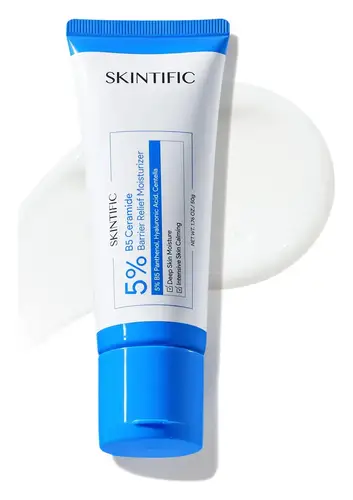
Skintific 5% B5 Ceramide Barrier Relief Moisturizer Versus Y.O.U Barrier Shield Intensive Calming Gel 3% Neobarrix
This barrier-repair moisturizer is formulated around Panthenol and Ceramide NP to strengthen the skin barrier and calm redness.
This barrier-repair moisturizer is formulated around Panthenol and Beta-Glucan to strengthen the skin barrier and calm redness.


What's inside
What's inside
 Key Ingredients
Benefits
Concerns
Ingredients Side-by-side
Water
Skin ConditioningPanthenol
Skin Conditioning




Dimethicone
Emollient
Butylene Glycol
Humectant
Glycerin
Humectant
Caprylic/Capric Triglyceride
Masking
Diethylhexyl Carbonate
EmollientSimmondsia Chinensis Seed Oil
Emollient


Astrocaryum Murumuru Seed Butter
Emollient

Behenyl Alcohol
Emollient
Polyglycerin-3
Humectant
Ceramide NP
Skin Conditioning

Ceramide Ns
Skin Conditioning
Ceramide As
Skin Conditioning
Ceramide AP
Skin Conditioning
Ceramide EOP
Skin Conditioning
Centella Asiatica Extract
Cleansing
Asiaticoside
Antioxidant
Madecassic Acid
Skin Conditioning
Asiatic Acid
Skin Conditioning
Hydroxyphenyl Propionamide
Antioxidant
Niacinamide
Smoothing





Ascorbyl Palmitate
Antioxidant
Trehalose
Humectant
Allantoin
Skin Conditioning
Sodium Hyaluronate
Humectant
Ectoin
Skin Conditioning
Tocopherol
Antioxidant
Lysine Hcl
Skin Conditioning
Histidine Hcl
Skin ConditioningArginine
Masking
Proline
Skin Conditioning
Glutamic Acid
Humectant
Threonine
Valine
MaskingLeucine
Skin ConditioningGlycine
Buffering
Isoleucine
Skin ConditioningPhenylalanine
Masking
Sodium Acetylated Hyaluronate
Humectant
Sodium Hyaluronate Crosspolymer
Humectant
Hydrolyzed Sodium Hyaluronate
Skin Conditioning
Serine
Masking
Phenoxyethanol
Preservative
Cetearyl Olivate
Hydroxyethyl Acrylate/Sodium Acryloyldimethyl Taurate Copolymer
Emulsion StabilisingHydrogenated Lecithin
Emulsifying
Divinyldimethicone/Dimethicone Crosspolymer
Skin Conditioning
Lauroyl Lysine
Skin Conditioning
Isopropyl Lauroyl Sarcosinate
Skin ConditioningAmmonium Acryloyldimethyltaurate/Beheneth-25 Methacrylate Crosspolymer
Emulsion StabilisingPentylene Glycol
Skin Conditioning
Sodium Polyacryloyldimethyl Taurate
Emulsion StabilisingTocopheryl Acetate
Antioxidant
Stearyl Glycyrrhetinate
Skin ConditioningEthylhexylglycerin
Skin ConditioningHydrogenated Polydecene
EmollientSorbitan Isostearate
Emulsifying
Polysorbate 60
Emulsifying
Ubiquinone
Antioxidant
Sodium PCA
Humectant
Opuntia Ficus-Indica Stem Extract
Skin Conditioning
Trideceth-10
CleansingBeta-Glucan
Skin Conditioning
Taurine
Buffering1,2-Hexanediol
Skin Conditioning
Hydroxyacetophenone
Antioxidant
Laminaria Digitata Extract
Skin Protecting
Tapioca Starch
Cetyl-Pg Hydroxyethyl Palmitamide
Skin ConditioningCholesterol
Emollient
Water, Panthenol, Dimethicone, Butylene Glycol, Glycerin, Caprylic/Capric Triglyceride, Diethylhexyl Carbonate, Simmondsia Chinensis Seed Oil, Astrocaryum Murumuru Seed Butter, Behenyl Alcohol, Polyglycerin-3, Ceramide NP, Ceramide Ns, Ceramide As, Ceramide AP, Ceramide EOP, Centella Asiatica Extract, Asiaticoside, Madecassic Acid, Asiatic Acid, Hydroxyphenyl Propionamide, Niacinamide, Ascorbyl Palmitate, Trehalose, Allantoin, Sodium Hyaluronate, Ectoin, Tocopherol, Lysine Hcl, Histidine Hcl, Arginine, Proline, Glutamic Acid, Threonine, Valine, Leucine, Glycine, Isoleucine, Phenylalanine, Sodium Acetylated Hyaluronate, Sodium Hyaluronate Crosspolymer, Hydrolyzed Sodium Hyaluronate, Serine, Phenoxyethanol, Cetearyl Olivate, Hydroxyethyl Acrylate/Sodium Acryloyldimethyl Taurate Copolymer, Hydrogenated Lecithin, Divinyldimethicone/Dimethicone Crosspolymer, Lauroyl Lysine, Isopropyl Lauroyl Sarcosinate, Ammonium Acryloyldimethyltaurate/Beheneth-25 Methacrylate Crosspolymer, Pentylene Glycol, Sodium Polyacryloyldimethyl Taurate, Tocopheryl Acetate, Stearyl Glycyrrhetinate, Ethylhexylglycerin, Hydrogenated Polydecene, Sorbitan Isostearate, Polysorbate 60, Ubiquinone, Sodium PCA, Opuntia Ficus-Indica Stem Extract, Trideceth-10, Beta-Glucan, Taurine, 1,2-Hexanediol, Hydroxyacetophenone, Laminaria Digitata Extract, Tapioca Starch, Cetyl-Pg Hydroxyethyl Palmitamide, Cholesterol
Water
Skin ConditioningButylene Glycol
Humectant
Glycerin
Humectant
PEG/PPG-17/6 Copolymer
SolventDimethicone
Emollient
Hexylene Glycol
EmulsifyingHydrogenated Polyisobutene
EmollientNelumbo Nucifera Flower Water
TonicAmmonium Acryloyldimethyltaurate/Vp Copolymer
Hydroxyacetophenone
Antioxidant
Glyceryl Glucoside
Humectant
Hydrogenated Lecithin
Emulsifying
Panthenol
Skin Conditioning
Arginine
Masking
Beta-Glucan
Skin Conditioning
Carbomer
Emulsion StabilisingInositol
Humectant
Bisabolol
Antioxidant
Allantoin
Skin Conditioning
Tocopheryl Acetate
Antioxidant
Caprylic/Capric Triglyceride
Masking
Hydroxyethyl Acrylate/Sodium Acryloyldimethyl Taurate Copolymer
Emulsion StabilisingHydrolyzed Oats
Skin ConditioningLeptospermum Scoparium Leaf Extract
Skin ConditioningCeramide NP
Skin Conditioning
Gardenia Florida Flower Extract
Skin Conditioning10-Hydroxydecanoic Acid
Skin ConditioningHydrolyzed Sodium Hyaluronate
Skin Conditioning
Disodium EDTA
ChelatingPolysorbate 60
Emulsifying
Stephania Tetrandra Root Extract
Skin ConditioningSorbitan Isostearate
Emulsifying
Ceramide Ns
Skin Conditioning
Ceramide As
Skin Conditioning
Mannitol
Humectant
Collagen
Moisturising
Acetyl Glucosamine
Skin Conditioning
Propanediol
Solvent
Trehalose
Humectant
Fibronectin
Skin ConditioningElastin
Skin ConditioningCholesterol
Emollient
Tetraacetylphytosphingosine
Skin ConditioningPhytosphingosine
Skin Conditioning
Salicyloyl Phytosphingosine
Skin ConditioningCeramide EOP
Skin Conditioning
Ceramide AP
Skin Conditioning
Water, Butylene Glycol, Glycerin, PEG/PPG-17/6 Copolymer, Dimethicone, Hexylene Glycol, Hydrogenated Polyisobutene, Nelumbo Nucifera Flower Water, Ammonium Acryloyldimethyltaurate/Vp Copolymer, Hydroxyacetophenone, Glyceryl Glucoside, Hydrogenated Lecithin, Panthenol, Arginine, Beta-Glucan, Carbomer, Inositol, Bisabolol, Allantoin, Tocopheryl Acetate, Caprylic/Capric Triglyceride, Hydroxyethyl Acrylate/Sodium Acryloyldimethyl Taurate Copolymer, Hydrolyzed Oats, Leptospermum Scoparium Leaf Extract, Ceramide NP, Gardenia Florida Flower Extract, 10-Hydroxydecanoic Acid, Hydrolyzed Sodium Hyaluronate, Disodium EDTA, Polysorbate 60, Stephania Tetrandra Root Extract, Sorbitan Isostearate, Ceramide Ns, Ceramide As, Mannitol, Collagen, Acetyl Glucosamine, Propanediol, Trehalose, Fibronectin, Elastin, Cholesterol, Tetraacetylphytosphingosine, Phytosphingosine, Salicyloyl Phytosphingosine, Ceramide EOP, Ceramide AP
Ingredients Explained
These ingredients are found in both products.
Ingredients higher up in an ingredient list are typically present in a larger amount.
Allantoin is a soothing ingredient known for its protective and moisturizing properties; it's basically a quiet workhorse ingredient you can find in a huge range of cosmetics.
Though it can be derived from the comfrey plant, allantoin is produced synthetically for cosmetic products to ensure purity.
Research shows it can encourage your skin cells to turn over and renew by stimulating keratinocyte and fibroblast proliferation.
It also has mild keratolytic properties to help loosen and shed dead skin cells without being harsh.
Studies also suggest allantoin can help calm inflammation by dialing down some of the chemical signals your skin sends out when it is irritated.
This ingredient is typically used in the 0.1-0.5% range, and the FDA recognizes it as a skin protectant in OTC products up to 2%.
Overall, allantoin is a wonderful addition to most routines; it is stable across a wide pH range (~4-8), works well with other ingredients, and is considered non-sensitizing/non-irritating.
Fun fact: Allantoin is naturally occurring in comfrey root, beets, chamomile, and wheat sprouts. Our bodies even produce it as a byproduct of uric acid metabolism.
Learn more about AllantoinArginine is a semi-essential amino acid. This just means our bodies can product a bit on its own, but sometimes needs a little boost from food sources.
It is a part of your skin's natural moisturizing factor (NMF), or the water-loving molecules in your outermost layer of skin (stratum corneum) that keeps everything hydrated and happy.
Here's an interesting thing about Arginine: your skin converts it into urea through the Krebs-Henseleit urea cycle. Urea is one of the most effective humectants your skin naturally produces.
A clinical study showed applying 2.5% arginine hydrochloride to atopic dermatitis skin showed significant urea levels in the stratum corneum and improved moisture in just four weeks.
Arginine is also a precursor to nitric oxide; nitric oxide improves microcirculation and supports wound healing and collagen synthesis.
One study found that an amino acid complex containing Arginine reduced skin irritation, improved hydration, and accelerated skin repair in clinical / in-vivo studies.
Arginine itself is an amino acid and not a fatty acid, oil, or ester. On its own, it's not a direct food source for Malassezia, or the yeast that causes fungal acne.
Learn more about ArginineBeta-Glucan is a soluble polysaccharide (a chain of glucose sugars) sourced from the cells walls of oats, baker's yeast, mushrooms, and seaweed.
It's a rare ingredient that pulls double-duty as a heavy-duty hydrator and skin-soothing repair agent.
On the surface, it acts as a humectant that holds water in place and reduces moisture loss for a plumper, smoother feel, while its anti-inflammatory and antioxidant properties make it a great pick for calming redness or sensitive skin
The more interesting story is underneath:
Despite its large molecular size, oat beta-glucan has been shown to penetrate the epidermis and reach the dermis by slipping between skin cells. Here, it interacts with fibroblasts and macrophages to nudge collagen synthesis and support wound repair.
A small 2005 split-face clinical study of 27 subjects found topical beta-glucan produced measurable reductions in wrinkle depth, height, and roughness after 8 weeks of use.
It is worth noting the trial was small and the penetration testing used frozen, irradiated skin so the anti-aging data is encouraging rather than definitive.
This ingredient gets along with pretty much everything and is typically used around 0.1-1%.
Fungal acne: This ingredient is not a food source for the Malassezia yeast because it is a glucose polysaccharide with no fatty acid or ester component.
Learn more about Beta-GlucanButylene Glycol (or BG) is used within cosmetic products for a few different reasons:
Overall, Butylene Glycol is a safe and well-rounded ingredient that works well with other ingredients.
Though this ingredient works well with most skin types, some people with sensitive skin may experience a reaction such as allergic rashes, closed comedones, or itchiness.
Learn more about Butylene GlycolCaprylic/Capric Triglyceride (aka MCT Oil) is a lightweight emollient, solvent, and texture enhancer. It is considered a skin-softener by helping to prevent moisture loss.
Though it behaves like an oil, it is not technically one due to its chemical composition. One perk of this ingredient is that it is very stable, resistant to oxidation, and unlikely to go rancid.
In practice, that translates to a long shelf life and a consistently elegant skin feel.
While there is an assumption Caprylic Triglyceride can clog pores due to it being derived from coconut oil, there is no research supporting this. Just patch test if you have concerns.
Fractionated coconut oil and MCT Oil are both listed as Caprylic/Capric Triglyceride according to INCI. This is because INCI names are based on the ingredient’s final chemical composition and not its marketing name or source.
This ingredient is treated as the gold standard fungal acne safe oil. Even though it is coconut derived, the problematic lauric acid is stripped out.
This leaves just caprylic (C8) and capric (C10) acid. These chain lengths actually trend antifungal; a 2020 study found caprylic acid was enough to disrupt Malassezia furfur cell membrane, with a caprylic acid derivative damaging membrane structures at concentrations as low as 0.2%.
Learn more about Caprylic/Capric TriglycerideCeramide AP is is a skin-identical lipid that mimics what your skin already makes naturally. Ceramides help maintain epidermal integrity and barrier function.
You'll often see this ingredient paired with other ceramides (like ceramide NP), cholesterol, or fatty acids because this combination best mimics the natural lipid mix your skin already has.
The skin's ability to produce ceramides gets disrupted in skin conditions like eczema. This in turn weakens the skin barrier and applying ceramides topically has been shown to replenish what's been lost to restore barrier function.
Most of the studies with Ceramide AP test it as part of a multi-ceramide complex; studies reinforce ceramide AP's role in rebalancing ceramides in skin and improving skin hydration.
Learn more about Ceramide APCeramide AS is formally known as Ceramides 4 and 5.
Ceramides are intercellular lipids naturally found in our skin that bonds dead skin cells together to create a barrier. They are known for their ability to hold water and thus are a great ingredient for dry skin.
Ceramide EOP is formally known as Ceramide 1.
It is naturally found in skin and part of the intercellular "mortar" holding everything together in your outermost layer.
EOP stands for a linked Ester fatty acid, a linked Omega hydroxy fatty acid, and the Phytosphingosine base.
What makes Ceramide EOP special is its ultra-long fatty acid chain; this unique structure allows it to bridge the lipid layers in your skin barrier to prevent water loss (something no other ceramide can do).
Low levels of Ceramide EOP have been found in people with eczema and psoriasis.
Using it together with other ceramides, cholesterol, and linoleic acid have been shown to meaningfully improve hydration and reduce water loss.
In one clinical study, a regimen using Ceramide EOP, NP, and AP led to significant symptom improvements in patients with eczema, psoriasis, and dry skin in just 4 weeks.
You'll usually see concentrations between 0.1-0.5% in formulations. Overall, this is a well-tolerated and safe ingredient for cosmetic use.
Learn more about Ceramide EOPCeramide NP (formerly known as Ceramide 3) is one of the skin's naturally occurring lipids.
Since ceramides are the major lipid components of the skin, they are crucial for maintaining skin barrier and hydration. Ceramide NP most closely mirrors the dominant kind in human skin amongst ceramide subtypes.
This ceramide works by slotting into gaps within the stratum corneum's lipid matrix to limit trans-epidermal water loss (TEWL) and shield the skin against external irritants.
A study with 312 patients found that using a ceramide-containing routine for 4 weeks reduced the severity of atopic dermatitis by over 61%.
Another clinical study in subjects aged 60 and older found that a ceramide body wash and moisturizer improved skin dryness and itchy skin in 15 days.
Overall, ceramides are considered non-irritating and safety tests have found little to no observable adverse effects from using this ingredient.
Ceramide NP is usually sourced from plants (like soybean or rice bran), or produced synthetically.
Learn more about Ceramide NPCeramide NS is formally known as Ceramide 2. It is one of the major ceramides in the stratum corneum (outermost layer of skin) plays a role in forming a protective barrier.
Due to its structure, skin lipids can be packed tightly and in turn, this strengthens the barrier and reduces water loss.
Studies show conditions like atopic dermatitis can worsen when ceramide NS levels are low.
Learn more about Ceramide NsCholesterol is a lipid that is naturally found in human skin and is one of the three key components of your skin barrier. In skincare, it is an emollient and barrier-repairing ingredient.
It works by fitting directly into the lipid layers of skin to help restore structure and reduce transepidermal water loss (TEWL).
This is a great ingredient for dry, compromised, or aging skin; our skin starts to produce less cholesterol with age.
Research shows cholesterol works best in combination with ceramides and fatty acids, the other two major components in your skin barrier.
Cholesterol is also a well-establish penetration enhancer and can help other actives absorb more effectively.
Cosmetic-grade cholesterol is usually derived from lanolin but plant and synthetic options also exist. We recommend reaching out to the brand if you have questions about their source of cholesterol.
Learn more about CholesterolDimethicone is a type of synthetic silicone created from natural materials such as quartz. It is also known as polydimethylsiloxane.
What it does:
Dimethicone comes in different viscosities:
Depending on the viscosity, dimethicone has different properties.
Ingredients lists don't always show which type is used, so we recommend reaching out to the brand if you have questions about the viscosity.
This ingredient is unlikely to cause irritation because it does not get absorbed into skin. However, people with silicone allergies should be careful about using this ingredient.
Note: Dimethicone may contribute to pilling. This is because it is not oil or water soluble, so pilling may occur when layered with products. When mixed with heavy oils in a formula, the outcome is also quite greasy.
Learn more about DimethiconeGlycerin (or glycerol) is a compound naturally found in your skin. It's a powerhouse humectant that pulls water into the stratum corneum.
Topically, glycerin does several things at once:
Your skin makes glycerin on its own (mostly from sebaceous oil breakdown) and shuttles it to your outermost layer of skin, or your epidermis, via aquaporin-3.
Aquaporin-3 is a transporter that is essential for normal skin hydration, elasticity, and repair. Interestingly, mice lacking in AQP3 have dry and less elastic skin that can be fully corrected with glycerin.
This ingredient is non-irritating, plays well with almost every ingredient, and works across all skin types. Typical use is anywhere between 3-10% but can go up to 79% in some leave-on products.
Just know very high concentrations (>40%) can feel tacky in low humidity.
Glycerin is the name for this ingredient in American English. British English uses Glycerol/Glycerine.
Learn more about GlycerinHydrogenated Lecithin is a more stable version of lecithin.
It's made by taking lecithin (a phospholipid commonly found in soybeans and egg yolks) and hydrogenating it. This just means the unsaturated fatty acids are turned into saturated ones so they don't go bad as easily.
This ingredient is an emollient, emulsifier, and penetration enhancer. As an emollient, it helps soften and hydrate skin by trapping moisture within. As an emulsifier, it prevents oil and water ingredients from separating.
Hydrogenated Lecithin can form tiny spherical structures made of phospholipid bilayers called liposomes. These liposomes are able to capture compounds inside their structure and deliver them through the skin barrier.
Because phospholipids are a natural component of our cell membranes, this ingredient is inherently compatible with skin.
A 2021 study found lecithin-based surfactants were less harsh and more tolerable comared to Sodium Lauryl Sulfate (SLS).
Learn more about Hydrogenated LecithinThis ingredient is created by putting sodium hyaluronate through hydrolysis.
You might know this as 'mini' or 'ultra low-molecular weight' hyaluronic acid. The small molecule size means it is able to travel deeper in the skin.
According to studies, low molecular-weight hyaluronic acid can:
One study from 2011 found ultra-low weight HA to show pro-inflammatory properties. Another study from 2022 found it to downregulate UV-B induced inflammation.
Hydrolysis is a process of changing a molecule using water or enzymes.
This ingredient is water-soluble.
Learn more about Hydrolyzed Sodium HyaluronateHydroxyacetophenone is a small phenolic molecule that earns its place in a formulas as an antioxidant and preservative booster.
As a phenol, it is able to neutralize free radicals to protect both the product and the skin from oxidative stress.
Though it can't kill microbes on its own, it works as a good supporting agent when combined with other preservatives like Phenoxyethanol or 1,2-Hexanediol.
This ingredient naturally occurs as piceol in Norwegian spruce needles (~0.4-1.1% dry weight and in cloudberries). Though the cosmetic-grade material is synthesized for purity and consistency.
You'll usually see it used at low levels and suppliers recommend up to 1% added to a water phase.
Safety testing was done at concentrations like 0.05% in SPF products and 0.5% in a Human Repeated Insult Patch Test. The safety evidence is assuring; this ingredient is safe for cosmetics in current use and also holds safety status as a food flavoring as well.
An honest caveat: the "soothing" and "anti-inflammatory" claims come mostly from supplier marketing rather than published clinical trials. The Cosmetic Ingredient Review's own literature search found no useful efficacy studies on this ingredient.
So the antioxidant and preservative-boosting roles are the well supported ones while the calming benefit is plausible but thinly evidenced.
Overall, this is a well-tolerated, low-irritation multitasker that quietly helps a formula stay fresh and stable.
Learn more about HydroxyacetophenoneThis is a synthetic polymer. It helps improve the texture of products by adding thickness and gel-like feel.
It is also an emulsifer, meaning it prevents ingredients such as oil and water from separating. It also helps evenly disperse other ingredients.
Panthenol is a common ingredient that helps hydrate and soothe the skin. It is found naturally in our skin and hair.
There are two forms of panthenol: D and L.
D-panthenol is also known as dexpanthenol. Most cosmetics use dexpanthenol or a mixture of D and L-panthenol.
Panthenol is famous due to its ability to go deeper into the skin's layers. Using this ingredient has numerous pros (and no cons):
Like hyaluronic acid, panthenol is a humectant. Humectants are able to bind and hold large amounts of water to keep skin hydrated.
This ingredient works well for wound healing. It works by increasing tissue in the wound and helps close open wounds.
Once oxidized, panthenol converts to pantothenic acid. Panthothenic acid is found in all living cells.
This ingredient is also referred to as pro-vitamin B5.
Learn more about PanthenolPolysorbate 60 is used to help stabilize products. It is a surfactant and emulsifier. These properties help keep ingredients together in a product. Surfactants help reduce surface tension between ingredients with different states, such as liquids and solids. Emulsifiers help prevent oils and waters from separating.
Polysorbate 60 is sorbitol-based and created from the ethoxylation of sorbitan. Ethoxylation is a chemical reaction used to add ethylene oxide. Sorbitan is a the dehydrated version of sorbitol, a sugar found in fruits.
In this case, the 60 comes from reacting 60 units of ethylene oxide with sorbitan.
Polysorbates are commonly used in medicine and foods.
Learn more about Polysorbate 60Sorbitan Isostearate is an emulsifer. It is created from isostearic acid and sorbitol.
As an emulsifier, it keeps the water and oil ingredients from separating. This keeps formulas stable and smooth.
In a 24 hour occlusive patch test on 56 subjects, 10% sorbitan isostearate was completely non-irritating. Most formulas use less than 10%.
Because it's a fatty acid ester, it may not be fungal acne safe since the Malassezia yeast can utilize it as a nutrient source.
Learn more about Sorbitan IsostearateTocopheryl Acetate is a stable, shelf-friendly form of vitamin E.
Formulators love it because plain vitamin E oxidizes quickly once it hits air. This acetate version stays stable and resists going off, helping to extend a product's shelf life.
It's actually inactive on its own and works like a slow-release "storage" form; the enzymes in your skin called esterases gradually convert it into active vitamin E over time.
One in vivo study showed 5% of the acetate in the living layer of the epidermis converted to vitamin E after 5 days of application. This study also found the skin gained protection against UV damage even though the conversion was slow and small.
Once converted, vitamin E acts as a skin's main fat-soluble antioxidant that fights free radicals to protect skin from damage.
Topical vitamin E generally boosts the skin's photoprotection, and it reduced UV-damage in animal models.
This ingredient has some brightening potential but it's more of a prevention ingredient than spot-fader. Cell studies show it can slow down melanin production but it's worth noting that it's not the most powerful brightener out there.
Overall, it has a pretty solid safety profile and has been found to be non-irritating and non-comedogenic. Allergic reactions may happen but stay rare due to how widely the ingredient gets used.
The concentration will vary depending on the formula; industry data shows 0.1% in baby lotions, 3% in lipsticks, and 5% in foot powders. You can also find this ingredient at 100% in a pure vitamin E oil.
Most leave-on skincare keeps it at the lower end, often between 0.5-1%.
Learn more about Tocopheryl AcetateTrehalose is a disaccharide made of two glucose molecules (glucose is sugar!). Trehalose is used to help moisturize skin. It also has antioxidant properties.
As a humectant, trehalose helps draw moisture from the air to your skin. This helps keep your skin hydrated.
Due to its antioxidant properties, trehalose may help with signs of aging. Antioxidants help fight free-radical molecules, unstable molecules that may damage your skin.
In medicine, trehalose and hyaluronic acid are used to help treat dry eyes.
Some animals, plants, and bacteria create trehalose as a source of energy to survive freeze or lack of water.
Learn more about TrehaloseWater. It's the most common cosmetic ingredient of all. You'll usually see it at the top of ingredient lists, meaning that it makes up the largest part of the product.
So why is it so popular? Water most often acts as a solvent - this means that it helps dissolve other ingredients into the formulation.
You'll also recognize water as that liquid we all need to stay alive. If you see this, drink a glass of water. Remember to stay hydrated!
Learn more about Water

