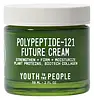
Youth To The People Polypeptide-121 Future Cream with Peptides and Ceramides Versus The Ordinary Multi-Peptide Serum for Hair Density
This anti-aging moisturizer is formulated around Hydrolyzed Hyaluronic Acid and Acetyl Tetrapeptide-9 to soften the look of wrinkles and hydrate skin.


What's inside
What's inside
 Key Ingredients
Benefits
Concerns
Ingredients Side-by-side
Water
Skin ConditioningDicaprylyl Carbonate
EmollientHydrolyzed Hyaluronic Acid
Humectant



Trimethylolpropane Tricaprylate/Tricaprate
EmollientTridecyl Trimellitate
EmollientPropanediol
Solvent
Sh-Polypeptide-121
Skin Conditioning
Polyglyceryl-3 Methylglucose Distearate
Emulsifying

Panthenol
Skin Conditioning

Niacinamide
Smoothing






Proline
Skin Conditioning
Tocopheryl Acetate
Antioxidant

Aloe Barbadensis Leaf Juice
Skin Conditioning
Hydrolyzed Cannabis Sativa Seed Extract
Skin ConditioningHydrolyzed Rice Protein
Skin ConditioningHydrolyzed Pea Protein
EmollientSalvia Hispanica Seed Extract
Emollient
Acetyl Tetrapeptide-11
Skin Conditioning
Acetyl Tetrapeptide-9
Skin Conditioning
Acetyl Tetrapeptide-2
Skin Conditioning
Hibiscus Sabdariffa Fruit Extract
Ammonium Acryloyldimethyltaurate/Beheneth-25 Methacrylate Crosspolymer
Emulsion StabilisingHydrolyzed Linseed Seed
HumectantCastor Oil/Ipdi Copolymer

Ceramide AP
Skin Conditioning
Ceramide NP
Skin Conditioning
Cetearyl Alcohol
Emollient




Cetearyl Glucoside
Emulsifying
Glycerin
Humectant
Hydrolyzed Sodium Hyaluronate
Skin Conditioning
Coco-Caprylate/Caprate
Emollient
Dilinoleic Acid
Emollient
Benzyl Alcohol
Perfuming





Zingiber Officinale Root Extract
Masking
Bisabolol
Antioxidant
Caprylyl Glycol
Emollient
Carbomer
Emulsion StabilisingDimethyl Isosorbide
SolventDipropylene Glycol
HumectantErythritol
Humectant
Ethylhexylglycerin
Skin ConditioningGlucose
Humectant
1,2-Hexanediol
Skin Conditioning
Trisodium Ethylenediamine Disuccinate
ChelatingGlyceryl Stearate
Emollient
Phytosphingosine
Skin Conditioning
Polyacrylate Crosspolymer-6
Emulsion StabilisingPolysorbate 20
Emulsifying
Caprylhydroxamic Acid
ChelatingPotassium Sorbate
Preservative
Glycine
Buffering
Hydroxyacetophenone
Antioxidant
Sodium Benzoate
Masking
T-Butyl Alcohol
Perfuming
Citric Acid
Buffering
Sodium Citrate
BufferingSodium Lactate
Buffering
Triheptanoin
Skin ConditioningXanthan Gum
EmulsifyingWater, Dicaprylyl Carbonate, Hydrolyzed Hyaluronic Acid, Trimethylolpropane Tricaprylate/Tricaprate, Tridecyl Trimellitate, Propanediol, Sh-Polypeptide-121, Polyglyceryl-3 Methylglucose Distearate, Panthenol, Niacinamide, Proline, Tocopheryl Acetate, Aloe Barbadensis Leaf Juice, Hydrolyzed Cannabis Sativa Seed Extract, Hydrolyzed Rice Protein, Hydrolyzed Pea Protein, Salvia Hispanica Seed Extract, Acetyl Tetrapeptide-11, Acetyl Tetrapeptide-9, Acetyl Tetrapeptide-2, Hibiscus Sabdariffa Fruit Extract, Ammonium Acryloyldimethyltaurate/Beheneth-25 Methacrylate Crosspolymer, Hydrolyzed Linseed Seed, Castor Oil/Ipdi Copolymer, Ceramide AP, Ceramide NP, Cetearyl Alcohol, Cetearyl Glucoside, Glycerin, Hydrolyzed Sodium Hyaluronate, Coco-Caprylate/Caprate, Dilinoleic Acid, Benzyl Alcohol, Zingiber Officinale Root Extract, Bisabolol, Caprylyl Glycol, Carbomer, Dimethyl Isosorbide, Dipropylene Glycol, Erythritol, Ethylhexylglycerin, Glucose, 1,2-Hexanediol, Trisodium Ethylenediamine Disuccinate, Glyceryl Stearate, Phytosphingosine, Polyacrylate Crosspolymer-6, Polysorbate 20, Caprylhydroxamic Acid, Potassium Sorbate, Glycine, Hydroxyacetophenone, Sodium Benzoate, T-Butyl Alcohol, Citric Acid, Sodium Citrate, Sodium Lactate, Triheptanoin, Xanthan Gum
Water
Skin ConditioningPropanediol
Solvent
Butylene Glycol
Humectant
Glycerin
Humectant
Caffeine
Skin Conditioning
Biotinoyl Tripeptide-1
Acetyl Tetrapeptide-3
Skin Protecting
Larix Europaea Wood Extract
HumectantPisum Sativum Extract
Skin ConditioningScutellaria Baicalensis Root Extract
Astringent
Triticum Vulgare Germ Extract
Skin ConditioningGlycine Soja Germ Extract
EmollientTrifolium Pratense Flower Extract
AstringentCamellia Sinensis Leaf Extract
Antimicrobial
Apigenin
Antioxidant
Oleanolic Acid
Skin ConditioningArginine
Masking
Glycine
Buffering
Calcium Gluconate
HumectantZinc Chloride
AntimicrobialLactic Acid
Buffering
Gluconolactone
Chelating
Dextran
Maltodextrin
Absorbent
Hydroxyethylcellulose
Emulsion StabilisingXanthan Gum
EmulsifyingPentylene Glycol
Skin Conditioning
Dimethyl Isosorbide
SolventPolysorbate 20
Emulsifying
PPG-26-Buteth-26
Skin ConditioningPEG-40 Hydrogenated Castor Oil
Emulsifying
Trisodium Ethylenediamine Disuccinate
ChelatingSodium Metabisulfite
Antioxidant
Sodium Benzoate
Masking
Phenoxyethanol
Preservative
Chlorphenesin
Antimicrobial
Water, Propanediol, Butylene Glycol, Glycerin, Caffeine, Biotinoyl Tripeptide-1, Acetyl Tetrapeptide-3, Larix Europaea Wood Extract, Pisum Sativum Extract, Scutellaria Baicalensis Root Extract, Triticum Vulgare Germ Extract, Glycine Soja Germ Extract, Trifolium Pratense Flower Extract, Camellia Sinensis Leaf Extract, Apigenin, Oleanolic Acid, Arginine, Glycine, Calcium Gluconate, Zinc Chloride, Lactic Acid, Gluconolactone, Dextran, Maltodextrin, Hydroxyethylcellulose, Xanthan Gum, Pentylene Glycol, Dimethyl Isosorbide, Polysorbate 20, PPG-26-Buteth-26, PEG-40 Hydrogenated Castor Oil, Trisodium Ethylenediamine Disuccinate, Sodium Metabisulfite, Sodium Benzoate, Phenoxyethanol, Chlorphenesin
Reviews
Ingredients Explained
These ingredients are found in both products.
Ingredients higher up in an ingredient list are typically present in a larger amount.
Dimethyl Isosorbide (often shortened to DMI) is a sugar-derived solvent made from sorbitol. It's used to dissolve tricky ingredients and help them mix smoothly into a formula.
Many actives sit as gritty crystals when undissolved, so DMI swoops in to full dissolve them. This helps improve texture, stability, and how evenly an active is distributed.
It does have a penetration-enhancing reputation that is a bit more nuanced than marketing suggests; a cell study on human skin found that 10% DMI didn't significantly boost the permeation of Hydroquinone, Salicylic Acid, or Octadecenedioic Acid compared to controls (though it did improve their solubility in the formula itself).
Typical usage concentrations usually range from 1-10% depending on the formula's needs; this ingredient is also well tolerated at these levels.
Learn more about Dimethyl IsosorbideGlycerin (or glycerol) is a compound naturally found in your skin. It's a powerhouse humectant that pulls water into the stratum corneum.
Topically, glycerin does several things at once:
Your skin makes glycerin on its own (mostly from sebaceous oil breakdown) and shuttles it to your outermost layer of skin, or your epidermis, via aquaporin-3.
Aquaporin-3 is a transporter that is essential for normal skin hydration, elasticity, and repair. Interestingly, mice lacking in AQP3 have dry and less elastic skin that can be fully corrected with glycerin.
This ingredient is non-irritating, plays well with almost every ingredient, and works across all skin types. Typical use is anywhere between 3-10% but can go up to 79% in some leave-on products.
Just know very high concentrations (>40%) can feel tacky in low humidity.
Glycerin is the name for this ingredient in American English. British English uses Glycerol/Glycerine.
Learn more about GlycerinGlycine is the smallest amino acid and a key building block of collagen. It's part if your skin's Natural Moisturizing Factor (NMF), or the water-loving molecules in your outermost layer of skin (stratum corneum) that keeps everything hydrated and happy.
A study from 2022 found that an amino acid complex featuring taurine, arginine, and glycine significantly reduced skin irritation, improved redness, and accelerated the skin repair process.
Polysorbate 20 is a gentle, water-soluble emulsifier and mild surfactant. It stops oil and water from separating to keep your formulas blended and stable.
It also acts as a mild penetration enhancer by helping active ingredients absorb slightly better.
The common safety discussion around this ingredient involves a manufacturing byproduct called 1,4-dioxane.
Trace amounts can form during production but the EU's Scientific Committee on Consumer Safety has concluded that levels at/below 10 ppm in finished products are safe (commercial products consistently fall within acceptable margins).
True allergic reactions are uncommon and the CIR Expert Panel has confirmed this ingredient to be safe as used in cosmetics.
Because it is derived from lauric acid, it may not be fungal acne safe.
Learn more about Polysorbate 20Propanediol is an all-star ingredient. It softens, hydrates, and smooths the skin.
It’s often used to:
Propanediol is not likely to cause sensitivity and considered safe to use. It is derived from corn or petroleum with a clear color and no scent.
Learn more about PropanediolSodium Benzoate is a preservative. It's used in both cosmetic and food products to inhibit the growth of mold and bacteria. It is typically produced synthetically.
Both the US FDA and EU Health Committee have approved the use of sodium benzoate. In the US, levels of 0.1% (of the total product) are allowed.
Sodium benzoate works as a preservative by inhibiting the growth of bacteria inside of cells. It prevents the cell from fermenting a type of sugar using an enzyme called phosphofructokinase.
It is the salt of benzoic acid. Foods containing sodium benzoate include soda, salad dressings, condiments, fruit juices, wines, and snack foods.
Studies for using ascorbic acid and sodium benzoate in cosmetics are lacking, especially in skincare routines with multiple steps.
We always recommend speaking with a professional, such as a dermatologist, if you have any concerns.
Learn more about Sodium BenzoateTrisodium Ethylenediamine Disuccinate is used to help stabilize a product.
It is a chelating agent, meaning it helps prevent metal ions from binding to other ingredients. This prevents unwanted reactions in products. Metal ions can come into a product via the water ingredient. They are found in trace amounts and are not known to be harmful.
Water. It's the most common cosmetic ingredient of all. You'll usually see it at the top of ingredient lists, meaning that it makes up the largest part of the product.
So why is it so popular? Water most often acts as a solvent - this means that it helps dissolve other ingredients into the formulation.
You'll also recognize water as that liquid we all need to stay alive. If you see this, drink a glass of water. Remember to stay hydrated!
Learn more about WaterXanthan gum is used as a stabilizer and thickener within cosmetic products. It helps give products a sticky, thick feeling - preventing them from being too runny.
On the technical side of things, xanthan gum is a polysaccharide - a combination consisting of multiple sugar molecules bonded together.
Xanthan gum is a pretty common and great ingredient. It is a natural, non-toxic, non-irritating ingredient that is also commonly used in food products.
Learn more about Xanthan Gum

