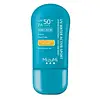
This hybrid sunscreen covers the full UV range and blocks ~98% of UVB at SPF 50.
This hybrid sunscreen covers the full UV range and blocks ~98% of UVB at SPF 50.


What's inside
What's inside
 Key Ingredients
Benefits
Concerns
Ingredients Side-by-side
Water
Skin ConditioningCyclopentasiloxane
Emollient
Octocrylene
UV Absorber



Diisopropyl Sebacate
EmollientHomosalate
Skin Conditioning
Talc
Abrasive
Ethylhexyl Salicylate
UV Absorber
Silica
Abrasive

Diethylamino Hydroxybenzoyl Hexyl Benzoate
UV Filter
Propylene Glycol
Humectant

Isododecane
EmollientBis-Ethylhexyloxyphenol Methoxyphenyl Triazine
UV Absorber
Phenylbenzimidazole Sulfonic Acid
UV Absorber
Lauroyl Lysine
Skin Conditioning
Tromethamine
BufferingTitanium Dioxide
Cosmetic Colorant
Dimethicone/Vinyl Dimethicone Crosspolymer
Skin Conditioning
Caprylic/Capric Triglyceride
Masking

Dimethicone Crosspolymer
Emulsion Stabilising
Cetyl PEG/PPG-10/1 Dimethicone
Emulsifying
Phenoxyethanol
Preservative
Silica Dimethyl Silylate
EmollientDimethicone
Emollient
Chlorphenesin
Antimicrobial
Disteardimonium Hectorite
StabilisingPolyhydroxystearic Acid
Emulsifying
Stearic Acid
Cleansing
Alumina
Abrasive
Tetrasodium EDTA
ChelatingTocopheryl Acetate
Antioxidant


Triethoxycaprylylsilane
Propanediol
Solvent
Butylene Glycol
Humectant
Buddleja Officinalis Flower Extract
UV FilterCamellia Sinensis Leaf Extract
Antimicrobial


Geranium Robertianum Extract
AstringentScutellaria Baicalensis Root Extract
Astringent
Houttuynia Cordata Extract
Skin Conditioning
Citrus Reticulata Peel Extract
Skin ConditioningAlgae Extract
Emollient
Centaurea Cyanus Flower Extract
Astringent
Aspalathus Linearis Extract
Skin ConditioningPhaseolus Radiatus Sprout Extract
HumectantWater, Cyclopentasiloxane, Octocrylene, Diisopropyl Sebacate, Homosalate, Talc, Ethylhexyl Salicylate, Silica, Diethylamino Hydroxybenzoyl Hexyl Benzoate, Propylene Glycol, Isododecane, Bis-Ethylhexyloxyphenol Methoxyphenyl Triazine, Phenylbenzimidazole Sulfonic Acid, Lauroyl Lysine, Tromethamine, Titanium Dioxide, Dimethicone/Vinyl Dimethicone Crosspolymer, Caprylic/Capric Triglyceride, Dimethicone Crosspolymer, Cetyl PEG/PPG-10/1 Dimethicone, Phenoxyethanol, Silica Dimethyl Silylate, Dimethicone, Chlorphenesin, Disteardimonium Hectorite, Polyhydroxystearic Acid, Stearic Acid, Alumina, Tetrasodium EDTA, Tocopheryl Acetate, Triethoxycaprylylsilane, Propanediol, Butylene Glycol, Buddleja Officinalis Flower Extract, Camellia Sinensis Leaf Extract, Geranium Robertianum Extract, Scutellaria Baicalensis Root Extract, Houttuynia Cordata Extract, Citrus Reticulata Peel Extract, Algae Extract, Centaurea Cyanus Flower Extract, Aspalathus Linearis Extract, Phaseolus Radiatus Sprout Extract
Dimethicone
Emollient
Water
Skin ConditioningZinc Oxide
Cosmetic Colorant
Alcohol
Antimicrobial

Talc
Abrasive
Isododecane
EmollientDiisopropyl Sebacate
EmollientOctocrylene
UV Absorber
Ethylhexyl Salicylate
UV Absorber
Silica
Abrasive
Isopropyl Myristate
Emollient
Titanium Dioxide
Cosmetic Colorant
PEG-9 Polydimethylsiloxyethyl Dimethicone
Emulsifying
Dextrin Palmitate
Emulsifying
Glycerin
Humectant
Homosalate
Skin Conditioning
Potentilla Erecta Root Extract
Skin ConditioningSodium Acetylated Hyaluronate
Humectant
Soluble Collagen
Humectant
PEG-10 Dimethicone
Skin Conditioning
Isostearic Acid
Cleansing
Stearic Acid
Cleansing
Trisodium Ethylenediamine Disuccinate
ChelatingPEG-6
HumectantTocopherol
Antioxidant
BHT
Antioxidant
Butylene Glycol
Humectant
Phenoxyethanol
Preservative
Parfum
Masking

Bis-Butyldimethicone Polyglyceryl-3
Cleansing
Sodium Chloride
MaskingAluminum Hydroxide
EmollientSynthetic Fluorphlogopite
Saccharide Isomerate
Humectant
Sodium Metabisulfite
Antioxidant
Sodium Citrate
BufferingCitrus Unshiu Peel Extract
MaskingCamellia Sinensis Leaf Extract
Antimicrobial
Diethylamino Hydroxybenzoyl Hexyl Benzoate
UV Filter
PEG/PPG-9/2 Dimethyl Ether
Skin ConditioningC12-15 Alkyl Benzoate
AntimicrobialTetrasodium Pyrophosphate
BufferingPolysilicone-15
UV Filter
PEG/PPG-14/7 Dimethyl Ether
Skin ConditioningEthylhexyl Triazone
UV Absorber
Lauryl Betaine
CleansingZea Mays Starch
Absorbent
Dipotassium Glycyrrhizate
Humectant
Citric Acid
Buffering
Disteardimonium Hectorite
StabilisingTriethoxycaprylylsilane
Bis-Ethylhexyloxyphenol Methoxyphenyl Triazine
UV Absorber
Trimethylsiloxysilicate
Emollient
Sodium Benzoate
Masking
Polyglyceryl-6 Polyricinoleate
Emulsifying
Charcoal Extract
Skin ConditioningTriethoxysilylethyl Polydimethylsiloxyethyl Dimethicone
Skin Conditioning
Dimethicone, Water, Zinc Oxide, Alcohol, Talc, Isododecane, Diisopropyl Sebacate, Octocrylene, Ethylhexyl Salicylate, Silica, Isopropyl Myristate, Titanium Dioxide, PEG-9 Polydimethylsiloxyethyl Dimethicone, Dextrin Palmitate, Glycerin, Homosalate, Potentilla Erecta Root Extract, Sodium Acetylated Hyaluronate, Soluble Collagen, PEG-10 Dimethicone, Isostearic Acid, Stearic Acid, Trisodium Ethylenediamine Disuccinate, PEG-6, Tocopherol, BHT, Butylene Glycol, Phenoxyethanol, Parfum, Bis-Butyldimethicone Polyglyceryl-3, Sodium Chloride, Aluminum Hydroxide, Synthetic Fluorphlogopite, Saccharide Isomerate, Sodium Metabisulfite, Sodium Citrate, Citrus Unshiu Peel Extract, Camellia Sinensis Leaf Extract, Diethylamino Hydroxybenzoyl Hexyl Benzoate, PEG/PPG-9/2 Dimethyl Ether, C12-15 Alkyl Benzoate, Tetrasodium Pyrophosphate, Polysilicone-15, PEG/PPG-14/7 Dimethyl Ether, Ethylhexyl Triazone, Lauryl Betaine, Zea Mays Starch, Dipotassium Glycyrrhizate, Citric Acid, Disteardimonium Hectorite, Triethoxycaprylylsilane, Bis-Ethylhexyloxyphenol Methoxyphenyl Triazine, Trimethylsiloxysilicate, Sodium Benzoate, Polyglyceryl-6 Polyricinoleate, Charcoal Extract, Triethoxysilylethyl Polydimethylsiloxyethyl Dimethicone
Reviews
Ingredients Explained
These ingredients are found in both products.
Ingredients higher up in an ingredient list are typically present in a larger amount.
This ingredient is better known as bemotrizinol or Tinosorb S and is one of the best broad-spectrum UV filters in modern sunscreen.
It works by absorbing UV light across a whole range (280-400 nm) with peaks around 310 nm (UVB) and 340-345 nm (UVA). This means it covers UVB plus the deeper UVA wavelengths that drive photoaging and pigmentation.
Another pro?
It's exceptionally photostable, barely degrades in sunlight, and acts as a "bodyguard" for less stable filters.
That's why you'll see it paired with avobenzone or octinoxate; this team up ensures they keep working through sun exposure.
Safety reviews have been reassuring across the board. This ingredient shows low absorption through the skin, rarely irritates, and lab studies found it doesn't act like a hormone in the body (a concern that's been raised about some older sunscreen filters).
On maximum concentrations:
In 2026, the US F.D.A finally added it as an OTC sunscreen ingredient at concentrations up to 6% for adults / children 6 months and older
Learn more about Bis-Ethylhexyloxyphenol Methoxyphenyl TriazineButylene Glycol (or BG) is used within cosmetic products for a few different reasons:
Overall, Butylene Glycol is a safe and well-rounded ingredient that works well with other ingredients.
Though this ingredient works well with most skin types, some people with sensitive skin may experience a reaction such as allergic rashes, closed comedones, or itchiness.
Learn more about Butylene GlycolCamellia Sinensis Leaf Extract (tea extract) is one of the most well-researched plant extracts in skincare with an impressive resume.
Black tea, green tea, and oolong tea are all harvested from the Camellia Sinensis plant.
Studies show green tea extract and its catechins (like epigallocatechin gallate (EGCG)) help your skin cells product energy more efficiently and reducing the number of free-radicals that can damage your skin from the inside.
In lab-grown skin models, this translated to younger, healthier, and stronger skin.
There's also good sun protection data; researchers saw less DNA damage and redness on human skin when green tea was applied before UVB exposure. And the more they applied, the better the protection.
Needless to say, this ingredient shouldn't replace your sunscreen. But it is a great supportive ingredient that you can already find in many sunscreens and antioxidant serums.
A 2009 study found a 2% green tea lotion was effective for mild-to-moderate acne thanks to its anti-inflammatory and mild antimicrobial activity.
The quality of the extract matters a lot here:
Good extracts contain 50-90% catechins while lower quality ones are mostly there for marketing. We recommend reaching out to the brand if you have questions about the quality or source of their ingredients.
Human Repeated Insult Patch Testing showed no irritation or sensitization at use concentrations (0.86% in leave-on products and up to 30% as leaf water).
Learn more about Camellia Sinensis Leaf ExtractDiethylamino Hydroxybenzoyl Hexyl Benzoate (DHHB) is a chemical UV-A absorber. It is formulated for high UVA protection (320-400 nm).
DHHB is well-liked for:
DHHB has been approved by the EU, Japan, Taiwan, and South America for use up to 10%. Unfortunately, it has not been approved for use in the US or Canada due to slow regulatory processes.
This ingredient is soluble in oils, fats, and lipids.
Learn more about Diethylamino Hydroxybenzoyl Hexyl BenzoateWe don't have a description for Diisopropyl Sebacate yet.
Dimethicone is a type of synthetic silicone created from natural materials such as quartz. It is also known as polydimethylsiloxane.
What it does:
Dimethicone comes in different viscosities:
Depending on the viscosity, dimethicone has different properties.
Ingredients lists don't always show which type is used, so we recommend reaching out to the brand if you have questions about the viscosity.
This ingredient is unlikely to cause irritation because it does not get absorbed into skin. However, people with silicone allergies should be careful about using this ingredient.
Note: Dimethicone may contribute to pilling. This is because it is not oil or water soluble, so pilling may occur when layered with products. When mixed with heavy oils in a formula, the outcome is also quite greasy.
Learn more about DimethiconeDisteardimonium Hectorite comes from the clay mineral named hectorite. It is used to add thickness to a product.
It can also help stabilize a product by helping to disperse other ingredients.
Hectorite is a rare, white clay mineral.
Learn more about Disteardimonium HectoriteEthylhexyl Salicylate (also called Octisalate or Octyl Salicylate) is an oil-soluble organic UV filter that's been used in sunscreen since the 1950's.
It absorbs UVB light in the 280-320 nm range with a peak absorbance around 306 nm.
You'll often see it paired with other UV filters to boost overall SPF because octisalate is a fairly week filter on its own.
The reason you'll see it so often is because it can help solubilize and stabilize the trickier filters like oxybenzone and avobenzone.
Unlike these filters, octisalate has pretty good photostability and doesn't create skin-damaging free radicals when exposed to sunlight.
The fatty-alcohol part of the molecule also gives it a light, emollient feel so it doubles as a nice texture enhancer.
Usage levels vary around the world:
Safety-wise, this ingredient has a pretty reassuring track record. The EU's Scientific Committee on Consumer Products (SCCP) found very low skin penetration in human skin tests and negative results for irritation, phototoxicity, and photoallergy.
The real-world allergy risk is pretty low too; a 2012 European study of 1,031 people recorded only 2 reactions to it (a rate of 0.19%).
You might have seen scary headlines about sunscreen getting into your blood.
In 2019, the FDA found that several chemical filters can absorb through the skin and show up in the bloodstream at small but measurable levels.
Here's the important part: these tiny levels are just a cutoff the FDA uses to decide which ingredients need more testing and doesn't mean anything harmful was found.
The researchers were clear that the results are no reason to stop wearing sunscreen.
Learn more about Ethylhexyl SalicylateHomosalate is an oil-soluble organic UVB filter that has been a sunscreen staple for decades. Its job is to absorb UVB rays (~295-315 nm) and protect your skin against sunburn,
This is one of the more photostable organic UV filters; it holds up pretty well under UV and a 2022 quantum-chemistry study found it stays stable in sunlight.
It's actually so reliable that formulators often pair it with shakier ingredients like oxybenzone and avobenzone. Formulators also use it to help dissolve the other UV filters into the oil phase.
One thing to keep in mind: "stable" isn't the same as "strong". On its own, homosalate is actually a pretty weak UV filter so it's better off as a helpful team player that helps boost overall SPF protection.
The safety picture is a bit nuanced but not scary.
This ingredient has a long track record of being gentle and regulators agree it isn't an irritant; EU's Scientific Committee on Consumer Safety found that homosalate is not considered a skin irritant and doesn't raise eye-irritation flags either.
There's talk about homosalate because your skin absorbs a little bit of it into your bloodstream. A 2020 FDA-backed study found homosalate showed up in people's blood levels at the level where the FDA decides to double check.
The EU's Scientific Committee on Consumer Safety (SCCS) also found small amounts in blood and breast milk. They estimated that about 5% of what you apply gets absorbed through the skin.
Due to the debate about whether it might mess with hormones, the SCCS recommended a maximum limit of 0.5% in most products of 7.3% in face creams/pump sprays.
One important thing to keep in mind: in the US, Homosalate is currently labeled "non-GRASE" by the FDA. This sounds alarming but really just means the FDA wants more data to confirm it's safe. It's not confidently saying this ingredient is harmful.
As of now, homosalate is still completely legal and widely used while that research gets done.
The current maximum limits are:
Learn more about HomosalateIsododecane is a fragrance, emollient, and solvent.
As an emollient, it helps your skin stay soft and hydrated. Emollients help trap moisture into your skin.
Isododecane's role as a solvent makes it a great texture enhancer. It spreads smoothly on skin and does not leave a sticky feeling behind. Isododecane also helps prevent color transfer in makeup products.
Isododecane is not absorbed into skin.
The chemical name for this ingredient is 2,2,4,6,6-PENTAMETHYLHEPTANE.
Learn more about IsododecaneOctocrylene is an oil-soluble organic UV filter that mainly absorbs UVB and short wave UVA II light.
Its real superpower is teamwork: octocrylene is remarkably photostable and is most famous for stabilizing avobenzone (the workhorse UVA filter).
This ingredient is commonly used to enhance both UVB and UVA protection due to its unique property in stabilizing avobenzone. It also pulls double duty by boosting water resistance and giving formulas a smooth, spreadable feel.
The EU's Scientific Committee on Consumer Safety (SCCS) has deemed octocrylene to be safe as a UV-filter at concentrations up to 10% (capped at 9% in propellant sprays). The US also permits it up to 10%.
Two things worth knowing:
You'll usually see this ingredient used in concentrations between 2-10% (higher amounts when used as a stabilizer for avobenzone).
Learn more about OctocrylenePhenoxyethanol is one of the most widely used preservatives in skincare (and for good reason!).
It has a large spectrum of antimicrobial activity and especially effective bacteria, yeast, and mold while only having a weak effect on your skin's natural microbiome.
On a cellular level, it disrupts the cell membranes of microbes by poking holes that make the cell leak. This shuts down the chemical reactions the microbe needs to make energy so it can no longer survive.
Another perk of this ingredient is that it stays functional across a wide pH range (3-10).
You'll often see it paired with boosters like Ethylhexylglycerin; one study showed that a 1:9 ratio of Ethylhexylglycerin to Phenoxyethanol damages bacterial membranes as effectively as doubling the Phenoxyethanol concentration on its own.
Typical use concentrations range from 0.3-1% depending on the formula, and this ingredient is capped at 1% int the EU.
Safety-wise, the fear mongering does not hold up to the evidence. The EU's Scientific Committee on Consumer Safety and FDA consider it safe as a preservative at up to 1%, including for children of all ages.
Adverse systemic effects only showed up in animal studies at exposures roughly 200x higher than what people get from cosmetics. And despite its very widespread use, this ingredient is a rare sensitizer and allergic reactions are uncommon.
Learn more about PhenoxyethanolSilica, also known as silicon dioxide, is a naturally occurring mineral. It is used as a fine, spherical, and porous powder in cosmetics.
Though it has exfoliant properties, the function of silica varies depending on the product.
The unique structure of silica enhances the spreadability and adds smoothness, making it a great texture enhancer.
It is also used as an active carrier, emulsifier, and mattifier due to its ability to absorb excess oil.
In some products, tiny microneedles called spicules are made from silica or hydrolyzed sponge. When you rub them in, they lightly polish away dead skin layers and enhance the penetration of active ingredients.
Learn more about SilicaStearic Acid is a fatty acid that is already found in your skin. It's one of the free fatty acids that works alongside ceramides and cholesterols to maintain your barrier.
In cosmetics, it is a multitasker:
Safety-wise, the CIR Expert Panel has concluded it to be safe in cosmetics when formulated to be non-irritating and non-sensitizing.
Free stearic acid is a C18 fatty acid that the Malassezia yeast can substrate, so this ingredient may not be fungal acne safe.
This ingredient does have a comedogenic rating of 2-3, but this doesn't mean a formula with this ingredient will clog pores.
Human testing has proved that any finished product with this ingredient won't automatically make you break out; it really comes down to concentration, formula, and your skin.
Learn more about Stearic AcidTalc is a clay mineral. It helps absorb moisture and improve the texture of products. Like other types of clay, Talc can have a slight exfoliating effect on skin. Talc can be added to increase the volume of products.
Some Baby powders are made by combining talc with corn starch. The word "talc" comes from Latin and originates from Arabic. Talc is a mineral commonly found throughout the world.
If you have any concerns about using talc, we recommend checking out the FDA's official page.
Learn more about TalcTitanium Dioxide (TD) is a mineral UV filter widely used in sunscreens and cosmetics.
It's one of only two UV filters officially classified as "mineral" by regulatory agencies (the other being Zinc Oxide).
A really common myth is that mineral filters work by reflecting UV light off your skin like tiny mirrors.
They don't only do that; modern research shows TD protects mostly by absorbing UV radiation, the same way chemical filters do.
When researchers measured this, reflection accounted for only about 4-5% of the protection (and less than SPF 2 on its own). The other ~95% comes from absorption: the UV photons hit the particle and their energy gets soaked up by its semiconductor band gap rather than bouncing off.
So "reflects vs. absorbs" was never really the right way to split mineral from chemical filters.
TD gives broad-spectrum protection that's strongest in the UVB and UVA-2 range and weaker in the UVA-1 range. Its UVA protection isn't quite as strong as Zinc Oxide's which is why you'll often see the two paired together.
Together, they make a solid broad-spectrum system.
TD is a great pick for sensitive, acne-prone, or redness-prone skin because it's non-irritating and chemically inert. Regulatory reviews classify it as a non-sensitizer and mild-to-non-irritant.
It's also unlikely to cause the "eye sting" some chemical filters are known for.
The main trade-off is cosmetic; TD can leave a white cast and has a thicker texture. This is why mineral sunscreens are often less cosmetically elegant than chemical or hybrid formulas (and harder to shade-match on deeper skin tones).
Formulators often use micronized or nano-sized TD to cut down on white case and improve spreadability. Smaller particles scatter less visible light so the formula looks less chalky while still filtering UV.
TD is almost always bundled with coatings like Alumina, Silica, Stearic Acid, or Dimethicone. These coatings do two important jobs:
TD can be used at up to 25% in a finished sunscreen; this is the regulatory ceiling in both the US and the EU.
In practice, the amount in any given product varies a lot depending on the target SPF and whether it's paired with other UV filters.
TD is one of the most heavily vetted sunscreen ingredients out there. It is approved as a UV filter in all major markets worldwide, including the US, EU, UK, Japan, Korea, China, Australia, and Canada.
The safety evidence is solid. There was an old worry that nano particles might absorb through skin into the body but multiple studies (including on damaged, sunburned, and UV-irradiated skin) have shown that TD stays on the surface and the layer of dead skin cells on top of everything else.
There's also no evidence of carcinogenicity, mutagenicity, or reproductive toxicity from dermal exposure of this ingredient.
For those who have seen the headline about a 2022 EU ban on TD, that was on TD as a food additive (a complete separate use from topical sunscreen).
There are ongoing questions about how nano-TD might affect marine ecosystems. As of now, there has been no conclusive evidence that any form of TD (or any other sunscreen filter) harms coral reefs or marine life.
The science is still developing and it's a space worth watching rather than packing over.
However, several destinations have reef-safety sunscreen rules that restrict certain chemical filters and steer visitors toward mineral, non-nano options. If you're traveling somewhere with these rules, a non-nano mineral sunscreen is the safe bet.
Learn more about Titanium DioxideTriethoxycaprylylsilane is a silicon-based surface modifier that makes sunscreens feel silky and makeup stay put.
Its main job is to coat mineral particles like titanium dioxide, zinc oxide, and color pigments in a thin, oily layer so they spread smoothly, don't clump, and stick to skin better.
This ingredient is typically used at low levels (up to 2.5% in eyeshadow and 1% in lipstick).
Learn more about TriethoxycaprylylsilaneWater. It's the most common cosmetic ingredient of all. You'll usually see it at the top of ingredient lists, meaning that it makes up the largest part of the product.
So why is it so popular? Water most often acts as a solvent - this means that it helps dissolve other ingredients into the formulation.
You'll also recognize water as that liquid we all need to stay alive. If you see this, drink a glass of water. Remember to stay hydrated!
Learn more about Water

