Clinique Smart Clinical Repair Overnight Recovery Cream + Mask Versus Clinique Smart Clinical Repair Wrinkle Correcting Serum
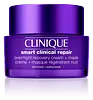
This anti-aging overnight mask is formulated around Acetyl Glucosamine and Sodium Hyaluronate to soften the look of wrinkles and strengthen the skin barrier.
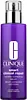
This anti-aging serum is formulated around Acetyl Hexapeptide-8 and Palmitoyl Tripeptide-1 to soften the look of wrinkles and refine skin texture.

What's inside
What's inside
 Key Ingredients
Benefits
Concerns
Ingredients Side-by-side
Water
Skin ConditioningIsostearyl Neopentanoate
Emollient

Glycerin
Humectant


Butylene Glycol
Humectant
Glyceryl Stearate
Emollient

PEG-100 Stearate
Surfactant
Dimethicone
Emollient
Cetearyl Alcohol
Emollient


Glycereth-26
Humectant
Acetyl Glucosamine
Skin Conditioning


Sodium Hyaluronate
Humectant

Hypnea Musciformis Extract
Skin Protecting
Gelidiella Acerosa Extract
Skin Protecting
Centaurium Erythraea Extract
Skin ConditioningDictyopteris Polypodioides Extract
EmollientCaffeine
Skin Conditioning
Astrocaryum Murumuru Seed Butter
Emollient
Saccharomyces/Xylinum/Black Tea Ferment
Skin Conditioning
Faex Extract
Skin ConditioningWhey Protein
Skin ConditioningGlycine Soja Protein
EmulsifyingPetrolatum
Emollient

Cetearyl Glucoside
Emulsifying
Isohexadecane
EmollientCaprylyl Glycol
Emollient
Adenosine
Skin Conditioning
Aminopropyl Ascorbyl Phosphate
Antioxidant



Soy Amino Acids
Skin ConditioningHexylene Glycol
EmulsifyingMicrococcus Lysate
Skin ConditioningAcetyl Hexapeptide-8
Humectant
Ergothioneine
Antioxidant
Palmitoyl Tripeptide-1
Skin Conditioning
Palmitoyl Tetrapeptide-7
Skin Conditioning
Biotin
AntiseborrhoeicCetyl Alcohol
Emollient
Acrylates/C10-30 Alkyl Acrylate Crosspolymer
Emulsion StabilisingSorbitan Oleate
Emulsifying
Lecithin
Emollient
Polysorbate 80
Emulsifying
Polysorbate 20
Emulsifying
Tromethamine
BufferingCitric Acid
Buffering
Acrylamide/Sodium Acryloyldimethyltaurate Copolymer
Emulsion StabilisingHydroxyethylcellulose
Emulsion StabilisingCarbomer
Emulsion StabilisingCalcium Chloride
AstringentTocopheryl Acetate
Antioxidant
Sodium Citrate
BufferingDisodium EDTA
Phenoxyethanol
Preservative
Sodium Benzoate
Masking
Potassium Sorbate
Preservative
Mica
Cosmetic ColorantCI 77891
Cosmetic ColorantWater, Isostearyl Neopentanoate, Glycerin, Butylene Glycol, Glyceryl Stearate, PEG-100 Stearate, Dimethicone, Cetearyl Alcohol, Glycereth-26, Acetyl Glucosamine, Sodium Hyaluronate, Hypnea Musciformis Extract, Gelidiella Acerosa Extract, Centaurium Erythraea Extract, Dictyopteris Polypodioides Extract, Caffeine, Astrocaryum Murumuru Seed Butter, Saccharomyces/Xylinum/Black Tea Ferment, Faex Extract, Whey Protein, Glycine Soja Protein, Petrolatum, Cetearyl Glucoside, Isohexadecane, Caprylyl Glycol, Adenosine, Aminopropyl Ascorbyl Phosphate, Soy Amino Acids, Hexylene Glycol, Micrococcus Lysate, Acetyl Hexapeptide-8, Ergothioneine, Palmitoyl Tripeptide-1, Palmitoyl Tetrapeptide-7, Biotin, Cetyl Alcohol, Acrylates/C10-30 Alkyl Acrylate Crosspolymer, Sorbitan Oleate, Lecithin, Polysorbate 80, Polysorbate 20, Tromethamine, Citric Acid, Acrylamide/Sodium Acryloyldimethyltaurate Copolymer, Hydroxyethylcellulose, Carbomer, Calcium Chloride, Tocopheryl Acetate, Sodium Citrate, Disodium EDTA, Phenoxyethanol, Sodium Benzoate, Potassium Sorbate, Mica, CI 77891
Water
Skin ConditioningDimethicone
Emollient
Isododecane
EmollientButylene Glycol
Humectant
Glycerin
Humectant
Polysilicone-11

Ascorbyl Glucoside
Antioxidant
Sodium Hyaluronate
Humectant
Tocopheryl Acetate
Antioxidant
Squalane
Emollient
Hypnea Musciformis Extract
Skin Protecting
Gelidiella Acerosa Extract
Skin Protecting
Sigesbeckia Orientalis Extract
Skin ConditioningHelianthus Annuus Seed Extract
Skin Conditioning
Hordeum Vulgare Extract
EmollientTriticum Vulgare Germ Extract
Skin ConditioningCucumis Sativus Fruit Extract
Emollient
Caffeine
Skin Conditioning
Acetyl Hexapeptide-8
Humectant
Palmitoyl Tripeptide-1
Skin Conditioning
Palmitoyl Tetrapeptide-7
Skin Conditioning
Palmitoyl Hexapeptide-12
Skin Conditioning
PEG-10 Dimethicone
Skin Conditioning
Glycyrrhetinic Acid
Skin Conditioning
Whey Protein
Skin ConditioningIsohexadecane
EmollientPropylene Glycol Dicaprate
EmollientCaprylyl Glycol
Emollient
Hydroxypinacolone Retinoate
Skin Conditioning

Acetyl Glucosamine
Skin Conditioning
Cholesterol
Emollient
PEG-8
HumectantFaex Extract
Skin ConditioningPEG-6
HumectantDimethyl Isosorbide
SolventGlyceryl Polymethacrylate
Polysorbate 20
Emulsifying
Sodium Phosphate
BufferingSynthetic Fluorphlogopite
Polysorbate 80
Emulsifying
Carbomer
Emulsion StabilisingHexylene Glycol
EmulsifyingAmmonium Acryloyldimethyltaurate/Vp Copolymer
Acrylamide/Sodium Acryloyldimethyltaurate Copolymer
Emulsion StabilisingPotassium Hydroxide
BufferingTin Oxide
Abrasive
Disodium Phosphate
BufferingCitric Acid
Buffering
Disodium EDTA
Sodium Citrate
BufferingPhenoxyethanol
Preservative
Potassium Sorbate
Preservative
CI 77891
Cosmetic ColorantWater, Dimethicone, Isododecane, Butylene Glycol, Glycerin, Polysilicone-11, Ascorbyl Glucoside, Sodium Hyaluronate, Tocopheryl Acetate, Squalane, Hypnea Musciformis Extract, Gelidiella Acerosa Extract, Sigesbeckia Orientalis Extract, Helianthus Annuus Seed Extract, Hordeum Vulgare Extract, Triticum Vulgare Germ Extract, Cucumis Sativus Fruit Extract, Caffeine, Acetyl Hexapeptide-8, Palmitoyl Tripeptide-1, Palmitoyl Tetrapeptide-7, Palmitoyl Hexapeptide-12, PEG-10 Dimethicone, Glycyrrhetinic Acid, Whey Protein, Isohexadecane, Propylene Glycol Dicaprate, Caprylyl Glycol, Hydroxypinacolone Retinoate, Acetyl Glucosamine, Cholesterol, PEG-8, Faex Extract, PEG-6, Dimethyl Isosorbide, Glyceryl Polymethacrylate, Polysorbate 20, Sodium Phosphate, Synthetic Fluorphlogopite, Polysorbate 80, Carbomer, Hexylene Glycol, Ammonium Acryloyldimethyltaurate/Vp Copolymer, Acrylamide/Sodium Acryloyldimethyltaurate Copolymer, Potassium Hydroxide, Tin Oxide, Disodium Phosphate, Citric Acid, Disodium EDTA, Sodium Citrate, Phenoxyethanol, Potassium Sorbate, CI 77891
Reviews
Ingredients Explained
These ingredients are found in both products.
Ingredients higher up in an ingredient list are typically present in a larger amount.
Acetyl Glucosamine is an antioxidant and humectant. It is an amino acid sugar and is naturally found in our skin.
The cool thing about this ingredient? It helps the skin produce hyaluronic acid and boost hydration. It also has antioxidant benefits to protect skin cells.
When paired with niacinamide, Acetyl Glucosamine has been shown to be effective at reducing discoloration.
Learn more about Acetyl GlucosamineAcetyl Hexapeptide-8 (also known as Argireline) is a synthetic hexapeptide that is often called a "topical Botox alternative".
It works by mimicking how Botox relaxes muscles; it interferes with the signaling process that tells your facial muscles to contract. This can help soften expression lines like forehead wrinkles or crow's feet over time.
The comparison to Botox does have limits because the molecule is water-loving and relatively large.
Acetyl Hexapeptide-8 has a hard time absorbing deeply enough through the skin's outer barrier to actually reach the muscles.
So whether it truly works the way Botox does at a biological level is still up for debate, but early clinical outcomes are fairly encouraging.
A 12 week human study of a multi-ingredient regimen containing this ingredient saw:
While some studies have observed improvements in wrinkle appearance, it is important to note that more consistent results are seen in multi-ingredient formulations (vs just Acetyl Hexapeptide-8 alone).
Some research studies also used higher concentrations (up to 10%) while this ingredient is usually found in concentrations up to 0.005% in leave-on formulations.
Learn more about Acetyl Hexapeptide-8This ingredient is a synthetic polymer used to stabilize formulas and give products a "gel-cream" feel.
When applied, this ingredient mostly stays on the surface of skin. Safety reviews have found these polymers safe in cosmetics when made to proper quality standards. Testing also shows they’re unlikely to cause irritation or sensitization at normal use levels.
Butylene Glycol (or BG) is used within cosmetic products for a few different reasons:
Overall, Butylene Glycol is a safe and well-rounded ingredient that works well with other ingredients.
Though this ingredient works well with most skin types, some people with sensitive skin may experience a reaction such as allergic rashes, closed comedones, or itchiness.
Learn more about Butylene GlycolCaffeine is a naturally occurring plant compound found in coffee beans, tea leaves, cocoa pods, and guarana.
As an antioxidant, caffeine protects your skin from free radical damage caused by UV exposure and envionrmnetal stressors.
Early research also shows that caffeine can help calm redness, soothe irritated skin, and support hair growth by stimulating microcirculation in the scalp.
You might have seen eye creams marketing caffeine as a depuffing ingredient. This is because it is a vasoconstrictor meaning it can temporarily constrict blood vessels, though clinical evidence for this specific use is still limited.
Most skincare products contain this ingredient at concentrations between 1-6%. It is able to penetrate skin easily regardless of skin type or thickness.
Just so you know, a very small number of case reports describe caffeine-induced allergy. This ingredient is generally well-tolerated, non-irritating, and non-sensitizing for the majority of people.
Learn more about CaffeineCaprylyl Glycol is a humectant, skin conditioner, emollient, and preservative booster derived from either caprylic acid or synthetically created.
Typical use levels vary from 0.3-1% as a preservative booster and go up to 2% to condition skin.
Because it is not a free-fatty acid, this ingredient is fungal acne safe (there's nothing for Malassezia to feed on).
Learn more about Caprylyl GlycolCarbomer is a synthetic thickening and gelling agent. It's basically the ingredient that gives a lot of serums, gels, creams, and sunscreens their smooth, non-sticky texture.
Although legally permitted at very high levels, carbomers are normally used at concentrations below 1%.
It also needs to be neutralized to actually thicken, and because it is a large molecule, it doesn't really penetrate the skin barrier.
Allergy-wise, the risk is very low. Clinical studies show carbomers have low potential for skin irritation/sensitization even at concentrations up to 100%.
A 2024 UK study patch-tested 1,302 patients and found true allergy to the parent group of carbomer to be rare with no confirmed relevant reactions.
Learn more about CarbomerCi 77891 is a white pigment from Titanium dioxide. It is naturally found in minerals such as rutile and ilmenite.
It's main function is to add a white color to cosmetics. It can also be mixed with other colors to create different shades.
Ci 77891 is commonly found in sunscreens due to its ability to block UV rays.
Learn more about CI 77891Citric Acid is an alpha hydroxy acid (AHA) naturally found in citrus fruits like oranges, lemons, and limes.
Like other AHAs, citric acid can exfoliate skin by breaking down the bonds that hold dead skin cells together. This helps reveal smoother and brighter skin underneath.
However, this exfoliating effect only happens at high concentrations (20%) which can be hard to find in cosmetic products.
Due to this, citric acid is usually included in small amounts as a pH adjuster. This helps keep products slightly more acidic and compatible with skin's natural pH.
In skincare formulas, citric acid can:
While it can provide some skin benefits, research shows lactic acid and glycolic acid are generally more effective and less irritating exfoliants.
Most citric acid used in skincare today is made by fermenting sugars (usually from molasses). This synthetic version is identical to the natural citrus form but easier to stabilize and use in formulations.
Rosacea skin has a lower threshold for acids generally, with 62.5% of rosacea subjects in one study reacting to lactic acid in a sting test. This is why we mark citric acid as a potential rosacea trigger.
However, this ingredient shows up as a pH adjuster or chelator at roughly 0.1-1% in many products. These low levels are unlikely to be an issue for rosacea skin and becomes a potential trigger at exfoliating concentrations (20%). Because everybody's skin is unique, we recommend a patch test if you are unsure.
Learn more about Citric AcidDimethicone is a type of synthetic silicone created from natural materials such as quartz. It is also known as polydimethylsiloxane.
What it does:
Dimethicone comes in different viscosities:
Depending on the viscosity, dimethicone has different properties.
Ingredients lists don't always show which type is used, so we recommend reaching out to the brand if you have questions about the viscosity.
This ingredient is unlikely to cause irritation because it does not get absorbed into skin. However, people with silicone allergies should be careful about using this ingredient.
Note: Dimethicone may contribute to pilling. This is because it is not oil or water soluble, so pilling may occur when layered with products. When mixed with heavy oils in a formula, the outcome is also quite greasy.
Learn more about DimethiconeDisodium EDTA is a chelating agent. It grabs onto and deactivates metal ions that sneak into your products from water, packaging, or air.
This ingredient mainly works behind the scenes and helps with:
On top of that, this ingredient can counteract the effects of hard water by binding to the minerals in it.
One thing worth knowing is that Disodium EDTA has been shown to be a mild penetration enhancer. It can help other ingredients absorb into skin more effectively which can be a double-edged sword (great for actives, but can also make the active too strong if you have sensitive skin).
Clinical patch testing showed no significant skin irritation at typical use concentrations and minimal dermal absorption.
You'll most likely see this ingredient near the end of an ingredient list. It's typically found in concentrations less than 1%.
Learn more about Disodium EDTAWe don't have a description for Faex Extract yet.
Gelidiella Acerosa Extract can be bad for acne prone skin.
Glycerin (or glycerol) is a compound naturally found in your skin. It's a powerhouse humectant that pulls water into the stratum corneum.
Topically, glycerin does several things at once:
Your skin makes glycerin on its own (mostly from sebaceous oil breakdown) and shuttles it to your outermost layer of skin, or your epidermis, via aquaporin-3.
Aquaporin-3 is a transporter that is essential for normal skin hydration, elasticity, and repair. Interestingly, mice lacking in AQP3 have dry and less elastic skin that can be fully corrected with glycerin.
This ingredient is non-irritating, plays well with almost every ingredient, and works across all skin types. Typical use is anywhere between 3-10% but can go up to 79% in some leave-on products.
Just know very high concentrations (>40%) can feel tacky in low humidity.
Glycerin is the name for this ingredient in American English. British English uses Glycerol/Glycerine.
Learn more about GlycerinHexylene Glycol is a multitasker ingredient that works as a solvent, humectant, emulsifier, viscosity reducer, and preservative booster.
It is able to dissolve both water and oil-soluble ingredients to stabilize tricky actives and make products spread more easily.
As a humectant, it pulls water into the skin. But it's a pretty minor moisturizing ingredient compared to other humectants, like glycerin.
Interestingly, it can act as a mild penetration enhancer. One in vitro study on human skin found a 12% concentration upped the absorption of mometasone furoate (a medicinal ingredient used to treat inflammatory skin conditions) up to 7%.
This ingredient is typically used at levels of 0.1-10% depending on the role it's playing.
A patch test study on eczema patients didn't find a significant increase in irritation versus the control group, but the potential for irritation rises at higher concentrations.
Learn more about Hexylene GlycolHypnea Musciformis Extract comes from the red algae called Hypnea musciformis. Hypnea Musciformis is commonly found in the Atlantic, Pacific, and Indian Oceans.
The cell walls of Hypnea Musciformis is rich in carrageenan.
Hypnea Musciformis Extract contains vitamins A, C, and E. It also has calcium, magnesium, sodium, potassium, and iron.
Learn more about Hypnea Musciformis ExtractIsohexadecane is added to enhance texture, emulsify, and to help cleanse. It is an isoparrafin. It is a component of petrolatum.
Due to its large size, Isohexadecane is not absorbed by the skin. Instead, it sits on top and acts as an emollient. Emollients help keep your skin soft and smooth by trapping moisture within.
Isohexadecane is often used in products designed to help oily skin. It is lightweight and non-greasy while helping to moisturize. When mixed with silicones, it gives a product a silky feel.
Learn more about IsohexadecanePalmitoyl Tetrapeptide-7 (formerly Palmitoyl Tetrapeptide-3) is a synthetic peptide. Its main job is to fight what researchers call "inflammaging".
"Inflammaging" is the slow, low-grade chronic inflammation that quietly breaks down collagen as we age.
This ingredient calms down a specific inflammation signal in your skin cells (called IL-6). When left unchecked, this signal triggers enzymes that break down collagen and elastin.
Clinical testing showed statistically significant improvements in:
Studies also found the more of this ingredient used, the more your skin produces Collagen I, fibronectin, and hyaluronic acid.
You'll likely see this ingredient paired with Palmitoyl Tripeptide-1 in the well-known Matrixyl 3000 complex for enhanced anti-aging effects.
A 3% concentration applied twice daily for two months showed meaningful skin rejuvenation results in clinical panels.
Fungal acne note:
Usually a palmitic acid component can feed Malassezia in unbound form, but here is is covalently bonded to the peptide. This means it is very difficult for Malassezia to access, and therefore very unlikely to cause fungal acne.
Palmitoyl Tripeptide-1 (aka Pal-GHK) is a synthetic signal peptide made of three amino acids attached to palmitic acid.
That fatty acid attachment is the key: it boosts the peptide's ability to penetrate the skin barrier. This puts it closer to the dermal cells where it can actually make a difference.
Once there, it acts as a matrikine, a signaling peptide that prompts fibroblasts to produce more collagen, fibronectin, and hyaluronic acid.
In vitro studies show it can boost collagen production in skin cells even when UV-damaged skin samples were treated with it at a tiny concentration (it almost fully restored dermal collagen at 5ppm). It achieved this at 100x lower concentration than retinoic acid, which needed 500 ppm to do the same thing.
Human clinical data is promising, but modest:
A study of 23 female volunteers found a small but statistically significant increase (~4%) in skin thickness after treatment at 4 ppm.
A separate small trial of 15 women showed statistically significant reductions in wrinkle length, depth, and skin roughness after applying it twice daily for four weeks.
You'll likely see Pal-GHK paired with Palmitoyl Tetrapeptide-7 as part of the Matrixyl 3000 complex.
Fungal acne note:
Usually a palmitic acid component can feed Malassezia in unbound form, but here is is covalently bonded to the peptide. This means it is very difficult for Malassezia to access, and therefore very unlikely to cause fungal acne.
Phenoxyethanol is one of the most widely used preservatives in skincare (and for good reason!).
It has a large spectrum of antimicrobial activity and especially effective bacteria, yeast, and mold while only having a weak effect on your skin's natural microbiome.
On a cellular level, it disrupts the cell membranes of microbes by poking holes that make the cell leak. This shuts down the chemical reactions the microbe needs to make energy so it can no longer survive.
Another perk of this ingredient is that it stays functional across a wide pH range (3-10).
You'll often see it paired with boosters like Ethylhexylglycerin; one study showed that a 1:9 ratio of Ethylhexylglycerin to Phenoxyethanol damages bacterial membranes as effectively as doubling the Phenoxyethanol concentration on its own.
Typical use concentrations range from 0.3-1% depending on the formula, and this ingredient is capped at 1% int the EU.
Safety-wise, the fear mongering does not hold up to the evidence. The EU's Scientific Committee on Consumer Safety and FDA consider it safe as a preservative at up to 1%, including for children of all ages.
Adverse systemic effects only showed up in animal studies at exposures roughly 200x higher than what people get from cosmetics. And despite its very widespread use, this ingredient is a rare sensitizer and allergic reactions are uncommon.
Learn more about PhenoxyethanolPolysorbate 20 is a gentle, water-soluble emulsifier and mild surfactant. It stops oil and water from separating to keep your formulas blended and stable.
It also acts as a mild penetration enhancer by helping active ingredients absorb slightly better.
The common safety discussion around this ingredient involves a manufacturing byproduct called 1,4-dioxane.
Trace amounts can form during production but the EU's Scientific Committee on Consumer Safety has concluded that levels at/below 10 ppm in finished products are safe (commercial products consistently fall within acceptable margins).
True allergic reactions are uncommon and the CIR Expert Panel has confirmed this ingredient to be safe as used in cosmetics.
Because it is derived from lauric acid, it may not be fungal acne safe.
Learn more about Polysorbate 20Polysorbate 80 is a synthetic surfactant and emulsifier derived from sorbitol and oleic acid.
It reduces the surface tension between oil and water phases to help them stay mixed and stable in a formulation. In other words, it prevents your formulas from separating into an oily mess.
The CIR Expert Panel has evaluated the scientific data and found this ingredient to be safe, non-irritating, and non-sensitizing at concentrations up to 5% (it's even approved by the FDA as an OTC eye drop ingredient).
Learn more about Polysorbate 80Potassium Sorbate is a preservative used to prevent yeast and mold in products. It is commonly found in both cosmetic and food products.
This ingredient comes from potassium salt derived from sorbic acid. Sorbic acid is a natural antibiotic and effective against fungus.
Both potassium sorbate and sorbic acid can be found in baked goods, cheeses, dried meats, dried fruit, ice cream, pickles, wine, yogurt, and more.
You'll often find this ingredient used with other preservatives.
Learn more about Potassium SorbateSodium Citrate is the sodium salts of citric acid. In skincare, it is used to alter pH levels and acts as a preservative.
Its main functions are to maintain the pH of a product and neutralize metal ions.
The acidity of our skin is maintained by our glands and skin biome; normal pH level of skin is slightly acidic (~4.75-5.5).
Being slightly acidic allows our skin to create an "acid mantle". This acid mantle is a thin barrier that protects our skin from bacteria and contaminants.
Learn more about Sodium CitrateSodium Hyaluronate is the salt form of hyaluronic acid. It is a long sugar chain that is naturally found in your skin, joints, and connective tissue that maintains hydration and elasticity.
In skincare, it works as a humectant. It pulls water from the environment and deeper layers of skin and binds it to the surface.
Interestingly, the size of the molecule affects its behavior:
Some clinical evidence links low molecular weight versions to improved wrinkle depth, elasticity, anti-inflammatory effects, and barrier repair.
Many serums use a blend of both weights so you can get surface hydration plus longer-lasting and deeper effects.
You'll typically see concentrations between 0.1-2% for this ingredient.
Learn more about Sodium HyaluronateTocopheryl Acetate is a stable, shelf-friendly form of vitamin E.
Formulators love it because plain vitamin E oxidizes quickly once it hits air. This acetate version stays stable and resists going off, helping to extend a product's shelf life.
It's actually inactive on its own and works like a slow-release "storage" form; the enzymes in your skin called esterases gradually convert it into active vitamin E over time.
One in vivo study showed 5% of the acetate in the living layer of the epidermis converted to vitamin E after 5 days of application. This study also found the skin gained protection against UV damage even though the conversion was slow and small.
Once converted, vitamin E acts as a skin's main fat-soluble antioxidant that fights free radicals to protect skin from damage.
Topical vitamin E generally boosts the skin's photoprotection, and it reduced UV-damage in animal models.
This ingredient has some brightening potential but it's more of a prevention ingredient than spot-fader. Cell studies show it can slow down melanin production but it's worth noting that it's not the most powerful brightener out there.
Overall, it has a pretty solid safety profile and has been found to be non-irritating and non-comedogenic. Allergic reactions may happen but stay rare due to how widely the ingredient gets used.
The concentration will vary depending on the formula; industry data shows 0.1% in baby lotions, 3% in lipsticks, and 5% in foot powders. You can also find this ingredient at 100% in a pure vitamin E oil.
Most leave-on skincare keeps it at the lower end, often between 0.5-1%.
Learn more about Tocopheryl AcetateWater. It's the most common cosmetic ingredient of all. You'll usually see it at the top of ingredient lists, meaning that it makes up the largest part of the product.
So why is it so popular? Water most often acts as a solvent - this means that it helps dissolve other ingredients into the formulation.
You'll also recognize water as that liquid we all need to stay alive. If you see this, drink a glass of water. Remember to stay hydrated!
Learn more about WaterWe don't have a description for Whey Protein yet.


