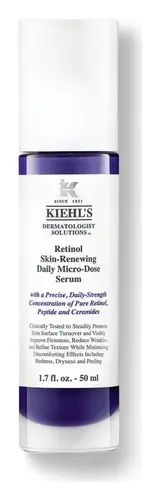
Guerlain Abeille Royale Advanced Youth Watery Oil Versus Kiehl's Retinol Skin-Renewing Daily Micro-Dose Serum
This anti-aging oil is formulated around Royal Jelly and Adenosine to soften the look of wrinkles.
This anti-aging serum is formulated around Retinol and Niacinamide to soften the look of wrinkles and refine skin texture.


What's inside
What's inside
 Key Ingredients
Benefits
Concerns
Ingredients Side-by-side
Water
Skin ConditioningGlycerin
Humectant


Polyglycerin-3
Humectant
1,2-Hexanediol
Skin Conditioning
Alcohol
Antimicrobial




Polysorbate 20
Emulsifying
Pentylene Glycol
Skin Conditioning
Mel
EmollientRoyal Jelly

Mannitol
Humectant
Cellulose
Absorbent
Chlorphenesin
Antimicrobial
Parfum
Masking

Polyacrylate Crosspolymer-6
Emulsion StabilisingPropanediol
Solvent
Trisodium Ethylenediamine Disuccinate
ChelatingSodium Citrate
BufferingCitric Acid
Buffering

Biosaccharide Gum-2
Skin ConditioningTocopheryl Acetate
Antioxidant

Maltodextrin
Absorbent
Adenosine
Skin Conditioning
Caprylic/Capric Triglyceride
Masking
Acrylates/Ammonium Methacrylate Copolymer
Synthetic Fluorphlogopite
Triethyl Citrate
Masking
CI 77891
Cosmetic ColorantSodium Benzoate
Masking
Biosaccharide Gum-1
Humectant
Sodium Metabisulfite
Antioxidant
CI 77492
Cosmetic ColorantPotassium Sorbate
Preservative
CI 77491
Cosmetic ColorantHydroxypropyl Methylcellulose
Emulsion StabilisingTin Oxide
Abrasive
Water, Glycerin, Polyglycerin-3, 1,2-Hexanediol, Alcohol, Polysorbate 20, Pentylene Glycol, Mel, Royal Jelly, Mannitol, Cellulose, Chlorphenesin, Parfum, Polyacrylate Crosspolymer-6, Propanediol, Trisodium Ethylenediamine Disuccinate, Sodium Citrate, Citric Acid, Biosaccharide Gum-2, Tocopheryl Acetate, Maltodextrin, Adenosine, Caprylic/Capric Triglyceride, Acrylates/Ammonium Methacrylate Copolymer, Synthetic Fluorphlogopite, Triethyl Citrate, CI 77891, Sodium Benzoate, Biosaccharide Gum-1, Sodium Metabisulfite, CI 77492, Potassium Sorbate, CI 77491, Hydroxypropyl Methylcellulose, Tin Oxide
Water
Skin ConditioningGlycerin
Humectant
Butylene Glycol
Humectant
Pentylene Glycol
Skin Conditioning
Niacinamide
Smoothing





Cetyl Alcohol
Emollient
Isohexadecane
EmollientIsononyl Isononanoate
EmollientDiisopropyl Sebacate
Emollient2-Oleamido-1,3-Octadecanediol
Skin Conditioning4-T-Butylcyclohexanol
Masking
Acetyl Dipeptide-1 Cetyl Ester
Skin Conditioning
Adenosine
Skin Conditioning
Ceramide NP
Skin Conditioning
Hydroxypalmitoyl Sphinganine
Skin Conditioning
Lauroyl Lysine
Skin Conditioning
Octyldodecanol
Emollient
Pentaerythrityl Tetra-Di-T-Butyl Hydroxyhydrocinnamate
Antioxidant
Sodium Chloride
MaskingSodium Hyaluronate
Humectant
Sodium Hydroxide
BufferingTrisodium Ethylenediamine Disuccinate
ChelatingRetinol
Skin Conditioning
Tocopherol
Antioxidant
Dicaprylyl Ether
Emollient
Ammonium Polyacryloyldimethyl Taurate
Emulsion StabilisingBehenyl Alcohol
Emollient
Caprylyl Glycol
Emollient
Carbomer
Emulsion StabilisingCetearyl Alcohol
Emollient

Cetearyl Glucoside
Emulsifying
Glycine Soja Oil
Emollient
Helianthus Annuus Seed Oil
Emollient
Hydroxyethylcellulose
Emulsion StabilisingLecithin
Emollient
Phenethyl Alcohol
MaskingPoloxamer 188
EmulsifyingPolycaprolactone
StabilisingSorbitan Laurate
Emulsifying
Steareth-100
Gel FormingCI 40800
Cosmetic ColorantChlorphenesin
Antimicrobial
Phenoxyethanol
Preservative
Water, Glycerin, Butylene Glycol, Pentylene Glycol, Niacinamide, Cetyl Alcohol, Isohexadecane, Isononyl Isononanoate, Diisopropyl Sebacate, 2-Oleamido-1,3-Octadecanediol, 4-T-Butylcyclohexanol, Acetyl Dipeptide-1 Cetyl Ester, Adenosine, Ceramide NP, Hydroxypalmitoyl Sphinganine, Lauroyl Lysine, Octyldodecanol, Pentaerythrityl Tetra-Di-T-Butyl Hydroxyhydrocinnamate, Sodium Chloride, Sodium Hyaluronate, Sodium Hydroxide, Trisodium Ethylenediamine Disuccinate, Retinol, Tocopherol, Dicaprylyl Ether, Ammonium Polyacryloyldimethyl Taurate, Behenyl Alcohol, Caprylyl Glycol, Carbomer, Cetearyl Alcohol, Cetearyl Glucoside, Glycine Soja Oil, Helianthus Annuus Seed Oil, Hydroxyethylcellulose, Lecithin, Phenethyl Alcohol, Poloxamer 188, Polycaprolactone, Sorbitan Laurate, Steareth-100, CI 40800, Chlorphenesin, Phenoxyethanol
Reviews
Ingredients Explained
These ingredients are found in both products.
Ingredients higher up in an ingredient list are typically present in a larger amount.
Adenosine is a purine nucleoside that your body already makes in every cell. In skincare, it acts mainly as a skin conditioning and anti-aging agent.
The way it works is fairly well mapped out:
Your skin has cells called fibroblasts that build collagen (the stuff that keeps skin firm and smooth). Adenosine basically flips a switch on these cells that tells them to get to work making more collagen and other proteins. These cells slow down on their own as skin ages, so Adenosine helps give them a little nudge to keep going.
The clinical backing is pretty solid too.
A blind, randomized, placebo-controlled trial of 126 women aged 45-65 tested a 0.1% cream twice daily and found real improvements in crow's feet and frown lines using a precise 3D skin-mapping technique; these changes showed up by week 3 and held at 2 months.
A later study using Adenosine-loaded dissolving microneedle patches reported gains in wrinkle depth, dermal density, elasticity, and hydration.
On concentrations, South Korea's Ministry of Food and Drug Safety has set 0.04% as the approved functional anti-wrinkle level. You'll typically see this ingredient used somewhere in the 0.04-0.1% range since it works at low doses.
This ingredient has been found safe for cosmetics with the data showing no irritation or sensitization.
Overall, this is a great ingredient for any anti-aging routine and has no photosensitizing effect, so it suits both AM and PM use.
Learn more about AdenosineChlorphenesin is a synthetic preservative. It helps protect a product against bacteria in order to extend shelf life. In most cases, Chlorphenesin is paired with other preservatives such as phenoxyethanol and caprylyl glycol.
Chlorphenesin is a biocide. This means it is able to help fight the microorganisms on our skin. It is also able to fight odor-releasing bacteria.
Chlorphenesin is soluble in both water and glycerin.
Studies show Chlorphenesin is easily absorbed by our skin. You should speak with a skincare professional if you have concerns about using Chlorphenesin.
Learn more about ChlorphenesinGlycerin (or glycerol) is a compound naturally found in your skin. It's a powerhouse humectant that pulls water into the stratum corneum.
Topically, glycerin does several things at once:
Your skin makes glycerin on its own (mostly from sebaceous oil breakdown) and shuttles it to your outermost layer of skin, or your epidermis, via aquaporin-3.
Aquaporin-3 is a transporter that is essential for normal skin hydration, elasticity, and repair. Interestingly, mice lacking in AQP3 have dry and less elastic skin that can be fully corrected with glycerin.
This ingredient is non-irritating, plays well with almost every ingredient, and works across all skin types. Typical use is anywhere between 3-10% but can go up to 79% in some leave-on products.
Just know very high concentrations (>40%) can feel tacky in low humidity.
Glycerin is the name for this ingredient in American English. British English uses Glycerol/Glycerine.
Learn more about GlycerinPentylene Glycol (1,2-pentanediol) is a multitasking little diol with three main roles in a formula:
Research on alkanediols (the family pentylene glycol belongs to) show they work by disrupting microbial cell membranes. This disruption helps the primary preservative system in a product work more effectively at lower doses.
On the safety side, the Cosmetic Ingredient Review Expert Panel has concluded this ingredient to be safe as used in current cosmetic practices + concentrations.
Typical use levels in a formula run about 1-5%.
Learn more about Pentylene GlycolTrisodium Ethylenediamine Disuccinate is used to help stabilize a product.
It is a chelating agent, meaning it helps prevent metal ions from binding to other ingredients. This prevents unwanted reactions in products. Metal ions can come into a product via the water ingredient. They are found in trace amounts and are not known to be harmful.
Water. It's the most common cosmetic ingredient of all. You'll usually see it at the top of ingredient lists, meaning that it makes up the largest part of the product.
So why is it so popular? Water most often acts as a solvent - this means that it helps dissolve other ingredients into the formulation.
You'll also recognize water as that liquid we all need to stay alive. If you see this, drink a glass of water. Remember to stay hydrated!
Learn more about Water

