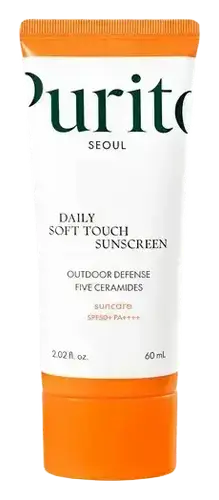
Charlotte Tilbury Invisible UV Flawless Primer Broad Spectrum SPF 50 Versus PURITO Daily Soft Touch Sunscreen SPF 50+
This chemical sunscreen covers most of the UV range, lighter on the deep UVA that drives aging.
This chemical sunscreen covers most of the UV range, lighter on the deep UVA that drives aging.


What's inside
What's inside
 Key Ingredients
Benefits
Concerns
Ingredients Side-by-side
Water
Skin ConditioningEthylhexyl Methoxycinnamate
UV Absorber


Ethylhexyl Salicylate
UV Absorber
Butylene Glycol
Humectant

Diethylhexyl Succinate
EmollientButyl Methoxydibenzoylmethane
UV Absorber
Glycerin
Humectant
Octocrylene
UV Absorber
Dextrin Palmitate
Emulsifying

Pentylene Glycol
Skin Conditioning
Hydroxyethyl Acrylate/Sodium Acryloyldimethyl Taurate Copolymer
Emulsion StabilisingPhenoxyethanol
Preservative
PEG-60 Glyceryl Isostearate
Surfactant
Marrubium Vulgare Extract
Skin ConditioningCI 77891
Cosmetic ColorantPolyglyceryl-2 Triisostearate
Emulsifying
Talc
Abrasive
Hydroxypropyl Methylcellulose Stearoxy Ether
Polysorbate 60
Emulsifying
Sorbitan Isostearate
Emulsifying
Agar
MaskingTocopherol
Antioxidant





Xanthan Gum
EmulsifyingCI 77492
Cosmetic ColorantIsopropyl Titanium Triisostearate
Emollient
Aluminum Hydroxide
EmollientSodium Hyaluronate
Humectant
CI 77491
Cosmetic ColorantKhaya Senegalensis Bark Extract
Skin ProtectingMaltodextrin
Absorbent
Citric Acid
Buffering
BHT
Antioxidant
Ascorbyl Glucoside
Antioxidant
Camellia Oleifera Seed Oil
Skin Conditioning
Butyrospermum Parkii Butter
Skin Conditioning

Rosa Canina Fruit Oil
Emollient
Sodium Hydroxide
BufferingCI 77499
Cosmetic ColorantPlumeria Alba Flower Extract
Skin ConditioningPotassium Sorbate
Preservative
Sodium Benzoate
Masking
Aloe Barbadensis Leaf Extract
Emollient
Solanum Tuberosum Pulp Extract
SmoothingAscorbyl Dipalmitate
Antioxidant
Water, Ethylhexyl Methoxycinnamate, Ethylhexyl Salicylate, Butylene Glycol, Diethylhexyl Succinate, Butyl Methoxydibenzoylmethane, Glycerin, Octocrylene, Dextrin Palmitate, Pentylene Glycol, Hydroxyethyl Acrylate/Sodium Acryloyldimethyl Taurate Copolymer, Phenoxyethanol, PEG-60 Glyceryl Isostearate, Marrubium Vulgare Extract, CI 77891, Polyglyceryl-2 Triisostearate, Talc, Hydroxypropyl Methylcellulose Stearoxy Ether, Polysorbate 60, Sorbitan Isostearate, Agar, Tocopherol, Xanthan Gum, CI 77492, Isopropyl Titanium Triisostearate, Aluminum Hydroxide, Sodium Hyaluronate, CI 77491, Khaya Senegalensis Bark Extract, Maltodextrin, Citric Acid, BHT, Ascorbyl Glucoside, Camellia Oleifera Seed Oil, Butyrospermum Parkii Butter, Rosa Canina Fruit Oil, Sodium Hydroxide, CI 77499, Plumeria Alba Flower Extract, Potassium Sorbate, Sodium Benzoate, Aloe Barbadensis Leaf Extract, Solanum Tuberosum Pulp Extract, Ascorbyl Dipalmitate
Butyl Methoxydibenzoylmethane 3%
UV Absorber
Homosalate 9%
Skin Conditioning
Ethylhexyl Salicylate 4.5%
UV Absorber
Octocrylene 5%
UV Absorber
Water
Skin ConditioningDipropylene Glycol
HumectantMethyl Methacrylate Crosspolymer

Glyceryl Polymethacrylate
Propylene Glycol
Humectant
Acrylates Copolymer
Butyloctyl Salicylate
Skin Conditioning
Ceteareth-20
CleansingEthylhexyl Methoxycrylene
Skin Conditioning
Polysorbate 60
Emulsifying
Sorbitan Stearate
Emulsifying
Caprylyl Glycol
Emollient
Cetearyl Olivate
Panthenol
Skin Conditioning
Sorbitan Olivate
Emulsifying
Acrylates/C10-30 Alkyl Acrylate Crosspolymer
Emulsion StabilisingEthylhexylglycerin
Skin ConditioningTromethamine
BufferingSodium Acrylate/Sodium Acryloyldimethyl Taurate Copolymer
Emulsion Stabilising1,2-Hexanediol
Skin Conditioning
Isohexadecane
EmollientAmmonium Acryloyldimethyltaurate/Vp Copolymer
BHT
Antioxidant
Butylene Glycol
Humectant
Polysorbate 80
Emulsifying
Trisodium Ethylenediamine Disuccinate
Sorbitan Oleate
Emulsifying
Xanthan Gum
EmulsifyingOenanthe Javanica Extract
AntimicrobialButyl Methoxydibenzoylmethane 3%, Homosalate 9%, Ethylhexyl Salicylate 4.5%, Octocrylene 5%, Water, Dipropylene Glycol, Methyl Methacrylate Crosspolymer, Glyceryl Polymethacrylate, Propylene Glycol, Acrylates Copolymer, Butyloctyl Salicylate, Ceteareth-20, Ethylhexyl Methoxycrylene, Polysorbate 60, Sorbitan Stearate, Caprylyl Glycol, Cetearyl Olivate, Panthenol, Sorbitan Olivate, Acrylates/C10-30 Alkyl Acrylate Crosspolymer, Ethylhexylglycerin, Tromethamine, Sodium Acrylate/Sodium Acryloyldimethyl Taurate Copolymer, 1,2-Hexanediol, Isohexadecane, Ammonium Acryloyldimethyltaurate/Vp Copolymer, BHT, Butylene Glycol, Polysorbate 80, Trisodium Ethylenediamine Disuccinate, Sorbitan Oleate, Xanthan Gum, Oenanthe Javanica Extract
Reviews
Ingredients Explained
These ingredients are found in both products.
Ingredients higher up in an ingredient list are typically present in a larger amount.
BHT is a synthetic antioxidant and preservative.
As an antioxidant, it helps your body fight off free-radicals. Free-radicals are molecules that may damage your skin cells.
As a preservative, it is used to stabilize products and prevent them from degrading. Specifically, BHT prevents degradation from oxidation.
The concerns related to BHT come from oral studies; this ingredient is currently allowed for use by both the FDA and EU.
However, it was recently restricted for use in the UK as of April 2024.
Learn more about BHTAlso known as Avobenzone, this ingredient is an oil-soluble used to absorb the full spectrum of UVA rays (peak 357 nm).
It's one of the most effective UVA filters available but has a major caveat of photostability: avobenzone is susceptible to photodegradation.
This means it can lose efficacy when exposed to sunlight without the help of a stabilizing agent.
Studies show antioxidants (like vitamin E or vitamin C) and some UV filters (like octocrylene and Tinosorb S) can meaningfully improve its stability in a formulation.
The maximum allowable concentration according to regulation is 3% in the US + Canada, and 5% in the EU, Australia, China, Korea, and ASEAN countries.
It has a well-support safety profile: a comprehensive 2025 review found minimal toxicity with no evidence of carcinogenicity.
Overall, avobenzone is a safe and regulated ingredient used in sunscreen for over 40 years.
Learn more about Butyl MethoxydibenzoylmethaneButylene Glycol (or BG) is used within cosmetic products for a few different reasons:
Overall, Butylene Glycol is a safe and well-rounded ingredient that works well with other ingredients.
Though this ingredient works well with most skin types, some people with sensitive skin may experience a reaction such as allergic rashes, closed comedones, or itchiness.
Learn more about Butylene GlycolEthylhexyl Salicylate (also called Octisalate or Octyl Salicylate) is an oil-soluble organic UV filter that's been used in sunscreen since the 1950's.
It absorbs UVB light in the 280-320 nm range with a peak absorbance around 306 nm.
You'll often see it paired with other UV filters to boost overall SPF because octisalate is a fairly week filter on its own.
The reason you'll see it so often is because it can help solubilize and stabilize the trickier filters like oxybenzone and avobenzone.
Unlike these filters, octisalate has pretty good photostability and doesn't create skin-damaging free radicals when exposed to sunlight.
The fatty-alcohol part of the molecule also gives it a light, emollient feel so it doubles as a nice texture enhancer.
Usage levels vary around the world:
Safety-wise, this ingredient has a pretty reassuring track record. The EU's Scientific Committee on Consumer Products (SCCP) found very low skin penetration in human skin tests and negative results for irritation, phototoxicity, and photoallergy.
The real-world allergy risk is pretty low too; a 2012 European study of 1,031 people recorded only 2 reactions to it (a rate of 0.19%).
You might have seen scary headlines about sunscreen getting into your blood.
In 2019, the FDA found that several chemical filters can absorb through the skin and show up in the bloodstream at small but measurable levels.
Here's the important part: these tiny levels are just a cutoff the FDA uses to decide which ingredients need more testing and doesn't mean anything harmful was found.
The researchers were clear that the results are no reason to stop wearing sunscreen.
Learn more about Ethylhexyl SalicylateOctocrylene is an oil-soluble organic UV filter that mainly absorbs UVB and short wave UVA II light.
Its real superpower is teamwork: octocrylene is remarkably photostable and is most famous for stabilizing avobenzone (the workhorse UVA filter).
This ingredient is commonly used to enhance both UVB and UVA protection due to its unique property in stabilizing avobenzone. It also pulls double duty by boosting water resistance and giving formulas a smooth, spreadable feel.
The EU's Scientific Committee on Consumer Safety (SCCS) has deemed octocrylene to be safe as a UV-filter at concentrations up to 10% (capped at 9% in propellant sprays). The US also permits it up to 10%.
Two things worth knowing:
You'll usually see this ingredient used in concentrations between 2-10% (higher amounts when used as a stabilizer for avobenzone).
Learn more about OctocrylenePolysorbate 60 is used to help stabilize products. It is a surfactant and emulsifier. These properties help keep ingredients together in a product. Surfactants help reduce surface tension between ingredients with different states, such as liquids and solids. Emulsifiers help prevent oils and waters from separating.
Polysorbate 60 is sorbitol-based and created from the ethoxylation of sorbitan. Ethoxylation is a chemical reaction used to add ethylene oxide. Sorbitan is a the dehydrated version of sorbitol, a sugar found in fruits.
In this case, the 60 comes from reacting 60 units of ethylene oxide with sorbitan.
Polysorbates are commonly used in medicine and foods.
Learn more about Polysorbate 60Water. It's the most common cosmetic ingredient of all. You'll usually see it at the top of ingredient lists, meaning that it makes up the largest part of the product.
So why is it so popular? Water most often acts as a solvent - this means that it helps dissolve other ingredients into the formulation.
You'll also recognize water as that liquid we all need to stay alive. If you see this, drink a glass of water. Remember to stay hydrated!
Learn more about WaterXanthan gum is used as a stabilizer and thickener within cosmetic products. It helps give products a sticky, thick feeling - preventing them from being too runny.
On the technical side of things, xanthan gum is a polysaccharide - a combination consisting of multiple sugar molecules bonded together.
Xanthan gum is a pretty common and great ingredient. It is a natural, non-toxic, non-irritating ingredient that is also commonly used in food products.
Learn more about Xanthan Gum