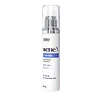
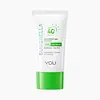
Dermax Professional Dermax Pro Acnex UV Gel Water-Based Sunscreen SPF 30+ Versus Y.O.U Sunbrella Acne Shield Light Sunscreen SPF 40+
This chemical sunscreen covers burning UVB and near UVA but not the deep UVA that drives aging.
This chemical sunscreen covers the full UV range and blocks ~98% of UVB at SPF 40.


What's inside
What's inside
 Key Ingredients
Benefits
Concerns
Ingredients Side-by-side
Aloe Barbadensis Leaf Water
MaskingEthylhexyl Methoxycinnamate
UV Absorber


Water
Skin ConditioningEthylhexyl Salicylate
UV Absorber
Bis-Ethylhexyloxyphenol Methoxyphenyl Triazine
UV Absorber
Methylene Bis-Benzotriazolyl Tetramethylbutylphenol
UV Filter
Ethylhexyl Triazone
UV Absorber
Potassium Cetyl Phosphate
EmulsifyingDiethylamino Hydroxybenzoyl Hexyl Benzoate
UV Filter
Butyloctyl Salicylate
Skin Conditioning
Propylene Glycol
Humectant


Cyclopentasiloxane
Emollient
Cetearyl Alcohol
Emollient




Butylene Glycol
Humectant
Dibutyl Adipate
EmollientSucrose Polystearate
EmollientPhenoxyethanol
Preservative
Hexylene Glycol
EmulsifyingDecyl Glucoside
Cleansing
Hydroxyacetophenone
Antioxidant
Sodium Carbomer
Emulsion StabilisingAcrylates/Beheneth-25 Methacrylate Copolymer
Microcrystalline Cellulose
Absorbent1,2-Hexanediol
Skin Conditioning
Ammonium Acryloyldimethyltaurate/Vp Copolymer
Bisabolol
Antioxidant


Allantoin
Skin Conditioning
Ethylhexylglycerin
Skin ConditioningGlyceryl Stearate
Emollient
Polyglyceryl-10 Laurate
Skin Conditioning
Polysorbate 60
Emulsifying
Sodium Laureth Sulfate
Cleansing

Menthol
Masking
Menthyl Lactate
Masking
Disodium EDTA
ChelatingOlea Europaea Oil Unsaponifiables
Skin Conditioning
Parfum
Masking

Xanthan Gum
EmulsifyingBHT
Antioxidant
Totarol
Antioxidant
Diethylhexyl Butamido Triazone
UV Absorber
Zinc PCA
Humectant



Centella Asiatica Leaf Extract
Skin Conditioning
Ectoin
Skin Conditioning
Malic Acid
Buffering



Phenylethyl Resorcinol
Antioxidant
Glycerin
Humectant
Thermus Thermophillus Ferment
Skin ConditioningPropanediol
Solvent
Caprylic/Capric Triglyceride
Masking
Mentha Piperita Leaf Extract
Skin ConditioningBuddleja Officinalis Leaf Extract
Skin ConditioningCeramide NP
Skin Conditioning
Hydrogenated Lecithin
Emulsifying
Potassium Sorbate
Preservative
Ceramide Ns
Skin Conditioning
Ceramide As
Skin Conditioning
Silica
Abrasive
Ceramide EOP
Skin Conditioning
Ceramide AP
Skin Conditioning
Aloe Barbadensis Leaf Water, Ethylhexyl Methoxycinnamate, Water, Ethylhexyl Salicylate, Bis-Ethylhexyloxyphenol Methoxyphenyl Triazine, Methylene Bis-Benzotriazolyl Tetramethylbutylphenol, Ethylhexyl Triazone, Potassium Cetyl Phosphate, Diethylamino Hydroxybenzoyl Hexyl Benzoate, Butyloctyl Salicylate, Propylene Glycol, Cyclopentasiloxane, Cetearyl Alcohol, Butylene Glycol, Dibutyl Adipate, Sucrose Polystearate, Phenoxyethanol, Hexylene Glycol, Decyl Glucoside, Hydroxyacetophenone, Sodium Carbomer, Acrylates/Beheneth-25 Methacrylate Copolymer, Microcrystalline Cellulose, 1,2-Hexanediol, Ammonium Acryloyldimethyltaurate/Vp Copolymer, Bisabolol, Allantoin, Ethylhexylglycerin, Glyceryl Stearate, Polyglyceryl-10 Laurate, Polysorbate 60, Sodium Laureth Sulfate, Menthol, Menthyl Lactate, Disodium EDTA, Olea Europaea Oil Unsaponifiables, Parfum, Xanthan Gum, BHT, Totarol, Diethylhexyl Butamido Triazone, Zinc PCA, Centella Asiatica Leaf Extract, Ectoin, Malic Acid, Phenylethyl Resorcinol, Glycerin, Thermus Thermophillus Ferment, Propanediol, Caprylic/Capric Triglyceride, Mentha Piperita Leaf Extract, Buddleja Officinalis Leaf Extract, Ceramide NP, Hydrogenated Lecithin, Potassium Sorbate, Ceramide Ns, Ceramide As, Silica, Ceramide EOP, Ceramide AP
Reviews
Ingredients Explained
These ingredients are found in both products.
Ingredients higher up in an ingredient list are typically present in a larger amount.
Cyclopentasiloxane (D5) is a lightweight silicone that mostly acts as an emollient and solvent in cosmetics. Its the reason your products feel silky, fast-spreading, and non-greasy.
Since D5 is volatile, it does its thing and then evaporates off the skin quickly.
The safety profile of this ingredient is reassuring; the US CIR Expert Panel concluded D5 is safe as used in cosmetics and Health Canada concluded that D5 is not harmful to human health or the environment as currently used in cosmetics
There's a study that people mention about D5 in a rat study showing tumors. This study is related to long-term inhalation of high D5 levels.
Regulatory bodies have judged this study to be not applicable in topical skincare since skin absorption of D5 is very low and we're not really inhaling huge amounts of D5.
The only restriction for this ingredient is environmental. The European Chemicals Agency (ECHA) restricted D5 in wash-off cosmetics at or above 0.1% due to their persistence in water.
Learn more about CyclopentasiloxanePhenoxyethanol is one of the most widely used preservatives in skincare (and for good reason!).
It has a large spectrum of antimicrobial activity and especially effective bacteria, yeast, and mold while only having a weak effect on your skin's natural microbiome.
On a cellular level, it disrupts the cell membranes of microbes by poking holes that make the cell leak. This shuts down the chemical reactions the microbe needs to make energy so it can no longer survive.
Another perk of this ingredient is that it stays functional across a wide pH range (3-10).
You'll often see it paired with boosters like Ethylhexylglycerin; one study showed that a 1:9 ratio of Ethylhexylglycerin to Phenoxyethanol damages bacterial membranes as effectively as doubling the Phenoxyethanol concentration on its own.
Typical use concentrations range from 0.3-1% depending on the formula, and this ingredient is capped at 1% int the EU.
Safety-wise, the fear mongering does not hold up to the evidence. The EU's Scientific Committee on Consumer Safety and FDA consider it safe as a preservative at up to 1%, including for children of all ages.
Adverse systemic effects only showed up in animal studies at exposures roughly 200x higher than what people get from cosmetics. And despite its very widespread use, this ingredient is a rare sensitizer and allergic reactions are uncommon.
Learn more about PhenoxyethanolPropanediol is an all-star ingredient. It softens, hydrates, and smooths the skin.
It’s often used to:
Propanediol is not likely to cause sensitivity and considered safe to use. It is derived from corn or petroleum with a clear color and no scent.
Learn more about PropanediolPropylene Glycol is a synthetic, colorless, odorless liquid that has been a staple in cosmetics for decades. It is a skin conditioning agent, humectant, and solvent.
As a humectant, it draw water to the skin to reduce flaking and restore suppleness. It's also a solvent that helps dissolve other actives and keeps formulas stable across temperature changes.
The CIR Expert Panel has confirmed this ingredient to be nontoxic and clinical studies show no sensitization at cosmetic use concentrations.
True allergic reactions are quite rare: a 15-year retrospective study of 6,751 patients found only 0.31% had a positive reaction (and less than half were considered clinically relevant).
It seemed that when sensitization does occur, it's most commonly linked to topical medication (like corticosteroids) and not cosmetics. Allergic contact dermatitis also appears largely limited to individuals with underlying skin conditions.
Overall, propylene glycol is a well-studied ingredient that most people can tolerate without issue.
Learn more about Propylene GlycolWater. It's the most common cosmetic ingredient of all. You'll usually see it at the top of ingredient lists, meaning that it makes up the largest part of the product.
So why is it so popular? Water most often acts as a solvent - this means that it helps dissolve other ingredients into the formulation.
You'll also recognize water as that liquid we all need to stay alive. If you see this, drink a glass of water. Remember to stay hydrated!
Learn more about Water

