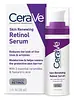
This anti-aging serum is formulated around Ceramide NP and Niacinamide to soften the look of wrinkles and refine skin texture.


What's inside
What's inside
 Key Ingredients
Benefits
Concerns
Ingredients Side-by-side
Water
Skin ConditioningGlycerin
Humectant


Caprylic/Capric Triglyceride
Masking
Potassium Cetyl Phosphate
EmulsifyingHydrogenated Palm Glycerides
Emollient

Polysorbate 20
Emulsifying
PEG-40 Stearate
Emulsifying
Cyclopentasiloxane
Emollient
Hydroxyethylcellulose
Emulsion StabilisingPotassium Phosphate
BufferingCeramide NP
Skin Conditioning



Ceramide AP
Skin Conditioning
Ceramide EOP
Skin Conditioning
Carbomer
Emulsion StabilisingNiacinamide
Smoothing






Isoceteth-10
EmulsifyingDimethicone/Vinyl Dimethicone Crosspolymer
Skin Conditioning
Triethanolamine
BufferingCetearyl Alcohol
Emollient



Behentrimonium Methosulfate
SurfactantCichorium Intybus Root Extract
MaskingLecithin
Emollient
Retinol
Skin Conditioning

Silica
Abrasive
Sodium Lauroyl Lactylate
EmulsifyingCholesterol
Emollient
Phenoxyethanol
Preservative
Tocopherol
Antioxidant

Alcohol
Antimicrobial

Hydroxyacetophenone
Antioxidant
Citric Acid
Buffering
Hydrolyzed Hyaluronic Acid
Humectant
Pentylene Glycol
Skin Conditioning
Xanthan Gum
EmulsifyingPhytosphingosine
Skin Conditioning
Butyrospermum Parkii Butter
Skin Conditioning
Ethylhexylglycerin
Skin ConditioningWater, Glycerin, Caprylic/Capric Triglyceride, Potassium Cetyl Phosphate, Hydrogenated Palm Glycerides, Polysorbate 20, PEG-40 Stearate, Cyclopentasiloxane, Hydroxyethylcellulose, Potassium Phosphate, Ceramide NP, Ceramide AP, Ceramide EOP, Carbomer, Niacinamide, Isoceteth-10, Dimethicone/Vinyl Dimethicone Crosspolymer, Triethanolamine, Cetearyl Alcohol, Behentrimonium Methosulfate, Cichorium Intybus Root Extract, Lecithin, Retinol, Silica, Sodium Lauroyl Lactylate, Cholesterol, Phenoxyethanol, Tocopherol, Alcohol, Hydroxyacetophenone, Citric Acid, Hydrolyzed Hyaluronic Acid, Pentylene Glycol, Xanthan Gum, Phytosphingosine, Butyrospermum Parkii Butter, Ethylhexylglycerin
Water
Skin ConditioningUrea
Buffering
Isopropyl Myristate
Emollient
Paraffinum Liquidum
Emollient
Glyceryl Stearate
Emollient
PEG-40 Stearate
Emulsifying
Sorbitol
Humectant
Cetearyl Ethylhexanoate
Emollient
Cetyl Alcohol
Emollient
Dimethicone
Emollient
Glycine
Buffering
Phenoxyethanol
Preservative
Persea Gratissima Oil
Skin Conditioning
Carbomer
Emulsion StabilisingAllantoin
Skin Conditioning
Palmitic Acid
Emollient
Stearic Acid
Cleansing
Acrylates/C10-30 Alkyl Acrylate Crosspolymer
Emulsion StabilisingDisodium EDTA
ChelatingEthylhexylglycerin
Skin ConditioningParfum
Masking

Sodium Hydroxide
BufferingLimonene
Perfuming
Hexyl Cinnamal
Perfuming
Lactic Acid
Buffering
Alpha-Isomethyl Ionone
Perfuming
Linalool
Perfuming
Benzyl Salicylate
Perfuming
Eugenol
Perfuming
Citral
Perfuming
Hydroxycitronellal
Perfuming
Coumarin
Perfuming
Water, Urea, Isopropyl Myristate, Paraffinum Liquidum, Glyceryl Stearate, PEG-40 Stearate, Sorbitol, Cetearyl Ethylhexanoate, Cetyl Alcohol, Dimethicone, Glycine, Phenoxyethanol, Persea Gratissima Oil, Carbomer, Allantoin, Palmitic Acid, Stearic Acid, Acrylates/C10-30 Alkyl Acrylate Crosspolymer, Disodium EDTA, Ethylhexylglycerin, Parfum, Sodium Hydroxide, Limonene, Hexyl Cinnamal, Lactic Acid, Alpha-Isomethyl Ionone, Linalool, Benzyl Salicylate, Eugenol, Citral, Hydroxycitronellal, Coumarin
Reviews
Ingredients Explained
These ingredients are found in both products.
Ingredients higher up in an ingredient list are typically present in a larger amount.
Carbomer is a synthetic thickening and gelling agent. It's basically the ingredient that gives a lot of serums, gels, creams, and sunscreens their smooth, non-sticky texture.
Although legally permitted at very high levels, carbomers are normally used at concentrations below 1%.
It also needs to be neutralized to actually thicken, and because it is a large molecule, it doesn't really penetrate the skin barrier.
Allergy-wise, the risk is very low. Clinical studies show carbomers have low potential for skin irritation/sensitization even at concentrations up to 100%.
A 2024 UK study patch-tested 1,302 patients and found true allergy to the parent group of carbomer to be rare with no confirmed relevant reactions.
Learn more about CarbomerEthylhexylglycerin is created from glycerin. It is a multitasker ingredient that:
The CIR Expert Panel found minimal skin absorption or sensitization of any kind in a safety assessment. Though this ingredient is considered well-tolerated, a small number of cases of allergic dermatitis have been published since 2002. Just be sure to patch test if you are unsure.
Industry-reported use ranges from 8% in rinse-off products and 2% in leave-on formulations.
Learn more about EthylhexylglycerinPEG-40 Stearate is a nonionic emulsifier and surfactant made from stearic acid.
It's water-soluble and good at coaxing oil + water to mix to keep everything stable.
The CIR Expert Panel has repeatedly concluded this ingredient to be safe at current cosmetic use levels with minimal skin/eye irritation when tested at 100%.
Your skincare also won't be containing 100% of this ingredient: the supplier recommends using 1-5% in a formula.
Broader reviews back this up: PEGs and their fatty-acid esters produce little or no skin/eye irritation, don't readily penetract intact skin, and rarely cause sensitization.
Because this ingredient is a PEG ester of stearic acid, it may not be fungal acne, or Malassezia, safe. Stearic acid (C18) sits in the C11-24 "edible window" that Malassezia lipases can cleave and metabolize.
Learn more about PEG-40 StearatePhenoxyethanol is one of the most widely used preservatives in skincare (and for good reason!).
It has a large spectrum of antimicrobial activity and especially effective bacteria, yeast, and mold while only having a weak effect on your skin's natural microbiome.
On a cellular level, it disrupts the cell membranes of microbes by poking holes that make the cell leak. This shuts down the chemical reactions the microbe needs to make energy so it can no longer survive.
Another perk of this ingredient is that it stays functional across a wide pH range (3-10).
You'll often see it paired with boosters like Ethylhexylglycerin; one study showed that a 1:9 ratio of Ethylhexylglycerin to Phenoxyethanol damages bacterial membranes as effectively as doubling the Phenoxyethanol concentration on its own.
Typical use concentrations range from 0.3-1% depending on the formula, and this ingredient is capped at 1% int the EU.
Safety-wise, the fear mongering does not hold up to the evidence. The EU's Scientific Committee on Consumer Safety and FDA consider it safe as a preservative at up to 1%, including for children of all ages.
Adverse systemic effects only showed up in animal studies at exposures roughly 200x higher than what people get from cosmetics. And despite its very widespread use, this ingredient is a rare sensitizer and allergic reactions are uncommon.
Learn more about PhenoxyethanolWater. It's the most common cosmetic ingredient of all. You'll usually see it at the top of ingredient lists, meaning that it makes up the largest part of the product.
So why is it so popular? Water most often acts as a solvent - this means that it helps dissolve other ingredients into the formulation.
You'll also recognize water as that liquid we all need to stay alive. If you see this, drink a glass of water. Remember to stay hydrated!
Learn more about Water

