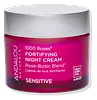
This calming night moisturizer is formulated around Aloe Barbadensis Leaf Juice and Rosa Damascena Flower Water to calm redness and hydrate skin.
This calming moisturizer is formulated around Aloe Barbadensis Leaf Juice and Sodium Hyaluronate to calm redness and hydrate skin.


What's inside
What's inside
 Key Ingredients
Benefits
Concerns
No concerns
Ingredients Side-by-side
Aloe Barbadensis Leaf Juice
Skin Conditioning


Water
Skin ConditioningCoco-Caprylate
Emollient
Myristyl Myristate
Emollient




Cetearyl Olivate
Sorbitan Olivate
Emulsifying
Glycerin
Humectant

Cetyl Palmitate
Emollient
Rosa Damascena Flower Water
Masking
Lactococcus Ferment Lysate
Skin Conditioning
Rosa Centifolia Flower Extract
Astringent
Rhododendron Ferrugineum Leaf Cell Culture Extract
Skin ConditioningMalus Domestica Fruit Cell Culture Extract
Skin ConditioningVitis Vinifera Fruit Cell Extract
Skin ConditioningAronia Melanocarpa Fruit Extract
Skin ConditioningEuterpe Oleracea Fruit Extract
Lycium Barbarum Fruit Extract
Astringent
Camellia Sinensis Extract
Antioxidant

Hydrolyzed Sodium Hyaluronate
Skin Conditioning
Ascorbyl Tetraisopalmitate
Antioxidant

Bisabolol
Antioxidant
Hydrolyzed Rice Protein
Skin ConditioningButyrospermum Parkii Butter
Skin Conditioning
Rosa Canina Fruit Oil
Emollient
Punica Granatum Seed Oil
Emollient
Gardenia Taitensis Flower Extract
Skin ConditioningSqualane
Emollient
Allantoin
Skin Conditioning
Punica Granatum Fruit Extract
Antioxidant
Panthenol
Skin Conditioning
Sorbitan Palmitate
Emulsifying
Tocopherol
Antioxidant

Helianthus Annuus Seed Oil
Emollient
Lecithin
Emollient
Isomalt
HumectantPalmitic Acid
Emollient
Butylene Glycol
Humectant
Xanthan Gum
EmulsifyingPotassium Sorbate
Preservative
Sodium Benzoate
Masking
Benzyl Alcohol
Perfuming



Dehydroacetic Acid
Preservative
Citric Acid
Buffering
Lactic Acid
Buffering

Sodium Chloride
MaskingMica
Cosmetic ColorantTitanium Dioxide
Cosmetic Colorant

Parfum
Masking
Pelargonium Graveolens Flower Oil
Masking
Geraniol
Perfuming
Linalool
Perfuming
Limonene
Perfuming
Citronellol
Perfuming
Aloe Barbadensis Leaf Juice, Water, Coco-Caprylate, Myristyl Myristate, Cetearyl Olivate, Sorbitan Olivate, Glycerin, Cetyl Palmitate, Rosa Damascena Flower Water, Lactococcus Ferment Lysate, Rosa Centifolia Flower Extract, Rhododendron Ferrugineum Leaf Cell Culture Extract, Malus Domestica Fruit Cell Culture Extract, Vitis Vinifera Fruit Cell Extract, Aronia Melanocarpa Fruit Extract, Euterpe Oleracea Fruit Extract, Lycium Barbarum Fruit Extract, Camellia Sinensis Extract, Hydrolyzed Sodium Hyaluronate, Ascorbyl Tetraisopalmitate, Bisabolol, Hydrolyzed Rice Protein, Butyrospermum Parkii Butter, Rosa Canina Fruit Oil, Punica Granatum Seed Oil, Gardenia Taitensis Flower Extract, Squalane, Allantoin, Punica Granatum Fruit Extract, Panthenol, Sorbitan Palmitate, Tocopherol, Helianthus Annuus Seed Oil, Lecithin, Isomalt, Palmitic Acid, Butylene Glycol, Xanthan Gum, Potassium Sorbate, Sodium Benzoate, Benzyl Alcohol, Dehydroacetic Acid, Citric Acid, Lactic Acid, Sodium Chloride, Mica, Titanium Dioxide, Parfum, Pelargonium Graveolens Flower Oil, Geraniol, Linalool, Limonene, Citronellol
Water
Skin ConditioningGlycerin
Humectant
Butylene Glycol
Humectant
Betaine
Humectant
Methylpropanediol
SolventSodium PCA
Humectant
Sodium Lactate
Buffering
Aloe Barbadensis Leaf Juice
Skin Conditioning
Sodium Hyaluronate
Humectant
Caprylyl Glycol
Emollient
Potassium Sorbate
Preservative
Barosma Betulina Leaf Extract
Perfuming
Phenylpropanol
Masking
Citric Acid
Buffering
Arctostaphylos Uva Ursi Leaf Extract
Skin Conditioning
Reviews
Ingredients Explained
These ingredients are found in both products.
Ingredients higher up in an ingredient list are typically present in a larger amount.
Aloe Barbadensis Leaf Juice is the filtered, stabilized liquid pressed from the inner gel of the aloe vera leaf.
In cosmetics, it shows up as either soothing active or a water-replacement base. It is roughly 98-99% water and the last 1-2% is an interesting mix of polysaccharides, amino acids, vitamins, minerals, and enzymes.
The polysaccharides do most of the work: they bind water at the skin surface for a light, non-greasy hydration boost. And one of the polysaccharides, glycomannan, is linked to fibroblast stimulation + collagen synthesis. This is also why aloe has such a long track record in wound and burn healing.
This ingredient is also calming with anti-inflammatory and mild antimicrobial activity, making it a great pick for sensitive, irritated, or post-sun skin.
Realistic expectations matter though; the solid evidence is mostly limited to hydration, soothing, and wound support. Deeper claims about anti-aging or sun protection are not well backed, and science reviews note it does not prevent radiation-induced skin injury.
Because it plays well with almost everything, it's commonly used as a base alongside other actives like niacinamide or vitamin C.
Typical usage concentrations range from 0.5% (where hydration benefits already show up) all the way to 90%+ (where it replaces water as the main base).
The safety for this ingredient is well-establish as well. Overall, this is a great supporting ingredient for those who want a boost in hydration.
Learn more about Aloe Barbadensis Leaf JuiceButylene Glycol (or BG) is used within cosmetic products for a few different reasons:
Overall, Butylene Glycol is a safe and well-rounded ingredient that works well with other ingredients.
Though this ingredient works well with most skin types, some people with sensitive skin may experience a reaction such as allergic rashes, closed comedones, or itchiness.
Learn more about Butylene GlycolCitric Acid is an alpha hydroxy acid (AHA) naturally found in citrus fruits like oranges, lemons, and limes.
Like other AHAs, citric acid can exfoliate skin by breaking down the bonds that hold dead skin cells together. This helps reveal smoother and brighter skin underneath.
However, this exfoliating effect only happens at high concentrations (20%) which can be hard to find in cosmetic products.
Due to this, citric acid is usually included in small amounts as a pH adjuster. This helps keep products slightly more acidic and compatible with skin's natural pH.
In skincare formulas, citric acid can:
While it can provide some skin benefits, research shows lactic acid and glycolic acid are generally more effective and less irritating exfoliants.
Most citric acid used in skincare today is made by fermenting sugars (usually from molasses). This synthetic version is identical to the natural citrus form but easier to stabilize and use in formulations.
Rosacea skin has a lower threshold for acids generally, with 62.5% of rosacea subjects in one study reacting to lactic acid in a sting test. This is why we mark citric acid as a potential rosacea trigger.
However, this ingredient shows up as a pH adjuster or chelator at roughly 0.1-1% in many products. These low levels are unlikely to be an issue for rosacea skin and becomes a potential trigger at exfoliating concentrations (20%). Because everybody's skin is unique, we recommend a patch test if you are unsure.
Learn more about Citric AcidGlycerin (or glycerol) is a compound naturally found in your skin. It's a powerhouse humectant that pulls water into the stratum corneum.
Topically, glycerin does several things at once:
Your skin makes glycerin on its own (mostly from sebaceous oil breakdown) and shuttles it to your outermost layer of skin, or your epidermis, via aquaporin-3.
Aquaporin-3 is a transporter that is essential for normal skin hydration, elasticity, and repair. Interestingly, mice lacking in AQP3 have dry and less elastic skin that can be fully corrected with glycerin.
This ingredient is non-irritating, plays well with almost every ingredient, and works across all skin types. Typical use is anywhere between 3-10% but can go up to 79% in some leave-on products.
Just know very high concentrations (>40%) can feel tacky in low humidity.
Glycerin is the name for this ingredient in American English. British English uses Glycerol/Glycerine.
Learn more about GlycerinPotassium Sorbate is a preservative used to prevent yeast and mold in products. It is commonly found in both cosmetic and food products.
This ingredient comes from potassium salt derived from sorbic acid. Sorbic acid is a natural antibiotic and effective against fungus.
Both potassium sorbate and sorbic acid can be found in baked goods, cheeses, dried meats, dried fruit, ice cream, pickles, wine, yogurt, and more.
You'll often find this ingredient used with other preservatives.
Learn more about Potassium SorbateWater. It's the most common cosmetic ingredient of all. You'll usually see it at the top of ingredient lists, meaning that it makes up the largest part of the product.
So why is it so popular? Water most often acts as a solvent - this means that it helps dissolve other ingredients into the formulation.
You'll also recognize water as that liquid we all need to stay alive. If you see this, drink a glass of water. Remember to stay hydrated!
Learn more about Water


