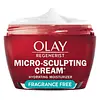
Olay Regenerist Micro-Sculpting Cream Moisturizer Fragrance Free Versus iNNBEAUTY PROJECT Extreme Cream Firming & Lifting Moisturizer
This anti-aging moisturizer is formulated around Niacinamide and Palmitoyl Pentapeptide-4 to soften the look of wrinkles and refine skin texture.
This anti-aging moisturizer is formulated around Squalane and Nicotiana Benthamiana Hexapeptide-40 Sh-Polypeptide-76 to soften the look of wrinkles and strengthen the skin barrier.

What's inside
What's inside
 Key Ingredients
Benefits
Concerns
Ingredients Side-by-side
Water
Skin ConditioningGlycerin
Humectant


Isohexadecane
EmollientNiacinamide
Smoothing









Distarch Phosphate
AbsorbentIsopropyl Isostearate
Emollient




Dimethicone
Emollient
Panthenol
Skin Conditioning
Palmitoyl Pentapeptide-4
Skin Conditioning
Sodium Hyaluronate
Humectant
Caprylic/Capric Triglyceride
Masking
Ethylhexylglycerin
Skin ConditioningHydroxyacetophenone
Antioxidant
Dimethiconol
Emollient
Cetearyl Glucoside
Emulsifying
Cetearyl Alcohol
Emollient
Stearic Acid
Cleansing
Palmitic Acid
Emollient
Stearyl Alcohol
Emollient
Cetyl Alcohol
Emollient
Behenyl Alcohol
Emollient
Disodium EDTA
ChelatingSodium Acrylates Copolymer
PEG-100 Stearate
Surfactant
Titanium Dioxide
Cosmetic Colorant

Mica
Cosmetic ColorantPhenoxyethanol
Preservative
Water, Glycerin, Isohexadecane, Niacinamide, Distarch Phosphate, Isopropyl Isostearate, Dimethicone, Panthenol, Palmitoyl Pentapeptide-4, Sodium Hyaluronate, Caprylic/Capric Triglyceride, Ethylhexylglycerin, Hydroxyacetophenone, Dimethiconol, Cetearyl Glucoside, Cetearyl Alcohol, Stearic Acid, Palmitic Acid, Stearyl Alcohol, Cetyl Alcohol, Behenyl Alcohol, Disodium EDTA, Sodium Acrylates Copolymer, PEG-100 Stearate, Titanium Dioxide, Mica, Phenoxyethanol
Water
Skin ConditioningC13-15 Alkane
SolventSqualane
Emollient
Propanediol
Solvent
Polyglyceryl-5 Polyricinoleate
Emulsifying
Bisabolol
Antioxidant
Coco-Caprylate/Caprate
Emollient
Glycerin
Humectant
Magnesium Sulfate
Panthenol
Skin Conditioning
Glyceryl Behenate
Emollient
1,2-Hexanediol
Skin Conditioning
Butylene Glycol
Humectant
Heptapeptide-7
Skin Conditioning
Acetyl Sh-Hexapeptide-5 Amide Acetate
Skin Conditioning
Nicotiana Benthamiana Hexapeptide-40 Sh-Polypeptide-76
Skin Conditioning
Ceramide AP
Skin Conditioning
Ceramide EOP
Skin Conditioning
Ceramide NP
Skin Conditioning
Tremella Fuciformis Extract
Humectant
Allantoin
Skin Conditioning
Oryza Sativa Bran Oil
Emollient
Arginine
Masking
Glycosphingolipids
EmollientPhytosphingosine
Skin Conditioning
Cholesterol
Emollient
Tetraacetylphytosphingosine
Skin ConditioningPolyglyceryl-6 Octastearate
EmulsifyingStearic Acid
Cleansing
Cetearyl Alcohol
Emollient
Glyceryl Glucoside
Humectant
Glyceryl Stearate
Emollient
Hydrogenated Polydecene
EmollientHydrogenated Lecithin
Emulsifying
Lecithin
Emollient
Xanthan Gum
EmulsifyingTocopherol
Antioxidant
Carnosine
Skin Conditioning
Potassium Sorbate
Preservative
Sodium Benzoate
Masking
Phenoxyethanol
Preservative
Citric Acid
Buffering
Quaternium-90 Bentonite
Mica
Cosmetic ColorantTriethyl Citrate
Masking

Zinc Stearate
Cosmetic ColorantEthylhexylglycerin
Skin ConditioningGluconolactone
Chelating
Calcium Gluconate
HumectantHydroxyacetophenone
Antioxidant
Water, C13-15 Alkane, Squalane, Propanediol, Polyglyceryl-5 Polyricinoleate, Bisabolol, Coco-Caprylate/Caprate, Glycerin, Magnesium Sulfate, Panthenol, Glyceryl Behenate, 1,2-Hexanediol, Butylene Glycol, Heptapeptide-7, Acetyl Sh-Hexapeptide-5 Amide Acetate, Nicotiana Benthamiana Hexapeptide-40 Sh-Polypeptide-76, Ceramide AP, Ceramide EOP, Ceramide NP, Tremella Fuciformis Extract, Allantoin, Oryza Sativa Bran Oil, Arginine, Glycosphingolipids, Phytosphingosine, Cholesterol, Tetraacetylphytosphingosine, Polyglyceryl-6 Octastearate, Stearic Acid, Cetearyl Alcohol, Glyceryl Glucoside, Glyceryl Stearate, Hydrogenated Polydecene, Hydrogenated Lecithin, Lecithin, Xanthan Gum, Tocopherol, Carnosine, Potassium Sorbate, Sodium Benzoate, Phenoxyethanol, Citric Acid, Quaternium-90 Bentonite, Mica, Triethyl Citrate, Zinc Stearate, Ethylhexylglycerin, Gluconolactone, Calcium Gluconate, Hydroxyacetophenone
Reviews
Ingredients Explained
These ingredients are found in both products.
Ingredients higher up in an ingredient list are typically present in a larger amount.
Cetearyl alcohol is a waxy mixture of two fatty alcohols: cetyl alcohol and stearyl alcohol. It is an emollient and emulsifier.
Despite having "alcohol" in its name, it has nothing to do with drying solvent alcohols; the FDA also allows "alcohol-free" products to contain fatty alcohols like this ingredient.
It plays several roles in a formula:
Typical use levels for this ingredient sit around 1-10% and the Cosmetic Ingredient Review Expert Panel has affirmed safety at concentrations up to 25% in leave-on products.
Multiple assessments have found it to be non-irritating and non-sensitizing to most people.
However, there have been some cases of allergic contact dermatitis in patients with chronically compromised skin barriers.
Cetearyl alcohol has a comedogenic rating of 2 and irritancy rating of 1. Both of these numbers come from the 1989 study that used rabbit ears; a "2" means mildly comedogenic and a "1" means low irritancy.
Here's the catch: rabbit skin is more sensitive than human skin and throws a lot of false positives. A 1996 reappraisal found that ingredients rated 1-2 in the rabbit ear tests are generally safe for humans.
Remember comedogenic ratings are unable to assess the entire formula of a product or how it will react on your skin. Just be sure to patch test if you are unsure about certain ingredients.
This ingredient is not fungal acne safe. Cetearyl alcohol is a fatty alcohol with chain lengths that fall within the range that Malassezia can metabolize.
A 2019 study has also observed Malassezia growth in the presence of this ingredient, confirming it to be not-fungal acne safe.
Learn more about Cetearyl AlcoholEthylhexylglycerin is created from glycerin. It is a multitasker ingredient that:
The CIR Expert Panel found minimal skin absorption or sensitization of any kind in a safety assessment. Though this ingredient is considered well-tolerated, a small number of cases of allergic dermatitis have been published since 2002. Just be sure to patch test if you are unsure.
Industry-reported use ranges from 8% in rinse-off products and 2% in leave-on formulations.
Learn more about EthylhexylglycerinGlycerin (or glycerol) is a compound naturally found in your skin. It's a powerhouse humectant that pulls water into the stratum corneum.
Topically, glycerin does several things at once:
Your skin makes glycerin on its own (mostly from sebaceous oil breakdown) and shuttles it to your outermost layer of skin, or your epidermis, via aquaporin-3.
Aquaporin-3 is a transporter that is essential for normal skin hydration, elasticity, and repair. Interestingly, mice lacking in AQP3 have dry and less elastic skin that can be fully corrected with glycerin.
This ingredient is non-irritating, plays well with almost every ingredient, and works across all skin types. Typical use is anywhere between 3-10% but can go up to 79% in some leave-on products.
Just know very high concentrations (>40%) can feel tacky in low humidity.
Glycerin is the name for this ingredient in American English. British English uses Glycerol/Glycerine.
Learn more about GlycerinHydroxyacetophenone is a small phenolic molecule that earns its place in a formulas as an antioxidant and preservative booster.
As a phenol, it is able to neutralize free radicals to protect both the product and the skin from oxidative stress.
Though it can't kill microbes on its own, it works as a good supporting agent when combined with other preservatives like Phenoxyethanol or 1,2-Hexanediol.
This ingredient naturally occurs as piceol in Norwegian spruce needles (~0.4-1.1% dry weight and in cloudberries). Though the cosmetic-grade material is synthesized for purity and consistency.
You'll usually see it used at low levels and suppliers recommend up to 1% added to a water phase.
Safety testing was done at concentrations like 0.05% in SPF products and 0.5% in a Human Repeated Insult Patch Test. The safety evidence is assuring; this ingredient is safe for cosmetics in current use and also holds safety status as a food flavoring as well.
An honest caveat: the "soothing" and "anti-inflammatory" claims come mostly from supplier marketing rather than published clinical trials. The Cosmetic Ingredient Review's own literature search found no useful efficacy studies on this ingredient.
So the antioxidant and preservative-boosting roles are the well supported ones while the calming benefit is plausible but thinly evidenced.
Overall, this is a well-tolerated, low-irritation multitasker that quietly helps a formula stay fresh and stable.
Learn more about HydroxyacetophenoneMica is a naturally occurring mineral used to add shimmer and color in cosmetics. It can also help improve the texture of a product or give it an opaque, white/silver color.
Serecite is the name for very fine but ragged grains of mica.
This ingredient is often coated with metal oxides like titanium dioxide. Trace amounts of heavy metals may be found in mica, but these metals are not harmful in our personal products.
Mica has been used since prehistoric times throughout the world. Ancient Egyptian, Indian, Greek, Roman, Aztec, and Chinese civilizations have used mica.
Learn more about MicaPanthenol is a common ingredient that helps hydrate and soothe the skin. It is found naturally in our skin and hair.
There are two forms of panthenol: D and L.
D-panthenol is also known as dexpanthenol. Most cosmetics use dexpanthenol or a mixture of D and L-panthenol.
Panthenol is famous due to its ability to go deeper into the skin's layers. Using this ingredient has numerous pros (and no cons):
Like hyaluronic acid, panthenol is a humectant. Humectants are able to bind and hold large amounts of water to keep skin hydrated.
This ingredient works well for wound healing. It works by increasing tissue in the wound and helps close open wounds.
Once oxidized, panthenol converts to pantothenic acid. Panthothenic acid is found in all living cells.
This ingredient is also referred to as pro-vitamin B5.
Learn more about PanthenolPhenoxyethanol is one of the most widely used preservatives in skincare (and for good reason!).
It has a large spectrum of antimicrobial activity and especially effective bacteria, yeast, and mold while only having a weak effect on your skin's natural microbiome.
On a cellular level, it disrupts the cell membranes of microbes by poking holes that make the cell leak. This shuts down the chemical reactions the microbe needs to make energy so it can no longer survive.
Another perk of this ingredient is that it stays functional across a wide pH range (3-10).
You'll often see it paired with boosters like Ethylhexylglycerin; one study showed that a 1:9 ratio of Ethylhexylglycerin to Phenoxyethanol damages bacterial membranes as effectively as doubling the Phenoxyethanol concentration on its own.
Typical use concentrations range from 0.3-1% depending on the formula, and this ingredient is capped at 1% int the EU.
Safety-wise, the fear mongering does not hold up to the evidence. The EU's Scientific Committee on Consumer Safety and FDA consider it safe as a preservative at up to 1%, including for children of all ages.
Adverse systemic effects only showed up in animal studies at exposures roughly 200x higher than what people get from cosmetics. And despite its very widespread use, this ingredient is a rare sensitizer and allergic reactions are uncommon.
Learn more about PhenoxyethanolStearic Acid is a fatty acid that is already found in your skin. It's one of the free fatty acids that works alongside ceramides and cholesterols to maintain your barrier.
In cosmetics, it is a multitasker:
Safety-wise, the CIR Expert Panel has concluded it to be safe in cosmetics when formulated to be non-irritating and non-sensitizing.
Free stearic acid is a C18 fatty acid that the Malassezia yeast can substrate, so this ingredient may not be fungal acne safe.
Learn more about Stearic AcidWater. It's the most common cosmetic ingredient of all. You'll usually see it at the top of ingredient lists, meaning that it makes up the largest part of the product.
So why is it so popular? Water most often acts as a solvent - this means that it helps dissolve other ingredients into the formulation.
You'll also recognize water as that liquid we all need to stay alive. If you see this, drink a glass of water. Remember to stay hydrated!
Learn more about Water

