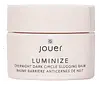
Jouer Cosmetics Luminize Overnight Dark Circle Slugging Balm Versus Dieux Skin Auracle Reviving Eye Gel
This brightening eye moisturizer is formulated around Simmondsia Chinensis Seed Oil and Rosa Canina Fruit Oil to fade the look of dark spots and hydrate skin.
This anti-aging eye moisturizer is formulated around Haematococcus Pluvialis Extract and Palmitoyl Tripeptide-1 to soften the look of wrinkles.


What's inside
What's inside
 Key Ingredients
Benefits
Concerns
Ingredients Side-by-side
Simmondsia Chinensis Seed Oil
Emollient





Helianthus Annuus Seed Oil
Emollient
Synthetic Beeswax
Emulsion Stabilising
Theobroma Cacao Seed Butter
Emollient


C18-38 Alkyl Hydroxystearoyl Stearate
EmollientStearic Acid
Cleansing
Butyrospermum Parkii Butter
Skin Conditioning
Lecithin
Emollient
Aluminum Starch Octenylsuccinate
Absorbent
Cocos Nucifera Oil
Masking

Rosa Canina Fruit Oil
Emollient
Persea Gratissima Oil
Skin Conditioning
Hydrogenated Vegetable Oil
Emollient
Prunus Amygdalus Dulcis Oil
Skin Conditioning
Jojoba Esters
Emollient
Helianthus Annuus Seed Cera
Emollient
Water
Skin ConditioningDipropylene Glycol
HumectantTetrahexyldecyl Ascorbate
Antioxidant





Caprylyl Glycol
Emollient
Coffea Arabica Seed Oil
Masking
Tocopheryl Acetate
Antioxidant
Camellia Sinensis Leaf Extract
Antimicrobial

Acacia Decurrens Flower Cera
Emollient
Polyglycerin-3
Humectant
Mannitol
Humectant
Phosphatidylcholine
EmulsifyingGlycerin
Humectant
Phytonadione Epoxide
AstringentCetyl Alcohol
Emollient
Citric Acid
Buffering
Decyl Glucoside
Cleansing
Polysorbate 80
Emulsifying
Potassium Sorbate
Preservative
Sodium Benzoate
Masking
Xanthan Gum
EmulsifyingSodium Chloride
MaskingSimmondsia Chinensis Seed Oil, Helianthus Annuus Seed Oil, Synthetic Beeswax, Theobroma Cacao Seed Butter, C18-38 Alkyl Hydroxystearoyl Stearate, Stearic Acid, Butyrospermum Parkii Butter, Lecithin, Aluminum Starch Octenylsuccinate, Cocos Nucifera Oil, Rosa Canina Fruit Oil, Persea Gratissima Oil, Hydrogenated Vegetable Oil, Prunus Amygdalus Dulcis Oil, Jojoba Esters, Helianthus Annuus Seed Cera, Water, Dipropylene Glycol, Tetrahexyldecyl Ascorbate, Caprylyl Glycol, Coffea Arabica Seed Oil, Tocopheryl Acetate, Camellia Sinensis Leaf Extract, Acacia Decurrens Flower Cera, Polyglycerin-3, Mannitol, Phosphatidylcholine, Glycerin, Phytonadione Epoxide, Cetyl Alcohol, Citric Acid, Decyl Glucoside, Polysorbate 80, Potassium Sorbate, Sodium Benzoate, Xanthan Gum, Sodium Chloride
Water
Skin ConditioningGlycerin
Humectant
Caprylic/Capric Triglyceride
Masking
Nylon-12 Fluorescent Brightener 230 Salt
Coco-Caprylate/Caprate
Emollient
Triheptanoin
Skin ConditioningMethylpropanediol
SolventPolyacrylate Crosspolymer-6
Emulsion StabilisingHydrogenated Starch Hydrolysate
HumectantPhenoxyethanol
Preservative
Caprylyl Glycol
Emollient
Sodium Polyacrylate
Absorbent
C9-12 Alkane
SolventDilinoleic Acid/Butanediol Copolymer
Haematococcus Pluvialis Extract
Antioxidant
Polyvinylalcohol Crosspolymer
Steareth-20
CleansingAsparagopsis Armata Extract
Skin Protecting
Castor Oil/Ipdi Copolymer
Chlorhexidine Digluconate
Antimicrobial
Ascophyllum Nodosum Extract
Skin Conditioning
N-Hydroxysuccinimide
Skin ConditioningPotassium Sorbate
Preservative
Citric Acid
Buffering
Chrysin
Skin ConditioningSodium Hydroxide
BufferingPalmitoyl Tripeptide-1
Skin Conditioning
Palmitoyl Tetrapeptide-7
Skin Conditioning
Water, Glycerin, Caprylic/Capric Triglyceride, Nylon-12 Fluorescent Brightener 230 Salt, Coco-Caprylate/Caprate, Triheptanoin, Methylpropanediol, Polyacrylate Crosspolymer-6, Hydrogenated Starch Hydrolysate, Phenoxyethanol, Caprylyl Glycol, Sodium Polyacrylate, C9-12 Alkane, Dilinoleic Acid/Butanediol Copolymer, Haematococcus Pluvialis Extract, Polyvinylalcohol Crosspolymer, Steareth-20, Asparagopsis Armata Extract, Castor Oil/Ipdi Copolymer, Chlorhexidine Digluconate, Ascophyllum Nodosum Extract, N-Hydroxysuccinimide, Potassium Sorbate, Citric Acid, Chrysin, Sodium Hydroxide, Palmitoyl Tripeptide-1, Palmitoyl Tetrapeptide-7
Reviews
Ingredients Explained
These ingredients are found in both products.
Ingredients higher up in an ingredient list are typically present in a larger amount.
Caprylyl Glycol is a humectant, skin conditioner, emollient, and preservative booster derived from either caprylic acid or synthetically created.
Typical use levels vary from 0.3-1% as a preservative booster and go up to 2% to condition skin.
Because it is not a free-fatty acid, this ingredient is fungal acne safe (there's nothing for Malassezia to feed on).
Learn more about Caprylyl GlycolCitric Acid is an alpha hydroxy acid (AHA) naturally found in citrus fruits like oranges, lemons, and limes.
Like other AHAs, citric acid can exfoliate skin by breaking down the bonds that hold dead skin cells together. This helps reveal smoother and brighter skin underneath.
However, this exfoliating effect only happens at high concentrations (20%) which can be hard to find in cosmetic products.
Due to this, citric acid is usually included in small amounts as a pH adjuster. This helps keep products slightly more acidic and compatible with skin's natural pH.
In skincare formulas, citric acid can:
While it can provide some skin benefits, research shows lactic acid and glycolic acid are generally more effective and less irritating exfoliants.
Most citric acid used in skincare today is made by fermenting sugars (usually from molasses). This synthetic version is identical to the natural citrus form but easier to stabilize and use in formulations.
Rosacea skin has a lower threshold for acids generally, with 62.5% of rosacea subjects in one study reacting to lactic acid in a sting test. This is why we mark citric acid as a potential rosacea trigger.
However, this ingredient shows up as a pH adjuster or chelator at roughly 0.1-1% in many products. These low levels are unlikely to be an issue for rosacea skin and becomes a potential trigger at exfoliating concentrations (20%). Because everybody's skin is unique, we recommend a patch test if you are unsure.
Learn more about Citric AcidGlycerin (or glycerol) is a compound naturally found in your skin. It's a powerhouse humectant that pulls water into the stratum corneum.
Topically, glycerin does several things at once:
Your skin makes glycerin on its own (mostly from sebaceous oil breakdown) and shuttles it to your outermost layer of skin, or your epidermis, via aquaporin-3.
Aquaporin-3 is a transporter that is essential for normal skin hydration, elasticity, and repair. Interestingly, mice lacking in AQP3 have dry and less elastic skin that can be fully corrected with glycerin.
This ingredient is non-irritating, plays well with almost every ingredient, and works across all skin types. Typical use is anywhere between 3-10% but can go up to 79% in some leave-on products.
Just know very high concentrations (>40%) can feel tacky in low humidity.
Glycerin is the name for this ingredient in American English. British English uses Glycerol/Glycerine.
Learn more about GlycerinPotassium Sorbate is a preservative used to prevent yeast and mold in products. It is commonly found in both cosmetic and food products.
This ingredient comes from potassium salt derived from sorbic acid. Sorbic acid is a natural antibiotic and effective against fungus.
Both potassium sorbate and sorbic acid can be found in baked goods, cheeses, dried meats, dried fruit, ice cream, pickles, wine, yogurt, and more.
You'll often find this ingredient used with other preservatives.
Learn more about Potassium SorbateWater. It's the most common cosmetic ingredient of all. You'll usually see it at the top of ingredient lists, meaning that it makes up the largest part of the product.
So why is it so popular? Water most often acts as a solvent - this means that it helps dissolve other ingredients into the formulation.
You'll also recognize water as that liquid we all need to stay alive. If you see this, drink a glass of water. Remember to stay hydrated!
Learn more about Water

