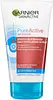
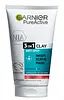
Garnier Pure Active Intensive Daily Exfoliation Scrub Spots & Blackheads Versus Garnier PureActive 3-In-1 Clay Wash + Scrub + Mask
This salicylic acid cream cleanser is formulated around Salicylic Acid to clear breakouts and unclog pores.

What's inside
What's inside
 Key Ingredients
Benefits
Concerns
Ingredients Side-by-side
Water
Skin ConditioningGlycerin
Humectant


Cetyl Alcohol
Emollient



Stearic Acid
Cleansing
PEG-7 Glyceryl Cocoate
Emulsifying

Sodium Laureth Sulfate
Cleansing

Palmitic Acid
Emollient
Steareth-21
CleansingPerlite
Absorbent

Salicylic Acid
Masking




Coco-Betaine
Cleansing
Ammonium Polyacryloyldimethyl Taurate
Emulsion StabilisingCapryloyl Salicylic Acid
Exfoliating

CI 19140
Cosmetic ColorantCI 42090
Cosmetic ColorantCI 77007
Cosmetic ColorantCopper PCA
HumectantHydrogenated Castor Oil
Emollient
Hydrogenated Jojoba Oil
Abrasive
Menthol
Masking
Myristic Acid
Cleansing
Myristyl Alcohol
Emollient
Pentasodium Ethylenediamine Tetramethylene Phosphonate
Polysorbate 60
Emulsifying
Propylene Glycol
Humectant
Silica
Abrasive
Sodium Chloride
MaskingSodium Hydroxide
BufferingSorbitol
Humectant
Stearyl Alcohol
Emollient
T-Butyl Alcohol
Perfuming


Tetrasodium EDTA
Vaccinium Myrtillus Fruit Extract
Skin ConditioningZinc Gluconate
Skin Conditioning
Parfum
Masking
Water, Glycerin, Cetyl Alcohol, Stearic Acid, PEG-7 Glyceryl Cocoate, Sodium Laureth Sulfate, Palmitic Acid, Steareth-21, Perlite, Salicylic Acid, Coco-Betaine, Ammonium Polyacryloyldimethyl Taurate, Capryloyl Salicylic Acid, CI 19140, CI 42090, CI 77007, Copper PCA, Hydrogenated Castor Oil, Hydrogenated Jojoba Oil, Menthol, Myristic Acid, Myristyl Alcohol, Pentasodium Ethylenediamine Tetramethylene Phosphonate, Polysorbate 60, Propylene Glycol, Silica, Sodium Chloride, Sodium Hydroxide, Sorbitol, Stearyl Alcohol, T-Butyl Alcohol, Tetrasodium EDTA, Vaccinium Myrtillus Fruit Extract, Zinc Gluconate, Parfum
Water
Skin ConditioningKaolin
Abrasive
Glycerin
Humectant
Zea Mays Starch
Absorbent
CI 77891
Cosmetic ColorantDecyl Glucoside
Cleansing
Perlite
Absorbent
Sodium Laureth Sulfate
Cleansing
PEG-7 Glyceryl Cocoate
Emulsifying
Eucalyptus Globulus Leaf Extract
Perfuming
PEG-30 Dipolyhydroxystearate
Emulsifying
Zinc Gluconate
Skin Conditioning
Trideceth-6
EmulsifyingSodium Hydroxide
BufferingSilica
Abrasive
Pumice
Abrasive
Hydrogenated Castor Oil
Emollient
Hydrogenated Jojoba Oil
Abrasive
Tetrasodium EDTA
Smithsonite Extract
Antioxidant
Xanthan Gum
EmulsifyingMenthol
Masking
Acrylates/C10-30 Alkyl Acrylate Crosspolymer
Emulsion StabilisingSalicylic Acid
Masking
Phenoxyethanol
Preservative
CI 77007
Cosmetic ColorantCI 42090
Cosmetic ColorantLinalool
Perfuming
Limonene
Perfuming
Benzyl Alcohol
Perfuming
Benzyl Salicylate
Perfuming
Parfum
Masking
Water, Kaolin, Glycerin, Zea Mays Starch, CI 77891, Decyl Glucoside, Perlite, Sodium Laureth Sulfate, PEG-7 Glyceryl Cocoate, Eucalyptus Globulus Leaf Extract, PEG-30 Dipolyhydroxystearate, Zinc Gluconate, Trideceth-6, Sodium Hydroxide, Silica, Pumice, Hydrogenated Castor Oil, Hydrogenated Jojoba Oil, Tetrasodium EDTA, Smithsonite Extract, Xanthan Gum, Menthol, Acrylates/C10-30 Alkyl Acrylate Crosspolymer, Salicylic Acid, Phenoxyethanol, CI 77007, CI 42090, Linalool, Limonene, Benzyl Alcohol, Benzyl Salicylate, Parfum
Reviews
Ingredients Explained
These ingredients are found in both products.
Ingredients higher up in an ingredient list are typically present in a larger amount.
Ci 42090 is a synthetic dye created from petroleum. It is used to give a bright blue color to cosmetics, medicine, and food.
This pigment is called Ultramarine blue lazurite. It gives a saturated blue color, but can be used to create other colors as well.
According to the manufacturer, it is usually made from kaolin, sodium sulfate, sodium carbonate, sulfur, and charcoal.
Glycerin (or glycerol) is a compound naturally found in your skin. It's a powerhouse humectant that pulls water into the stratum corneum.
Topically, glycerin does several things at once:
Your skin makes glycerin on its own (mostly from sebaceous oil breakdown) and shuttles it to your outermost layer of skin, or your epidermis, via aquaporin-3.
Aquaporin-3 is a transporter that is essential for normal skin hydration, elasticity, and repair. Interestingly, mice lacking in AQP3 have dry and less elastic skin that can be fully corrected with glycerin.
This ingredient is non-irritating, plays well with almost every ingredient, and works across all skin types. Typical use is anywhere between 3-10% but can go up to 79% in some leave-on products.
Just know very high concentrations (>40%) can feel tacky in low humidity.
Glycerin is the name for this ingredient in American English. British English uses Glycerol/Glycerine.
Learn more about GlycerinHydrogenated Castor Oil (aka "castor wax") is what you get when castor oil is turned into a wax.
Its dominant fatty acid is ricinoleic acid, giving it both emollient and mild humectant properties.
According to EU CosIng, this ingredient helps soften skin, keep oil and water stay mixed, and thickens products.
Hydrogenated castor oil at 30% did not trigger a positive patch-test reaction and is well-tolerated.
Since this ingredient is based on an 18-carbon fatty acid, it falls into the chain-length range that Malassezia can feed on and may not be fungal acne safe.
Learn more about Hydrogenated Castor OilHydrogenated Jojoba Oil is the "hardened version" of jojoba oil; jojoba oil is technically not an oil at all but a liquid wax that has a structure similar to your skin's own sebum.
Adding hydrogen turns this liquid wax into a colorless, odorless, hard wax with a melting point of around 70°C. This is why you'll see it in "stick formulations" like lipstick, eyeliner, and lip balm.
It also acts as a cushiony emollient and skin conditioning agent that leaves skin soft and smooth.
The safety profile of this ingredient is reassuring; the Cosmetic Ingredient Review Expert Panel has concluded this ingredient to be safe in cosmetics and that it isn't am irritant or sensitizer.
Typical use levels range from 1% up to 25-31% in stick products.
Learn more about Hydrogenated Jojoba OilMenthol is a compound found in mint plants, such as peppermint. In its pure form, it is a clear crystalline substance.
Menthol is known for its cooling sensation; however, the cooling is actually from your skin being sensitized. Menthol can worsen rosacea. We recommend speaking with a professional if you have concerns.
Menthol also has antimicrobial properties.
Learn more about MentholParfum is a catch-all term for an ingredient or more that is used to give a scent to products.
Also called "fragrance", this ingredient can be a blend of hundreds of chemicals or plant oils. This means every product with "fragrance" or "parfum" in the ingredients list is a different mixture.
For instance, Habanolide is a proprietary trade name for a specific aroma chemical. When used as a fragrance ingredient in cosmetics, most aroma chemicals fall under the broad labeling category of “FRAGRANCE” or “PARFUM” according to EU and US regulations.
The term 'parfum' or 'fragrance' is not regulated in many countries. In many cases, it is up to the brand to define this term.
For instance, many brands choose to label themselves as "fragrance-free" because they are not using synthetic fragrances. However, their products may still contain ingredients such as essential oils that are considered a fragrance by INCI standards.
One example is Calendula flower extract. Calendula is an essential oil that still imparts a scent or 'fragrance'.
Depending on the blend, the ingredients in the mixture can cause allergies and sensitivities on the skin. Some ingredients that are known EU allergens include linalool and citronellol.
Parfum can also be used to mask or cover an unpleasant scent.
The bottom line is: not all fragrances/parfum/ingredients are created equally. If you are worried about fragrances, we recommend taking a closer look at an ingredient. And of course, we always recommend speaking with a professional.
Learn more about ParfumPEG-7 Glyceryl Cocoate is a synthetic, water-soluble surfactant and emulsifier.
It's a "superfatting" agent that helps replenish some of your skin's oils after they're stripped away by other surfactants.
This is why "gentle" and "moisturizing" cleansers feel less stripping than basic ones.
Typical concentrations range from 1-10% and it has a solid safety record. The CIR Expert Panel has concluded this ingredient to be safe at concentrations up to 10% in leave-on products.
Dermal application tests at 50% also did not produce irritation in two studies.
This ingredient may not be fungal acne safe and in vitro studies have shown Malassezia can metabolize it.
Learn more about PEG-7 Glyceryl CocoatePerlite can be good for oily skin. It can help to reduce large pores.
Salicylic Acid (also known as beta hydroxy acid or BHA) is a well-known ingredient for treating skin that struggles with acne and clogged pores. It exfoliates both the skin's surface and deep within the pores to help clear out buildup, control oil, and reduce inflammation.
Unlike AHAs (alpha hydroxy acids), salicylic acid is oil-soluble. This allows it to penetrate into pores which makes it especially effective for treating blackheads and preventing future breakouts.
Salicylic acid is also known for its soothing properties. It has a similar structure to aspirin and can calm inflamed or irritated skin, making it a good option for acne-prone skin that is also sensitive.
Concentrations of 0.5-2% are recognized by the U.S. FDA as an over-the-counter topical acne product.
It can cause irritation and/or dryness if one's skin already has a compromised moisture barrier, so it's best to focus on repairing that before introducing this ingredient into your routine.
While salicylic acid does not increase sun sensitivity, it’s still important to wear sunscreen daily to protect your skin.
If you are looking for the ingredient called BHA or Butylated Hydroxyanisole, click here.
Learn more about Salicylic AcidSilica, also known as silicon dioxide, is a naturally occurring mineral. It is used as a fine, spherical, and porous powder in cosmetics.
Though it has exfoliant properties, the function of silica varies depending on the product.
The unique structure of silica enhances the spreadability and adds smoothness, making it a great texture enhancer.
It is also used as an active carrier, emulsifier, and mattifier due to its ability to absorb excess oil.
In some products, tiny microneedles called spicules are made from silica or hydrolyzed sponge. When you rub them in, they lightly polish away dead skin layers and enhance the penetration of active ingredients.
Learn more about SilicaSodium Hydroxide is also known as lye or caustic soda. It is used to adjust the pH of products; many ingredients require a specific pH to be effective.
In small amounts, sodium hydroxide is considered safe to use. However, large amounts may cause chemical burns due to its high alkaline.
Your skin has a natural pH and acid mantle. This acid mantle helps prevent harmful bacteria from breaking through. The acid mantle also helps keep your skin hydrated.
"Alkaline" refers to a high pH level. A low pH level would be considered acidic.
Learn more about Sodium HydroxideSodium Laureth Sulfate (SLES) is a foaming, cleansing, and emulsifying ingredient. It is created from palm kernel oil or coconut oil. SLES is not the same as sodium lauryl sulfate. It is much milder and less likely to irritate.
SLES helps create foam in personal products. It also prevents ingredients from separating, helping to elongate the shelf life.
Sodium Laureth Sulfate is a type of sulfate. It can be drying. We recommend speaking with a professional about using this ingredient if you have concerns.
Learn more about Sodium Laureth SulfateTetrasodium EDTA is the salt formed from neutralizing ethylenediamine tetraacetic acid with sodium hydroxide. It is a chelating agent and used to prevent metal ions from binding to other ingredients. This helps keep the product and ingredients stable.
Tetrasodium EDTA comes as a white solid and is soluble in water.
Water. It's the most common cosmetic ingredient of all. You'll usually see it at the top of ingredient lists, meaning that it makes up the largest part of the product.
So why is it so popular? Water most often acts as a solvent - this means that it helps dissolve other ingredients into the formulation.
You'll also recognize water as that liquid we all need to stay alive. If you see this, drink a glass of water. Remember to stay hydrated!
Learn more about WaterZinc gluconate has antibacterial and wound healing properties. It is particularly effective against fighting inflammatory acne.
This ingredient is the zinc salt of the PHA gluconic acid. PHAs are gentle cousins to AHAs.


