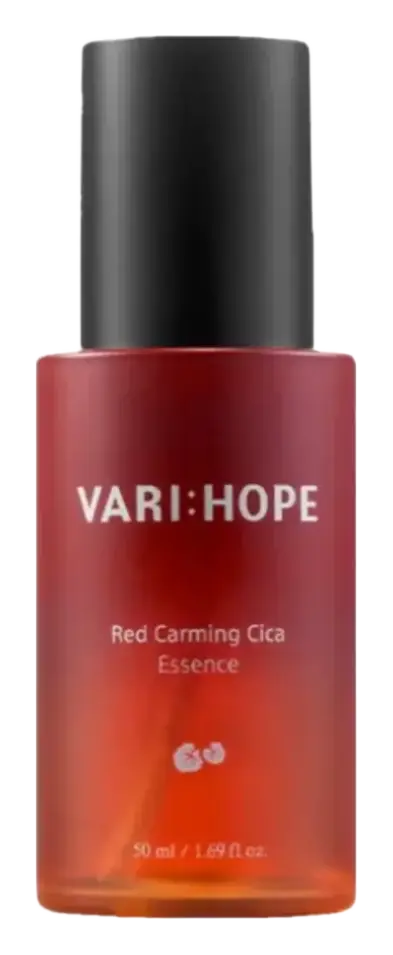
Vari:hope Red Calming Cica Essence
A essence with 46 ingredients, including niacinamide and hyaluronic acid.
This calming essence is formulated around Niacinamide and Centella Asiatica Leaf Water to calm redness and strengthen the skin barrier.
We independently verify ingredients, backed by peer-reviewed research. Suggest an update.
What's inside
Ingredients List
Water
Skin ConditioningGlycerin
Humectant


Butylene Glycol
Humectant
Propanediol
Solvent
Dipropylene Glycol
HumectantNiacinamide
Smoothing









Centella Asiatica Leaf Water
Skin Conditioning
Polyglycerin-3
Humectant
Hydroxyethyl Urea
Humectant
Octyldodeceth-16
EmulsifyingMelaleuca Alternifolia Leaf Extract
Perfuming
Tromethamine
BufferingGlyceryl Glucoside
Humectant
1,2-Hexanediol
Skin Conditioning
Acrylates/C10-30 Alkyl Acrylate Crosspolymer
Emulsion StabilisingGalactomyces Ferment Filtrate
Humectant

Isopentyldiol
Humectant
Carbomer
Emulsion StabilisingButeth-3
SolventAdenosine
Skin Conditioning
Citrus Paradisi Fruit Extract
Skin ConditioningCaprylyl Glycol
Emollient
Dextrin
AbsorbentSodium Benzotriazolyl Butylphenol Sulfonate
UV AbsorberGardenia Jasminoides Fruit Extract
Cosmetic ColorantInulin
Skin Conditioning
Polyglyceryl-4 Oleate
Emulsifying
Linum Usitatissimum Seed Extract
Perfuming
Disodium EDTA
ChelatingTheobroma Cacao Extract
Skin ConditioningSchisandra Chinensis Fruit Extract
Skin Conditioning
Perilla Frutescens Leaf Extract
MaskingAlpha-Glucan Oligosaccharide
Cleansing
Acorus Calamus Root Extract
Perfuming
Asiaticoside
Antioxidant
Sodium Stearoyl Glutamate
CleansingMadecassic Acid
Skin Conditioning
Tributyl Citrate
SolventSodium Hyaluronate Crosspolymer
Humectant
Benzyl Glycol
SolventAsiatic Acid
Skin Conditioning
Sodium Surfactin
CleansingMadecassoside
Antioxidant
Ethylhexylglycerin
Skin ConditioningGlucuronic Acid
Buffering
Parfum
Masking


Water, Glycerin, Butylene Glycol, Propanediol, Dipropylene Glycol, Niacinamide, Centella Asiatica Leaf Water, Polyglycerin-3, Hydroxyethyl Urea, Octyldodeceth-16, Melaleuca Alternifolia Leaf Extract, Tromethamine, Glyceryl Glucoside, 1,2-Hexanediol, Acrylates/C10-30 Alkyl Acrylate Crosspolymer, Galactomyces Ferment Filtrate, Isopentyldiol, Carbomer, Buteth-3, Adenosine, Citrus Paradisi Fruit Extract, Caprylyl Glycol, Dextrin, Sodium Benzotriazolyl Butylphenol Sulfonate, Gardenia Jasminoides Fruit Extract, Inulin, Polyglyceryl-4 Oleate, Linum Usitatissimum Seed Extract, Disodium EDTA, Theobroma Cacao Extract, Schisandra Chinensis Fruit Extract, Perilla Frutescens Leaf Extract, Alpha-Glucan Oligosaccharide, Acorus Calamus Root Extract, Asiaticoside, Sodium Stearoyl Glutamate, Madecassic Acid, Tributyl Citrate, Sodium Hyaluronate Crosspolymer, Benzyl Glycol, Asiatic Acid, Sodium Surfactin, Madecassoside, Ethylhexylglycerin, Glucuronic Acid, Parfum
Key Ingredients
Benefits
Concerns
Ingredients Explained
Water. It's the most common cosmetic ingredient of all. You'll usually see it at the top of ingredient lists, meaning that it makes up the largest part of the product.
So why is it so popular? Water most often acts as a solvent - this means that it helps dissolve other ingredients into the formulation.
You'll also recognize water as that liquid we all need to stay alive. If you see this, drink a glass of water. Remember to stay hydrated!
Learn more about WaterGlycerin (or glycerol) is a compound naturally found in your skin. It's a powerhouse humectant that pulls water into the stratum corneum.
Topically, glycerin does several things at once:
Your skin makes glycerin on its own (mostly from sebaceous oil breakdown) and shuttles it to your outermost layer of skin, or your epidermis, via aquaporin-3.
Aquaporin-3 is a transporter that is essential for normal skin hydration, elasticity, and repair. Interestingly, mice lacking in AQP3 have dry and less elastic skin that can be fully corrected with glycerin.
This ingredient is non-irritating, plays well with almost every ingredient, and works across all skin types. Typical use is anywhere between 3-10% but can go up to 79% in some leave-on products.
Just know very high concentrations (>40%) can feel tacky in low humidity.
Glycerin is the name for this ingredient in American English. British English uses Glycerol/Glycerine.
Learn more about GlycerinButylene Glycol (or BG) is used within cosmetic products for a few different reasons:
Overall, Butylene Glycol is a safe and well-rounded ingredient that works well with other ingredients.
Though this ingredient works well with most skin types, some people with sensitive skin may experience a reaction such as allergic rashes, closed comedones, or itchiness.
Learn more about Butylene GlycolPropanediol is an all-star ingredient. It softens, hydrates, and smooths the skin.
It’s often used to:
Propanediol is not likely to cause sensitivity and considered safe to use. It is derived from corn or petroleum with a clear color and no scent.
Learn more about PropanediolDipropylene Glycol is a synthetically created humectant, stabilizer, and solvent.
This ingredient helps:
Dipropylene glycol is technically an alcohol, but it belongs to the glycol family (often considered part of the ‘good’ alcohols). This means it is hydrating and gentle on skin unlike drying solvent alcohols like denatured alcohol.
As a masking agent, Dipropylene Glycol can be used to cover the smell of other ingredients. However, it does not have a scent.
Studies show Dipropylene Glycol is considered safe to use in skincare.
Learn more about Dipropylene GlycolNiacinamide is a multitasking form of vitamin B3 that strengthens the skin barrier, reduces pores and dark spots, regulates oil, and improves signs of aging.
And the best part? It's gentle and well-tolerated by most skin types, including sensitive and reactive skin.
You might have heard of "niacin flush", or the reddening of skin that causes itchiness. Niacinamide has not been found to cause this.
In very rare cases, some individuals may not be able to tolerate niacinamide at all or experience an allergic reaction to it.
If you are experiencing flaking, irritation, and dryness with this ingredient, be sure to double check all your products as this ingredient can be found in all categories of skincare.
When incorporating niacinamide into your routine, look out for concentration amounts. Typically, 5% niacinamide provides benefits such as fading dark spots. However, if you have sensitive skin, it is better to begin with a smaller concentration.
When you apply niacinamide to your skin, your body converts it into nicotinamide adenine dinucleotide (NAD). NAD is an essential coenzyme that is already found in your cells as "fuel" and powers countless biological processes.
In your skin, NAD helps repair cell damage, produce new healthy cells, support collagen production, strengthen the skin barrier, and fight environmental stressors (like UV and pollution).
Our natural NAD levels start to decline with age, leading to slower skin repair, visible aging, and a weaker skin barrier. By providing your skin niacinamide, you're recharging your skin's NAD levels. This leads to stronger, healthier, and younger looking skin.
Another name for vitamin B3 is nicotinamide. This vitamin is water-soluble and our bodies don't store it. We obtain Vitamin B3 from either food or skincare. Meat, fish, wheat, yeast, and leafy greens contain vitamin B3.
The type of niacinamide used in skincare is synthetically created.
Learn more about NiacinamideCentella Asiatica Leaf Water is created by distilling centella asiatica leaves. Centella Asiatica is a herb native to Southeast Asia.
Many active components found in Centella Asiatica Extract, such as Madecassic Acid and Asiaticoside, encourage the skin to naturally produce hyaluronic acid. This helps keep our skin hydrated. Many of these components also show antioxidant activity and may help reduce the signs of aging.
Other components of Centella Asiatic Extract include Vitamin A, vitamin C, several B vitamins, and Asiatic Acid.
Learn more about Centella Asiatica Leaf WaterPolyglycerin-3 is a 3-unit glycerin polymer.
Like glycerin, this ingredient is a humectant. Humectants help hydrate your skin by drawing water to it.
Having moisturized skin helps improve the skin barrier. Your skin barrier helps protect against irritants and bacteria.
Learn more about Polyglycerin-3Octyldodeceth-16 is a lab-made ingredient that acts as an emulsifier that helps blend water + oil ingredients.
The Cosmetic Ingredient Review has deemed it safe for as in cosmetics and usage concentrations typically range from 0.1-2%.
Like other emulsifiers, this ingredient can cause mild skin irritation or sensitivity in a small amount of people. A patch test is reasonable if you have sensitive skin.
Learn more about Octyldodeceth-16Melaleuca Alternifolia Leaf Extract comes from the Tea Tree, Melaleuca alternifolia, Myrtaceae. This tea tree is native to Australia.
Tea Leaf extract contains antimicrobial and anti-acne properties.
This ingredient has perfuming properties and contains linalool and limonene. These fragrance and terpinen components can cause skin sensitivity.
Learn more about the benefits of Tea Tree Oil here.
Learn more about Melaleuca Alternifolia Leaf ExtractTromethamine (aka THAM) is a synthetic amino acid that shows up in skincare as a helper ingredient.
It functions as a pH adjuster to help neutralize acidic ingredients and set a formula's pH to the right spot.
This matters a lot because a lot of actives (like vitamin C) needs a specific pH to work well and feel comfortable on skin.
Concentration use ranges from 0.1-1.0% depending on the formula.
Learn more about TromethamineGlyceryl Glucoside is made from glycerol and glucose.
It is a humectant. Humectants help hydrate your skin by drawing moisture to it from the air.
Some foods that contain glyceryl glucoside include sake, miso, and wines.
Learn more about Glyceryl Glucoside1,2-Hexanediol is a synthetic liquid and another multi-functional powerhouse.
It is a:
- Humectant, drawing moisture into the skin
- Emollient, helping to soften skin
- Solvent, dispersing and stabilizing formulas
- Preservative booster, enhancing the antimicrobial activity of other preservatives
Acrylates/C10-30 Alkyl Acrylate Crosspolymer is a synthetic polymer. It is used to thicken, emulsify, and improve the texture of products.
As an emulsifier, it helps stabilize oil-in-water emulsions to give products an elegant feel when applied.
It can also form a thin protective film on skin. One study found that a formula using this polymer helped slow down how quickly other ingredients (like DEET) were absorbed through skin.
A 2024 study of over 1,300 patients confirmed that sensitization to this ingredient is rare. It is also non-mutagenic and has a clean track record.
Learn more about Acrylates/C10-30 Alkyl Acrylate CrosspolymerGalactomyces Ferment Filtrate (GFF) is a byproduct of fermenting Galactomyces yeast (the same yeast traditionally used to brew sake, Japan's beloved rice wine).
Sake brewers have long been known for their remarkably youthful hands. This is what actually first sparked scientific interest in GFF's skin benefits.
GFF works by stimulating filaggrin production in the skin. Filaggrin is a protein that binds structural proteins in the outer skin layer together to form a tight barrier that shields against allergens, bacteria, and moisture loss.
It's also a key building block of our natural moisturizing factors (NMF), or the network of compounds that keep skin plump and hydrated.
By boosting filaggrin, GFF helps strengthen both our barrier and our skin's ability to retain moisture.
Beyond hydration, GFF has notable antioxidant properties that help protect against oxidative stress and UV-induced inflammation.
Research also suggests it may help regulate sebum and keratin production. This could be an interesting option for those concerned about oiliness or skin texture.
Fungal acne:
This ingredient doesn't contain fatty acids or oils that could feed Malassezia, and the yeast used to make it (Galactomyces) is a different genera of fungi from Malassezia. The presence of one doesn't stimulate the other.
However, there is a concern raised by some communities that this ingredient could trigger a reaction in people who are broadly sensitive to yeast/fungal-derived ingredients.
Learn more about Galactomyces Ferment FiltrateIsopentyldiol is a synthetic solvent, humectant, and emollient.
Humectants have the ability to attract and hold water while emollients create a thin film to prevent water from evaporating. This combination keeps your skin and hair soft and hydrated. Plus, isopentyldiol does not leave a sticky feeling behind.
As a surfactant, isopentyldiol is a hydrotrope. Hydrotropes help surfactants (cleansing agents) dissolve into water.
According to the manufacturer, using this ingredient with sorbitol boosts skin hydration and helps close cuticles of damaged hair.
This ingredient is water-soluble.
Learn more about IsopentyldiolCarbomer is a synthetic thickening and gelling agent. It's basically the ingredient that gives a lot of serums, gels, creams, and sunscreens their smooth, non-sticky texture.
Although legally permitted at very high levels, carbomers are normally used at concentrations below 1%.
It also needs to be neutralized to actually thicken, and because it is a large molecule, it doesn't really penetrate the skin barrier.
Allergy-wise, the risk is very low. Clinical studies show carbomers have low potential for skin irritation/sensitization even at concentrations up to 100%.
A 2024 UK study patch-tested 1,302 patients and found true allergy to the parent group of carbomer to be rare with no confirmed relevant reactions.
Learn more about CarbomerWe don't have a description for Buteth-3 yet.
Adenosine is a purine nucleoside that your body already makes in every cell. In skincare, it acts mainly as a skin conditioning and anti-aging agent.
The way it works is fairly well mapped out:
Your skin has cells called fibroblasts that build collagen (the stuff that keeps skin firm and smooth). Adenosine basically flips a switch on these cells that tells them to get to work making more collagen and other proteins. These cells slow down on their own as skin ages, so Adenosine helps give them a little nudge to keep going.
The clinical backing is pretty solid too.
A blind, randomized, placebo-controlled trial of 126 women aged 45-65 tested a 0.1% cream twice daily and found real improvements in crow's feet and frown lines using a precise 3D skin-mapping technique; these changes showed up by week 3 and held at 2 months.
A later study using Adenosine-loaded dissolving microneedle patches reported gains in wrinkle depth, dermal density, elasticity, and hydration.
On concentrations, South Korea's Ministry of Food and Drug Safety has set 0.04% as the approved functional anti-wrinkle level. You'll typically see this ingredient used somewhere in the 0.04-0.1% range since it works at low doses.
This ingredient has been found safe for cosmetics with the data showing no irritation or sensitization.
Overall, this is a great ingredient for any anti-aging routine and has no photosensitizing effect, so it suits both AM and PM use.
Learn more about AdenosineWe don't have a description for Citrus Paradisi Fruit Extract yet.
Caprylyl Glycol is a humectant, skin conditioner, emollient, and preservative booster derived from either caprylic acid or synthetically created.
Typical use levels vary from 0.3-1% as a preservative booster and go up to 2% to condition skin.
Because it is not a free-fatty acid, this ingredient is fungal acne safe (there's nothing for Malassezia to feed on).
Learn more about Caprylyl GlycolDextrin is a starch-derived polysaccharide. It's made by partially breaking down corn, potato, or other plant starches.
Think of it as "half-processed" starch; it's less complex than the original but not fully broken down into sugar like maltodextrin.
In cosmetics, it mainly functions as a bulking agent, viscosity controller, binder, and absorbent. It helps thicken products, stabilize powders, and get certain textures a less "wet" feel.
This ingredient has a pretty solid safety profile; it's recognized as a safe food additive and its large molecular size means it doesn't meaningfully penetrate skin.
Human repeat insult patch tests using a rinse-off facial product containing 42.69% dextrin found no skin irritation or sensitization in 54 subjects.
Typical real-world usage is much lower: usually under 1% as a texture modifier and up to 40% in masks (rinse off products use less).
Learn more about DextrinWe don't have a description for Sodium Benzotriazolyl Butylphenol Sulfonate yet.
We don't have a description for Gardenia Jasminoides Fruit Extract yet.
Inulin is a polysaccharide (carbohydrate) with prebiotic and antioxidant properties.
The majority of inulin is extracted from chicory, but can also be obtained from other plants such as garlic, onion, asparagus, and sugarcane.
Studies show inulin may help with controlling your skin's natural microbiota when applied topically.
The antioxidant potential of inulin varies depending on the source.
Learn more about InulinPolyglyceryl-4 Oleate isn't fungal acne safe.
This ingredient is also known as flaxseed extract. It has skin conditioning and perfuming properties.
Flaxseed naturally contains polysaccharides (sugars) and small amounts of fatty acid-related compounds to help hydrate the skin. The seed also contains antioxidants being studied for its effects on inflammation pathways.
A small clinical trial found topical flaxseed oil improved hand eczema over the course of 4 weeks. In an animal study, topical flaxseed cream supported wound-healing outcomes.
Overall, flaxseed is a great hydrating and barrier supporting ingredient. Like other plant extracts, some rare cases of allergic reactions can occur.
Though flaxseed has a perfuming function according to INCI, this doesn't mean the ingredient is added as a fragrance. It just means the material can contribute an odor or modify the scent of a formula.
Learn more about Linum Usitatissimum Seed ExtractDisodium EDTA is a chelating agent. It grabs onto and deactivates metal ions that sneak into your products from water, packaging, or air.
This ingredient mainly works behind the scenes and helps with:
On top of that, this ingredient can counteract the effects of hard water by binding to the minerals in it.
One thing worth knowing is that Disodium EDTA has been shown to be a mild penetration enhancer. It can help other ingredients absorb into skin more effectively which can be a double-edged sword (great for actives, but can also make the active too strong if you have sensitive skin).
Clinical patch testing showed no significant skin irritation at typical use concentrations and minimal dermal absorption.
You'll most likely see this ingredient near the end of an ingredient list. It's typically found in concentrations less than 1%.
Learn more about Disodium EDTAThis ingredient is extracted from the seeds of the cocoa tree.
Cacao seeds contain antioxidants known as polyphenols. These include flavonoids, procyanidins, and epicatechins.
Studies show these polyphenols help improve skin health.
The more famous ingredient from cocoa tree is cocoa butter.
Learn more about Theobroma Cacao ExtractThis ingredient comes from the "five-flavor" berry native to northeast Asia. It has skin conditioning properties and is rich in antioxidants.
In lab models, this ingredient displays antioxidant effects in keratinocytes (the main cells in the epidermis). Some studies also report tyrosinase inhibiting or skin brightening activity.
One study using reconstructed human epidermis found this ingredient to help counter pollution-like inflammatory signaling in skin exposed to urban dust.
Learn more about Schisandra Chinensis Fruit ExtractWe don't have a description for Perilla Frutescens Leaf Extract yet.
Alpha-Glucan Oligosaccharide is a prebiotic. It prevents harmful bacteria from growing on skin by keeping the skin's microbiome in balance.
Another benefit of this ingredient is its antioxidant properties. Antioxidants protect our skin from oxidative damage.
Acorus Calamus Root Extract is a fragrance.
Asiaticoside comes from the super popular skin-soothing ingredient, Centella asiatica. It's the reason centella-based products have a strong reputation for repairing and calming skin, along with its sibling compound Madecassoside.
Research from 2016-2025 supports its role in:
You'll usually find this in concentrations between 0.2-5%.
Learn more about AsiaticosideSodium Stearoyl Glutamate is an amino-acid based emulsifier. It is made by combining stearic acid with L-glutamic acid and neutralizing it to a sodium salt.
As an emulsifier, it works mainly as an oil-in-water one and helps keep the oil and water in your formulas blended. It also contributes to a smooth, non-greasy skin feel.
This ingredient is biodegradable and commonly available in natural/COSMOS-certified grades.
Learn more about Sodium Stearoyl GlutamateMadecassic Acid is one of the four star actives in Centella Asiatica. In skincare, it earns its keep as a calming and repairing ingredient.
It works through the same core pathways as the rest of the centella family.
First, it turns down inflammation so it helps with things like redness and general upset skin.
Second, it acts as an antioxidant which means it helps protect skin from daily stress and damage.
And third, it nudges the skin to make more collagen and rebuild its support structure.
That combination is why the whole Centella family is known for calming skin, strengthening the barrier, fading redness, and giving anti-aging benefits.
It's worth being honest about the evidence here; a lot of the strongest data is on the full extract or a Madecassoside/Asiaticoside rather than Madecassic Acid alone. Reviewers also note more long-term clinical trials are needed to confirm the full potential.
Concentration-wise, this ingredient is rarely used pure and usually shows up as part of a standardized centella extract where reported content ranges from 0.02-3.06%.
Finished products typically run somewhere in the 0.1-10% range depending on the format.
In real-world tolerance tests, a repeat-insult patch test on an eye lotion with 0.2% Centella extract showed no irritation or allergic contact dermatitis in 54 subjects. And a mascara with 0.5% Madecassoside caused neither irritation nor sensitization in 109 subjects.
Allergy risk is very low, but not zero. Centella and its constituents are classified as weak contact sensitizers and some rare cases of allergic contact dermatitis exist.
Learn more about Madecassic AcidWe don't have a description for Tributyl Citrate yet.
Sodium Hyaluronate Crosspolymer is a crosslinked version of sodium hyaluronate. This just means it's linked into a 3D mesh network that lets it be more stable and sit on skin as a cohesive, gel-like film rather than sinking into skin.
A 2016 human skin study found crosslinked HA increased epidermal water content by 7.6% over the control group and reduced transepidermal water loss by 27.8%.
A follow-up clinical trial found that a topical crosslinked HA serum applied after fillers, microneedling, or chemical peels was well-tolerated and enhanced skin quality at 14 / 28 days.
More recent research suggests that concentrations as low as 0.03% can act as a penetration enhancer for other skincare actives.
Learn more about Sodium Hyaluronate CrosspolymerWe don't have a description for Benzyl Glycol yet.
Asiatic Acid is one of the four main actives found in Centella Asiatica. Its headline job is stimulating collagen.
Lab tests on human skin cells show Asiatic Acid tells your skin to make more collagen, the protein that keeps skin firm and bouncy.
It also calms inflammation and acts as an antioxidant so it can help skin heal faster, rebuild itself, and repair a damaged barrier.
And on naming, even though "acid" is in the name, it's nothing like an AHA or BHA exfoliant. It's a gentle firming and soothing ingredient that supports your skin barrier.
Concentration-wise, Asiatic Acid is potent at very low doses and usually shows up as a small fraction of a broader centella extract.
Analyses of centella material put Asiatic Acid reported in the range of 0.2-3% of the extract.
This ingredient is non-sensitizing and guinea pig sensitization testing also found it to be a weak sensitizer. That means the risk of acquiring contact sensitivty is quite low.
Allergic contact dermatitis does exist but is also very rare; documented cases tend to involve prolonged use on broken skin plus co-sensitization to fragrance ingredients.
Learn more about Asiatic AcidWe don't have a description for Sodium Surfactin yet.
Madecassoside is one of four active compounds found in Centella asiatica and is one of the main reasons Centella is so effective at calming irritated skin and supporting the moisture barrier.
There's a solid body of peer-reviewed research backing Madecassoside for several skin benefits. Studies have found:
Madecassoside pairs well with other hydrating or antioxidant ingredients like Ascorbic Acid or Hyaluronic Acid.
Learn more about MadecassosideEthylhexylglycerin is created from glycerin. It is a multitasker ingredient that:
The CIR Expert Panel found minimal skin absorption or sensitization of any kind in a safety assessment. Though this ingredient is considered well-tolerated, a small number of cases of allergic dermatitis have been published since 2002. Just be sure to patch test if you are unsure.
Industry-reported use ranges from 8% in rinse-off products and 2% in leave-on formulations.
Learn more about EthylhexylglycerinGlucuronic Acid is a type of sugar used by our bodies to expel harmful substances via urine. In skincare, it is used as a humectant to boost skin moisture.
Fun fact: This ingredient is a precursor of ascorbic acid. It is also found in fermentation products such as kombucha.
Parfum is a catch-all term for an ingredient or more that is used to give a scent to products.
Also called "fragrance", this ingredient can be a blend of hundreds of chemicals or plant oils. This means every product with "fragrance" or "parfum" in the ingredients list is a different mixture.
For instance, Habanolide is a proprietary trade name for a specific aroma chemical. When used as a fragrance ingredient in cosmetics, most aroma chemicals fall under the broad labeling category of “FRAGRANCE” or “PARFUM” according to EU and US regulations.
The term 'parfum' or 'fragrance' is not regulated in many countries. In many cases, it is up to the brand to define this term.
For instance, many brands choose to label themselves as "fragrance-free" because they are not using synthetic fragrances. However, their products may still contain ingredients such as essential oils that are considered a fragrance by INCI standards.
One example is Calendula flower extract. Calendula is an essential oil that still imparts a scent or 'fragrance'.
Depending on the blend, the ingredients in the mixture can cause allergies and sensitivities on the skin. Some ingredients that are known EU allergens include linalool and citronellol.
Parfum can also be used to mask or cover an unpleasant scent.
The bottom line is: not all fragrances/parfum/ingredients are created equally. If you are worried about fragrances, we recommend taking a closer look at an ingredient. And of course, we always recommend speaking with a professional.
Learn more about ParfumReviews
No written reviews yet. Be the first to review this product.
Recent searches
Search reviews by skin type, ingredient, or keyword.
Where it's from
Vari:hope is a Korean brand


We're dedicated to providing you with the most up-to-date and science-backed ingredient info out there.
The data we've presented on this page has been verified by a member of the SkinSort Team.
Read more about us· Updated September 13, 2026 • Added by aprilcat


