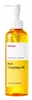
This oil-based makeup remover is made to dissolve makeup, sunscreen, and daily buildup.
This oil-based makeup remover is made to dissolve makeup, sunscreen, and daily buildup.

What's inside
What's inside
 Key Ingredients
Benefits
Concerns
Ingredients Side-by-side
Glycine Soja Oil
Emollient








Corylus Avellana Seed Oil
Emollient
Sorbeth-30 Tetraoleate
Emulsifying
Vitis Vinifera Seed Oil
Emollient
Olea Europaea Fruit Oil
Masking
Caprylic/Capric Triglyceride
Masking

Squalane
Emollient
Isoamyl Laurate
Emollient
Camellia Japonica Seed Oil
Emollient
Oenothera Biennis Oil
Emollient
Simmondsia Chinensis Seed Oil
Emollient
Helianthus Annuus Seed Oil
Emollient
Argania Spinosa Kernel Oil
Emollient
Orbignya Oleifera Seed Oil
Emollient
Saponaria Officinalis Leaf Extract
AntimicrobialCamellia Sinensis Leaf Extract
Antimicrobial


Oryza Sativa Bran Oil
Emollient
Rice Ferment Filtrate
Skin Conditioning
Decyl Glucoside
Cleansing
Ginkgo Biloba Leaf Extract
Skin Conditioning
Lavandula Angustifolia Oil
Masking


Aloe Barbadensis Leaf Extract
Emollient
Citrus Aurantium Dulcis Oil
Masking
Melaleuca Alternifolia Leaf Oil
Antioxidant
Tocopherol
Antioxidant
Glycine Soja Oil, Corylus Avellana Seed Oil, Sorbeth-30 Tetraoleate, Vitis Vinifera Seed Oil, Olea Europaea Fruit Oil, Caprylic/Capric Triglyceride, Squalane, Isoamyl Laurate, Camellia Japonica Seed Oil, Oenothera Biennis Oil, Simmondsia Chinensis Seed Oil, Helianthus Annuus Seed Oil, Argania Spinosa Kernel Oil, Orbignya Oleifera Seed Oil, Saponaria Officinalis Leaf Extract, Camellia Sinensis Leaf Extract, Oryza Sativa Bran Oil, Rice Ferment Filtrate, Decyl Glucoside, Ginkgo Biloba Leaf Extract, Lavandula Angustifolia Oil, Aloe Barbadensis Leaf Extract, Citrus Aurantium Dulcis Oil, Melaleuca Alternifolia Leaf Oil, Tocopherol
Olea Europaea Fruit Oil
Masking
Ethylhexyl Palmitate
Emollient
Sorbeth-30 Tetraoleate
Emulsifying
Oryza Sativa Bran Oil
Emollient
Glycine Soja Oil
Emollient
Pogostemon Cablin Leaf Oil
Masking
Parfum
Masking
Oryza Sativa Bran Extract
Skin Conditioning
Centella Asiatica Extract
Cleansing
Polygonum Cuspidatum Root Extract
Antioxidant
Scutellaria Baicalensis Root Extract
Astringent
Camellia Sinensis Leaf Extract
Antimicrobial
Glycyrrhiza Glabra Root Extract
Bleaching
Chamomilla Recutita Flower Extract
Masking
Rosmarinus Officinalis Leaf Extract
AntimicrobialOlea Europaea Fruit Oil, Ethylhexyl Palmitate, Sorbeth-30 Tetraoleate, Oryza Sativa Bran Oil, Glycine Soja Oil, Pogostemon Cablin Leaf Oil, Parfum, Oryza Sativa Bran Extract, Centella Asiatica Extract, Polygonum Cuspidatum Root Extract, Scutellaria Baicalensis Root Extract, Camellia Sinensis Leaf Extract, Glycyrrhiza Glabra Root Extract, Chamomilla Recutita Flower Extract, Rosmarinus Officinalis Leaf Extract
Reviews
Ingredients Explained
These ingredients are found in both products.
Ingredients higher up in an ingredient list are typically present in a larger amount.
Camellia Sinensis Leaf Extract (tea extract) is one of the most well-researched plant extracts in skincare with an impressive resume.
Black tea, green tea, and oolong tea are all harvested from the Camellia Sinensis plant.
Studies show green tea extract and its catechins (like epigallocatechin gallate (EGCG)) help your skin cells product energy more efficiently and reducing the number of free-radicals that can damage your skin from the inside.
In lab-grown skin models, this translated to younger, healthier, and stronger skin.
There's also good sun protection data; researchers saw less DNA damage and redness on human skin when green tea was applied before UVB exposure. And the more they applied, the better the protection.
Needless to say, this ingredient shouldn't replace your sunscreen. But it is a great supportive ingredient that you can already find in many sunscreens and antioxidant serums.
A 2009 study found a 2% green tea lotion was effective for mild-to-moderate acne thanks to its anti-inflammatory and mild antimicrobial activity.
The quality of the extract matters a lot here:
Good extracts contain 50-90% catechins while lower quality ones are mostly there for marketing. We recommend reaching out to the brand if you have questions about the quality or source of their ingredients.
Human Repeated Insult Patch Testing showed no irritation or sensitization at use concentrations (0.86% in leave-on products and up to 30% as leaf water).
Learn more about Camellia Sinensis Leaf ExtractGlycine Soja Oil is a plant-derived oil from soybean seeds. Like other oils, it is rich in essential fatty acids (mostly linoleic and oleic) that support skin hydration and barrier function.
The fatty acids are able to integrate into the lipid matrix of the stratum corneum to help soften skin and reduce water loss.
On top of that, soybean oil is rich in vitamins like vitamin E, a potent antioxidant.
Research on soybean's active components also point to anti-inflammatory, collagen-stimulating, antioxidant activity, and protection against UV-induced oxidative damage.
Most of this research applies to the broader soybean plant and not just the oil fraction alone.
This ingredient does carry a comedogenic rating of 3 from the old rabbit-ear assay. Just remember testing finished products in humans showed that formulas built with "comedogenic" ingredients are not necessarily comedogenic themselves. It's worth patch testing if you're breakout prone, and always listen to your skin.
Because this ingredient is a saturated triglyceride, it may not be fungal acne safe. This is because Malassezia breaks down sebum triglycerides into fatty acids it can consume, making this ingredient a possible source for the yeast.
Learn more about Glycine Soja OilThis ingredient is also known as olive oil. It has been used in skincare for centuries and science largely backs up its reputation as a nourishing emollient.
The main components of olive oil are oleic acid (55-83%), linoleic acid (3.5-20%), and palmitic acid (7-20%). Oleic acid promotes skin regeneration and helps regulate inflammatory responses.
Squalene is also naturally present in olive oil and exhibits moisturizing and antioxidant properties.
The polyphenols in olive oil also show anti-aging promise; one clinical study found a measurable improvement in skin appearance after 30 days of topical serum use.
Just be aware that applying olive oil directly to skin can weaken the barrier and cause redness. One study with volunteers found even people without sensitive skin experienced a significant reduction in stratum corneum integrity and induced mild erythema.
It's best to use this ingredient as part of a carefully crafted formula (instead of putting it on skin directly from the bottle).
Because it has a 0-2 on the comedogenic scale, it is low risk for acne-prone skin. Just remember the overall formulation of a product matters more than a few ingredients with comedogenic ratings.
This ingredient may not be fungal acne safe because of the oleic and palmitic acid content. These fall within the C11-24 fatty acid range that the Malassezia yeast can metabolize to grow.
Overall, olive oil is a well-studied and nourishing skincare ingredient.
Learn more about Olea Europaea Fruit OilThis oil comes from the outer layer (bran) of rice grains. It is packed with skin-friendly fatty acids to soften and condition the skin while supporting your moisture barrier.
What makes it stand out from other plant oils is its naturally high concentration of gamma-oryzanol, a potent antioxidant. This antioxidant has shown some UV-absorptive properties in research.
Other antioxidants found in this oil include tocopherols, tocotrienols, and ferulic acid.
According to manufacturers, this oil has a lightweight texture that absorbs nicely.
The CIR (Cosmetic Ingredient Review) has concluded this ingredient to be safe as used in cosmetics and it has not shown to be a skin sensitizer in testing (unless you have a known rice allergy).
Due to the fatty acids (primarily Oleic Acid ~40%, Linoleic Acid ~30%, and some Palmitic Acid), this ingredient may not be fungal acne safe.
Learn more about Oryza Sativa Bran OilSorbeth-30 Tetraoleate is a surfactant and emulsifier.
This ingredient is a tetraester from oleic acid and polyethylene glycol ether of sorbitol.
As an emulsifier, it helps ingredients such as oil and water mix together. This allows the dirt and oils in your skin to be washed away.
One study found pumpkin oil containing Sorbeth-30 Tetraoleate helped hydrate the skin and did not cause any irritation.
Learn more about Sorbeth-30 Tetraoleate

