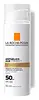
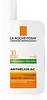
La Roche-Posay SPF 50 Anthelios Age Correct Versus La Roche-Posay Anthelios AC Matte Fluid Anti-Shine SPF 30
This chemical sunscreen covers the full UV range and blocks ~98% of UVB at SPF 50.
This hybrid sunscreen covers the full UV range and blocks ~97% of UVB at SPF 30.

What's inside
What's inside
 Key Ingredients
Benefits
Concerns
Ingredients Side-by-side
Water
Skin ConditioningC12-15 Alkyl Benzoate
AntimicrobialGlycerin
Humectant


Octocrylene
UV Absorber



Niacinamide
Smoothing









Butyl Methoxydibenzoylmethane
UV Absorber
Dimethicone
Emollient
Ethylhexyl Triazone
UV Absorber
Silica
Abrasive
Aluminum Starch Octenylsuccinate
Absorbent
Vinyl Dimethicone/Methicone Silsesquioxane Crosspolymer
Terephthalylidene Dicamphor Sulfonic Acid
UV Absorber
Potassium Cetyl Phosphate
EmulsifyingDrometrizole Trisiloxane
UV Absorber
PEG-100 Stearate
Surfactant

Stearyl Alcohol
Emollient
Glyceryl Stearate
Emollient
Ammonium Polyacryloyldimethyl Taurate
Emulsion StabilisingBenzyl Alcohol
Perfuming




Benzyl Benzoate
Antimicrobial
Capryloyl Salicylic Acid
Exfoliating
Caprylyl Glycol
Emollient
Hydrolyzed Hyaluronic Acid
Humectant
Phenoxyethanol
Preservative
Phenylethyl Resorcinol
Antioxidant
Poloxamer 338
EmulsifyingTocopherol
Antioxidant
Triethanolamine
BufferingTrisodium Ethylenediamine Disuccinate
ChelatingXanthan Gum
EmulsifyingParfum
Masking
Water, C12-15 Alkyl Benzoate, Glycerin, Octocrylene, Niacinamide, Butyl Methoxydibenzoylmethane, Dimethicone, Ethylhexyl Triazone, Silica, Aluminum Starch Octenylsuccinate, Vinyl Dimethicone/Methicone Silsesquioxane Crosspolymer, Terephthalylidene Dicamphor Sulfonic Acid, Potassium Cetyl Phosphate, Drometrizole Trisiloxane, PEG-100 Stearate, Stearyl Alcohol, Glyceryl Stearate, Ammonium Polyacryloyldimethyl Taurate, Benzyl Alcohol, Benzyl Benzoate, Capryloyl Salicylic Acid, Caprylyl Glycol, Hydrolyzed Hyaluronic Acid, Phenoxyethanol, Phenylethyl Resorcinol, Poloxamer 338, Tocopherol, Triethanolamine, Trisodium Ethylenediamine Disuccinate, Xanthan Gum, Parfum
Water
Skin ConditioningDimethicone
Emollient
Isononyl Isononanoate
EmollientAlcohol Denat.
Antimicrobial
Glycerin
Humectant
Octocrylene
UV Absorber
Talc
Abrasive
Titanium Dioxide
Cosmetic Colorant
Diisopropyl Sebacate
EmollientC12-15 Alkyl Benzoate
AntimicrobialPolymethylsilsesquioxane
Butyl Methoxydibenzoylmethane
UV Absorber
Styrene/Acrylates Copolymer
PEG-30 Dipolyhydroxystearate
Emulsifying
Bis-Ethylhexyloxyphenol Methoxyphenyl Triazine
UV Absorber
Nylon-12
Isododecane
EmollientSilica
Abrasive
Perlite
Absorbent
Propylene Glycol
Humectant
Cassia Alata Leaf Extract
AstringentDisodium EDTA
ChelatingDisteardimonium Hectorite
StabilisingDodecene
MaskingDrometrizole
UV AbsorberTrisiloxane
Skin Conditioning
Ethylhexyl Triazone
UV Absorber
Isopropyl Lauroyl Sarcosinate
Skin ConditioningLauryl PEG/PPG-18/18 Methicone
Skin Conditioning
Maltodextrin
Absorbent
Methicone
Emollient
PEG-8 Laurate
Emulsifying
Phenoxyethanol
Preservative
Poloxamer 407
EmulsifyingPropylene Carbonate
SolventTerephthalylidene Dicamphor Sulfonic Acid
UV Absorber
Tocopherol
Antioxidant
Triethanolamine
BufferingZinc Gluconate
Skin Conditioning
Water, Dimethicone, Isononyl Isononanoate, Alcohol Denat., Glycerin, Octocrylene, Talc, Titanium Dioxide, Diisopropyl Sebacate, C12-15 Alkyl Benzoate, Polymethylsilsesquioxane, Butyl Methoxydibenzoylmethane, Styrene/Acrylates Copolymer, PEG-30 Dipolyhydroxystearate, Bis-Ethylhexyloxyphenol Methoxyphenyl Triazine, Nylon-12, Isododecane, Silica, Perlite, Propylene Glycol, Cassia Alata Leaf Extract, Disodium EDTA, Disteardimonium Hectorite, Dodecene, Drometrizole, Trisiloxane, Ethylhexyl Triazone, Isopropyl Lauroyl Sarcosinate, Lauryl PEG/PPG-18/18 Methicone, Maltodextrin, Methicone, PEG-8 Laurate, Phenoxyethanol, Poloxamer 407, Propylene Carbonate, Terephthalylidene Dicamphor Sulfonic Acid, Tocopherol, Triethanolamine, Zinc Gluconate
Reviews
Ingredients Explained
These ingredients are found in both products.
Ingredients higher up in an ingredient list are typically present in a larger amount.
Also known as Avobenzone, this ingredient is an oil-soluble used to absorb the full spectrum of UVA rays (peak 357 nm).
It's one of the most effective UVA filters available but has a major caveat of photostability: avobenzone is susceptible to photodegradation.
This means it can lose efficacy when exposed to sunlight without the help of a stabilizing agent.
Studies show antioxidants (like vitamin E or vitamin C) and some UV filters (like octocrylene and Tinosorb S) can meaningfully improve its stability in a formulation.
The maximum allowable concentration according to regulation is 3% in the US + Canada, and 5% in the EU, Australia, China, Korea, and ASEAN countries.
It has a well-support safety profile: a comprehensive 2025 review found minimal toxicity with no evidence of carcinogenicity.
Overall, avobenzone is a safe and regulated ingredient used in sunscreen for over 40 years.
Learn more about Butyl MethoxydibenzoylmethaneC12-15 Alkyl Benzoate is a lightweight emollient made by combinig benzoic acid with fatty alcohols that are 12-15 carbons long.
In cosmetics, it plays several roles:
The Cosmetic Review Expert Panel has concluded the alkyl benzoate group to be safe as used in cosmetics; it wasn't found to be a skin irritant and unlikely to be absorbed due to its low water solubility.
This report recorded almost 1000 reported uses with concentrations up to 59% in leave-on products but your cosmetics will typically use 0.5-15% depending on the product.
It's often called a "SPF booster": this is because it keeps UV filters properly dissolved and evenly distributed to support a sunscreen's performance. It doesn't actually raise SPF on its own.
Overall, this ingredient is well tolerated.
This ingredient is fungal acne safe because it is an ester of benzoic acid.
Think of this ingredient as two parts stuck together: an oily part and an acid part. Malassezia only gets a meal when it can snip off a fatty acid to eat. With C12-15 Alkyl Benzoate, the acid part is benzoic acid, which isn't a fatty acid and which the yeast can't use as food.
Benzoic acid is actually used as a preservative to stop yeast from growing.
The oily part is a blend of C12-15 fatty alcohols but fatty alcohols in this size range can support only a little Malassezia growth (mostly for one species of Malassezia as well).
In the ingredient, those alcohols stay locked inside the molecule. The yeast can only reach them by snipping the benzoate bond, and that type of bond is harder for it to cut than a normal fatty bond.
So not much gets released. And whatever does get snipped comes packaged with benzoic acid, which discourages yeast growth.
Learn more about C12-15 Alkyl BenzoateDimethicone is a type of synthetic silicone created from natural materials such as quartz. It is also known as polydimethylsiloxane.
What it does:
Dimethicone comes in different viscosities:
Depending on the viscosity, dimethicone has different properties.
Ingredients lists don't always show which type is used, so we recommend reaching out to the brand if you have questions about the viscosity.
This ingredient is unlikely to cause irritation because it does not get absorbed into skin. However, people with silicone allergies should be careful about using this ingredient.
Note: Dimethicone may contribute to pilling. This is because it is not oil or water soluble, so pilling may occur when layered with products. When mixed with heavy oils in a formula, the outcome is also quite greasy.
Learn more about DimethiconeEthylhexyl Triazone (aka Octyl Triazone) is an oil-soluble organic UVB filter. It has peak absorption around 314 nm, right in the middle of the UVB range.
This ingredient is described as one of the most effective UVB filters available and small concentrations are enough to deliver a high SPF thanks to its strong UV absorbing power.
Formulators love it for its stability; its ability to filter UV stays practically unchanged even under intense radiation and it can also help boost the photostability of less stable filters like avobenzone.
It's also a great pick for water resistant products because it's insoluble in water and has a good affinity for keratin.
Because it's a big, heavy molecule, the European Scientific Committee has found to to have very low dermal penetration and negative results for allergenicity.
In vitro testing also showed a low absorption rate and clean results on irritation.
Typical use levels are 1-5% with 5% being the maximum in the EU, Japan, and other markets that allow it. However, this ingredient is not approved yet in the US or Canada.
Learn more about Ethylhexyl TriazoneGlycerin (or glycerol) is a compound naturally found in your skin. It's a powerhouse humectant that pulls water into the stratum corneum.
Topically, glycerin does several things at once:
Your skin makes glycerin on its own (mostly from sebaceous oil breakdown) and shuttles it to your outermost layer of skin, or your epidermis, via aquaporin-3.
Aquaporin-3 is a transporter that is essential for normal skin hydration, elasticity, and repair. Interestingly, mice lacking in AQP3 have dry and less elastic skin that can be fully corrected with glycerin.
This ingredient is non-irritating, plays well with almost every ingredient, and works across all skin types. Typical use is anywhere between 3-10% but can go up to 79% in some leave-on products.
Just know very high concentrations (>40%) can feel tacky in low humidity.
Glycerin is the name for this ingredient in American English. British English uses Glycerol/Glycerine.
Learn more about GlycerinOctocrylene is an oil-soluble organic UV filter that mainly absorbs UVB and short wave UVA II light.
Its real superpower is teamwork: octocrylene is remarkably photostable and is most famous for stabilizing avobenzone (the workhorse UVA filter).
This ingredient is commonly used to enhance both UVB and UVA protection due to its unique property in stabilizing avobenzone. It also pulls double duty by boosting water resistance and giving formulas a smooth, spreadable feel.
The EU's Scientific Committee on Consumer Safety (SCCS) has deemed octocrylene to be safe as a UV-filter at concentrations up to 10% (capped at 9% in propellant sprays). The US also permits it up to 10%.
Two things worth knowing:
You'll usually see this ingredient used in concentrations between 2-10% (higher amounts when used as a stabilizer for avobenzone).
Learn more about OctocrylenePhenoxyethanol is one of the most widely used preservatives in skincare (and for good reason!).
It has a large spectrum of antimicrobial activity and especially effective bacteria, yeast, and mold while only having a weak effect on your skin's natural microbiome.
On a cellular level, it disrupts the cell membranes of microbes by poking holes that make the cell leak. This shuts down the chemical reactions the microbe needs to make energy so it can no longer survive.
Another perk of this ingredient is that it stays functional across a wide pH range (3-10).
You'll often see it paired with boosters like Ethylhexylglycerin; one study showed that a 1:9 ratio of Ethylhexylglycerin to Phenoxyethanol damages bacterial membranes as effectively as doubling the Phenoxyethanol concentration on its own.
Typical use concentrations range from 0.3-1% depending on the formula, and this ingredient is capped at 1% int the EU.
Safety-wise, the fear mongering does not hold up to the evidence. The EU's Scientific Committee on Consumer Safety and FDA consider it safe as a preservative at up to 1%, including for children of all ages.
Adverse systemic effects only showed up in animal studies at exposures roughly 200x higher than what people get from cosmetics. And despite its very widespread use, this ingredient is a rare sensitizer and allergic reactions are uncommon.
Learn more about PhenoxyethanolSilica, also known as silicon dioxide, is a naturally occurring mineral. It is used as a fine, spherical, and porous powder in cosmetics.
Though it has exfoliant properties, the function of silica varies depending on the product.
The unique structure of silica enhances the spreadability and adds smoothness, making it a great texture enhancer.
It is also used as an active carrier, emulsifier, and mattifier due to its ability to absorb excess oil.
In some products, tiny microneedles called spicules are made from silica or hydrolyzed sponge. When you rub them in, they lightly polish away dead skin layers and enhance the penetration of active ingredients.
Learn more about SilicaTerephthalylidene Dicamphor Sulfonic Acid (aka ecamsule or Mexoryl SX) is a water-soluble organic UV filter developed and patented by L'Oreal back in 1982.
It's one of the better UVA protectors out there and shields skin across a broad UVA range (~290-390 nm) with peak absorption right around 345 nm.
This peak absorption happens to be the exact type of UVA light that sinks deepest into skin and does the most to cause aging and dark spots.
Ecamsule works by soaking up UV rays and turning them into a tiny bit of harmless heat. The molecule basically flips, releases that energy as heat, then snaps back to its original shape and does it all over again. This is also why it's so stable in sunlight and doesn't break down or wear out the way some filters do.
The clinical backing for this ingredient is solid as well:
A large 2008 review by Fourtanier & colleagues (2008) pulled together human trials showing ecamsule-containing sunscreens prevented UV-induced pigmentation, DNA damage, and signs of aging.
That built on earlier work by Seite et al. (1998) that found it protected skin from repeated low-level UVA exposure. And a controlled study by DeLeo et al. (2009) showed that even an SPF 40 cream with ecamsule helped prevent sun-triggered rash even under the real sun.
On concentrations:
Because this ingredient is an acid, it has to be neutralized so it doesn't tank the product's pH.
Safety-wise, it's pretty well tolerated. There are some rare cases of mild irritation mostly in people with sensitivities towards camphor derivatives.
A 2019 FDA study found that volunteers who slathered on sunscreen heavily for several days had tiny amounts of ecamsule show up in their blood. This was slightly above the level at which the FDA asks for extra safety testing; this just means the FDA wants more safety studies done and not evidence that anything harmful actually happens. No problems were found and dermatologists still recommend using sunscreen.
Learn more about Terephthalylidene Dicamphor Sulfonic AcidTocopherol is a fat-soluble antioxidant known as Vitamin E.
You'll find this ingredient in the vast majority of skincare (for good reason). It works to neutralize free radicals, or unstable molecules generated by UV exposure, pollution, and other environmental stressors, before they can cause oxidative damage to your skin cells.
Topically applied tocopherol has been shown to protect against UV damage by ramping up the skin's own natural defense enzymes.
It also acts as a skin conditioning agent; some studies show that regular topical use can improve the skin's water-binding capacity over 2-4 weeks.
This ingredient is especially loved for being a team player. When combined with Vitamin C, the photoprotective effect of both ingredients roughly doubles and the combo also helps reduce UV-induced DNA damage.
This ingredient has some brightening potential but it's more of a prevention ingredient than spot-fader. Cell studies show it can slow down melanin production but it's worth noting that it's not the most powerful brightener out there.
In formulations, it also serves as a stabilizer that helps protect other oxidation-prone ingredients from degrading.
Concentrations usually range from 0.1-1% in most leave-on products.
Learn more about TocopherolTriethanolamine (TEA) is an emulsifier and pH adjuster. It is created using ethylene oxide and ammonia. This gives Triethanolamine a nitrogen core and a similar scent to ammonia.
As an emulsifier, it prevents ingredients from separating and enhances texture by adding volume to a product.
PH adjusters are common in cosmetic products. The pH of a product can affect the effectiveness of other ingredients. A product with a high pH may also irritate the skin.
If you are looking for the tea leaf ingredient, click here.
Learn more about TriethanolamineWater. It's the most common cosmetic ingredient of all. You'll usually see it at the top of ingredient lists, meaning that it makes up the largest part of the product.
So why is it so popular? Water most often acts as a solvent - this means that it helps dissolve other ingredients into the formulation.
You'll also recognize water as that liquid we all need to stay alive. If you see this, drink a glass of water. Remember to stay hydrated!
Learn more about Water

