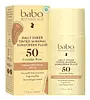
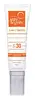
babo botanicals Daily Sheer Tinted Mineral Sunscreen Fluid SPF 50 Versus Suntegrity 5-IN-1 Tinted Sunscreen Moisturizer - Broad Spectrum SPF 30

What's inside
What's inside
 Key Ingredients
Benefits
Concerns
Ingredients Side-by-side
Zinc Oxide 20.6%
Cosmetic Colorant


Water
Skin ConditioningButyloctyl Salicylate
Skin Conditioning
Diheptyl Succinate
EmollientCalcium Sodium Borosilicate
Octyldodecyl Neopentanoate
EmollientErythritol
Humectant
Lauryl Laurate
Skin Conditioning
Passiflora Edulis Seed Oil
Emollient
Propanediol
Solvent
Carthamus Tinctorius Flower
MaskingBentonite
Absorbent

Aloe Barbadensis Leaf Juice
Skin Conditioning
Lupinus Albus Seed Oil
Skin Conditioning
Rubus Idaeus Seed Oil
Emollient
Bisabolol
Antioxidant

Tocopherol
Antioxidant



Glycerin
Humectant
Helianthus Annuus Seed Oil
Emollient
Calendula Officinalis Flower Extract
Masking
Chamomilla Recutita Flower Extract
Masking
Nasturtium Officinale Flower/Leaf Extract
AntiseborrhoeicSpiraea Ulmaria Flower Extract
Skin ConditioningTriticum Vulgare Germ Oil Unsaponifiables
Emollient
Hydrolyzed Wheat Protein/Pvp Crosspolymer
Cetearyl Alcohol
Emollient



Caprylyl Glycol
Emollient
Ethyl Ferulate
Antioxidant
Sucrose Polystearate
EmollientCapryloyl Glycerin
Sucrose Stearate
EmollientCoco-Glucoside
Cleansing
Octyldodecyl Oleate
Emollient
Polyhydroxystearic Acid
Emulsifying
Sodium Gluconate
Skin ConditioningCaprylhydroxamic Acid
Microcrystalline Cellulose
AbsorbentXanthan Gum
EmulsifyingCitric Acid
Buffering

Iron Oxides
Zinc Oxide 20.6%, Water, Butyloctyl Salicylate, Diheptyl Succinate, Calcium Sodium Borosilicate, Octyldodecyl Neopentanoate, Erythritol, Lauryl Laurate, Passiflora Edulis Seed Oil, Propanediol, Carthamus Tinctorius Flower, Bentonite, Aloe Barbadensis Leaf Juice, Lupinus Albus Seed Oil, Rubus Idaeus Seed Oil, Bisabolol, Tocopherol, Glycerin, Helianthus Annuus Seed Oil, Calendula Officinalis Flower Extract, Chamomilla Recutita Flower Extract, Nasturtium Officinale Flower/Leaf Extract, Spiraea Ulmaria Flower Extract, Triticum Vulgare Germ Oil Unsaponifiables, Hydrolyzed Wheat Protein/Pvp Crosspolymer, Cetearyl Alcohol, Caprylyl Glycol, Ethyl Ferulate, Sucrose Polystearate, Capryloyl Glycerin, Sucrose Stearate, Coco-Glucoside, Octyldodecyl Oleate, Polyhydroxystearic Acid, Sodium Gluconate, Caprylhydroxamic Acid, Microcrystalline Cellulose, Xanthan Gum, Citric Acid, Iron Oxides
Zinc Oxide 20%
Cosmetic Colorant
Aloe Barbadensis Leaf Water
MaskingCaprylic/Capric Triglyceride
Masking
Polyglyceryl-3 Polyricinoleate
Emulsifying
Glycerin
Humectant
Hydrogenated Castor Oil
Emollient
Sorbitan Sesquioleate
Emulsifying
Hydrogenated Methyl Abietate
Stearyl/Octyldodecyl Citrate Crosspolymer
HumectantMagnesium Sulfate
Glyceryl Caprylate
EmollientSimmondsia Chinensis Seed Oil
Emollient
Cucumis Sativus Extract
Skin Conditioning
Camellia Sinensis Extract
Antioxidant
Helianthus Annuus Seed Oil
Emollient
Punica Granatum Seed Oil
Emollient
Astaxanthin
Skin Conditioning
Sodium Hyaluronate
Humectant
Caprylhydroxamic Acid
Ethylhexylglycerin
Skin ConditioningGalactoarabinan
Iron Oxides
Zinc Oxide 20%, Aloe Barbadensis Leaf Water, Caprylic/Capric Triglyceride, Polyglyceryl-3 Polyricinoleate, Glycerin, Hydrogenated Castor Oil, Sorbitan Sesquioleate, Hydrogenated Methyl Abietate, Stearyl/Octyldodecyl Citrate Crosspolymer, Magnesium Sulfate, Glyceryl Caprylate, Simmondsia Chinensis Seed Oil, Cucumis Sativus Extract, Camellia Sinensis Extract, Helianthus Annuus Seed Oil, Punica Granatum Seed Oil, Astaxanthin, Sodium Hyaluronate, Caprylhydroxamic Acid, Ethylhexylglycerin, Galactoarabinan, Iron Oxides
Reviews
Ingredients Explained
These ingredients are found in both products.
Ingredients higher up in an ingredient list are typically present in a larger amount.
Caprylhydroxamic Acid is a chelating agent that helps cosmetics stay fresh, stable, and consistent over time.
Chelating agents help prevent metal ions from binding to other ingredients. This helps prevent unwanted reactions and effects from using the product. It also helps prevent the growth of unwanted microbes in products that contain water.
Caprylhydroxamic Acid is often used with natural antimicrobial products as an alternative to preservatives.
Learn more about Caprylhydroxamic AcidGlycerin (or glycerol) is a compound naturally found in your skin. It's a powerhouse humectant that pulls water into the stratum corneum.
Topically, glycerin does several things at once:
Your skin makes glycerin on its own (mostly from sebaceous oil breakdown) and shuttles it to your outermost layer of skin, or your epidermis, via aquaporin-3.
Aquaporin-3 is a transporter that is essential for normal skin hydration, elasticity, and repair. Interestingly, mice lacking in AQP3 have dry and less elastic skin that can be fully corrected with glycerin.
This ingredient is non-irritating, plays well with almost every ingredient, and works across all skin types. Typical use is anywhere between 3-10% but can go up to 79% in some leave-on products.
Just know very high concentrations (>40%) can feel tacky in low humidity.
Glycerin is the name for this ingredient in American English. British English uses Glycerol/Glycerine.
Learn more about GlycerinHelianthus Annuus Seed Oil is a plant oil derived from the seeds of a sunflower.
It is rich in fatty acids, primarily linoleic acid and oleic acid. This gives it emollient and skin conditioning properties.
The reason this ingredient is so effective is because it forms a thin film on the skin that reduces transepidermal water loss (TEWL) while supplying linoleic acid to the stratum corneum to improve barrier strength.
The high linoleic acid content is particularly noteworthy for acne-prone skin.
Research suggests that acne-prone skin tends to be deficient in linoleic acid in sebum. Topical application may help replenish this to support a healthier follicular environment and less comedone-promoting sebum.
One randomized study found sunflower seed oil preserved skin barrier integrity in adult volunteers with and without atopic dermatitis (outperforming olive oil).
This ingredient is well-studied, gentle, and an effective emollient suitable for most skin types.
On fungal acne: This ingredient may not be Fungal acne (Malassezia folliculitis) safe. This is because it contains fatty acids with carbon chain lengths in the C11-C24 range.
Learn more about Helianthus Annuus Seed OilZinc Oxide is a mineral broad-spectrum UV filter; it is the broadest UVA and UVB reflector approved by the FDA. It also has skin protectant and skin soothing properties.
Zinc oxide is one of the most effective broad-spectrum UV filters. It protects against UVB, UVAII, and UVAI. In comparison to its counterpart titanium dioxide, zinc oxide provides uniform and extended UVA protection.
Another great benefit? This ingredient is highly photostable so it won't degrade easily under sunlight.
A common myth is that mineral UV filters are widely believed to primarily reflect UV light.
However, modern research shows titanium dioxide absorbs UV radiation like chemical filters (~95% absorption & 5% reflection).
Zinc oxide has great skin soothing properties so you'll likely find this in sunscreens formulated for sensitive skin or babies/children. It is unlikely to cause "eye sting" like other sunscreen ingredients.
Regulatory agencies consider zinc oxide to be non-toxic and safe. It has also been shown to not penetrate the skin.
Unfortunately, this ingredient does leave a visible white cast. This is why mineral sunscreens are often less cosmetically elegant than chemical or hybrid ones.
In cosmetics, zinc oxide can be found in both non-nano and nano-sized forms. The nano version is used to reduce white cast and improve the texture of sunscreen formulas.
There are ongoing concerns surrounding nano-zinc oxide's impact on marine ecosystems and whether it can be absorbed into skin.
Regarding marine ecosystems and coral reefs, there is no conclusive evidence that any form of zinc oxide (or any other sunscreen ingredients) will cause harm. The science is still developing but many consumers are keeping a close eye on this issue.
Please note, many destinations have reef-safety sunscreen rules. For instance, the U.S. Virgin Islands advises all visitors to use non-nano mineral sunscreens.
There has also been some stir about whether micronized or nano zinc oxide has potential photoxicity and absorption through the skin/lungs.
An in-vitro (done in a test tube or petri dish) study demonstrated micronized zinc oxide to have potential phototoxicity. There's no need to fret; the EU Commission's Scientific Committee on Consumer Safety has stated, "The relevance of these findings needs to be clarified by appropriate investigations in vivo." Or in other words, further studies done on living organisms are needed to prove this.
Current research shows zinc oxide nanoparticles do not penetrate intact or sunburned skin. They either remain on the surface or in the outermost layer of dead skin (stratum corneum).
Zinc oxide is one of only two classified mineral UV filters with titanium dioxide being the other one.
Fun fact: Zinc has been used throughout history as an ingredient in paint and medicine. An Indian text from 500BC is believed to list zinc oxide as a salve for open wound. The Ancient Greek physician Dioscorides has also mentioned the use of zinc as an ointment in 1AD.
Learn more about Zinc OxideThis ingredient is a combination of red, black, and yellow iron oxide pigments. This combination of colors is usually found in foundation, because it results in a "skin" color.
The EU typically uses CI numbers for colorants when applicable, such as CI 77489. In the US, iron oxides are regulated as color additives and "iron oxides" is the most commonly used name in US cosmetic practice.
A 2021 paper looked at skincare formulations containing iron oxides and found that they reduced transmission of blue light when measured optically. In simple terms, the pigment particles helped block or scatter part of the visible light spectrum in lab testing and the authors suggest this could translate into better protection against blue-light-related skin effects.
There is also clinical and experimental research showing that tinted products containing iron oxides can reduce visible light-induced pigmentation:
Please note, whether a product reduces visible or blue light depends on things like:
In the EU's CosIng database, iron oxides are only listed as a colorant. CosIng groups ingredients by their main cosmetic role, such as colorant, preservative, or UV filter.
Though studies say iron oxides can "attenuate blue light", they're describing an optical property and not an officially recognized cosmetic function.
So CosIng isn’t contradicting the research. It’s just classifying iron oxides by what they officially are: pigments that add color.
Learn more about Iron Oxides
