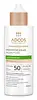
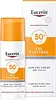
Adcos Protetor Solar Aqua Fluid SPF 50 Versus Eucerin Sun Face Oil Control Dry Touch Gel-Cream SPF 50+
This hybrid sunscreen covers the full UV range and blocks ~98% of UVB at SPF 50.
This chemical sunscreen covers most of the UV range, lighter on the deep UVA that drives aging.


What's inside
What's inside
 Key Ingredients
Benefits
Concerns
Ingredients Side-by-side
Water
Skin ConditioningDisodium Phenyl Dibenzimidazole Tetrasulfonate
UV Absorber
Ethylhexyl Methoxycinnamate
UV Absorber

CI 77891
Cosmetic ColorantDicaprylyl Carbonate
EmollientDiisopropyl Adipate
EmollientPhenylbenzimidazole Sulfonic Acid
UV Absorber
Bis-Ethylhexyloxyphenol Methoxyphenyl Triazine
UV Absorber
Niacinamide
Smoothing











Diethylamino Hydroxybenzoyl Hexyl Benzoate
UV Filter
Sodium Hydroxide
BufferingVp/Va Copolymer
Caprylyl Methicone
Skin Conditioning
Potassium Cetyl Phosphate
EmulsifyingAluminum Starch Octenylsuccinate
Absorbent
Phenoxyethanol
Preservative
Hydrogenated Palm Glycerides
Emollient

Methylene Bis-Benzotriazolyl Tetramethylbutylphenol
UV Filter
Glycereth-26 Caprylate
EmollientDimethicone
Emollient
Titanium Dioxide
Cosmetic Colorant
Caprylyl Glycol
Emollient
Sodium Stearoyl Glutamate
CleansingSilica
Abrasive
Glyceryl Stearate
Emollient
Cetyl Alcohol
Emollient
CI 77492
Cosmetic ColorantMatrine
Antioxidant
Aesculus Hippocastanum Extract
Antioxidant
Hydrogen Dimethicone
CI 77499
Cosmetic ColorantAmmonium Glycyrrhizate
MaskingAluminum Hydroxide
EmollientPropylene Glycol
Humectant

Panthenol
Skin Conditioning
Zinc Gluconate
Skin Conditioning
Hydrolyzed Hyaluronic Acid
Humectant
Caffeine
Skin Conditioning
Biotin
AntiseborrhoeicWater, Disodium Phenyl Dibenzimidazole Tetrasulfonate, Ethylhexyl Methoxycinnamate, CI 77891, Dicaprylyl Carbonate, Diisopropyl Adipate, Phenylbenzimidazole Sulfonic Acid, Bis-Ethylhexyloxyphenol Methoxyphenyl Triazine, Niacinamide, Diethylamino Hydroxybenzoyl Hexyl Benzoate, Sodium Hydroxide, Vp/Va Copolymer, Caprylyl Methicone, Potassium Cetyl Phosphate, Aluminum Starch Octenylsuccinate, Phenoxyethanol, Hydrogenated Palm Glycerides, Methylene Bis-Benzotriazolyl Tetramethylbutylphenol, Glycereth-26 Caprylate, Dimethicone, Titanium Dioxide, Caprylyl Glycol, Sodium Stearoyl Glutamate, Silica, Glyceryl Stearate, Cetyl Alcohol, CI 77492, Matrine, Aesculus Hippocastanum Extract, Hydrogen Dimethicone, CI 77499, Ammonium Glycyrrhizate, Aluminum Hydroxide, Propylene Glycol, Panthenol, Zinc Gluconate, Hydrolyzed Hyaluronic Acid, Caffeine, Biotin
Water
Skin ConditioningHomosalate
Skin Conditioning
Polymethylsilsesquioxane
Butyl Methoxydibenzoylmethane
UV Absorber
Ethylhexyl Salicylate
UV Absorber
Octocrylene
UV Absorber
Alcohol Denat.
Antimicrobial

Tapioca Starch
Phenylbenzimidazole Sulfonic Acid
UV Absorber
Cyclomethicone
Emollient
Behenyl Alcohol
Emollient
Cetearyl Alcohol
Emollient

Methylpropanediol
SolventSilica Dimethyl Silylate
EmollientGlycerin
Humectant
Carnitine
Cleansing
Glycyrrhetinic Acid
Skin Conditioning
Glycyrrhiza Inflata Root Extract
Skin Conditioning
Sodium Stearoyl Glutamate
CleansingAcrylates/C10-30 Alkyl Acrylate Crosspolymer
Emulsion StabilisingCarbomer
Emulsion StabilisingXanthan Gum
EmulsifyingSodium Hydroxide
BufferingSodium Chloride
MaskingTrisodium EDTA
Ethylhexylglycerin
Skin ConditioningPhenoxyethanol
Preservative
Water, Homosalate, Polymethylsilsesquioxane, Butyl Methoxydibenzoylmethane, Ethylhexyl Salicylate, Octocrylene, Alcohol Denat., Tapioca Starch, Phenylbenzimidazole Sulfonic Acid, Cyclomethicone, Behenyl Alcohol, Cetearyl Alcohol, Methylpropanediol, Silica Dimethyl Silylate, Glycerin, Carnitine, Glycyrrhetinic Acid, Glycyrrhiza Inflata Root Extract, Sodium Stearoyl Glutamate, Acrylates/C10-30 Alkyl Acrylate Crosspolymer, Carbomer, Xanthan Gum, Sodium Hydroxide, Sodium Chloride, Trisodium EDTA, Ethylhexylglycerin, Phenoxyethanol
Reviews
Ingredients Explained
These ingredients are found in both products.
Ingredients higher up in an ingredient list are typically present in a larger amount.
Phenoxyethanol is one of the most widely used preservatives in skincare (and for good reason!).
It has a large spectrum of antimicrobial activity and especially effective bacteria, yeast, and mold while only having a weak effect on your skin's natural microbiome.
On a cellular level, it disrupts the cell membranes of microbes by poking holes that make the cell leak. This shuts down the chemical reactions the microbe needs to make energy so it can no longer survive.
Another perk of this ingredient is that it stays functional across a wide pH range (3-10).
You'll often see it paired with boosters like Ethylhexylglycerin; one study showed that a 1:9 ratio of Ethylhexylglycerin to Phenoxyethanol damages bacterial membranes as effectively as doubling the Phenoxyethanol concentration on its own.
Typical use concentrations range from 0.3-1% depending on the formula, and this ingredient is capped at 1% int the EU.
Safety-wise, the fear mongering does not hold up to the evidence. The EU's Scientific Committee on Consumer Safety and FDA consider it safe as a preservative at up to 1%, including for children of all ages.
Adverse systemic effects only showed up in animal studies at exposures roughly 200x higher than what people get from cosmetics. And despite its very widespread use, this ingredient is a rare sensitizer and allergic reactions are uncommon.
Learn more about PhenoxyethanolPhenylbenzimidazole Sulfonic Acid (aka Ensulizole) is a chemical UV filter that's a bit of a unicorn in the sunscreen world: it's water-soluble where most organic filters are oil-based.
Being water-solubility is the headline because it feels lightweight and non-greasy in formulations. This makes it suitable for oily or acne-prone skin in gel/water-based products.
Ensulizole primarily protects against UVB radiation (~290-320 nm) but offers some minimal UVA protection. You'll see it often paired with UVA filters to ensure broad-spectrum coverage.
Interestingly, it can help boost SPF and stabilize finicky filters when combined with other UVB absorbers.
The FDA has approved this ingredient for OTC sunscreens up to 4% and the EU's Scientific Committee on Consumer Products concluded that up to 8% is allowed in cosmetics.
In practice, you'll most likely see it formulated around 1-4%.
Safety-wise, it is neither irritating nor sensitizing, shows no photoallergenic potential, and in vivo tests show no mutagenic potential.
You might see discussion about the "double-edged sword" effect of this ingredient. This is because lab tests done on cells in a dish (not on humans) showed Ensulizole can create small amounts of unstable molecules called free radicals that can damage DNA when exposed to UV light. It sounds scary but this is just test-tube research. There hasn't been proof that this can happen when used in a sunscreen on skin.
Learn more about Phenylbenzimidazole Sulfonic AcidSodium Hydroxide is also known as lye or caustic soda. It is used to adjust the pH of products; many ingredients require a specific pH to be effective.
In small amounts, sodium hydroxide is considered safe to use. However, large amounts may cause chemical burns due to its high alkaline.
Your skin has a natural pH and acid mantle. This acid mantle helps prevent harmful bacteria from breaking through. The acid mantle also helps keep your skin hydrated.
"Alkaline" refers to a high pH level. A low pH level would be considered acidic.
Learn more about Sodium HydroxideSodium Stearoyl Glutamate is an amino-acid based emulsifier. It is made by combining stearic acid with L-glutamic acid and neutralizing it to a sodium salt.
As an emulsifier, it works mainly as an oil-in-water one and helps keep the oil and water in your formulas blended. It also contributes to a smooth, non-greasy skin feel.
This ingredient is biodegradable and commonly available in natural/COSMOS-certified grades.
Learn more about Sodium Stearoyl GlutamateWater. It's the most common cosmetic ingredient of all. You'll usually see it at the top of ingredient lists, meaning that it makes up the largest part of the product.
So why is it so popular? Water most often acts as a solvent - this means that it helps dissolve other ingredients into the formulation.
You'll also recognize water as that liquid we all need to stay alive. If you see this, drink a glass of water. Remember to stay hydrated!
Learn more about Water

