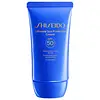
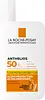
Shiseido Ultimate Sun Protector Cream SPF 50 Versus La Roche-Posay Anthelios Invisible Fluid Facial Sunscreen SPF50+
This hybrid sunscreen covers the full UV range and blocks ~98% of UVB at SPF 50.
This chemical sunscreen covers the full UV range and blocks ~98% of UVB at SPF 50.


What's inside
What's inside
 Key Ingredients
Benefits
Concerns
Ingredients Side-by-side
Ethylhexyl Salicylate 3%
UV Absorber

Octocrylene 3%
UV Absorber

Zinc Oxide 19.4%
Cosmetic Colorant
Water
Skin ConditioningDiisopropyl Sebacate
EmollientIsopropyl Myristate
Emollient



Alcohol Denat.
Antimicrobial

PEG/PPG-9/2 Dimethyl Ether
Skin ConditioningGlycerin
Humectant


Alcohol
Antimicrobial
PPG-3 Dipivalate
Skin ConditioningTalc
Abrasive
Polyglyceryl-6 Polyricinoleate
Emulsifying
Silica
Abrasive
Dextrin Palmitate
Emulsifying
Dextrin Palmitate/Ethylhexanoate
Emulsifying
Acrylamides/Dmapa Acrylates/Methoxy PEG Methacrylate Copolymer
Dipotassium Glycyrrhizate
Humectant

Aminoethanesulfinic Acid
Antioxidant
PEG/PPG-14/7 Dimethyl Ether
Skin ConditioningSaxifraga Sarmentosa Extract
Skin ConditioningCamellia Sinensis Leaf Extract
Antimicrobial

Eucheuma Serra/Grateloupia Sparsa/Saccharina Angustata/Ulva Linza/Undaria Pinnatifida Extract
EmollientSodium Hyaluronate
Humectant
Sophora Angustifolia Root Extract
Skin ConditioningSaccharina Angustata/Undaria Pinnatifida Extract
EmollientHydrogen Dimethicone

Dimethylacrylamide/Sodium Acryloyldimethyltaurate Crosspolymer
Hydroxypropyl Methylcellulose Stearoxy Ether
Succinoglycan
Skin ConditioningTocopherol
Antioxidant

BHT
Antioxidant
Butylene Glycol
Humectant
Stearic Acid
Cleansing
Sodium Metabisulfite
Antioxidant
PEG-6
HumectantBis-Butyldimethicone Polyglyceryl-3
Cleansing
Syzygium Jambos Leaf Extract
Skin ConditioningChlorphenesin
Antimicrobial
Parfum
Masking

Ethylhexyl Salicylate 3%, Octocrylene 3%, Zinc Oxide 19.4%, Water, Diisopropyl Sebacate, Isopropyl Myristate, Alcohol Denat., PEG/PPG-9/2 Dimethyl Ether, Glycerin, Alcohol, PPG-3 Dipivalate, Talc, Polyglyceryl-6 Polyricinoleate, Silica, Dextrin Palmitate, Dextrin Palmitate/Ethylhexanoate, Acrylamides/Dmapa Acrylates/Methoxy PEG Methacrylate Copolymer, Dipotassium Glycyrrhizate, Aminoethanesulfinic Acid, PEG/PPG-14/7 Dimethyl Ether, Saxifraga Sarmentosa Extract, Camellia Sinensis Leaf Extract, Eucheuma Serra/Grateloupia Sparsa/Saccharina Angustata/Ulva Linza/Undaria Pinnatifida Extract, Sodium Hyaluronate, Sophora Angustifolia Root Extract, Saccharina Angustata/Undaria Pinnatifida Extract, Hydrogen Dimethicone, Dimethylacrylamide/Sodium Acryloyldimethyltaurate Crosspolymer, Hydroxypropyl Methylcellulose Stearoxy Ether, Succinoglycan, Tocopherol, BHT, Butylene Glycol, Stearic Acid, Sodium Metabisulfite, PEG-6, Bis-Butyldimethicone Polyglyceryl-3, Syzygium Jambos Leaf Extract, Chlorphenesin, Parfum
Water
Skin ConditioningAlcohol Denat.
Antimicrobial
Diisopropyl Sebacate
EmollientSilica
Abrasive
Isopropyl Myristate
Emollient
Ethylhexyl Salicylate
UV Absorber
Ethylhexyl Triazone
UV Absorber
Bis-Ethylhexyloxyphenol Methoxyphenyl Triazine
UV Absorber
Butyl Methoxydibenzoylmethane
UV Absorber
Glycerin
Humectant
C12-22 Alkyl Acrylate/Hydroxyethylacrylate Copolymer
StabilisingPropanediol
Solvent
Drometrizole Trisiloxane
UV Absorber
Perlite
Absorbent
Tocopherol
Antioxidant
Caprylic/Capric Triglyceride
Masking
Acrylates/C10-30 Alkyl Acrylate Crosspolymer
Emulsion StabilisingCaprylyl Glycol
Emollient
Hydroxyethylcellulose
Emulsion StabilisingTerephthalylidene Dicamphor Sulfonic Acid
UV Absorber
Triethanolamine
BufferingTrisodium Ethylenediamine Disuccinate
ChelatingWater, Alcohol Denat., Diisopropyl Sebacate, Silica, Isopropyl Myristate, Ethylhexyl Salicylate, Ethylhexyl Triazone, Bis-Ethylhexyloxyphenol Methoxyphenyl Triazine, Butyl Methoxydibenzoylmethane, Glycerin, C12-22 Alkyl Acrylate/Hydroxyethylacrylate Copolymer, Propanediol, Drometrizole Trisiloxane, Perlite, Tocopherol, Caprylic/Capric Triglyceride, Acrylates/C10-30 Alkyl Acrylate Crosspolymer, Caprylyl Glycol, Hydroxyethylcellulose, Terephthalylidene Dicamphor Sulfonic Acid, Triethanolamine, Trisodium Ethylenediamine Disuccinate
Reviews
Ingredients Explained
These ingredients are found in both products.
Ingredients higher up in an ingredient list are typically present in a larger amount.
Alcohol Denat. is an alcohol with a denaturant property. It is created by mixing ethanol with other additives.
The "denat" part just means "denatured"; common denaturants include Denatonium Benzoate, t-butyl alcohol, and Diethyl Phthalate. This step makes the alcohol undrinkable (and lets brand skip taxes related to beverage alcohol).
This ingredient gets a bad rep because it is irritating and drying due to its astringent property. Astringents draw out natural oils in tissue to constrict pores and dry out your skin.
However, alcohol denat. is not all that bad.
Due to its low molecular weight, alcohol denat. tends to evaporate quickly. One study on pig skin found half of applied alcohol evaporated in 10 seconds and less than 3% stayed on skin.
This also helps other ingredients become better absorbed upon application.
Studies are conflicted about whether this ingredient causes skin dehydration. One study from 2005 found adding emollients to propanol-based sanitizer decreased skin dryness and irritation. Another study found irritation only occurs if your skin is already damaged.
Small amounts of alcohol are generally tolerated by oily skin or people who live in humid environments.
The rule of thumb is this ingredient will probably not affect your skin much if it is near the end of an ingredients list.
One thing to note:
People with ALDH2 (aldehyde dehydrogenase 2) deficiency may experience skin irritation from continued alcohol use. About 8% of the world's population have this deficiency.
The Cosmetic Ingredient Review Expert Panel has determined denatured alcohols to be safe for use in concentrations between 0.05% and 12% (depending on which denaturant is used).
Also...
This ingredient has antimicrobial and solvent properties.
The antimicrobial property helps preserve products and increase their shelf life. As a solvent, it helps dissolve other ingredients.
Look for formulas that contain glycerin, hyaluronic acid, or panthenol if you want to offset any drying effect.
This ingredient will trip away your skin's natural oils/lipids that help it lock in moisture. This can worsen dryness, trigger eczema flare-ups, and aggravate rosacea.
Be sure to patch test any product with this ingredient if you have dry or sensitive skin, eczema, or rosacea.
Learn more about Alcohol Denat.We don't have a description for Diisopropyl Sebacate yet.
Ethylhexyl Salicylate (also called Octisalate or Octyl Salicylate) is an oil-soluble organic UV filter that's been used in sunscreen since the 1950's.
It absorbs UVB light in the 280-320 nm range with a peak absorbance around 306 nm.
You'll often see it paired with other UV filters to boost overall SPF because octisalate is a fairly week filter on its own.
The reason you'll see it so often is because it can help solubilize and stabilize the trickier filters like oxybenzone and avobenzone.
Unlike these filters, octisalate has pretty good photostability and doesn't create skin-damaging free radicals when exposed to sunlight.
The fatty-alcohol part of the molecule also gives it a light, emollient feel so it doubles as a nice texture enhancer.
Usage levels vary around the world:
Safety-wise, this ingredient has a pretty reassuring track record. The EU's Scientific Committee on Consumer Products (SCCP) found very low skin penetration in human skin tests and negative results for irritation, phototoxicity, and photoallergy.
The real-world allergy risk is pretty low too; a 2012 European study of 1,031 people recorded only 2 reactions to it (a rate of 0.19%).
You might have seen scary headlines about sunscreen getting into your blood.
In 2019, the FDA found that several chemical filters can absorb through the skin and show up in the bloodstream at small but measurable levels.
Here's the important part: these tiny levels are just a cutoff the FDA uses to decide which ingredients need more testing and doesn't mean anything harmful was found.
The researchers were clear that the results are no reason to stop wearing sunscreen.
Learn more about Ethylhexyl SalicylateGlycerin (or glycerol) is a compound naturally found in your skin. It's a powerhouse humectant that pulls water into the stratum corneum.
Topically, glycerin does several things at once:
Your skin makes glycerin on its own (mostly from sebaceous oil breakdown) and shuttles it to your outermost layer of skin, or your epidermis, via aquaporin-3.
Aquaporin-3 is a transporter that is essential for normal skin hydration, elasticity, and repair. Interestingly, mice lacking in AQP3 have dry and less elastic skin that can be fully corrected with glycerin.
This ingredient is non-irritating, plays well with almost every ingredient, and works across all skin types. Typical use is anywhere between 3-10% but can go up to 79% in some leave-on products.
Just know very high concentrations (>40%) can feel tacky in low humidity.
Glycerin is the name for this ingredient in American English. British English uses Glycerol/Glycerine.
Learn more about GlycerinIsopropyl Myristate is an ester made by combining isopropyl alcohol with myristic acid.
It is primarily an emollient and penetration enhancer that gives products a lightweight, silky feel without the heaviness of oils.
This ingredient is generally considered non-toxic, non-irritating, and has low absorption potential.
This ingredient does have a comedogenic rating of 3-5, but this doesn't mean a formula with this ingredient will clog pores.
Dermatologist Dr. Zoe Draelos has also confirmed in a peer-reviewed paper that products containing comedogenic ingredients are not necessarily comedogenic themselves.
A small subset of people (~2%) may experience contact sensitivity so patch testing is a reasonable idea if you have reactive skin.
Since this ingredient is an ester of myristic acid (a C14 fatty acid), it falls within the carbon chain range that is known to feed Malassezia. This ingredient may not be fungal acne safe.
Learn more about Isopropyl MyristateSilica, also known as silicon dioxide, is a naturally occurring mineral. It is used as a fine, spherical, and porous powder in cosmetics.
Though it has exfoliant properties, the function of silica varies depending on the product.
The unique structure of silica enhances the spreadability and adds smoothness, making it a great texture enhancer.
It is also used as an active carrier, emulsifier, and mattifier due to its ability to absorb excess oil.
In some products, tiny microneedles called spicules are made from silica or hydrolyzed sponge. When you rub them in, they lightly polish away dead skin layers and enhance the penetration of active ingredients.
Learn more about SilicaTocopherol is a fat-soluble antioxidant known as Vitamin E.
You'll find this ingredient in the vast majority of skincare (for good reason). It works to neutralize free radicals, or unstable molecules generated by UV exposure, pollution, and other environmental stressors, before they can cause oxidative damage to your skin cells.
Topically applied tocopherol has been shown to protect against UV damage by ramping up the skin's own natural defense enzymes.
It also acts as a skin conditioning agent; some studies show that regular topical use can improve the skin's water-binding capacity over 2-4 weeks.
This ingredient is especially loved for being a team player. When combined with Vitamin C, the photoprotective effect of both ingredients roughly doubles and the combo also helps reduce UV-induced DNA damage.
This ingredient has some brightening potential but it's more of a prevention ingredient than spot-fader. Cell studies show it can slow down melanin production but it's worth noting that it's not the most powerful brightener out there.
In formulations, it also serves as a stabilizer that helps protect other oxidation-prone ingredients from degrading.
Concentrations usually range from 0.1-1% in most leave-on products.
Learn more about TocopherolWater. It's the most common cosmetic ingredient of all. You'll usually see it at the top of ingredient lists, meaning that it makes up the largest part of the product.
So why is it so popular? Water most often acts as a solvent - this means that it helps dissolve other ingredients into the formulation.
You'll also recognize water as that liquid we all need to stay alive. If you see this, drink a glass of water. Remember to stay hydrated!
Learn more about Water

