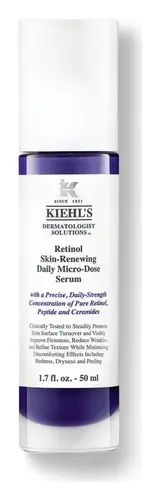
This anti-aging serum is formulated around Retinal and Tetrahexyldecyl Ascorbate to soften the look of wrinkles and refine skin texture.
This anti-aging serum is formulated around Retinal to soften the look of wrinkles and refine skin texture.


What's inside
What's inside
 Key Ingredients
Benefits
Concerns
Ingredients Side-by-side
Water
Skin ConditioningCaprylic/Capric Triglyceride
Masking


Glycerin
Humectant
Isododecane
EmollientCetearyl Olivate


Sodium Acrylate/Sodium Acryloyldimethyl Taurate Copolymer
Emulsion StabilisingCetearyl Alcohol
Emollient



PPG-12/Smdi Copolymer
EmollientSorbitan Olivate
Emulsifying
Tocopheryl Acetate
Antioxidant


Titanium Dioxide
Cosmetic Colorant

Eclipta Prostrata Extract
Skin Conditioning
Cyclodextrin
AbsorbentSqualane
Emollient
Hydroxyethyl Acrylate/Sodium Acryloyldimethyl Taurate Copolymer
Emulsion StabilisingPhenoxyethanol
Preservative
Melia Azadirachta Leaf Extract
Skin ConditioningHydroxypropyl Methylcellulose
Emulsion StabilisingSodium Hyaluronate
Humectant

Tetrahexyldecyl Ascorbate
Antioxidant


Rubus Chamaemorus Seed Oil
Skin Conditioning
Alumina
Abrasive
Isostearic Acid
Cleansing
Lecithin
Emollient
Polyglyceryl-3 Polyricinoleate
Emulsifying
Polyhydroxystearic Acid
Emulsifying
Stearic Acid
Cleansing
Pentylene Glycol
Skin Conditioning
Retinal
Skin Conditioning




Moringa Oleifera Seed Oil
Emollient
Sodium Polyaspartate
HumectantClimbazole
Antimicrobial
Disodium EDTA
ChelatingLonicera Japonica Flower Extract
Skin ConditioningLonicera Caprifolium Flower Extract
Perfuming
Daucus Carota Sativa Seed Oil
Emollient
Ethylhexylglycerin
Skin Conditioning3-O-Ethyl Ascorbic Acid
Skin Conditioning
Dipteryx Odorata Bean Extract
Masking
Hydroxyacetophenone
Antioxidant
Polysorbate 60
Emulsifying
Sorbitan Isostearate
Emulsifying
Vanilla Planifolia Fruit Extract
Skin Conditioning
Decylene Glycol
Skin Conditioning1,2-Hexanediol
Skin Conditioning
BHT
Antioxidant
Coumarin
Perfuming

Water, Caprylic/Capric Triglyceride, Glycerin, Isododecane, Cetearyl Olivate, Sodium Acrylate/Sodium Acryloyldimethyl Taurate Copolymer, Cetearyl Alcohol, PPG-12/Smdi Copolymer, Sorbitan Olivate, Tocopheryl Acetate, Titanium Dioxide, Eclipta Prostrata Extract, Cyclodextrin, Squalane, Hydroxyethyl Acrylate/Sodium Acryloyldimethyl Taurate Copolymer, Phenoxyethanol, Melia Azadirachta Leaf Extract, Hydroxypropyl Methylcellulose, Sodium Hyaluronate, Tetrahexyldecyl Ascorbate, Rubus Chamaemorus Seed Oil, Alumina, Isostearic Acid, Lecithin, Polyglyceryl-3 Polyricinoleate, Polyhydroxystearic Acid, Stearic Acid, Pentylene Glycol, Retinal, Moringa Oleifera Seed Oil, Sodium Polyaspartate, Climbazole, Disodium EDTA, Lonicera Japonica Flower Extract, Lonicera Caprifolium Flower Extract, Daucus Carota Sativa Seed Oil, Ethylhexylglycerin, 3-O-Ethyl Ascorbic Acid, Dipteryx Odorata Bean Extract, Hydroxyacetophenone, Polysorbate 60, Sorbitan Isostearate, Vanilla Planifolia Fruit Extract, Decylene Glycol, 1,2-Hexanediol, BHT, Coumarin


Reviews
Ingredients Explained
These ingredients are found in both products.
Ingredients higher up in an ingredient list are typically present in a larger amount.
Retinal (aka retinaldehyde) is a form of retinoid that formulators use mainly as an antiaging and skin-renewing active.
What makes it special is its position in the retinoid family; skin converts it to retinoic acid (the prescription gold standard) in just one step.
Because retinal only requires 1 conversion step to become retinoic acid, it's the strongest over-the-counter retinoid. It also works at lower concentrations than retinol, since retinal is about 10x more bioavailable.
Studies back up its efficacy in skin:
A foundational trial showed that applying 0.05-0.5% retinal for 1-3 months produced a dose-dependent and significant increase in epidermal thickness + cell turnover markers.
And a head-to-head comparison of 0.05% retinal against a 0.05% retinoid acid found both formulations were effective for the basis of wrinkle/skin roughness features, but retinoic acid caused more local irritation.
More recent controlled trials confirm it improves wrinkles, dermal density, and firmness over 12-24 weeks, with significant improvements in skin texture and firmness (particularly with the higher 0.1% concentration).
Retinal also has one trick the other retinoids do not: it directly fights against acne bacteria since a clinical study showed retinaldehyde-treated areas displayed a significant decrease in counts of viable P. acnes.
This makes it a great pick for people who want to treat aging and breakouts.
Typical cosmetic use sits in the 0.05-0.1% range with 0.05% being the gentle starting point and 0.1% giving stronger results.
Like all retinoids, retinal works best with nightly use, a good moisturizer, and daytime sunscreen. It can cause some irritation so ease into it slowly rather than going all in.
The "ramp up" method works well: start with Retinal once a week to give your skin time to adjust, which keeps irritation low.
Slowly add more nights until you reach your goal frequency once your skin feels comfortable.
Retinoids also make your skin more sensitive to the sun in the first few weeks, so wear sunscreen every morning and protect your skin from direct sun while you build up tolerance.
Learn more about Retinal