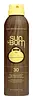
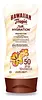
Sun Bum Original SPF 30 Sunscreen Spray Versus Hawaiian Tropic Silk Hydration Protective Sun Lotion SPF 50
This chemical sunscreen covers most of the UV range, lighter on the deep UVA that drives aging.
This chemical sunscreen covers most of the UV range, lighter on the deep UVA that drives aging.

What's inside
What's inside
 Key Ingredients
Benefits
Concerns
Ingredients Side-by-side



Water
Skin ConditioningOctocrylene
UV Absorber



Benzophenone-3
UV Absorber
Butyl Methoxydibenzoylmethane
UV Absorber
Ethylhexyl Benzoate
EmollientGlycerin
Humectant


Vp/Eicosene Copolymer
Cetearyl Alcohol
Emollient




Diisopropyl Adipate
EmollientIsopropyl Myristate
Emollient
Isopropyl Palmitate
Emollient
Phenethyl Benzoate
Emollient

Polymethylsilsesquioxane

Polyethylene
Abrasive
Sodium Polyacrylate
Absorbent
Caprylyl Glycol
Emollient
Dimethicone
Emollient
Coco-Glucoside
Cleansing
Ceteth-10 Phosphate
CleansingDicetyl Phosphate
EmulsifyingXanthan Gum
EmulsifyingDisodium EDTA
ChelatingParaffin
Skin Conditioning
Silk Amino Acids
HumectantButyrospermum Parkii Butter
Skin Conditioning
Mangifera Indica Seed Butter
Skin Conditioning
Panthenol
Skin Conditioning

Sodium Ascorbyl Phosphate
Antioxidant





Tocopheryl Acetate
Antioxidant
Aloe Barbadensis Leaf Juice
Skin Conditioning
Carica Papaya Fruit Extract
Skin ConditioningColocasia Antiquorum Root Extract
Skin ConditioningMangifera Indica Fruit Extract
Skin ConditioningPassiflora Incarnata Fruit Extract
Skin ConditioningPlumeria Acutifolia Flower Extract
Skin ConditioningPhenoxyethanol
Preservative
Methylparaben
Preservative
Propylparaben
Preservative
Parfum
Masking
Hydroxycitronellal
Perfuming
Linalool
Perfuming
Mica
Cosmetic ColorantCI 77163
Cosmetic Colorant
Iron Oxides
Water, Octocrylene, Benzophenone-3, Butyl Methoxydibenzoylmethane, Ethylhexyl Benzoate, Glycerin, Vp/Eicosene Copolymer, Cetearyl Alcohol, Diisopropyl Adipate, Isopropyl Myristate, Isopropyl Palmitate, Phenethyl Benzoate, Polymethylsilsesquioxane, Polyethylene, Sodium Polyacrylate, Caprylyl Glycol, Dimethicone, Coco-Glucoside, Ceteth-10 Phosphate, Dicetyl Phosphate, Xanthan Gum, Disodium EDTA, Paraffin, Silk Amino Acids, Butyrospermum Parkii Butter, Mangifera Indica Seed Butter, Panthenol, Sodium Ascorbyl Phosphate, Tocopheryl Acetate, Aloe Barbadensis Leaf Juice, Carica Papaya Fruit Extract, Colocasia Antiquorum Root Extract, Mangifera Indica Fruit Extract, Passiflora Incarnata Fruit Extract, Plumeria Acutifolia Flower Extract, Phenoxyethanol, Methylparaben, Propylparaben, Parfum, Hydroxycitronellal, Linalool, Mica, CI 77163, Iron Oxides
Reviews
Ingredients Explained
These ingredients are found in both products.
Ingredients higher up in an ingredient list are typically present in a larger amount.
Also known as Avobenzone, this ingredient is an oil-soluble used to absorb the full spectrum of UVA rays (peak 357 nm).
It's one of the most effective UVA filters available but has a major caveat of photostability: avobenzone is susceptible to photodegradation.
This means it can lose efficacy when exposed to sunlight without the help of a stabilizing agent.
Studies show antioxidants (like vitamin E or vitamin C) and some UV filters (like octocrylene and Tinosorb S) can meaningfully improve its stability in a formulation.
The maximum allowable concentration according to regulation is 3% in the US + Canada, and 5% in the EU, Australia, China, Korea, and ASEAN countries.
It has a well-support safety profile: a comprehensive 2025 review found minimal toxicity with no evidence of carcinogenicity.
Overall, avobenzone is a safe and regulated ingredient used in sunscreen for over 40 years.
Learn more about Butyl MethoxydibenzoylmethaneOctocrylene is an oil-soluble organic UV filter that mainly absorbs UVB and short wave UVA II light.
Its real superpower is teamwork: octocrylene is remarkably photostable and is most famous for stabilizing avobenzone (the workhorse UVA filter).
This ingredient is commonly used to enhance both UVB and UVA protection due to its unique property in stabilizing avobenzone. It also pulls double duty by boosting water resistance and giving formulas a smooth, spreadable feel.
The EU's Scientific Committee on Consumer Safety (SCCS) has deemed octocrylene to be safe as a UV-filter at concentrations up to 10% (capped at 9% in propellant sprays). The US also permits it up to 10%.
Two things worth knowing:
You'll usually see this ingredient used in concentrations between 2-10% (higher amounts when used as a stabilizer for avobenzone).
Learn more about OctocryleneParfum is a catch-all term for an ingredient or more that is used to give a scent to products.
Also called "fragrance", this ingredient can be a blend of hundreds of chemicals or plant oils. This means every product with "fragrance" or "parfum" in the ingredients list is a different mixture.
For instance, Habanolide is a proprietary trade name for a specific aroma chemical. When used as a fragrance ingredient in cosmetics, most aroma chemicals fall under the broad labeling category of “FRAGRANCE” or “PARFUM” according to EU and US regulations.
The term 'parfum' or 'fragrance' is not regulated in many countries. In many cases, it is up to the brand to define this term.
For instance, many brands choose to label themselves as "fragrance-free" because they are not using synthetic fragrances. However, their products may still contain ingredients such as essential oils that are considered a fragrance by INCI standards.
One example is Calendula flower extract. Calendula is an essential oil that still imparts a scent or 'fragrance'.
Depending on the blend, the ingredients in the mixture can cause allergies and sensitivities on the skin. Some ingredients that are known EU allergens include linalool and citronellol.
Parfum can also be used to mask or cover an unpleasant scent.
The bottom line is: not all fragrances/parfum/ingredients are created equally. If you are worried about fragrances, we recommend taking a closer look at an ingredient. And of course, we always recommend speaking with a professional.
Learn more about Parfum

