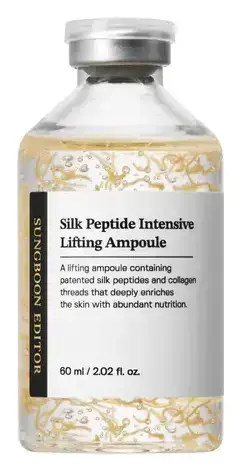
Sungboon Editor Silk Peptide Intensive Lifting Ampoule Versus JUMISO Snail Mucin 95 + Peptide Essence
This anti-aging ampoule is formulated around Niacinamide and Adenosine to soften the look of wrinkles.
This barrier-repair essence is formulated around Snail Secretion Filtrate and Panthenol to strengthen the skin barrier and soften the look of wrinkles.

What's inside
What's inside
 Key Ingredients
Benefits
Ingredients Side-by-side
Water
Skin ConditioningButylene Glycol
Humectant

Glycerin
Humectant
Methylpropanediol
Solvent1,2-Hexanediol
Skin Conditioning
Niacinamide
Smoothing









Carbomer
Emulsion StabilisingTromethamine
BufferingPPG-13-Decyltetradeceth-24
EmulsifyingHydroxyethylcellulose
Emulsion StabilisingSilk Extract
Skin ConditioningAdenosine
Skin Conditioning
Iron Powder
Agar
MaskingEthylhexylglycerin
Skin ConditioningDisodium EDTA
ChelatingAcrylates/C10-30 Alkyl Acrylate Crosspolymer
Emulsion StabilisingSynthetic Fluorphlogopite
Betaine
Humectant
Panthenol
Skin Conditioning
Hydrolyzed Elastin
EmollientTitanium Dioxide
Cosmetic Colorant

CI 77491
Cosmetic ColorantMica
Cosmetic ColorantGellan Gum
Hydrolyzed Collagen
Emollient
Centella Asiatica Extract
Cleansing
Propanediol
Solvent
Magnesium Ascorbyl Phosphate
Antioxidant

Polygonum Fagopyrum Seed Extract
Skin ConditioningLecithin
Emollient
Acetyl Glutamine
Skin ConditioningPhenoxyethanol
Preservative
Artemisia Vulgaris Extract
Skin Conditioning
Sodium Hyaluronate
Humectant
Caprylyl Glycol
Emollient
Tin Oxide
Abrasive
Gold
Cosmetic ColorantSqualane
Emollient
Hydrogenated Polyisobutene
EmollientBenzyl Glycol
SolventSh-Oligopeptide-1
Skin Conditioning
Sh-Polypeptide-1
Skin Conditioning
Sh-Oligopeptide-2
Skin Conditioning
Sh-Polypeptide-11
Sh-Polypeptide-9
Skin Conditioning
Bacillus
Skin ConditioningHydrolyzed Glycosaminoglycans
HumectantCollagen
Moisturising
Tocopherol
Antioxidant
Sodium Hyaluronate Crosspolymer
Humectant
Caffeoyl Hexapeptide-65
Antimicrobial
Hydrolyzed Hyaluronic Acid
Humectant
Sh-Decapeptide-7
Antioxidant
Sh-Octapeptide-4
Antioxidant
Sh-Oligopeptide-9
Humectant
Sh-Pentapeptide-19
Skin Conditioning
Hydroxypropyltrimonium Hyaluronate
Palmitoyl Pentapeptide-4
Skin Conditioning
Acetyl Hexapeptide-8
Humectant
Copper Tripeptide-1
Skin Conditioning
Hyaluronic Acid
Humectant
Ulmus Davidiana Root Extract
Skin Conditioning
Sodium Acetylated Hyaluronate
Humectant
Water, Butylene Glycol, Glycerin, Methylpropanediol, 1,2-Hexanediol, Niacinamide, Carbomer, Tromethamine, PPG-13-Decyltetradeceth-24, Hydroxyethylcellulose, Silk Extract, Adenosine, Iron Powder, Agar, Ethylhexylglycerin, Disodium EDTA, Acrylates/C10-30 Alkyl Acrylate Crosspolymer, Synthetic Fluorphlogopite, Betaine, Panthenol, Hydrolyzed Elastin, Titanium Dioxide, CI 77491, Mica, Gellan Gum, Hydrolyzed Collagen, Centella Asiatica Extract, Propanediol, Magnesium Ascorbyl Phosphate, Polygonum Fagopyrum Seed Extract, Lecithin, Acetyl Glutamine, Phenoxyethanol, Artemisia Vulgaris Extract, Sodium Hyaluronate, Caprylyl Glycol, Tin Oxide, Gold, Squalane, Hydrogenated Polyisobutene, Benzyl Glycol, Sh-Oligopeptide-1, Sh-Polypeptide-1, Sh-Oligopeptide-2, Sh-Polypeptide-11, Sh-Polypeptide-9, Bacillus, Hydrolyzed Glycosaminoglycans, Collagen, Tocopherol, Sodium Hyaluronate Crosspolymer, Caffeoyl Hexapeptide-65, Hydrolyzed Hyaluronic Acid, Sh-Decapeptide-7, Sh-Octapeptide-4, Sh-Oligopeptide-9, Sh-Pentapeptide-19, Hydroxypropyltrimonium Hyaluronate, Palmitoyl Pentapeptide-4, Acetyl Hexapeptide-8, Copper Tripeptide-1, Hyaluronic Acid, Ulmus Davidiana Root Extract, Sodium Acetylated Hyaluronate
Snail Secretion Filtrate
Skin Conditioning
Betaine
Humectant
Butylene Glycol
Humectant
Ethyl Hexanediol
SolventAllantoin
Skin Conditioning
Phenoxyethanol
Preservative
Sodium Polyacrylate
Absorbent
Carbomer
Emulsion StabilisingWater
Skin Conditioning1,2-Hexanediol
Skin Conditioning
Sodium Hyaluronate
Humectant
Panthenol
Skin Conditioning
Adenosine
Skin Conditioning
Arginine
Masking
Copper Tripeptide-1
Skin Conditioning
Palmitoyl Pentapeptide-4
Skin Conditioning
Acetyl Hexapeptide-8
Humectant
Palmitoyl Tripeptide-1
Skin Conditioning
Palmitoyl Tetrapeptide-7
Skin Conditioning
Snail Secretion Filtrate, Betaine, Butylene Glycol, Ethyl Hexanediol, Allantoin, Phenoxyethanol, Sodium Polyacrylate, Carbomer, Water, 1,2-Hexanediol, Sodium Hyaluronate, Panthenol, Adenosine, Arginine, Copper Tripeptide-1, Palmitoyl Pentapeptide-4, Acetyl Hexapeptide-8, Palmitoyl Tripeptide-1, Palmitoyl Tetrapeptide-7
Reviews
Ingredients Explained
These ingredients are found in both products.
Ingredients higher up in an ingredient list are typically present in a larger amount.
1,2-Hexanediol is a synthetic liquid and another multi-functional powerhouse.
It is a:
- Humectant, drawing moisture into the skin
- Emollient, helping to soften skin
- Solvent, dispersing and stabilizing formulas
- Preservative booster, enhancing the antimicrobial activity of other preservatives
Acetyl Hexapeptide-8 (also known as Argireline) is a synthetic hexapeptide that is often called a "topical Botox alternative".
It works by mimicking how Botox relaxes muscles; it interferes with the signaling process that tells your facial muscles to contract. This can help soften expression lines like forehead wrinkles or crow's feet over time.
The comparison to Botox does have limits because the molecule is water-loving and relatively large.
Acetyl Hexapeptide-8 has a hard time absorbing deeply enough through the skin's outer barrier to actually reach the muscles.
So whether it truly works the way Botox does at a biological level is still up for debate, but early clinical outcomes are fairly encouraging.
A 12 week human study of a multi-ingredient regimen containing this ingredient saw:
While some studies have observed improvements in wrinkle appearance, it is important to note that more consistent results are seen in multi-ingredient formulations (vs just Acetyl Hexapeptide-8 alone).
Some research studies also used higher concentrations (up to 10%) while this ingredient is usually found in concentrations up to 0.005% in leave-on formulations.
Learn more about Acetyl Hexapeptide-8Adenosine is a purine nucleoside that your body already makes in every cell. In skincare, it acts mainly as a skin conditioning and anti-aging agent.
The way it works is fairly well mapped out:
Your skin has cells called fibroblasts that build collagen (the stuff that keeps skin firm and smooth). Adenosine basically flips a switch on these cells that tells them to get to work making more collagen and other proteins. These cells slow down on their own as skin ages, so Adenosine helps give them a little nudge to keep going.
The clinical backing is pretty solid too.
A blind, randomized, placebo-controlled trial of 126 women aged 45-65 tested a 0.1% cream twice daily and found real improvements in crow's feet and frown lines using a precise 3D skin-mapping technique; these changes showed up by week 3 and held at 2 months.
A later study using Adenosine-loaded dissolving microneedle patches reported gains in wrinkle depth, dermal density, elasticity, and hydration.
On concentrations, South Korea's Ministry of Food and Drug Safety has set 0.04% as the approved functional anti-wrinkle level. You'll typically see this ingredient used somewhere in the 0.04-0.1% range since it works at low doses.
This ingredient has been found safe for cosmetics with the data showing no irritation or sensitization.
Overall, this is a great ingredient for any anti-aging routine and has no photosensitizing effect, so it suits both AM and PM use.
Learn more about AdenosineBetaine is a humectant. Like hyaluronic acid, it helps attract and retain moisture in the skin. It’s known for being gentle and for helping the skin maintain balanced hydration.
Betaine is mainly used to improve hydration and support calmer skin. It helps skin cells regulate water balance because it functions as an osmolyte.
Some studies suggest betaine may support making skin tone more even.
Fun fact: Betaine naturally exists in the skin and the body. In cosmetic products, it can be either plant-derived (most commonly from sugar beets) or synthetically produced for consistency and stability.
Betaine is also known as trimethylglycine.
Learn more about BetaineButylene Glycol (or BG) is used within cosmetic products for a few different reasons:
Overall, Butylene Glycol is a safe and well-rounded ingredient that works well with other ingredients.
Though this ingredient works well with most skin types, some people with sensitive skin may experience a reaction such as allergic rashes, closed comedones, or itchiness.
Learn more about Butylene GlycolCarbomer is a synthetic thickening and gelling agent. It's basically the ingredient that gives a lot of serums, gels, creams, and sunscreens their smooth, non-sticky texture.
Although legally permitted at very high levels, carbomers are normally used at concentrations below 1%.
It also needs to be neutralized to actually thicken, and because it is a large molecule, it doesn't really penetrate the skin barrier.
Allergy-wise, the risk is very low. Clinical studies show carbomers have low potential for skin irritation/sensitization even at concentrations up to 100%.
A 2024 UK study patch-tested 1,302 patients and found true allergy to the parent group of carbomer to be rare with no confirmed relevant reactions.
Learn more about CarbomerCopper Tripeptide-1 (GHK-Cu) is a skin repairing ingredient said to boost collagen, improve firmness, and support skin regeneration.
It is a complex made up of a naturally occurring peptide (glycine-histidine-lysine) and copper, an essential trace element.
While studying wound healing, researchers noticed GHK-Cu stimulated hair follicle enlargement and growth by keeping hair in its active growth phase longer. This has made it a promising ingredient for hair regrowth treatments.
Some people have reported increased facial hair. While GHK-Cu can make your hair follicles bigger, it usually doesn’t turn soft, barely-visible facial hairs into thick, dark ones.
Anecdotal reports suggest that overusing copper peptides might lead to premature aging due to excess free copper or enzyme imbalances. This claim isn’t backed by large-scale studies.
Unfortunately, there are limited human studies for this ingredient. While early results are promising, many studies are either small, in-vitro, or not rigorously controlled.
For example, there is a 1998 study that explored the effects of copper tripeptide, vitamin C, tretinoin, and melatonin on skin repair and collagen synthesis.
After one month, increased procollagen production was seen in 7 out of 10 participants using copper tripeptide (more than those using vitamin C, melatonin, or tretinoin.
While the study was exploratory, it offers early evidence that copper tripeptide may support collagen production. Larger, well-designed trials are still needed to confirm its potential and understand individual responses.
Read more about other common types of peptides here:
Learn more about Copper Tripeptide-1You might know this ingredient as Matrixyl. It is a synthetic peptide made up of five amino acids attached to a palmitic acid, a fatty acid that helps it absorb into skin more easily.
As a signal peptide, Matrixyl acts like a little messenger. Once it reaches your skin cells, it tells them to ramp up production of collagen, elastin, and other proteins that keep skin looking firm and smooth.
A 12 week clinical study found that a moisturizer containing just 3 ppm of Matrixyl led to a significant improvement in fine-lines and wrinkles. Another study showed an 18% reduction in wrinkle depth, 37% reduction in wrinkle thickness, and a 21% improvement in skin firmness after just 28 days of twice-daily use.
The coolest part is that it works at incredibly low concentrations (like 0.0003%) and it plays well with other actives.
The CIR (Cosmetic Ingredient Review) panel found it to be non-sensitizing across multiple tests and human patch tests also showed no irritation or sensitization.
Fun fact: Matrixyl was originally developed by French company Sederma and Procter & Gamble.
Read more about other common types of peptides here:
Learn more about Palmitoyl Pentapeptide-4Panthenol is a common ingredient that helps hydrate and soothe the skin. It is found naturally in our skin and hair.
There are two forms of panthenol: D and L.
D-panthenol is also known as dexpanthenol. Most cosmetics use dexpanthenol or a mixture of D and L-panthenol.
Panthenol is famous due to its ability to go deeper into the skin's layers. Using this ingredient has numerous pros (and no cons):
Like hyaluronic acid, panthenol is a humectant. Humectants are able to bind and hold large amounts of water to keep skin hydrated.
This ingredient works well for wound healing. It works by increasing tissue in the wound and helps close open wounds.
Once oxidized, panthenol converts to pantothenic acid. Panthothenic acid is found in all living cells.
This ingredient is also referred to as pro-vitamin B5.
Learn more about PanthenolPhenoxyethanol is one of the most widely used preservatives in skincare (and for good reason!).
It has a large spectrum of antimicrobial activity and especially effective bacteria, yeast, and mold while only having a weak effect on your skin's natural microbiome.
On a cellular level, it disrupts the cell membranes of microbes by poking holes that make the cell leak. This shuts down the chemical reactions the microbe needs to make energy so it can no longer survive.
Another perk of this ingredient is that it stays functional across a wide pH range (3-10).
You'll often see it paired with boosters like Ethylhexylglycerin; one study showed that a 1:9 ratio of Ethylhexylglycerin to Phenoxyethanol damages bacterial membranes as effectively as doubling the Phenoxyethanol concentration on its own.
Typical use concentrations range from 0.3-1% depending on the formula, and this ingredient is capped at 1% int the EU.
Safety-wise, the fear mongering does not hold up to the evidence. The EU's Scientific Committee on Consumer Safety and FDA consider it safe as a preservative at up to 1%, including for children of all ages.
Adverse systemic effects only showed up in animal studies at exposures roughly 200x higher than what people get from cosmetics. And despite its very widespread use, this ingredient is a rare sensitizer and allergic reactions are uncommon.
Learn more about PhenoxyethanolSodium Hyaluronate is the salt form of hyaluronic acid. It is a long sugar chain that is naturally found in your skin, joints, and connective tissue that maintains hydration and elasticity.
In skincare, it works as a humectant. It pulls water from the environment and deeper layers of skin and binds it to the surface.
Interestingly, the size of the molecule affects its behavior:
Some clinical evidence links low molecular weight versions to improved wrinkle depth, elasticity, anti-inflammatory effects, and barrier repair.
Many serums use a blend of both weights so you can get surface hydration plus longer-lasting and deeper effects.
You'll typically see concentrations between 0.1-2% for this ingredient.
Learn more about Sodium HyaluronateWater. It's the most common cosmetic ingredient of all. You'll usually see it at the top of ingredient lists, meaning that it makes up the largest part of the product.
So why is it so popular? Water most often acts as a solvent - this means that it helps dissolve other ingredients into the formulation.
You'll also recognize water as that liquid we all need to stay alive. If you see this, drink a glass of water. Remember to stay hydrated!
Learn more about Water