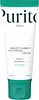
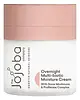
PURITO Mighty Bamboo Panthenol Cream Versus The Jojoba Company Overnight Multi-biotic Moisture Cream
This barrier-repair moisturizer is formulated around Panthenol and Niacinamide to strengthen the skin barrier and calm redness.
This barrier-repair night moisturizer is formulated around Simmondsia Chinensis Seed Oil and Lactococcus Ferment Lysate to strengthen the skin barrier and hydrate skin.


What's inside
What's inside
 Key Ingredients
Benefits
Concerns
Ingredients Side-by-side
Water
Skin ConditioningPanthenol 10%
Skin Conditioning




Squalane
Emollient
Butylene Glycol
Humectant
1,2-Hexanediol
Skin Conditioning
Niacinamide
Smoothing






Bambusa Vulgaris Extract
Skin Conditioning
Hydrolyzed Jojoba Esters
Skin Conditioning

Acrylates/C10-30 Alkyl Acrylate Crosspolymer
Emulsion StabilisingAmmonium Acryloyldimethyltaurate/Vp Copolymer
Hydroxyacetophenone
Antioxidant
Tromethamine
BufferingDipotassium Glycyrrhizate
Humectant
Ethylhexylglycerin
Skin ConditioningXanthan Gum
EmulsifyingDisodium EDTA
Sodium Hyaluronate
Humectant
Madecassoside
Antioxidant
Asiaticoside
Antioxidant
Asiatic Acid
Skin Conditioning
Madecassic Acid
Skin Conditioning
Copper Tripeptide-1
Skin Conditioning
Water, Panthenol 10%, Squalane, Butylene Glycol, 1,2-Hexanediol, Niacinamide, Bambusa Vulgaris Extract, Hydrolyzed Jojoba Esters, Acrylates/C10-30 Alkyl Acrylate Crosspolymer, Ammonium Acryloyldimethyltaurate/Vp Copolymer, Hydroxyacetophenone, Tromethamine, Dipotassium Glycyrrhizate, Ethylhexylglycerin, Xanthan Gum, Disodium EDTA, Sodium Hyaluronate, Madecassoside, Asiaticoside, Asiatic Acid, Madecassic Acid, Copper Tripeptide-1
Water
Skin ConditioningSimmondsia Chinensis Seed Oil
Emollient
Jojoba Esters
Emollient
Lactococcus Ferment Lysate
Skin Conditioning
Hydrogenated Sunflower Seed Oil Glyceryl Esters
Emulsifying
Hydrogenated Sunflower Seed Oil Polyglyceryl-3 Esters
Emulsifying
Stearyl Alcohol
Emollient
Jojoba Alcohol
Emollient
Cetearyl Alcohol
Emollient



Butyrospermum Parkii Butter
Skin Conditioning
Sodium Stearoyl Lactylate
EmulsifyingPentylene Glycol
Skin Conditioning
Cetyl Alcohol
Emollient
Tremella Fuciformis Extract
Humectant
Hydrolyzed Tremella Fuciformis Sporocarp Extract
Antioxidant
Glycerin
Humectant
Propanediol
Solvent
Hydroxyacetophenone
Antioxidant
Xanthan Gum
EmulsifyingCitrus Nobilis Oil
Masking
Pelargonium Roseum Leaf Oil
Perfuming


Tocopherol
Antioxidant
Benzyl Alcohol
Perfuming



Salicylic Acid
Masking

Sorbic Acid
Preservative
Limonene
Perfuming
Citronellol
Perfuming
Geraniol
Perfuming
Linalool
Perfuming
Water, Simmondsia Chinensis Seed Oil, Jojoba Esters, Lactococcus Ferment Lysate, Hydrogenated Sunflower Seed Oil Glyceryl Esters, Hydrogenated Sunflower Seed Oil Polyglyceryl-3 Esters, Stearyl Alcohol, Jojoba Alcohol, Cetearyl Alcohol, Butyrospermum Parkii Butter, Sodium Stearoyl Lactylate, Pentylene Glycol, Cetyl Alcohol, Tremella Fuciformis Extract, Hydrolyzed Tremella Fuciformis Sporocarp Extract, Glycerin, Propanediol, Hydroxyacetophenone, Xanthan Gum, Citrus Nobilis Oil, Pelargonium Roseum Leaf Oil, Tocopherol, Benzyl Alcohol, Salicylic Acid, Sorbic Acid, Limonene, Citronellol, Geraniol, Linalool
Reviews
Ingredients Explained
These ingredients are found in both products.
Ingredients higher up in an ingredient list are typically present in a larger amount.
Hydroxyacetophenone is a small phenolic molecule that earns its place in a formulas as an antioxidant and preservative booster.
As a phenol, it is able to neutralize free radicals to protect both the product and the skin from oxidative stress.
Though it can't kill microbes on its own, it works as a good supporting agent when combined with other preservatives like Phenoxyethanol or 1,2-Hexanediol.
This ingredient naturally occurs as piceol in Norwegian spruce needles (~0.4-1.1% dry weight and in cloudberries). Though the cosmetic-grade material is synthesized for purity and consistency.
You'll usually see it used at low levels and suppliers recommend up to 1% added to a water phase.
Safety testing was done at concentrations like 0.05% in SPF products and 0.5% in a Human Repeated Insult Patch Test. The safety evidence is assuring; this ingredient is safe for cosmetics in current use and also holds safety status as a food flavoring as well.
An honest caveat: the "soothing" and "anti-inflammatory" claims come mostly from supplier marketing rather than published clinical trials. The Cosmetic Ingredient Review's own literature search found no useful efficacy studies on this ingredient.
So the antioxidant and preservative-boosting roles are the well supported ones while the calming benefit is plausible but thinly evidenced.
Overall, this is a well-tolerated, low-irritation multitasker that quietly helps a formula stay fresh and stable.
Learn more about HydroxyacetophenoneWater. It's the most common cosmetic ingredient of all. You'll usually see it at the top of ingredient lists, meaning that it makes up the largest part of the product.
So why is it so popular? Water most often acts as a solvent - this means that it helps dissolve other ingredients into the formulation.
You'll also recognize water as that liquid we all need to stay alive. If you see this, drink a glass of water. Remember to stay hydrated!
Learn more about WaterXanthan gum is used as a stabilizer and thickener within cosmetic products. It helps give products a sticky, thick feeling - preventing them from being too runny.
On the technical side of things, xanthan gum is a polysaccharide - a combination consisting of multiple sugar molecules bonded together.
Xanthan gum is a pretty common and great ingredient. It is a natural, non-toxic, non-irritating ingredient that is also commonly used in food products.
Learn more about Xanthan Gum

