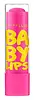
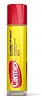
This barrier-repair lip moisturizer is formulated around Petrolatum and Butyrospermum Parkii Butter to strengthen the lip barrier and hydrate lips.
This smoothing lip moisturizer is formulated around Petrolatum and Limnanthes Alba Seed Oil to refine skin texture and hydrate lips.

What's inside
What's inside
 Key Ingredients
Benefits
Concerns
Ingredients Side-by-side
Polybutene
Octyldodecanol
Emollient
Isopropyl Myristate
Emollient





Petrolatum
Emollient

Ethylhexyl Methoxycinnamate
UV Absorber

Polyethylene
Abrasive
Ozokerite
Emulsion StabilisingEthylhexyl Salicylate
UV Absorber
Butyrospermum Parkii Butter
Skin Conditioning
Diisostearyl Malate
EmollientEuphorbia Cerifera Cera
Astringent
Vp/Hexadecene Copolymer
Silica Dimethyl Silylate
EmollientParfum
Masking

Calcium Aluminum Borosilicate
Pentaerythrityl Tetra-Di-T-Butyl Hydroxyhydrocinnamate
Antioxidant
Tocopherol
Antioxidant




Tocopheryl Acetate
Antioxidant
Alumina
Abrasive
Aroma
Silica
Abrasive

Isopropyl Palmitate
Emollient
Pentaerythrityl Tetraisostearate
Emollient
Limonene
Perfuming
Synthetic Fluorphlogopite
Calcium Sodium Borosilicate
Benzyl Benzoate
Antimicrobial
Centella Asiatica Extract
Cleansing


Aluminum Hydroxide
EmollientCitral
Perfuming
Linalool
Perfuming
Hexyl Cinnamal
Perfuming
Tin Oxide
Abrasive
Geraniol
Perfuming
Eugenol
Perfuming
Aloe Barbadensis Extract
Skin Conditioning
Aloe Barbadensis Leaf Extract
Emollient
Mel
EmollientCalcium Pantothenate
Ascorbic Acid
Antioxidant
Dimethicone
Emollient
Sodium Chondroitin Sulfate
Skin ConditioningAtelocollagen
Skin Conditioning
CI 77891
Cosmetic ColorantMica
Cosmetic ColorantCI 45410
Cosmetic ColorantCI 77491
Cosmetic ColorantCI 77492
Cosmetic ColorantCI 77499
Cosmetic ColorantCI 15850
Cosmetic ColorantCI 45380
Cosmetic ColorantCI 19140
Cosmetic ColorantCI 42090
Cosmetic ColorantCI 15985
Cosmetic ColorantCI 75470
Cosmetic ColorantPolybutene, Octyldodecanol, Isopropyl Myristate, Petrolatum, Ethylhexyl Methoxycinnamate, Polyethylene, Ozokerite, Ethylhexyl Salicylate, Butyrospermum Parkii Butter, Diisostearyl Malate, Euphorbia Cerifera Cera, Vp/Hexadecene Copolymer, Silica Dimethyl Silylate, Parfum, Calcium Aluminum Borosilicate, Pentaerythrityl Tetra-Di-T-Butyl Hydroxyhydrocinnamate, Tocopherol, Tocopheryl Acetate, Alumina, Aroma, Silica, Isopropyl Palmitate, Pentaerythrityl Tetraisostearate, Limonene, Synthetic Fluorphlogopite, Calcium Sodium Borosilicate, Benzyl Benzoate, Centella Asiatica Extract, Aluminum Hydroxide, Citral, Linalool, Hexyl Cinnamal, Tin Oxide, Geraniol, Eugenol, Aloe Barbadensis Extract, Aloe Barbadensis Leaf Extract, Mel, Calcium Pantothenate, Ascorbic Acid, Dimethicone, Sodium Chondroitin Sulfate, Atelocollagen, CI 77891, Mica, CI 45410, CI 77491, CI 77492, CI 77499, CI 15850, CI 45380, CI 19140, CI 42090, CI 15985, CI 75470




Reviews
Ingredients Explained
These ingredients are found in both products.
Ingredients higher up in an ingredient list are typically present in a larger amount.
Aroma refers to an ingredient, or mixture of ingredients, that impart or mask a flavor.
The name is slightly confusing. This is because INCI associates aroma with flavor instead of smell.
Here is the official definition from the The International Cosmetic Ingredient Dictionary and Handbook:
“Aroma is a term for ingredient labeling used to identify that a product contains a material or combination of materials normally added to a cosmetic to produce or to mask a particular flavor.”
INCI shows the only purpose of aroma to be "flavouring".
However, due to regulation differences, some companies may use aroma in place of parfum.
In Canada, this ingredient only has to be listed in concentrations above 1%.
Learn more about AromaThis ingredient is also known as Octinoxate and is one of the oldest and most widely used chemical UV filters in skincare.
It has a simple job: soap up UVB radiation (290-320 nm), the wavelengths responsible for sunburn and a big chunk of long-term sun damage.
In formulas, it's always paired with a separate UVA filter because octinoxate solely protects skin from UVB.
Because it's an oil-soluble liquid, it's easy to blend into the oil phase of lotions/creams and gives a cosmetically elegant feel.
The one quirk about formulating this ingredient is photostability; the molecule slowly changes shape into a less effective version when sunlight hits it. So the longer you're in the sun, the weaker its protection gets. The drop can be more than 30% in some formulas.
It also doesn't play nice with Avobenzone (the common UVA filter) since avobenzone destabilizes octinoxate and the two degrade each other. But don't worry: brands have solved this issue by adding photostabilizers like Tinosorb S to prevent degradation and keep SPF stable under heavy UV exposure.
The maximum allowed level is 10% in the EU and Australia, 7.5% in the US and Canada, and 20% in Japan.
The Cosmetic Ingredient Review Panel has concluded this ingredient to be safe in cosmetics up to 10%.
One last thing worth knowing for context:
Octinoxate has been the subject of ongoing review in Europe where the Scientific Committee on Consumer Safety's (SCCS) 2025 final opinion is that this ingredient is an endocrine-active substance.
Lab and animal studies suggest it can act a bit like a hormone in the body (mildly mimicking estrogen and slightly blocking male hormones). It's important to know this hasn't really been shown to happen in everyday human use.
This ingredient is also banned in Hawaii over coral reef concerns.
Learn more about Ethylhexyl MethoxycinnamateOzokerite is a naturally occuring mineral wax. In cosmetics, ozokerite is used as a texture enhancer.
Ceresin wax is derived from this ingredient.
The melting point of ozokerite is 58-100 C.
Ozokerite is found all over the world including Scotland, the US, and India.
Learn more about OzokeritePetrolatum is more commonly known as petroleum jelly. It is created by mixing waxes and mineral oils.
This ingredient is effective at reducing water loss by 99%. This is because it is an occlusive. Occlusives create a hydrophobic barrier on the skin to prevent evaporation. This property makes it great for hydrating dry skin.
Pro tip: Use occlusives, such as this ingredient, on damp skin for the best results.
The quality or origin of petrolatum is only known when disclosed by the brand. Most cosmetic petrolatum has gone through several purification stages.
Another benefit of occlusives is it protects your skin against infection or allergies.
Petrolatum is fungal acne safe. It is a hydrocarbon with no fatty acid structure, so Malassezia cannot metabolize it. In-vitro studies support negligible growth stimulation as well.
It's also worth noting that petrolatum has a comedogenic rating of 0. In updated rabbit ear testing (and in human testing), petrolatum was found to be not comedogenic. This means it didn’t promote comedone formation in standard models.
Learn more about Petrolatum

