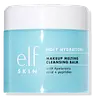
e.l.f. cosmetics Holy Hydration! Makeup Melting Cleansing Balm Versus The Face Shop Rice Water Bright Deep Peeling Cleansing Balm
This oil-based makeup remover is made to dissolve makeup, sunscreen, and daily buildup.
This oil-based makeup remover is made to dissolve makeup, sunscreen, and daily buildup.


What's inside
What's inside
 Key Ingredients

Benefits
Concerns
Ingredients Side-by-side
Cetyl Ethylhexanoate
EmollientCaprylic/Capric Triglyceride
Masking


Hydrogenated Polydecene
EmollientPEG-20 Glyceryl Triisostearate
Emollient

Polyethylene
Abrasive

PEG-10 Isostearate
Emulsifying
Helianthus Annuus Seed Oil
Emollient
Hydrogenated Sunflower Seed Oil
Skin Conditioning
Palmitoyl Tripeptide-1
Skin Conditioning



Palmitoyl Tetrapeptide-7
Skin Conditioning
Ceramide NP
Skin Conditioning


Ceramide AP
Skin Conditioning
Ceramide EOP
Skin Conditioning
Hydrolyzed Sodium Hyaluronate
Skin Conditioning
Phytosphingosine
Skin Conditioning
Glycerin
Humectant
Butylene Glycol
Humectant
Water
Skin ConditioningPolysorbate 20
Emulsifying
Carbomer
Emulsion StabilisingXanthan Gum
EmulsifyingCholesterol
Emollient
Sodium Lauroyl Lactylate
EmulsifyingPhenoxyethanol
Preservative
Ethylhexylglycerin
Skin ConditioningCaprylyl Glycol
Emollient
Geraniol
Perfuming


Linalool
Perfuming
Parfum
Masking
Cetyl Ethylhexanoate, Caprylic/Capric Triglyceride, Hydrogenated Polydecene, PEG-20 Glyceryl Triisostearate, Polyethylene, PEG-10 Isostearate, Helianthus Annuus Seed Oil, Hydrogenated Sunflower Seed Oil, Palmitoyl Tripeptide-1, Palmitoyl Tetrapeptide-7, Ceramide NP, Ceramide AP, Ceramide EOP, Hydrolyzed Sodium Hyaluronate, Phytosphingosine, Glycerin, Butylene Glycol, Water, Polysorbate 20, Carbomer, Xanthan Gum, Cholesterol, Sodium Lauroyl Lactylate, Phenoxyethanol, Ethylhexylglycerin, Caprylyl Glycol, Geraniol, Linalool, Parfum
Cetyl Ethylhexanoate
EmollientTriethylhexanoin
MaskingPEG-20 Glyceryl Triisostearate
Emollient
Cellulose
Absorbent
Synthetic Wax
Abrasive
Caprylic/Capric Triglyceride
Masking
Citrus Aurantium Dulcis Peel Oil
Masking
Water
Skin Conditioning1,2-Hexanediol
Skin Conditioning
Caprylyl Glycol
Emollient
Lavandula Angustifolia Oil
Masking
Myristica Fragrans Extract
MaskingTocopherol
Antioxidant



Butylene Glycol
Humectant
Citric Acid
Buffering
Gluconolactone
Chelating


Hydrolyzed Hyaluronic Acid
Humectant
Lactobionic Acid
Buffering
Panthenol
Skin Conditioning
Oryza Sativa Extract
Absorbent
Limonene
Perfuming
Linalool
Perfuming
Cetyl Ethylhexanoate, Triethylhexanoin, PEG-20 Glyceryl Triisostearate, Cellulose, Synthetic Wax, Caprylic/Capric Triglyceride, Citrus Aurantium Dulcis Peel Oil, Water, 1,2-Hexanediol, Caprylyl Glycol, Lavandula Angustifolia Oil, Myristica Fragrans Extract, Tocopherol, Butylene Glycol, Citric Acid, Gluconolactone, Hydrolyzed Hyaluronic Acid, Lactobionic Acid, Panthenol, Oryza Sativa Extract, Limonene, Linalool
Reviews
Ingredients Explained
These ingredients are found in both products.
Ingredients higher up in an ingredient list are typically present in a larger amount.
Butylene Glycol (or BG) is used within cosmetic products for a few different reasons:
Overall, Butylene Glycol is a safe and well-rounded ingredient that works well with other ingredients.
Though this ingredient works well with most skin types, some people with sensitive skin may experience a reaction such as allergic rashes, closed comedones, or itchiness.
Learn more about Butylene GlycolCaprylic/Capric Triglyceride (aka MCT Oil) is a lightweight emollient, solvent, and texture enhancer. It is considered a skin-softener by helping to prevent moisture loss.
Though it behaves like an oil, it is not technically one due to its chemical composition. One perk of this ingredient is that it is very stable, resistant to oxidation, and unlikely to go rancid.
In practice, that translates to a long shelf life and a consistently elegant skin feel.
While there is an assumption Caprylic Triglyceride can clog pores due to it being derived from coconut oil, there is no research supporting this. Just patch test if you have concerns.
Fractionated coconut oil and MCT Oil are both listed as Caprylic/Capric Triglyceride according to INCI. This is because INCI names are based on the ingredient’s final chemical composition and not its marketing name or source.
This ingredient is treated as the gold standard fungal acne safe oil. Even though it is coconut derived, the problematic lauric acid is stripped out.
This leaves just caprylic (C8) and capric (C10) acid. These chain lengths actually trend antifungal; a 2020 study found caprylic acid was enough to disrupt Malassezia furfur cell membrane, with a caprylic acid derivative damaging membrane structures at concentrations as low as 0.2%.
Learn more about Caprylic/Capric TriglycerideCaprylyl Glycol is a humectant, skin conditioner, emollient, and preservative booster derived from either caprylic acid or synthetically created.
Typical use levels vary from 0.3-1% as a preservative booster and go up to 2% to condition skin.
Because it is not a free-fatty acid, this ingredient is fungal acne safe (there's nothing for Malassezia to feed on).
Learn more about Caprylyl GlycolCetyl Ethylhexanoate is an emollient ester. It comes from cetearyl alcohol and 2-ethylhexanoic acid.
Cetyl Ethylhexanoate is an emollient that adds a velvety feel to skin without being greasy or oily. Emollients help trap moisture into your skin, keeping your skin soft and hydrated.
Linalool is a small, naturally occurring scent molecule found in plants like lavender, coriander, bergamot, and more.
It is one of the two most-used fragrance ingredients in cosmetics and added purely for smell. Since it's not used for a skin benefit, there's no "effective dose". Concentration depends on the fragrance load of the product.
The EU requires it to be named on the label above 0.001% in leave-on and 0.01% in rinse-off products.
Fresh linalool is a weak sensitizer but air exposure turns some of it into hydroperoxides, which are strong sensitizers. Those oxidation products are the actual allergy concern.
Patch-test clinics see positive reactions to linalool hydroperoxides in about 4% to 12% of dermatitis patients depending on country and test concentration.
Resassuringly, one analytical study found hydroperoxide levels in real fragranced products to be orders of magnitude below what induced sensitization in animal studies with no evidence of oxidation building up during normal storage.
The practical takeaway is that linalool is fine for most people but worth avoiding if you have a confirmed fragrance contact allergy or a badly compromised barrier.
Products stored a long time after opening are also the high-risk scenario since that is when oxidation happens.
The scent of linalool is described as floral, spicy tropical, and citrus-like.
Learn more about LinaloolPEG-20 Glyceryl Triisostearate is a synthetic, oil-loving helper ingredient that does two jobs:
This ingredient is made by joining three building blocks: PEG, Isostearic Acid and glycerin. The PEG gives it the oil-and-water blending power.
This ingredient has been found safe for use in cosmetics and broader PEG family testing shows minimal irritation/sensitization. The molecule's large size also means it isn't expected to penetrate skin to any meaningful degree.
Fungal acne note: This ingredient may not be fungal acne safe due to isostearic acid (C18). Isostearic acid falls into the C11-24 range that Malassezia can feed on.
Learn more about PEG-20 Glyceryl TriisostearateWater. It's the most common cosmetic ingredient of all. You'll usually see it at the top of ingredient lists, meaning that it makes up the largest part of the product.
So why is it so popular? Water most often acts as a solvent - this means that it helps dissolve other ingredients into the formulation.
You'll also recognize water as that liquid we all need to stay alive. If you see this, drink a glass of water. Remember to stay hydrated!
Learn more about Water

