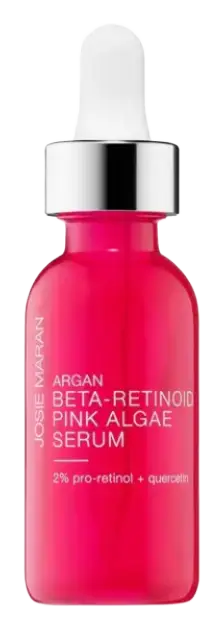
Josie Maran Argan Beta Retinol Pink Algae Serum
A serum with 34 ingredients, including vitamin E.
This serum is formulated around Argania Spinosa Kernel Oil to hydrate and support the skin barrier.
We independently verify ingredients, backed by peer-reviewed research. Suggest an update.
What's inside
Ingredients List
Argania Spinosa Kernel Oil
Emollient







Coconut Alkanes
Emollient
Oleyl Lactate
EmollientOctyldodecyl PCA
EmollientDimethyl Isosorbide
SolventIsosorbide Disunflowerseedate
HumectantSqualane
Emollient
Isostearyl Lactate
EmollientGlyceryl Linoleate
Emollient
Psoralea Corylifolia Seed Powder
Skin ConditioningCaprylic/Capric Triglyceride
Masking
Eclipta Prostrata Extract
Skin Conditioning
Cocos Nucifera Oil
Masking



Coco-Caprylate/Caprate
Emollient
Glyceryl Oleate
Emollient
Quercus Suber Bark Extract
Skin ConditioningGlyceryl Palmitate
EmollientPterocarpus Marsupium Bark Extract
Hydrogenated Vegetable Oil
Emollient
Dipalmitoyl Hydroxyproline
Skin Conditioning
Melia Azadirachta Leaf Extract
Skin ConditioningGlyceryl Linolenate
Emollient
Glyceryl Stearate
Emollient
Oak Root Extract
Skin ConditioningLecithin
Emollient
Palmitic Acid
Emollient
Dunaliella Salina Extract
Skin ConditioningCrithmum Maritimum Extract
Skin ConditioningMoringa Oleifera Seed Oil
Emollient
Olea Europaea Fruit Oil
Masking
Quercetin
Antioxidant
Water
Skin ConditioningTocopherol
Antioxidant


Glycine Soja Oil
Emollient
Argania Spinosa Kernel Oil, Coconut Alkanes, Oleyl Lactate, Octyldodecyl PCA, Dimethyl Isosorbide, Isosorbide Disunflowerseedate, Squalane, Isostearyl Lactate, Glyceryl Linoleate, Psoralea Corylifolia Seed Powder, Caprylic/Capric Triglyceride, Eclipta Prostrata Extract, Cocos Nucifera Oil, Coco-Caprylate/Caprate, Glyceryl Oleate, Quercus Suber Bark Extract, Glyceryl Palmitate, Pterocarpus Marsupium Bark Extract, Hydrogenated Vegetable Oil, Dipalmitoyl Hydroxyproline, Melia Azadirachta Leaf Extract, Glyceryl Linolenate, Glyceryl Stearate, Oak Root Extract, Lecithin, Palmitic Acid, Dunaliella Salina Extract, Crithmum Maritimum Extract, Moringa Oleifera Seed Oil, Olea Europaea Fruit Oil, Quercetin, Water, Tocopherol, Glycine Soja Oil
Key Ingredients
Benefits
Concerns
Ingredients Explained
You may know this ingredient as argan oil. It has emollient and skin conditioning properties that help soften skin and reinforce the lipid barrier.
The fatty acid profile of argan oil is roughly 45-55% oleic acid, 28-36% linoleic acid, 10-15% palmitic acid, and 5-7% stearic acid. It also contains vitamin E, sterols, squalene, and polyphenols like ferulic acid.
Two clinical studies in postmenopausal women found that applying argan oil for 60 days significantly improved skin elasticity and moisturization (reduced transepidermal water loss and increased epidermal water content).
Since it is high in oleic and linoleic acid, this ingredient may not be fungal acne safe. Both of these fall in the C11-C24 range that Malassezia yeast can metabolize.
Learn more about Argania Spinosa Kernel OilCoconut Alkanes is a lightweight, plant-derived emollient and solvent made from the fatty acids of coconut oil.
It spreads easily and adds a soft, silky, non-greasy slip, then evaporates rather than sinking into skin. Due to this behavior, it's prized as a natural and renewable replacement for silicones.
Typical use concentrations can go anywhere up to 20%.
The CIR Expert Panel has reviewed coconut oil and its hydrogenated derivatives and found them to be safe as used in cosmetics. It's a low-irritating and well-tolerated ingredient with no notable sensitization concerns.
Because it's a pure saturated hydrocarbon and not a free fatty acid or ester in the C11-24 range that Malassezia can feed on, it doesn't provide the lipids for Malassezia to feed on. This ingredient is generally regarded as safe for fungal acne.
Learn more about Coconut AlkanesWe don't have a description for Oleyl Lactate yet.
We don't have a description for Octyldodecyl PCA yet.
Dimethyl Isosorbide (often shortened to DMI) is a sugar-derived solvent made from sorbitol. It's used to dissolve tricky ingredients and help them mix smoothly into a formula.
Many actives sit as gritty crystals when undissolved, so DMI swoops in to full dissolve them. This helps improve texture, stability, and how evenly an active is distributed.
It does have a penetration-enhancing reputation that is a bit more nuanced than marketing suggests; a cell study on human skin found that 10% DMI didn't significantly boost the permeation of Hydroquinone, Salicylic Acid, or Octadecenedioic Acid compared to controls (though it did improve their solubility in the formula itself).
Typical usage concentrations usually range from 1-10% depending on the formula's needs; this ingredient is also well tolerated at these levels.
Learn more about Dimethyl IsosorbideWe don't have a description for Isosorbide Disunflowerseedate yet.
Squalane is the hydrogenated and shelf-stable form of squalene (a lipid that naturally occurs in human sebum).
It is an emollient and skin conditioning agent that is able to integrate seamlessly into the skin's lipid barrier without clogging pores.
This is due to how structurally similar it is to what your skin already produces.
Though it is mostly an emollient that helps soften and hydrate skin, it also has some humectant and occlusive action. Humectants help the skin retain moisture while occlusives seal it in, making squalane a triple-threat moisturizer.
Research shows it has antioxidant capabilities that help protect against stressors like UV exposure, specifically UVA induced oxidative stress. This study also found that it supports collagen biosynthesis in human dermal fibroblasts.
No clinical study has reported significant adverse effects and irritation reactions are very rare from this ingredient (even at 100% concentration).
Overall, it's a fantastic ingredient for hydration and is suitable for all skin types.
This depends on the source. Squalane can be derived from both plants and animals. Most squalane used in skincare comes from plants.
Please note: the source of squalane is only known if disclosed by the brand. We recommend reaching out to the brand if you have any questions about their squalane.
Read more about squalene with an "e".
Though squalane is often called an oil, it’s technically not one. It is a hydrocarbon, meaning it is only made of carbon and hydrogen. True oils are triglycerides and made of fatty acids and glycerol.
The term “oil-free” isn’t regulated so companies can define it however they want. Some exclude all oils, while others just avoid mineral oil or comedogenic oils.
Squalane has a comedogenic rating of 1 from the original 1972 study that tested raw ingredients under occlusion on rabbit ears. This system is not standardized or peer-reviewed, and using the raw ingredients is very different from how diluted cosmetic formulations are used on human skin.
A comedogenic rating of 1 means it is "unlikely to clog pores" according to the original rating system.
The overall formula of a product matters more than the individual ingredients on whether or not it will cause clogged pores.
Learn more about SqualaneWe don't have a description for Isostearyl Lactate yet.
Glyceryl Linoleate isn't fungal acne safe.
We don't have a description for Psoralea Corylifolia Seed Powder yet.
Caprylic/Capric Triglyceride (aka MCT Oil) is a lightweight emollient, solvent, and texture enhancer. It is considered a skin-softener by helping to prevent moisture loss.
Though it behaves like an oil, it is not technically one due to its chemical composition. One perk of this ingredient is that it is very stable, resistant to oxidation, and unlikely to go rancid.
In practice, that translates to a long shelf life and a consistently elegant skin feel.
While there is an assumption Caprylic Triglyceride can clog pores due to it being derived from coconut oil, there is no research supporting this. Just patch test if you have concerns.
Fractionated coconut oil and MCT Oil are both listed as Caprylic/Capric Triglyceride according to INCI. This is because INCI names are based on the ingredient’s final chemical composition and not its marketing name or source.
This ingredient is treated as the gold standard fungal acne safe oil. Even though it is coconut derived, the problematic lauric acid is stripped out.
This leaves just caprylic (C8) and capric (C10) acid. These chain lengths actually trend antifungal; a 2020 study found caprylic acid was enough to disrupt Malassezia furfur cell membrane, with a caprylic acid derivative damaging membrane structures at concentrations as low as 0.2%.
Learn more about Caprylic/Capric TriglycerideThis ingredient is also known as Bhringaraj extract or False Daisy. It is a skin conditioning ingredient that keeps skin soft and hydrated.
Research shows it has antioxidant properties; lab studies have found it can protect skin cells from UV-induced damage and help suppress inflammation.
There's also some interesting research on its potential to support hair growth by promoting the growth phase of the hair cycle.
Those with an allergy to plants in the daisy family may want to patch test this ingredient. This ingredient is generally well-tolerated otherwise.
Learn more about Eclipta Prostrata ExtractThis ingredient is also known as coconut oil. It is a plant-derived ingredient with skin conditioning properties.
The fatty acid profile of coconut oil is mostly lauric acid (~54%), followed by capric, caprylic, palmitic, and myristic acids. This profile allows it to penetrate easily into skin, moisturize, and improve dry skin.
A double-blind study confirmed that extra virgin coconut oil is as effective as mineral oil for treating very dry skin. Another study found it outperformed mineral oil for mild to moderate atopic dermatitis in children.
Another study from 2018 found that virgin coconut oil can soothe inflammation and boost key skin barrier proteins. Just know this evidence is still only from lab settings and not human trials.
It has also been shown to reduce Staphylococcus aureus, a bacteria that commonly overgrows in people with eczema.
Clinical testing shows very minimal skin irritation and no evidence of sensitization or phototoxicity.
Coconut oil gets flagged as a "fragrance" because it has a natural mild scent (not because it's a synthetic perfume). The European Cosmetic ingredient database also lists "perfuming" as a function of this ingredient.
Just so you know, the term "fragrance" is completely unregulated. Some brands still use botanical extracts or essential oils in their "fragrance-free" formulas, but regulatory databases technically classify these under "fragrance".
Coconut oil has a tiny and useless bit of natural SPF. Early lab studies clocked it around SPF 7-8 but a more recent study found the real number closer to SPF 1.2. It also offers no meaningful UVA protection (SPF only overs UVB rays).
The comedogenic rating of 4/5 means it has a high potential to clog pores; but it's worth noting that comedogenicity is highly individual and ratings cannot predict how an overall formula will behave on skin.
Since lauric acid is the dominant fatty acid, this ingredient may not be fungal acne safe. The Malassezia yeast feeds on fatty acids with carbon chain lengths between 11-24, and lauric acid falls within these lengths (C12).
Learn more about Cocos Nucifera OilCoco-Caprylate/Caprate is a lightweight ester created from coconut oil fatty acids, caprylic acid, and capric acid.
It is an emollient that helps soften skin and reduce transepidermal water loss (TEWL). What sets it apart from heavier emollients is its ultralight, non-greasy feel.
Once applied, this ingredient dries down quickly and leaves a dry, silky finish behind. This also helps improve spreadability and texture.
This ingredient has an excellent safety-record and is non-irritating.
Typical concentrations for cosmetics range from 0.5-62%.
Research on Malassezia growth found no growth on fatty acid esters with chain lengths shorter than 12 carbons (it prefers C11-24).
Since Coco-Caprylate/Caprate is built on C8 and C10 fatty acids, it is out of the range that Malassezia metabolizes, and therefore safe for fungal acne.
Learn more about Coco-Caprylate/CaprateGlyceryl Oleate is the monoester of glycerin and oleic acid. It is a skin-conditioning emollient that also helps form emulsions.
What makes glyceryl oleate special is its "re-fatting" effect.
When you wash your hair and skin with a surfactant-based cleanser, the surfactants grab onto everything. This includes your skin's natural lipids, or the fats that live in your skin barrier and sebum. Once you rinse these surfactants away, it leaves your skin feeling tight, dry, and clean (in a not-good way).
Re-fatting is essentially putting some of these lipids back. Glyceryl oleate deposits a thin layer of emollient lipids back on the skin or hair surface reduce some of the barrier damage.
Also, glyceryl oleate isn't a foreign molecule to your skin. It's chemically identical to something your skin already produces and manages naturally. This is why it tends to be well-tolerated with low risk of irritation.
Typical use levels range from 0.5-5%.
Glyceryl Oleate has a function of "perfuming" in the CosIng database. This just means that the ingredient has some scent character that can contribute to the product's overall smell.
The scent of this ingredient is described as "waxy".
As an ester of oleic acid, this ingredient may not be fungal acne safe. This is because oleic acid falls into the carbon-chain length that Malassezia can use as a substrate.
Learn more about Glyceryl OleateWe don't have a description for Quercus Suber Bark Extract yet.
We don't have a description for Glyceryl Palmitate yet.
We don't have a description for Pterocarpus Marsupium Bark Extract yet.
Hydrogenated Vegetable Oil is created by adding hydrogen to vegetable oil in order to give it more stability. This process also raises the melting point of vegetable oil. In cosmetics, it is an emollient.
Emollients help soothe and soften the skin. They do this by creating a protective film on your skin. This barrier helps trap moisture and keeps your skin hydrated. Emollients may be effective at treating dry or itchy skin.
The term "Hydrogenated Vegetable Oil" is an umbrella term and can refer to a variety of vegetable oils and blends of: sunflower oil, soybean oil, olive oil, coconut oil, palm oil, and more.
Due to the differences in vegetables, the benefits may vary.
Learn more about Hydrogenated Vegetable OilDipalmitoyl Hydroxyproline isn't fungal acne safe.
This ingredient is also known as neem leaf extract. It contains natural compounds like nimbidin, quercetin, and other polyphenols that give it antibacterial, antifungal, and anti-inflammatory activity.
Lab studies have shown neem leaf extract can inhibit acne-related bacteria and help calm skin. Animal studies on wound gels using 1-3% neem leaf extract found it sped up healing without causing irritation.
A wound-healing study testing gels with the extract at 1%, 2%, and 3% concentrations and found none of them irritated the skin.
Most commercial products also use it in a similar low range (typically under 5%).
Allergy-wise, there are some case reports on neem oil causing allergic contact dermatitis so people with plant/botanical sensitivities may want to patch test first.
Learn more about Melia Azadirachta Leaf ExtractGlyceryl Linolenate isn't fungal acne safe.
Glyceryl Stearate is made by reacting glycerin with stearic acid (typically sourced from plant oils like palm or coconut). It's an emulsifier, emollient, and mild occlusive.
Emulsifiers help ingredients like oil and water stay mixed so your formula stays nicely blended and uniform in texture.
This ingredient is typically used in concentrations between 1-10%. Studies have found it to be non-sensitizing, non-phototoxic, and non-photoallergenic.
A close cousin of this ingredient is Glyceryl Stearate SE ("self-emulsifying"). This just has a small amount of sodium or potassium stearate added so it can emulsify without a co-emulsifier.
Since this ingredient is an ester of a C18 fatty acid, it may not be fungal acne safe. The Malassezia yeast can potentially metabolize within the C11-C24 range.
Fun fact: The human body also creates Glyceryl Stearate naturally.
Learn more about Glyceryl StearateWe don't have a description for Oak Root Extract yet.
Lecithin is a term for a group of substances found in the cell membranes of plants, animals, and humans. They are made up of phospholipids.
Thanks to its amphiphilic structure (water-loving head and oil-loving tail), it is a true multitasker:
It plays well with most ingredients and is typically used at 0.1-1%. However, concentrations up to 50% have been reported in moisturizers.
Learn more about LecithinPalmitic Acid is a fatty acid naturally found in our skin and in many plant and animal sources.
In cosmetics, it is usually derived from palm oil. It serves many purposes in skincare, acting as a cleanser, emollient, and emulsifier.
Interestingly, topically applied Palmitic Acid can be elongated into longer chain fatty acids and ceramides. A 2019 study found low levels of Palmitic Acid lead to slower development of cells, suggesting it plays a role in keeping your skin's renewal process on track.
The CIR (Cosmetic Ingredient Review) panel determined it safe as used in cosmetics at concentrations up to 13%. It is non-irritating and non-sensitizing in clinical studies.
The culprit behind fungal acne, the Malassezia yeast, feeds on fatty acids with carbon chain lengths between C11-C24. Palmitic Acid, at C16, falls right into that sweet spot.
In vitro studies have shown that Palmitic Acid is one of the fatty acids that induce rapid Malassezia growth in lab settings.
It's worth noting that what feeds yeast in a lab doesn't necessarily feed it on your face since formulation and your skin's chemistry play a bigger role.
Learn more about Palmitic AcidWe don't have a description for Dunaliella Salina Extract yet.
This ingredient is also known as sea fennel. It is a coastal plant extract with plant compounds like chlorogenic acid. This plant contains both "water" and "oil" parts.
One small human study (12 people over the age of 50) found formulas containing sea fennel biomass showed faster recovery of barrier function / TEWL after the barrier was deliberately disrupted.
A 2025 paper reported improved markers of regeneration in a UV-weakened full-thickness skin model using both water and oil parts. Markers include thicker epidermis, higher loricrin, and more collagen-related signals compared to an oil-only extract.
Broader phytochemical reviews describe antioxidant and anti-inflammatory activity in experimental models.
The plant's essential oil side can contain fragrant terpenes that can irritate sensitive skin, but many skincare formulas focus more on antioxidants like chlorogenic acid.
Learn more about Crithmum Maritimum ExtractMoringa Oleifera Seed Oil is a lightweight oil from the seeds of the Moringa oleifera tree. In cosmetics, it's an emollient that forms a light film to slow water loss and soften skin.
Its fatty acid composition is dominated by oleic acid (70-78%), with smaller amounts of behenic, palmitic, and stearic acids (this profile is actually pretty similar to olive oil).
Notably, this ingredient is oxidatively stable for an oil and resists going rancid as fast as other oils.
A small, in vivo study on 32 participants found a cream with this ingredient increased skin hydration with no reported skin irritation. It also found the tocopherol content gave it some antioxidant activity as well.
One thing to flag for fungal acne:
Because this oil is so high in oleic acid, Malassezia can use it as a food source and this ingredient may not be fungal acne safe.
For everyone else, this ingredient is well-tolerated and nourishing with a good safety track record.
Learn more about Moringa Oleifera Seed OilThis ingredient is also known as olive oil. It has been used in skincare for centuries and science largely backs up its reputation as a nourishing emollient.
The main components of olive oil are oleic acid (55-83%), linoleic acid (3.5-20%), and palmitic acid (7-20%). Oleic acid promotes skin regeneration and helps regulate inflammatory responses.
Squalene is also naturally present in olive oil and exhibits moisturizing and antioxidant properties.
The polyphenols in olive oil also show anti-aging promise; one clinical study found a measurable improvement in skin appearance after 30 days of topical serum use.
Just be aware that applying olive oil directly to skin can weaken the barrier and cause redness. One study with volunteers found even people without sensitive skin experienced a significant reduction in stratum corneum integrity and induced mild erythema.
It's best to use this ingredient as part of a carefully crafted formula (instead of putting it on skin directly from the bottle).
Because it has a 2-3 on the comedogenic scale, it is a moderate risk for acne-prone skin. However, the overall formulation of a product matters more than a few ingredients with comedogenic ratings.
This ingredient may not be fungal acne safe because of the oleic and palmitic acid content. These fall within the C11-24 fatty acid range that the Malassezia yeast can metabolize to grow.
Overall, olive oil is a well-studied and nourishing skincare ingredient.
Learn more about Olea Europaea Fruit OilQuercetin is a polyphenol flavonoid that can be naturally found in plants like apples, onions, berries, and broccoli. It has antioxidant and skin soothing properties.
The anti-inflammatory research for this ingredient is pretty solid:
It also looks promising for anti-aging; it activates pathways tied to cellular "youthfulness" by helping the cells that produce collagen and elastin do their job better. It also switches on the "longevity" gene that keeps cells acting young.
As of right now, most of the anti-aging research has been done on animals or cells in petri dishes, but there's no harm in trying this ingredient in your routine.
Another cool perk of this ingredient?
It does a great job stabilizing the chemical UV filters avobenzone and octinoxate against sun degradation. One study found it outperformed both tocopherol and octocrylene as a photostabilizer.
The only downside (if you can even call it that) is that quercetin doesn't dissolve well in water and cannot penetrate skin easily on its own. This just means formulators pair it with delivery systems to actually get it into skin.
There is some recent buzz about this ingredient having brightening effects, but the research hasn't backed this up.
Learn more about QuercetinWater. It's the most common cosmetic ingredient of all. You'll usually see it at the top of ingredient lists, meaning that it makes up the largest part of the product.
So why is it so popular? Water most often acts as a solvent - this means that it helps dissolve other ingredients into the formulation.
You'll also recognize water as that liquid we all need to stay alive. If you see this, drink a glass of water. Remember to stay hydrated!
Learn more about WaterTocopherol is a fat-soluble antioxidant known as Vitamin E.
You'll find this ingredient in the vast majority of skincare (for good reason). It works to neutralize free radicals, or unstable molecules generated by UV exposure, pollution, and other environmental stressors, before they can cause oxidative damage to your skin cells.
Topically applied tocopherol has been shown to protect against UV damage by ramping up the skin's own natural defense enzymes.
It also acts as a skin conditioning agent; some studies show that regular topical use can improve the skin's water-binding capacity over 2-4 weeks.
This ingredient is especially loved for being a team player. When combined with Vitamin C, the photoprotective effect of both ingredients roughly doubles and the combo also helps reduce UV-induced DNA damage.
This ingredient has some brightening potential but it's more of a prevention ingredient than spot-fader. Cell studies show it can slow down melanin production but it's worth noting that it's not the most powerful brightener out there.
In formulations, it also serves as a stabilizer that helps protect other oxidation-prone ingredients from degrading.
Concentrations usually range from 0.1-1% in most leave-on products.
Learn more about TocopherolGlycine Soja Oil is a plant-derived oil from soybean seeds. Like other oils, it is rich in essential fatty acids (mostly linoleic and oleic) that support skin hydration and barrier function.
The fatty acids are able to integrate into the lipid matrix of the stratum corneum to help soften skin and reduce water loss.
On top of that, soybean oil is rich in vitamins like vitamin E, a potent antioxidant.
Research on soybean's active components also point to anti-inflammatory, collagen-stimulating, antioxidant activity, and protection against UV-induced oxidative damage.
Most of this research applies to the broader soybean plant and not just the oil fraction alone.
This ingredient may not be fungal acne safe due to the oleic acid content.
Learn more about Glycine Soja OilReviews
No written reviews yet. Be the first to review this product.
Recent searches
Search reviews by skin type, ingredient, or keyword.
Where it's from
Josie Maran is a American brand

Often compared with

We're dedicated to providing you with the most up-to-date and science-backed ingredient info out there.
The data we've presented on this page has been verified by a member of the SkinSort Team.
Read more about us· Published July 13, 2020


