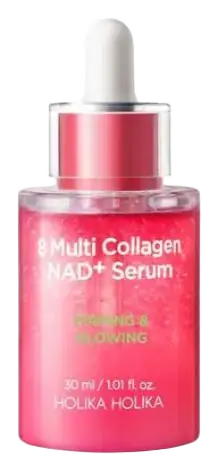
Holika Holika 8 Multi Collagen NAD+ Serum
A serum with 52 ingredients, including niacinamide, vitamin E, and hyaluronic acid.
This anti-aging serum is formulated around Niacinamide and Collagen Extract to soften the look of wrinkles and hydrate skin.
We independently verify ingredients, backed by peer-reviewed research. Suggest an update.
What's inside
Ingredients List
Water
Skin ConditioningGlycerin
Humectant


Butylene Glycol
Humectant
1,2-Hexanediol
Skin Conditioning
Methyl Gluceth-20
Humectant
Niacinamide
Smoothing









Trehalose
Humectant
Caprylic/Capric Triglyceride
Masking
Polyglycerin-3
Humectant
Isononyl Isononanoate
EmollientGlyceryl Polymethacrylate
Panthenol
Skin Conditioning
Polyglyceryl-10 Laurate
Skin Conditioning

Ammonium Acryloyldimethyltaurate/Vp Copolymer
Propanediol
Solvent
Carbomer
Emulsion StabilisingCastor Oil/Ipdi Copolymer

Tromethamine
BufferingSodium Hyaluronate Crosspolymer
Humectant
Ethylhexylglycerin
Skin ConditioningHydrogenated Lecithin
Emulsifying
Hydrolyzed Glycosaminoglycans
HumectantAdenosine
Skin Conditioning
Sodium Hyaluronate
Humectant
Benzyl Glycol
SolventCeramide NP
Skin Conditioning
Cyanocobalamin
Skin ConditioningArginine
Masking
Dextrin
AbsorbentTheobroma Cacao Extract
Skin ConditioningBeta-Glucan
Skin Conditioning
Hydrolyzed Hyaluronic Acid
Humectant
Amodimethicone

Phellinus Linteus Extract
Skin ConditioningHyaluronic Acid
Humectant
Nicotinamide Adenine Dinucleotide
Skin ConditioningTocopherol
Antioxidant

Nicotinamide Mononucleotide
Antioxidant
Atelocollagen
Skin Conditioning
Desamido Collagen
Skin Conditioning
Hydrolyzed Collagen
Emollient
Soluble Collagen
Humectant
Collagen Extract
Skin Conditioning
Collagen
Moisturising
Collagen Amino Acids
Moisturising
Sorbitan Laurate
Emulsifying
Palmitoyl Tripeptide-5
Skin Conditioning
Hydroxyethylcellulose
Emulsion StabilisingProcollagen
Skin Conditioning
Resveratrol
Antioxidant
Acetyl Dipeptide-1 Cetyl Ester
Skin Conditioning
Acetyl Tetrapeptide-5
Humectant
Water, Glycerin, Butylene Glycol, 1,2-Hexanediol, Methyl Gluceth-20, Niacinamide, Trehalose, Caprylic/Capric Triglyceride, Polyglycerin-3, Isononyl Isononanoate, Glyceryl Polymethacrylate, Panthenol, Polyglyceryl-10 Laurate, Ammonium Acryloyldimethyltaurate/Vp Copolymer, Propanediol, Carbomer, Castor Oil/Ipdi Copolymer, Tromethamine, Sodium Hyaluronate Crosspolymer, Ethylhexylglycerin, Hydrogenated Lecithin, Hydrolyzed Glycosaminoglycans, Adenosine, Sodium Hyaluronate, Benzyl Glycol, Ceramide NP, Cyanocobalamin, Arginine, Dextrin, Theobroma Cacao Extract, Beta-Glucan, Hydrolyzed Hyaluronic Acid, Amodimethicone, Phellinus Linteus Extract, Hyaluronic Acid, Nicotinamide Adenine Dinucleotide, Tocopherol, Nicotinamide Mononucleotide, Atelocollagen, Desamido Collagen, Hydrolyzed Collagen, Soluble Collagen, Collagen Extract, Collagen, Collagen Amino Acids, Sorbitan Laurate, Palmitoyl Tripeptide-5, Hydroxyethylcellulose, Procollagen, Resveratrol, Acetyl Dipeptide-1 Cetyl Ester, Acetyl Tetrapeptide-5
Key Ingredients
Benefits
Ingredients Explained
Water. It's the most common cosmetic ingredient of all. You'll usually see it at the top of ingredient lists, meaning that it makes up the largest part of the product.
So why is it so popular? Water most often acts as a solvent - this means that it helps dissolve other ingredients into the formulation.
You'll also recognize water as that liquid we all need to stay alive. If you see this, drink a glass of water. Remember to stay hydrated!
Learn more about WaterGlycerin (or glycerol) is a compound naturally found in your skin. It's a powerhouse humectant that pulls water into the stratum corneum.
Topically, glycerin does several things at once:
Your skin makes glycerin on its own (mostly from sebaceous oil breakdown) and shuttles it to your outermost layer of skin, or your epidermis, via aquaporin-3.
Aquaporin-3 is a transporter that is essential for normal skin hydration, elasticity, and repair. Interestingly, mice lacking in AQP3 have dry and less elastic skin that can be fully corrected with glycerin.
This ingredient is non-irritating, plays well with almost every ingredient, and works across all skin types. Typical use is anywhere between 3-10% but can go up to 79% in some leave-on products.
Just know very high concentrations (>40%) can feel tacky in low humidity.
Glycerin is the name for this ingredient in American English. British English uses Glycerol/Glycerine.
Learn more about GlycerinButylene Glycol (or BG) is used within cosmetic products for a few different reasons:
Overall, Butylene Glycol is a safe and well-rounded ingredient that works well with other ingredients.
Though this ingredient works well with most skin types, some people with sensitive skin may experience a reaction such as allergic rashes, closed comedones, or itchiness.
Learn more about Butylene Glycol1,2-Hexanediol is a synthetic liquid and another multi-functional powerhouse.
It is a:
- Humectant, drawing moisture into the skin
- Emollient, helping to soften skin
- Solvent, dispersing and stabilizing formulas
- Preservative booster, enhancing the antimicrobial activity of other preservatives
Methyl Gluceth-20 is a humectant. Humectants help draw moisture from the air to your skin.
It is created by combining polyethylene glycol with glucose.
Niacinamide is a multitasking form of vitamin B3 that strengthens the skin barrier, reduces pores and dark spots, regulates oil, and improves signs of aging.
And the best part? It's gentle and well-tolerated by most skin types, including sensitive and reactive skin.
You might have heard of "niacin flush", or the reddening of skin that causes itchiness. Niacinamide has not been found to cause this.
In very rare cases, some individuals may not be able to tolerate niacinamide at all or experience an allergic reaction to it.
If you are experiencing flaking, irritation, and dryness with this ingredient, be sure to double check all your products as this ingredient can be found in all categories of skincare.
When incorporating niacinamide into your routine, look out for concentration amounts. Typically, 5% niacinamide provides benefits such as fading dark spots. However, if you have sensitive skin, it is better to begin with a smaller concentration.
When you apply niacinamide to your skin, your body converts it into nicotinamide adenine dinucleotide (NAD). NAD is an essential coenzyme that is already found in your cells as "fuel" and powers countless biological processes.
In your skin, NAD helps repair cell damage, produce new healthy cells, support collagen production, strengthen the skin barrier, and fight environmental stressors (like UV and pollution).
Our natural NAD levels start to decline with age, leading to slower skin repair, visible aging, and a weaker skin barrier. By providing your skin niacinamide, you're recharging your skin's NAD levels. This leads to stronger, healthier, and younger looking skin.
Another name for vitamin B3 is nicotinamide. This vitamin is water-soluble and our bodies don't store it. We obtain Vitamin B3 from either food or skincare. Meat, fish, wheat, yeast, and leafy greens contain vitamin B3.
The type of niacinamide used in skincare is synthetically created.
Learn more about NiacinamideTrehalose is a disaccharide made of two glucose molecules (glucose is sugar!). Trehalose is used to help moisturize skin. It also has antioxidant properties.
As a humectant, trehalose helps draw moisture from the air to your skin. This helps keep your skin hydrated.
Due to its antioxidant properties, trehalose may help with signs of aging. Antioxidants help fight free-radical molecules, unstable molecules that may damage your skin.
In medicine, trehalose and hyaluronic acid are used to help treat dry eyes.
Some animals, plants, and bacteria create trehalose as a source of energy to survive freeze or lack of water.
Learn more about TrehaloseCaprylic/Capric Triglyceride (aka MCT Oil) is a lightweight emollient, solvent, and texture enhancer. It is considered a skin-softener by helping to prevent moisture loss.
Though it behaves like an oil, it is not technically one due to its chemical composition. One perk of this ingredient is that it is very stable, resistant to oxidation, and unlikely to go rancid.
In practice, that translates to a long shelf life and a consistently elegant skin feel.
While there is an assumption Caprylic Triglyceride can clog pores due to it being derived from coconut oil, there is no research supporting this. Just patch test if you have concerns.
Fractionated coconut oil and MCT Oil are both listed as Caprylic/Capric Triglyceride according to INCI. This is because INCI names are based on the ingredient’s final chemical composition and not its marketing name or source.
This ingredient is treated as the gold standard fungal acne safe oil. Even though it is coconut derived, the problematic lauric acid is stripped out.
This leaves just caprylic (C8) and capric (C10) acid. These chain lengths actually trend antifungal; a 2020 study found caprylic acid was enough to disrupt Malassezia furfur cell membrane, with a caprylic acid derivative damaging membrane structures at concentrations as low as 0.2%.
Learn more about Caprylic/Capric TriglyceridePolyglycerin-3 is a 3-unit glycerin polymer.
Like glycerin, this ingredient is a humectant. Humectants help hydrate your skin by drawing water to it.
Having moisturized skin helps improve the skin barrier. Your skin barrier helps protect against irritants and bacteria.
Learn more about Polyglycerin-3Isononyl Isononanoate is a synthetic skin-conditioner and texture enhancer. It is created from nonanoic acid, a fatty acid found in cocoa and lavender oil.
As an emollient, Isononyl Isononanoate helps keep your skin soft and smooth. This is because emollients create a barrier on the skin to trap moisture in.
Isononyl Isononanoate helps give products a velvet feel and improves spreadability.
Learn more about Isononyl IsononanoateThis is a synthetic polymer made by combining glycerin with polymethacrylic acid.
It is a non-drying, non-greasy moisturizer that helps enhance the feel and slip of formulations, helps stabilize emulsions, creates a film, and controls viscosity.
As a film former, it creates a light and flexible layer on the skin's surface. This helps lock in moisture without feeling heavy.
It's typically used at concentrations up to 1.9% in leave-on products. CIR has concluded that these ingredients are safe in cosmetics at current use levels.
Due to its large molecule size, it doesn't readily penetrate into skin and mostly just sits on the surface. A large UK-based patch test study of over 1,300 patients found that sensitization to related acrylate copolymers is rare.
Learn more about Glyceryl PolymethacrylatePanthenol is a common ingredient that helps hydrate and soothe the skin. It is found naturally in our skin and hair.
There are two forms of panthenol: D and L.
D-panthenol is also known as dexpanthenol. Most cosmetics use dexpanthenol or a mixture of D and L-panthenol.
Panthenol is famous due to its ability to go deeper into the skin's layers. Using this ingredient has numerous pros (and no cons):
Like hyaluronic acid, panthenol is a humectant. Humectants are able to bind and hold large amounts of water to keep skin hydrated.
This ingredient works well for wound healing. It works by increasing tissue in the wound and helps close open wounds.
Once oxidized, panthenol converts to pantothenic acid. Panthothenic acid is found in all living cells.
This ingredient is also referred to as pro-vitamin B5.
Learn more about PanthenolPolyglyceryl-10 Laurate is a cleansing agent and emulsifier.
It rounds up dirt, oil, and grime, so they can be rinsed off easily as a cleanser.
On the emulsifier side, it keeps your formula smooth and well-mixed by playing peacekeeper for ingredients that don't naturally get along (like oil and water).
Because it has a C12 (lauric acid) fatty acid chain, this ingredient can potentially feed the Malassezia yeast that causes fungal acne. The Malassezia yeast prefers esters with C11-C24 fatty acids.
This ingredient is an ester of lauric acid and Polyglycerin-10.
Learn more about Polyglyceryl-10 LaurateAmmonium Acryloyldimethyltaurate/Vp Copolymer is a synthetically created polymer. It's used as a film-forming agent and used to thicken the consistency of products.
Think of it as a supportive ingredient that helps your gel-creams feel silky, "cloud cream-like", and spread evenly without being greasy.
The Cosmetic Ingredient Review (CIR) Expert Panel evaluated it (along with 22 other acryloyldimethyltaurate polymers) and concluded it's:
Due to its large molecular size, it sits on the surface of skin rather than penetrating it.
Learn more about Ammonium Acryloyldimethyltaurate/Vp CopolymerPropanediol is an all-star ingredient. It softens, hydrates, and smooths the skin.
It’s often used to:
Propanediol is not likely to cause sensitivity and considered safe to use. It is derived from corn or petroleum with a clear color and no scent.
Learn more about PropanediolCarbomer is a synthetic thickening and gelling agent. It's basically the ingredient that gives a lot of serums, gels, creams, and sunscreens their smooth, non-sticky texture.
Although legally permitted at very high levels, carbomers are normally used at concentrations below 1%.
It also needs to be neutralized to actually thicken, and because it is a large molecule, it doesn't really penetrate the skin barrier.
Allergy-wise, the risk is very low. Clinical studies show carbomers have low potential for skin irritation/sensitization even at concentrations up to 100%.
A 2024 UK study patch-tested 1,302 patients and found true allergy to the parent group of carbomer to be rare with no confirmed relevant reactions.
Learn more about CarbomerCastor Oil/Ipdi Copolymer is an oil and isn't fungal acne safe.
Tromethamine (aka THAM) is a synthetic amino acid that shows up in skincare as a helper ingredient.
It functions as a pH adjuster to help neutralize acidic ingredients and set a formula's pH to the right spot.
This matters a lot because a lot of actives (like vitamin C) needs a specific pH to work well and feel comfortable on skin.
Concentration use ranges from 0.1-1.0% depending on the formula.
Learn more about TromethamineSodium Hyaluronate Crosspolymer is a crosslinked version of sodium hyaluronate. This just means it's linked into a 3D mesh network that lets it be more stable and sit on skin as a cohesive, gel-like film rather than sinking into skin.
A 2016 human skin study found crosslinked HA increased epidermal water content by 7.6% over the control group and reduced transepidermal water loss by 27.8%.
A follow-up clinical trial found that a topical crosslinked HA serum applied after fillers, microneedling, or chemical peels was well-tolerated and enhanced skin quality at 14 / 28 days.
More recent research suggests that concentrations as low as 0.03% can act as a penetration enhancer for other skincare actives.
Learn more about Sodium Hyaluronate CrosspolymerEthylhexylglycerin is created from glycerin. It is a multitasker ingredient that:
The CIR Expert Panel found minimal skin absorption or sensitization of any kind in a safety assessment. Though this ingredient is considered well-tolerated, a small number of cases of allergic dermatitis have been published since 2002. Just be sure to patch test if you are unsure.
Industry-reported use ranges from 8% in rinse-off products and 2% in leave-on formulations.
Learn more about EthylhexylglycerinHydrogenated Lecithin is a more stable version of lecithin.
It's made by taking lecithin (a phospholipid commonly found in soybeans and egg yolks) and hydrogenating it. This just means the unsaturated fatty acids are turned into saturated ones so they don't go bad as easily.
This ingredient is an emollient, emulsifier, and penetration enhancer. As an emollient, it helps soften and hydrate skin by trapping moisture within. As an emulsifier, it prevents oil and water ingredients from separating.
Hydrogenated Lecithin can form tiny spherical structures made of phospholipid bilayers called liposomes. These liposomes are able to capture compounds inside their structure and deliver them through the skin barrier.
Because phospholipids are a natural component of our cell membranes, this ingredient is inherently compatible with skin.
A 2021 study found lecithin-based surfactants were less harsh and more tolerable comared to Sodium Lauryl Sulfate (SLS).
Learn more about Hydrogenated LecithinWe don't have a description for Hydrolyzed Glycosaminoglycans yet.
Adenosine is a purine nucleoside that your body already makes in every cell. In skincare, it acts mainly as a skin conditioning and anti-aging agent.
The way it works is fairly well mapped out:
Your skin has cells called fibroblasts that build collagen (the stuff that keeps skin firm and smooth). Adenosine basically flips a switch on these cells that tells them to get to work making more collagen and other proteins. These cells slow down on their own as skin ages, so Adenosine helps give them a little nudge to keep going.
The clinical backing is pretty solid too.
A blind, randomized, placebo-controlled trial of 126 women aged 45-65 tested a 0.1% cream twice daily and found real improvements in crow's feet and frown lines using a precise 3D skin-mapping technique; these changes showed up by week 3 and held at 2 months.
A later study using Adenosine-loaded dissolving microneedle patches reported gains in wrinkle depth, dermal density, elasticity, and hydration.
On concentrations, South Korea's Ministry of Food and Drug Safety has set 0.04% as the approved functional anti-wrinkle level. You'll typically see this ingredient used somewhere in the 0.04-0.1% range since it works at low doses.
This ingredient has been found safe for cosmetics with the data showing no irritation or sensitization.
Overall, this is a great ingredient for any anti-aging routine and has no photosensitizing effect, so it suits both AM and PM use.
Learn more about AdenosineSodium Hyaluronate is the salt form of hyaluronic acid. It is a long sugar chain that is naturally found in your skin, joints, and connective tissue that maintains hydration and elasticity.
In skincare, it works as a humectant. It pulls water from the environment and deeper layers of skin and binds it to the surface.
Interestingly, the size of the molecule affects its behavior:
Some clinical evidence links low molecular weight versions to improved wrinkle depth, elasticity, anti-inflammatory effects, and barrier repair.
Many serums use a blend of both weights so you can get surface hydration plus longer-lasting and deeper effects.
You'll typically see concentrations between 0.1-2% for this ingredient.
Learn more about Sodium HyaluronateWe don't have a description for Benzyl Glycol yet.
Ceramide NP (formerly known as Ceramide 3) is one of the skin's naturally occurring lipids.
Since ceramides are the major lipid components of the skin, they are crucial for maintaining skin barrier and hydration. Ceramide NP most closely mirrors the dominant kind in human skin amongst ceramide subtypes.
This ceramide works by slotting into gaps within the stratum corneum's lipid matrix to limit trans-epidermal water loss (TEWL) and shield the skin against external irritants.
A study with 312 patients found that using a ceramide-containing routine for 4 weeks reduced the severity of atopic dermatitis by over 61%.
Another clinical study in subjects aged 60 and older found that a ceramide body wash and moisturizer improved skin dryness and itchy skin in 15 days.
Overall, ceramides are considered non-irritating and safety tests have found little to no observable adverse effects from using this ingredient.
Ceramide NP is usually sourced from plants (like soybean or rice bran), or produced synthetically.
Learn more about Ceramide NPCyanocobalamin is the manufactured version of vitamin B12. It has skin soothing, antioxidant, and barrier protecting properties. Topical cyanocobalamin is used to treat skin irritation and atopic dermatitis.
Arginine is a semi-essential amino acid. This just means our bodies can product a bit on its own, but sometimes needs a little boost from food sources.
It is a part of your skin's natural moisturizing factor (NMF), or the water-loving molecules in your outermost layer of skin (stratum corneum) that keeps everything hydrated and happy.
Here's an interesting thing about Arginine: your skin converts it into urea through the Krebs-Henseleit urea cycle. Urea is one of the most effective humectants your skin naturally produces.
A clinical study showed applying 2.5% arginine hydrochloride to atopic dermatitis skin showed significant urea levels in the stratum corneum and improved moisture in just four weeks.
Arginine is also a precursor to nitric oxide; nitric oxide improves microcirculation and supports wound healing and collagen synthesis.
One study found that an amino acid complex containing Arginine reduced skin irritation, improved hydration, and accelerated skin repair in clinical / in-vivo studies.
Arginine itself is an amino acid and not a fatty acid, oil, or ester. On its own, it's not a direct food source for Malassezia, or the yeast that causes fungal acne.
Learn more about ArginineDextrin is a starch-derived polysaccharide. It's made by partially breaking down corn, potato, or other plant starches.
Think of it as "half-processed" starch; it's less complex than the original but not fully broken down into sugar like maltodextrin.
In cosmetics, it mainly functions as a bulking agent, viscosity controller, binder, and absorbent. It helps thicken products, stabilize powders, and get certain textures a less "wet" feel.
This ingredient has a pretty solid safety profile; it's recognized as a safe food additive and its large molecular size means it doesn't meaningfully penetrate skin.
Human repeat insult patch tests using a rinse-off facial product containing 42.69% dextrin found no skin irritation or sensitization in 54 subjects.
Typical real-world usage is much lower: usually under 1% as a texture modifier and up to 40% in masks (rinse off products use less).
Learn more about DextrinThis ingredient is extracted from the seeds of the cocoa tree.
Cacao seeds contain antioxidants known as polyphenols. These include flavonoids, procyanidins, and epicatechins.
Studies show these polyphenols help improve skin health.
The more famous ingredient from cocoa tree is cocoa butter.
Learn more about Theobroma Cacao ExtractBeta-Glucan is a soluble polysaccharide (a chain of glucose sugars) sourced from the cells walls of oats, baker's yeast, mushrooms, and seaweed.
It's a rare ingredient that pulls double-duty as a heavy-duty hydrator and skin-soothing repair agent.
On the surface, it acts as a humectant that holds water in place and reduces moisture loss for a plumper, smoother feel, while its anti-inflammatory and antioxidant properties make it a great pick for calming redness or sensitive skin
The more interesting story is underneath:
Despite its large molecular size, oat beta-glucan has been shown to penetrate the epidermis and reach the dermis by slipping between skin cells. Here, it interacts with fibroblasts and macrophages to nudge collagen synthesis and support wound repair.
A small 2005 split-face clinical study of 27 subjects found topical beta-glucan produced measurable reductions in wrinkle depth, height, and roughness after 8 weeks of use.
It is worth noting the trial was small and the penetration testing used frozen, irradiated skin so the anti-aging data is encouraging rather than definitive.
This ingredient gets along with pretty much everything and is typically used around 0.1-1%.
Fungal acne: This ingredient is not a food source for the Malassezia yeast because it is a glucose polysaccharide with no fatty acid or ester component.
Learn more about Beta-GlucanHydrolyzed Hyaluronic Acid is hyaluronic acid (HA) that is broken down into lower molecular weight fragments.
It's a humectant that pulls and holds water in the skin to help with hydration, plumpness, and reduce transepidermal water loss.
Because hydrolyzed hyaluronic acid is smaller in size, it can slip past your outermost layer of skin more easily than full-sized HA.
Most formulations will combine all sizes to get the best of both worlds.
Typical usage levels range from 0.01-1%. Any percentage higher than 2% might become goopy and tacky.
Learn more about Hydrolyzed Hyaluronic AcidThis water-soluble silicone is used for its hydrating and softening properties. It is used to add a silky feel to skincare products and has great benefits for haircare.
In haircare, this ingredient:
- Adds shine
- Protects color
- Offers thermal protection
- Boosts hair strength
- Does not build up as easily
We don't have a description for Phellinus Linteus Extract yet.
Hyaluronic acid (HA) is a glycosaminoglycan (basically a long sugar chain) that your skin already makes on its own. In your skin, HA lives in the extracellular matrix and acts as the body's moisture reservoir.
Topically, HA is a humectant that binds water and helps skin look more plump, smooth, and hydrated.
The only catch is that HA isn't a single thing; it actually comes in a wide range of molecular weights (~50 - 2,000+ kDA) and size matters.
Some clinical evidence links low molecular weight versions to improved wrinkle depth, elasticity, anti-inflammatory effects, and barrier repair.
This is why the best HA serums blend the two sizes together so you get the best of both worlds.
The majority of cosmetic HA is produced by bacterial fermentation, typically using Streptococcus or Bacillus strains. Typical use levels in skincare sit around 0.1-2%.
A clinical study using a 0.2% low-molecular weight HA gel showed improvement in facial seborrheic dermatitis with excellent tolerance.
These are some other common types of Hyaluronic Acid:
Learn more about Hyaluronic AcidThis ingredient is also called NAD+.
It is a coenzyme naturally found in every living cell where it plays a role in energy metabolism, DNA repair, and the activation of enzymes that maintain cellular health. Niacinamide is one of its key precursors.
Our NAD+ levels naturally decline with age and several DNA repair mechanisms critical to skin health are directly dependent on NAD+ to function.
In-vitro studies on human fibroblasts have shown that exogenous NAD+ can protect agsinst UV-induced extrinsic and intrinsic aging.
Here's a big caveat: NAD+ is a large, polar moleculate that has difficult penetrating the skin's stratum corneum. It also degrades quickly when exposed to light, heat, or pH changes. That's why brands prefer to use smaller, more stable precursors like NMN or NR.
The optimal stability for NAD+ is a pH of 6-7.5 and it is typically used in concentration ranges from 0.5-2%.
If you're looking for the most well-studied topical route to support your skin's NAD+, niacinamide is your best bet.
Learn more about Nicotinamide Adenine DinucleotideTocopherol is a fat-soluble antioxidant known as Vitamin E.
You'll find this ingredient in the vast majority of skincare (for good reason). It works to neutralize free radicals, or unstable molecules generated by UV exposure, pollution, and other environmental stressors, before they can cause oxidative damage to your skin cells.
Topically applied tocopherol has been shown to protect against UV damage by ramping up the skin's own natural defense enzymes.
It also acts as a skin conditioning agent; some studies show that regular topical use can improve the skin's water-binding capacity over 2-4 weeks.
This ingredient is especially loved for being a team player. When combined with Vitamin C, the photoprotective effect of both ingredients roughly doubles and the combo also helps reduce UV-induced DNA damage.
This ingredient has some brightening potential but it's more of a prevention ingredient than spot-fader. Cell studies show it can slow down melanin production but it's worth noting that it's not the most powerful brightener out there.
In formulations, it also serves as a stabilizer that helps protect other oxidation-prone ingredients from degrading.
Concentrations usually range from 0.1-1% in most leave-on products.
Learn more about TocopherolNicotinamide Mononucleotide, or NMN, is a nucleotide derived from niacin and a precursor to NAD+.
NAD+ is a coenzyme that is used for cellular energy production, DNA repair, and signaling protein activation. These all slow down as we age and as NAD+ levels decline.
In lab and animal studies, NMN has demonstrated:
This ingredient also breaks down into niacinamide even as it degrades.
There are two major caveats to this ingredient:
1) It is not stable and degrades quickly in water-based formulations.
2) Most of the skin data is still prelinical (cell and animal studies) and human clinical trials are still limited.
Atelocollagen can help to reduce the effects of aging.
Desamido Collagen can help to reduce the effects of aging.
Hydrolyzed Collagen is Collagen (usually sourced from fish, bovine, or porcine byproducts) that's been broken down into smaller peptides. This makes it water-soluble and easy to blend into formulations.
In a formula, it works mainly as a skin-conditioning and moisturizing agent.
The small peptides and amino acids (including Natural Moisturizing Factor components like Hydroxyproline, Serine, and Aspartic Acid) help the surface of the skin hold onto water, feel softer, and look temporarily plumper.
This ingredient also has mild film-forming and antioxidant properties with research showing the antioxidant effect is stronger the lower the molecular weight of the peptides.
It's worth being realistic here:
Topically applied Hydrolyzed Collagen conditions the upper layers of skin rather than rebuilding the structural collagen deep in your dermis (the wrinkle-and-firmness benefits people associate with Collagen mostly come from oral supplements in studies, not topicals).
However, recent lab and skin-model work on Hydrolyzed Fish Collagen has shown promising effects on cell viability and wound healing when used as an active.
Typical concentrations range from 0.2-2%, but the percentage can go much higher in rinse-off or hair products (sometimes even above 50%).
Clinical studies on this ingredient showed no irritation, sensitization, or phototoxicity.
If you are looking for vegan collagen, it usually goes by a different INCI name like hydrolyzed soy protein. Vegan collagen is derived from yeast, bacteria, or plant sources.
The results are varied.
A study from 2021 found hydrolyzed collagen increased elasticity and improved wrinkles in 1,125 participants between age 20 and 70. Another study found increased skin thickness in participants between the ages of 45 to 59.
However, It is difficult to prove that oral collagen will end up working on your skin. Many of the studies using hydrolyzed collagen also add several vitamins and nutrients into the test mixture as well.
Further studies are needed at this time.
Learn more about Hydrolyzed CollagenSoluble collagen is a large, water-loving protein typically extracted from cattle hides or marine sources like fish skin.
In cosmetics, it works purely as a humectant and film-former.
Despite the marketing that surrounds the word "collagen", its molecule is far too large to penetrate skin so it can't rebuild the collagen in your dermis.
Instead, it sits on the surface and binds water to help reduce transepidermal water loss and leave skin feeling soft, plump, and temporarily tightened.
Suppliers commonly recommend using it around 3-6% though industry data shows concentrations are often much lower (down to a fraction of a percent).
This ingredient has been found safe to use in cosmetics with no reported irritation, sensitization, or phototoxicity.
Learn more about Soluble CollagenCollagen extract is derived from parts of animals. It has skin conditioning properties and is mostly comprised of glycine, proline, and hydroxypoline. These are amino acids.
While our skin does have collagen, this ingredient is not used by the skin for anti-aging. Applying collagen topically has not been linked to helping with collagen loss in skin. All the benefits of collagen are related to hydration.
This ingredient will not increase sun sensitivity, but you should always wear sunscreen during the day.
Learn more about Collagen ExtractCollagen is a big structural protein that your body uses to keep skin firm and bouncy. Despite the marketing, topically applied collagen doesn't "refill" the collagen in your skin.
The molecule is too big to pass through your skin barrier so intact Collagen physically can't get past the surface.
What it actually does in your skincare is work as a humectant and film-former: it binds water, lays down a light moisturizing film, and reduces water loss from the surface. This helps make skin feel smoother and temporarily plumper.
This ingredient has been found safe for use in cosmetics with clinical studies showing no irritation, sensitization, or phototoxicity. It's typically used at low concentrations (often a fraction of a percent up to a few percent).
Collagen will not increase sun sensitivity, but you should always wear sunscreen during the day.
Learn more about hydrolyzed collagen or soluble collagen.
Learn more about CollagenCollagen amino acids are naturally found in the outermost layer of your skin.Your body uses amino acids to build collagen and elastin.
Due to their tiny size, amino acids are able to be absorbed into the skin. They mostly play a role in keeping your skin hydrated and reinforcing your NMF (natural moisturizing factors).
Sorbitan Laurate is created from lauric acid and derivatives from sorbitol. It is an emulsifier.
Palmitoyl Tripeptide-5 is a synthetic signal lipopeptide. This just means it is a three amino acid chain bolted onto a palmitic acid tail so it can slip through the skin's lipid barrier.
This peptide has a "build more, lose less" approach.
It's designed to mimic the collagen-stimulating activity in your skin by copying a snippet of one of your skin's own matrix proteins. This nudges fibroblasts into making more collagen while inhibiting the enzyme that breaks down skin protein.
The manufacturer's in vivo study of 45 volunteers found 1% and 2.5% reduced the appearance of wrinkles by 7% and 12% respectively, after using it twice daily for 84 days.
This is in the expected range for peptides; they're slow and cumulative actives and not overnight fixers.
Typical use levels range from 1-3% and this ingredient gets along with pretty much everything.
On the fungal acne front:
Although palmitic acid sits in the chain length that Malassezia can feed on, this ingredient has it locked in an amine bond. This makes it hard for Malassezia to access as a source of food, and therefore fungal acne safe.
Hydroxyethylcellulose is used to improve the texture of products. It is created from a chemical reaction involving ethylene oxide and alkali-cellulose. Cellulose is a sugar found in plant cell walls and help give plants structure.
This ingredient helps stabilize products by preventing ingredients from separating. It can also help thicken the texture of a product.
This ingredient can also be found in pill medicines to help our bodies digest other ingredients.
Learn more about HydroxyethylcelluloseProcollagen can help to reduce the effects of aging.
Resveratrol is a well-studied polyphenol antioxidant that has gained attention in skincare for its protective and calming effects on the skin. It’s often considered a gentler option for people who can’t tolerate retinoids.
This antioxidant is best known for its anti-aging benefits. Research suggests resveratrol helps combat visible signs of aging by:
Beyond anti-aging, resveratrol is also valued for its skin-brightening and soothing properties.
Some forms of resveratrol appear to be more effective than others. Resveratrol isobutyrate and resveratrol butyrate are often cited as more stable derivatives.
Research also suggests these two forms have stronger effects on Type I collagen stimulation and inflammation reduction compared to basic resveratrol.
Resveratrol is naturally unstable and can degrade when exposed to light and oxygen. Well-designed products often use stabilized derivatives, airless or opaque packaging, and supporting antioxidants to help maintain effectiveness on skin.
A note on resveratrol as a retinoid alternative:
While resveratrol offers antioxidant protection, inflammation control, and some collagen-supporting benefits, it does not replace retinoids in terms of cell turnover or acne treatment.
However, it can be a useful option for people with retinoid sensitivity or intolerance, or for those looking to support skin health without irritation.
Fun fact: Resveratrol is naturally found in grapes, peanuts, and berries, which is why it’s frequently associated with wine and grape-derived skincare ingredients.
Learn more about ResveratrolAcetyl Dipeptide-1 Cetyl Ester is a peptide composed of amino acids arginine and tyrosine.
This peptide is considered a neurotransmitter peptide, meaning it has pain-relieving and relaxing properties. It has the ability to calm skin irritation from external factors such as chemical stinging or heat.
Neurotransmitter peptides are also often called "botox in a bottle". This is because these peptides have the ability to relax the muscles.
Though relaxing the muscles can prevent expression lines (as we have seen in botox), the studies do not show these peptides to be a botox replacement. The effects of this muscle relaxation is also short-term, as opposed to longer-term results from botox.
Learn more about Acetyl Dipeptide-1 Cetyl EsterAcetyl Tetrapeptide-5 is a peptide that goes by another name, eyeseryl, due to claims that it can help reduce eye puffiness.
The manufacturer claims this ingredient reduces eye puffiness by:
An in-vivo study from the manufacturer found 95% of volunteers saw eye bag improvement by the end of the study.
Eye puffiness is caused by two major factors: fluid retention and fat.
Those with fluid retention may see improvement from using this ingredient. However, those with eye fat will need surgical intervention in order to get rid of puffiness.
Learn more about Acetyl Tetrapeptide-5Reviews
No written reviews yet. Be the first to review this product.
Recent searches
Search reviews by skin type, ingredient, or keyword.
Where it's from
Holika Holika is a Korean brand


We're dedicated to providing you with the most up-to-date and science-backed ingredient info out there.
The data we've presented on this page has been verified by a member of the SkinSort Team.
Read more about us· Updated August 17, 2026 • Added by H20


