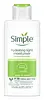
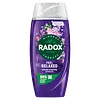
Simple Skincare Kind To Skin Hydrating Light Moisturiser Versus Radox Feel Relaxed Lavender & Waterlily Shower Gel
This barrier-repair moisturizer is formulated around Panthenol and Borago Officinalis Seed Oil to strengthen the skin barrier and hydrate skin.

What's inside
What's inside
 Key Ingredients
Benefits
Concerns
Ingredients Side-by-side
Water
Skin ConditioningGlycerin
Humectant


Paraffinum Liquidum
Emollient


Polyglyceryl-3 Methylglucose Distearate
Emulsifying

Cetyl Palmitate
Emollient
Dimethicone
Emollient
Panthenol
Skin Conditioning

Tocopheryl Acetate
Antioxidant


Borago Officinalis Seed Oil
Emollient

Pantolactone
Humectant
Bisabolol
Antioxidant
Sodium Lactate
Buffering
Lactic Acid
Buffering





Serine
Masking
Urea
Buffering
Sorbitol
Humectant
Allantoin
Skin Conditioning
Sodium Chloride
MaskingPotassium Hydroxide
BufferingCarbomer
Emulsion StabilisingAcrylates/C10-30 Alkyl Acrylate Crosspolymer
Emulsion StabilisingCetyl Alcohol
Emollient

Pentylene Glycol
Skin Conditioning
Disodium EDTA
ChelatingMethylparaben
Preservative


Propylparaben
Preservative
2-Bromo-2-Nitropropane-1,3-Diol
Preservative
Mica
Cosmetic ColorantTitanium Dioxide
Cosmetic Colorant
Water, Glycerin, Paraffinum Liquidum, Polyglyceryl-3 Methylglucose Distearate, Cetyl Palmitate, Dimethicone, Panthenol, Tocopheryl Acetate, Borago Officinalis Seed Oil, Pantolactone, Bisabolol, Sodium Lactate, Lactic Acid, Serine, Urea, Sorbitol, Allantoin, Sodium Chloride, Potassium Hydroxide, Carbomer, Acrylates/C10-30 Alkyl Acrylate Crosspolymer, Cetyl Alcohol, Pentylene Glycol, Disodium EDTA, Methylparaben, Propylparaben, 2-Bromo-2-Nitropropane-1,3-Diol, Mica, Titanium Dioxide
Water
Skin ConditioningSodium Laureth Sulfate
Cleansing

Sodium Chloride
MaskingCocamidopropyl Betaine
Cleansing
Sodium Benzoate
Masking
Parfum
Masking

Citric Acid
Buffering
Sodium Lactate
Buffering
Tetrasodium EDTA
ChelatingPropylene Glycol
Humectant
Calcium Chloride
AstringentMaris Sal
Skin ConditioningMagnesium Sulfate
Lavandula Angustifolia Flower Extract
Cleansing
Nymphaea Alba Root Extract
Skin ConditioningLactic Acid
Buffering
Linalool
Perfuming
CI 17200
Cosmetic ColorantCI 42090
Cosmetic ColorantWater, Sodium Laureth Sulfate, Sodium Chloride, Cocamidopropyl Betaine, Sodium Benzoate, Parfum, Citric Acid, Sodium Lactate, Tetrasodium EDTA, Propylene Glycol, Calcium Chloride, Maris Sal, Magnesium Sulfate, Lavandula Angustifolia Flower Extract, Nymphaea Alba Root Extract, Lactic Acid, Linalool, CI 17200, CI 42090
Reviews
Ingredients Explained
These ingredients are found in both products.
Ingredients higher up in an ingredient list are typically present in a larger amount.
Lactic Acid is another well-loved alpha hydroxy acid (AHA). It is gentler than glycolic acid but still highly effective.
Its main role is to exfoliate the surface of the skin by loosening the “glue” that holds dead skin cells together. Shedding those old cells leads to smoother, softer, and more even-toned skin.
Because lactic acid molecules are larger than glycolic acid, they don’t penetrate as deeply. This means they’re less likely to sting or irritate, making it a great choice for beginners or those with sensitive skin.
Like glycolic acid, it can:
Lactic acid also acts as a humectant (like hyaluronic acid). It can draw water into the skin to improve hydration and also plays a role in the skin's natural moisturizing factor (NMF) in the form of sodium lactate.
Studies show it can boost ceramide production to strengthen the skin barrier and even help balance the skin’s microbiome.
To get results, choose products with a pH between 3-4.
Lower strengths (5-12%) focus on surface exfoliation; higher strengths (12% and up) can reach deeper in the dermis (deeper, supportive layer) to improve skin texture and firmness over time.
Though it was originally derived from milk, most modern lactic acid used in skincare is vegan. It is made through non-dairy fermentation to create a bio-identical and stable form suitable for all formulations.
When lactic acid shows up near the end of an ingredient list, it usually means the brand added just a tiny amount to adjust the product’s pH.
Legend has it that Cleopatra used to bathe in sour milk to help reduce wrinkles.
Lactic acid is truly a gentle multitasker: it exfoliates, hydrates, strengthens, and brightens. It's a great ingredient for giving your skin a smooth, glowing, and healthy look without the harshness of stronger acids.
Read more about some other popular AHA's here:
Learn more about Lactic AcidChances are, you eat sodium chloride every day. Sodium Chloride is also known as table salt. This ingredient has many purposes in skincare: thickener, emulsifier, and exfoliator.
You'll most likely find this ingredient in cleansers where it is used to create a gel-like texture. As an emulsifier, it also prevents ingredients from separating.
You might see people debate whether Sodium Chloride is comedogenic, but there actually haven't been any comedogenic tests done on it. Either way, the overall formulation of a product matters a lot more than any single ingredient.
You might see this ingredient used in scrubs as a primary exfoliating ingredient.
Learn more about Sodium ChlorideSodium Lactate is the sodium salt of lactic acid, an AHA. It is a humectant and sometimes used to adjust the pH of a product.
This ingredient is part of our skin's NMF, or natural moisturizing factor. Our NMF is essential for the hydration of our top skin layers and plasticity of skin. NMF also influences our skin's natural acid mantle and pH, which protects our skin from harmful bacteria.
High percentages of Sodium Lactate can have an exfoliating effect.
Fun fact: Sodium Lactate is produced from fermented sugar.
Learn more about Sodium LactateWater. It's the most common cosmetic ingredient of all. You'll usually see it at the top of ingredient lists, meaning that it makes up the largest part of the product.
So why is it so popular? Water most often acts as a solvent - this means that it helps dissolve other ingredients into the formulation.
You'll also recognize water as that liquid we all need to stay alive. If you see this, drink a glass of water. Remember to stay hydrated!
Learn more about Water


