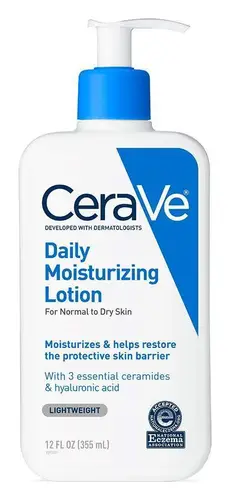
This calming moisturizer is formulated around Lactobacillus Ferment Lysate and Panthenol to calm redness and hydrate skin.
This moisturizer is formulated around Petrolatum to hydrate skin.


What's inside
What's inside
 Key Ingredients
Benefits
Concerns
Ingredients Side-by-side
Water
Skin ConditioningCaprylic/Capric Triglyceride
Masking


C12-15 Alkyl Benzoate
AntimicrobialDimethicone
Emollient

Glycerin
Humectant
Glyceryl Stearate Se
Emulsifying




Sorbitol
Humectant
Lactobacillus Ferment Lysate
Skin Conditioning
Cetyl Alcohol
Emollient
Yogurt Extract
Skin ConditioningPanthenol
Skin Conditioning
Carthamus Tinctorius Seed Oil
Masking
Camellia Sinensis Leaf Extract
Antimicrobial




Chamomilla Recutita Flower Extract
Masking
Calendula Officinalis Flower Extract
Masking
Cucumis Sativus Seed Extract
Skin ConditioningSpirulina Platensis Extract
Skin ProtectingPyrus Malus Fruit Extract
Skin Conditioning
Humulus Lupulus Extract
AntimicrobialLavandula Angustifolia Flower/Leaf/Stem Extract
Masking
Citrus Limon Peel Extract
EmollientCarbomer
Emulsion StabilisingSodium Hydroxide
BufferingStearic Acid
Cleansing
PEG-100 Stearate
Surfactant
Glyceryl Stearate
Emollient
Sodium PCA
Humectant
Disodium EDTA
ChelatingBenzyl Alcohol
Perfuming



Dehydroacetic Acid
Preservative
Hexyl Cinnamal
Perfuming
Parfum
Masking
Water, Caprylic/Capric Triglyceride, C12-15 Alkyl Benzoate, Dimethicone, Glycerin, Glyceryl Stearate Se, Sorbitol, Lactobacillus Ferment Lysate, Cetyl Alcohol, Yogurt Extract, Panthenol, Carthamus Tinctorius Seed Oil, Camellia Sinensis Leaf Extract, Chamomilla Recutita Flower Extract, Calendula Officinalis Flower Extract, Cucumis Sativus Seed Extract, Spirulina Platensis Extract, Pyrus Malus Fruit Extract, Humulus Lupulus Extract, Lavandula Angustifolia Flower/Leaf/Stem Extract, Citrus Limon Peel Extract, Carbomer, Sodium Hydroxide, Stearic Acid, PEG-100 Stearate, Glyceryl Stearate, Sodium PCA, Disodium EDTA, Benzyl Alcohol, Dehydroacetic Acid, Hexyl Cinnamal, Parfum


Reviews
Ingredients Explained
These ingredients are found in both products.
Ingredients higher up in an ingredient list are typically present in a larger amount.
Carbomer is a synthetic thickening and gelling agent. It's basically the ingredient that gives a lot of serums, gels, creams, and sunscreens their smooth, non-sticky texture.
Although legally permitted at very high levels, carbomers are normally used at concentrations below 1%.
It also needs to be neutralized to actually thicken, and because it is a large molecule, it doesn't really penetrate the skin barrier.
Allergy-wise, the risk is very low. Clinical studies show carbomers have low potential for skin irritation/sensitization even at concentrations up to 100%.
A 2024 UK study patch-tested 1,302 patients and found true allergy to the parent group of carbomer to be rare with no confirmed relevant reactions.
Learn more about CarbomerGlyceryl Stearate is made by reacting glycerin with stearic acid (typically sourced from plant oils like palm or coconut). It's an emulsifier, emollient, and mild occlusive.
Emulsifiers help ingredients like oil and water stay mixed so your formula stays nicely blended and uniform in texture.
This ingredient is typically used in concentrations between 1-10%. Studies have found it to be non-sensitizing, non-phototoxic, and non-photoallergenic.
A close cousin of this ingredient is Glyceryl Stearate SE ("self-emulsifying"). This just has a small amount of sodium or potassium stearate added so it can emulsify without a co-emulsifier.
Since this ingredient is an ester of a C18 fatty acid, it may not be fungal acne safe. The Malassezia yeast can potentially metabolize within the C11-C24 range.
Fun fact: The human body also creates Glyceryl Stearate naturally.
Learn more about Glyceryl StearateSodium Hydroxide is also known as lye or caustic soda. It is used to adjust the pH of products; many ingredients require a specific pH to be effective.
In small amounts, sodium hydroxide is considered safe to use. However, large amounts may cause chemical burns due to its high alkaline.
Your skin has a natural pH and acid mantle. This acid mantle helps prevent harmful bacteria from breaking through. The acid mantle also helps keep your skin hydrated.
"Alkaline" refers to a high pH level. A low pH level would be considered acidic.
Learn more about Sodium HydroxideWater. It's the most common cosmetic ingredient of all. You'll usually see it at the top of ingredient lists, meaning that it makes up the largest part of the product.
So why is it so popular? Water most often acts as a solvent - this means that it helps dissolve other ingredients into the formulation.
You'll also recognize water as that liquid we all need to stay alive. If you see this, drink a glass of water. Remember to stay hydrated!
Learn more about Water