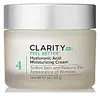
ClarityRx Feel Better Hyaluronic Acid Moisturizing Cream Versus e.l.f. cosmetics Holy Hydration! Daily Moisturizer
This barrier-repair moisturizer is formulated around Simmondsia Chinensis Seed Oil and Squalane to strengthen the skin barrier and hydrate skin.
This barrier-repair moisturizer is formulated around Butyrospermum Parkii Butter and Simmondsia Chinensis Seed Oil to strengthen the skin barrier and hydrate skin.

What's inside
What's inside
 Key Ingredients
Benefits
Concerns
Ingredients Side-by-side
Water
Skin ConditioningButylene Glycol
Humectant

Hydrogenated Polyisobutene
EmollientGlycerin
Humectant
Steareth-21
CleansingDimethicone
Emollient
Butyrospermum Parkii Butter
Skin Conditioning




Simmondsia Chinensis Seed Oil
Emollient
Steareth-2
EmulsifyingCetearyl Alcohol
Emollient

Stearic Acid
Cleansing
PEG-100 Stearate
Surfactant
Glyceryl Stearate
Emollient
Phenoxyethanol
Preservative
Vitis Vinifera Seed Oil
Emollient
Tromethamine
BufferingCaprylyl Glycol
Emollient
Acrylates/C10-30 Alkyl Acrylate Crosspolymer
Emulsion StabilisingParfum
Masking


Sodium Hyaluronate
Humectant

Tocopheryl Acetate
Antioxidant


Saccharum Officinarum Extract
MoisturisingDisodium EDTA
ChelatingVaccinium Myrtillus Fruit/Leaf Extract
AstringentCitrus Aurantium Dulcis Fruit Extract
MaskingAcer Saccharum Extract
Skin ConditioningCitrus Limon Fruit Extract
Masking
Aloe Barbadensis Leaf Extract
Emollient
Chrysanthellum Indicum Extract
Skin Conditioning
Geraniol
Perfuming
Linalool
Perfuming
Water, Butylene Glycol, Hydrogenated Polyisobutene, Glycerin, Steareth-21, Dimethicone, Butyrospermum Parkii Butter, Simmondsia Chinensis Seed Oil, Steareth-2, Cetearyl Alcohol, Stearic Acid, PEG-100 Stearate, Glyceryl Stearate, Phenoxyethanol, Vitis Vinifera Seed Oil, Tromethamine, Caprylyl Glycol, Acrylates/C10-30 Alkyl Acrylate Crosspolymer, Parfum, Sodium Hyaluronate, Tocopheryl Acetate, Saccharum Officinarum Extract, Disodium EDTA, Vaccinium Myrtillus Fruit/Leaf Extract, Citrus Aurantium Dulcis Fruit Extract, Acer Saccharum Extract, Citrus Limon Fruit Extract, Aloe Barbadensis Leaf Extract, Chrysanthellum Indicum Extract, Geraniol, Linalool
Reviews
Ingredients Explained
These ingredients are found in both products.
Ingredients higher up in an ingredient list are typically present in a larger amount.
Phenoxyethanol is one of the most widely used preservatives in skincare (and for good reason!).
It has a large spectrum of antimicrobial activity and especially effective bacteria, yeast, and mold while only having a weak effect on your skin's natural microbiome.
On a cellular level, it disrupts the cell membranes of microbes by poking holes that make the cell leak. This shuts down the chemical reactions the microbe needs to make energy so it can no longer survive.
Another perk of this ingredient is that it stays functional across a wide pH range (3-10).
You'll often see it paired with boosters like Ethylhexylglycerin; one study showed that a 1:9 ratio of Ethylhexylglycerin to Phenoxyethanol damages bacterial membranes as effectively as doubling the Phenoxyethanol concentration on its own.
Typical use concentrations range from 0.3-1% depending on the formula, and this ingredient is capped at 1% int the EU.
Safety-wise, the fear mongering does not hold up to the evidence. The EU's Scientific Committee on Consumer Safety and FDA consider it safe as a preservative at up to 1%, including for children of all ages.
Adverse systemic effects only showed up in animal studies at exposures roughly 200x higher than what people get from cosmetics. And despite its very widespread use, this ingredient is a rare sensitizer and allergic reactions are uncommon.
Learn more about PhenoxyethanolJojoba oil is one of the most well-studied plant-derived ingredients in cosmetics. It is an emollient with a special structure.
Because it is made up of 97-98% wax esters, it closely mirrors the linear monoesters found in human sebum. This makes it skin compatible, non-greasy, and lightweight.
Unlike other plant oils, jojoba wax doesn't easily penetrate skin. It mostly works in the uppermost layers as an emollient. This just means it forms a light barrier on the skin to help retain moisture.
Formulations with jojoba esters up to 90% reduced transepidermal water loss (TEWL) and increased barrier recovery by 81% (outperforming bisabolol at 47%).
Besides barrier support, the science also suggests jojoba to have anti-inflammatory effects and potential applications for skin infections, aging, and wound healing.
Fun fact: Indigenous cultures have used jojoba as a moisturizer and to help treat burns for centuries.
Fungal acne: The Malassezia yeast is known to metabolize fatty acids in the C11-24 range and jojoba's dominant fatty acid components fall into this range. This ingredient may not be fungal acne safe.
Learn more about Simmondsia Chinensis Seed OilWater. It's the most common cosmetic ingredient of all. You'll usually see it at the top of ingredient lists, meaning that it makes up the largest part of the product.
So why is it so popular? Water most often acts as a solvent - this means that it helps dissolve other ingredients into the formulation.
You'll also recognize water as that liquid we all need to stay alive. If you see this, drink a glass of water. Remember to stay hydrated!
Learn more about Water


