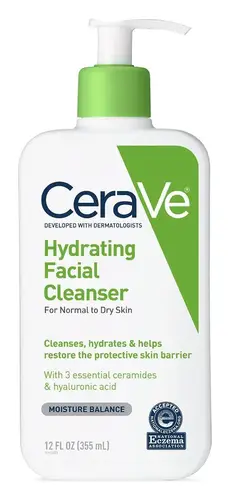
This cream cleanser uses mild cleansing ingredients, but contains alcohol that may feel drying for some.

What's inside
What's inside
 Key Ingredients
No key ingredients
Benefits
Concerns
Ingredients Side-by-side
Water
Skin ConditioningCetyl Alcohol
Emollient



Glyceryl Stearate Se
Emulsifying


Stearic Acid
Cleansing
Vitis Vinifera Seed Oil
Emollient

Glycerin
Humectant

Persea Gratissima Oil
Skin Conditioning
Prunus Armeniaca Kernel Oil
Masking
Benzyl Alcohol
Perfuming





Prunus Amygdalus Dulcis Oil
Skin Conditioning
Olus Oil
Emollient
Stearyl Alcohol
Emollient
Xanthan Gum
EmulsifyingSodium Ascorbyl Phosphate
Antioxidant





Parfum
Masking
Dehydroacetic Acid
Preservative
Pentaerythrityl Tetra-Di-T-Butyl Hydroxyhydrocinnamate
Antioxidant
Alcohol
Antimicrobial
Tris(Tetramethylhydroxypiperidinol)Citrate
StabilisingCI 19140
Cosmetic ColorantCI 16035
Cosmetic ColorantWater, Cetyl Alcohol, Glyceryl Stearate Se, Stearic Acid, Vitis Vinifera Seed Oil, Glycerin, Persea Gratissima Oil, Prunus Armeniaca Kernel Oil, Benzyl Alcohol, Prunus Amygdalus Dulcis Oil, Olus Oil, Stearyl Alcohol, Xanthan Gum, Sodium Ascorbyl Phosphate, Parfum, Dehydroacetic Acid, Pentaerythrityl Tetra-Di-T-Butyl Hydroxyhydrocinnamate, Alcohol, Tris(Tetramethylhydroxypiperidinol)Citrate, CI 19140, CI 16035
Water
Skin ConditioningStearic Acid
Cleansing
Sodium Cocoamphoacetate
CleansingPEG-10 Glyceryl Stearate
Emulsifying
Glycerin
Humectant
Triethanolamine
BufferingCetearyl Alcohol
Emollient
Prunus Amygdalus Dulcis Oil
Skin Conditioning
Prunus Armeniaca Kernel Oil
Masking
Cucumis Sativus Juice
EmollientParfum
Masking
Simmondsia Chinensis Seed Oil
Emollient
Theobroma Grandiflorum Seed Butter
Skin Conditioning
Citrus Aurantifolia Peel
Skin ConditioningCitrus Aurantium Sinensis Fiber
Emulsion StabilisingBoswellia Carterii Oil
Masking
Geraniol
Perfuming
Limonene
Perfuming
Linalool
Perfuming
Hydroxycitronellal
Perfuming
Methylparaben
Preservative

Water, Stearic Acid, Sodium Cocoamphoacetate, PEG-10 Glyceryl Stearate, Glycerin, Triethanolamine, Cetearyl Alcohol, Prunus Amygdalus Dulcis Oil, Prunus Armeniaca Kernel Oil, Cucumis Sativus Juice, Parfum, Simmondsia Chinensis Seed Oil, Theobroma Grandiflorum Seed Butter, Citrus Aurantifolia Peel, Citrus Aurantium Sinensis Fiber, Boswellia Carterii Oil, Geraniol, Limonene, Linalool, Hydroxycitronellal, Methylparaben
Reviews
Ingredients Explained
These ingredients are found in both products.
Ingredients higher up in an ingredient list are typically present in a larger amount.
Glycerin (or glycerol) is a compound naturally found in your skin. It's a powerhouse humectant that pulls water into the stratum corneum.
Topically, glycerin does several things at once:
Your skin makes glycerin on its own (mostly from sebaceous oil breakdown) and shuttles it to your outermost layer of skin, or your epidermis, via aquaporin-3.
Aquaporin-3 is a transporter that is essential for normal skin hydration, elasticity, and repair. Interestingly, mice lacking in AQP3 have dry and less elastic skin that can be fully corrected with glycerin.
This ingredient is non-irritating, plays well with almost every ingredient, and works across all skin types. Typical use is anywhere between 3-10% but can go up to 79% in some leave-on products.
Just know very high concentrations (>40%) can feel tacky in low humidity.
Glycerin is the name for this ingredient in American English. British English uses Glycerol/Glycerine.
Learn more about GlycerinParfum is a catch-all term for an ingredient or more that is used to give a scent to products.
Also called "fragrance", this ingredient can be a blend of hundreds of chemicals or plant oils. This means every product with "fragrance" or "parfum" in the ingredients list is a different mixture.
For instance, Habanolide is a proprietary trade name for a specific aroma chemical. When used as a fragrance ingredient in cosmetics, most aroma chemicals fall under the broad labeling category of “FRAGRANCE” or “PARFUM” according to EU and US regulations.
The term 'parfum' or 'fragrance' is not regulated in many countries. In many cases, it is up to the brand to define this term.
For instance, many brands choose to label themselves as "fragrance-free" because they are not using synthetic fragrances. However, their products may still contain ingredients such as essential oils that are considered a fragrance by INCI standards.
One example is Calendula flower extract. Calendula is an essential oil that still imparts a scent or 'fragrance'.
Depending on the blend, the ingredients in the mixture can cause allergies and sensitivities on the skin. Some ingredients that are known EU allergens include linalool and citronellol.
Parfum can also be used to mask or cover an unpleasant scent.
The bottom line is: not all fragrances/parfum/ingredients are created equally. If you are worried about fragrances, we recommend taking a closer look at an ingredient. And of course, we always recommend speaking with a professional.
Learn more about ParfumThis ingredient is also known as sweet almond oil. It is a lightweight, cold-pressed oil from the ripe seeds of the sweet almond tree.
Sweet almond oil is rich in skin-nourishing fatty acids such as oleic acid (55-86%) and linolenic acid (7-35%).
As an emollient, it softens and hydrates skin by forming a thin barrier that locks in moisture.
Clinical studies have found it to be non-irritating and non-sensitizing. The CIR Expert Panel has evaluated the available safety data and concluded it is safe for topical use.
Because of the oleic acid content, this ingredient may not be fungal acne safe.
This ingredient does have a comedogenic rating of 3, but this doesn't mean a formula with this ingredient will clog pores.
Human testing has proved that any finished product with a comedogenic ingredient won't automatically make you break out; it really comes down to concentration, formula, and your skin.
Learn more about Prunus Amygdalus Dulcis OilThis ingredient is also known as Apricot kernel oil, and it comes form the seed kernels of apricot (a member of the Rosaceae family like almond, peach, cherry, and plum).
It's mostly made up of triglycerides: oleic acid (43.9-78.5%), linoleic acid (9.7-37%), and palmitic acid (4.9-7.3%). These numbers vary depending on the variety of Prunus and the ripeness of the fruit; oleic tends to go up at late harvest while linoleic goes down.
Vitamin E is also prevalent in this ingredient and the most dominant form is gamma-tocopherol.
These compounds give the ingredient emollient and skin conditioning properties that keep the skin soft and hydrated.
There's no regulatory maximum cap for this ingredient so you'll see it across a huge concentration range (100% as a single ingredient facial oil).
On allergies: refined cosmetic-grade oils carry almost no protein. The CIR notes that people allergic to a food generally do not react to the refined oil because the allergenic protein does not partition into it (though cold-pressed grades retain more).
However, it's worth patch testing if you have a stone fruit or tree nut allergy because manufacturer processes for removing the protein can vary.
Malassezia lacks the cytosolic fatty acid synthase gene so the yeast cannot make palmitate on its own and instead uses lipases and phospholipases to release fatty acids from host lipids. Since apricot kernel oil is entirely C16-18 (right in the usable range of C11-24), this ingredient may not be fungal acne safe.
Old rabbit-ear testing did assign this ingredient a comedogenic rating of 1-2. The original author has stated that testing on rabbit ears is not an ideal model for human comedogenicity.
Human testing has proved that any finished product with a comedogenic ingredient won't automatically make you break out; it really comes down to concentration, formula, and your skin.
Just know high-oleic oils tend to feel heavier on oily skin so it's worth patch testing.
Learn more about Prunus Armeniaca Kernel OilStearic Acid is a fatty acid that is already found in your skin. It's one of the free fatty acids that works alongside ceramides and cholesterols to maintain your barrier.
In cosmetics, it is a multitasker:
Safety-wise, the CIR Expert Panel has concluded it to be safe in cosmetics when formulated to be non-irritating and non-sensitizing.
Free stearic acid is a C18 fatty acid that the Malassezia yeast can substrate, so this ingredient may not be fungal acne safe.
This ingredient does have a comedogenic rating of 2-3, but this doesn't mean a formula with this ingredient will clog pores.
Human testing has proved that any finished product with this ingredient won't automatically make you break out; it really comes down to concentration, formula, and your skin.
Learn more about Stearic AcidWater. It's the most common cosmetic ingredient of all. You'll usually see it at the top of ingredient lists, meaning that it makes up the largest part of the product.
So why is it so popular? Water most often acts as a solvent - this means that it helps dissolve other ingredients into the formulation.
You'll also recognize water as that liquid we all need to stay alive. If you see this, drink a glass of water. Remember to stay hydrated!
Learn more about Water