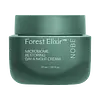
Nobe Forest Elixir Microbiome Restoring Day & Night Cream Versus [ comfort zone ] Remedy Defense Cream
This barrier-repair moisturizer is formulated around Squalane to strengthen the skin barrier and hydrate skin.
This calming moisturizer is formulated around Alpha-Glucan Oligosaccharide and Magnolia Officinalis Bark Extract to calm redness.


What's inside
What's inside
 Key Ingredients
Benefits
Concerns
Ingredients Side-by-side
Water
Skin ConditioningSqualane
Emollient


Helianthus Annuus Seed Oil
Emollient


Glycerin
Humectant
Propanediol
Solvent
Coco-Caprylate
Emollient
Simmondsia Chinensis Seed Oil
Emollient
Cetearyl Olivate
Sorbitan Olivate
Emulsifying
Sodium Levulinate
Skin ConditioningCetearyl Alcohol
Emollient



Cetyl Palmitate
Emollient
Sorbitan Oleate
Emulsifying
Sorbitan Palmitate
Emulsifying
Humus Extract
Skin ConditioningInositol
Humectant
Tocopherol
Antioxidant




Xanthan Gum
EmulsifyingSodium Anisate
AntimicrobialCitric Acid
Buffering
Parfum
Masking


Water, Squalane, Helianthus Annuus Seed Oil, Glycerin, Propanediol, Coco-Caprylate, Simmondsia Chinensis Seed Oil, Cetearyl Olivate, Sorbitan Olivate, Sodium Levulinate, Cetearyl Alcohol, Cetyl Palmitate, Sorbitan Oleate, Sorbitan Palmitate, Humus Extract, Inositol, Tocopherol, Xanthan Gum, Sodium Anisate, Citric Acid, Parfum
Water
Skin ConditioningGlycerin
Humectant
Cetearyl Isononanoate
Emollient
Oleyl Erucate
Emollient
Behenyl Alcohol
Emollient
Caprylic/Capric Triglyceride
Masking
Cetearyl Olivate
Butylene Glycol
Humectant
Propanediol
Solvent
Sorbitan Olivate
Emulsifying
Coco-Caprylate
Emollient
Sclerocarya Birrea Seed Oil
Humectant
Alpha-Glucan Oligosaccharide
Cleansing
Mirabilis Jalapa Extract
Skin ConditioningMicrocrystalline Cellulose
Absorbent1,2-Hexanediol
Skin Conditioning
Cetearyl Alcohol
Emollient
Cetearyl Glucoside
Emulsifying
Butyrospermum Parkii Butter
Skin Conditioning
Xanthan Gum
EmulsifyingSodium Levulinate
Skin ConditioningSodium Anisate
AntimicrobialCellulose Gum
Emulsion StabilisingTocopherol
Antioxidant
Magnolia Officinalis Bark Extract
Antimicrobial
Sodium Hydroxide
BufferingDisodium EDTA
Caprylhydroxamic Acid
O-Cymen-5-Ol
Antimicrobial
Water, Glycerin, Cetearyl Isononanoate, Oleyl Erucate, Behenyl Alcohol, Caprylic/Capric Triglyceride, Cetearyl Olivate, Butylene Glycol, Propanediol, Sorbitan Olivate, Coco-Caprylate, Sclerocarya Birrea Seed Oil, Alpha-Glucan Oligosaccharide, Mirabilis Jalapa Extract, Microcrystalline Cellulose, 1,2-Hexanediol, Cetearyl Alcohol, Cetearyl Glucoside, Butyrospermum Parkii Butter, Xanthan Gum, Sodium Levulinate, Sodium Anisate, Cellulose Gum, Tocopherol, Magnolia Officinalis Bark Extract, Sodium Hydroxide, Disodium EDTA, Caprylhydroxamic Acid, O-Cymen-5-Ol
Ingredients Explained
These ingredients are found in both products.
Ingredients higher up in an ingredient list are typically present in a larger amount.
Cetearyl alcohol is a waxy mixture of two fatty alcohols: cetyl alcohol and stearyl alcohol. It is an emollient and emulsifier.
Despite having "alcohol" in its name, it has nothing to do with drying solvent alcohols; the FDA also allows "alcohol-free" products to contain fatty alcohols like this ingredient.
It plays several roles in a formula:
Typical use levels for this ingredient sit around 1-10% and the Cosmetic Ingredient Review Expert Panel has affirmed safety at concentrations up to 25% in leave-on products.
Multiple assessments have found it to be non-irritating and non-sensitizing to most people.
However, there have been some cases of allergic contact dermatitis in patients with chronically compromised skin barriers.
Cetearyl alcohol has a comedogenic rating of 2 and irritancy rating of 1. Both of these numbers come from the 1989 study that used rabbit ears; a "2" means mildly comedogenic and a "1" means low irritancy.
Here's the catch: rabbit skin is more sensitive than human skin and throws a lot of false positives. A 1996 reappraisal found that ingredients rated 1-2 in the rabbit ear tests are generally safe for humans.
Remember comedogenic ratings are unable to assess the entire formula of a product or how it will react on your skin. Just be sure to patch test if you are unsure about certain ingredients.
This ingredient is not fungal acne safe. Cetearyl alcohol is a fatty alcohol with chain lengths that fall within the range that Malassezia can metabolize.
A 2019 study has also observed Malassezia growth in the presence of this ingredient, confirming it to be not-fungal acne safe.
Learn more about Cetearyl AlcoholCetearyl Olivate is a plant-derived emulsifier and texture enhancer. It helps keep the oil and water phases from separating so your formulas stay stable.
You'll likely see it combined with Sorbitan Olivate (together sold as the trade name Olivem 1000). This combination generates a liquid crystal structure that closely resemble the lipid organization of the stratum corneum.
These "skin-like" liquid crystals improve skin barrier integrity and promote the delivery of actives into the skin.
This ingredient is well-tolerated and has no significant sensitization data.
Because it is derived from the fatty acids in olive oil, this ingredient may not be fungal acne safe.
Learn more about Cetearyl OlivateCoco-Caprylate is a lightweight emollient made by combining coconut-derived fatty alcohols (caprylic and capric acid).
Its primary role in formulas is as a skin-softening emollient with excellent spreadability (it's considered a plant-based alternative to silicone oils like dimethicone).
This ingredient is considered safe for use and concentrations range from 0.5-62%.
Caprylic and capric fall outside the C11-24 range that Malassezia feeds on, and a 2020 study found caprylic acid disrupted Malassezia furfur cell membrane, with a caprylic acid derivative damaging membrane structures at concentrations as low as 0.2%.
Learn more about Coco-CaprylateGlycerin (or glycerol) is a compound naturally found in your skin. It's a powerhouse humectant that pulls water into the stratum corneum.
Topically, glycerin does several things at once:
Your skin makes glycerin on its own (mostly from sebaceous oil breakdown) and shuttles it to your outermost layer of skin, or your epidermis, via aquaporin-3.
Aquaporin-3 is a transporter that is essential for normal skin hydration, elasticity, and repair. Interestingly, mice lacking in AQP3 have dry and less elastic skin that can be fully corrected with glycerin.
This ingredient is non-irritating, plays well with almost every ingredient, and works across all skin types. Typical use is anywhere between 3-10% but can go up to 79% in some leave-on products.
Just know very high concentrations (>40%) can feel tacky in low humidity.
Glycerin is the name for this ingredient in American English. British English uses Glycerol/Glycerine.
Learn more about GlycerinPropanediol is an all-star ingredient. It softens, hydrates, and smooths the skin.
It’s often used to:
Propanediol is not likely to cause sensitivity and considered safe to use. It is derived from corn or petroleum with a clear color and no scent.
Learn more about PropanediolSodium Anisate comes from fennel. It is used as a preservative and to add flavoring.
Sodium Anisate has antimicrobial properties.
Sodium levulinate is the a sodium salt of Levulinic Acid. Oncedissolved in an aqueous solution, the two ingredients become identical. It is usually derived from renewable plant sources like corn starch or sugarcane.
In skincare, it mostly acts as a skin conditioning agent that keeps skin soft and hydrated. It also acts as a preservative booster by inhibiting the growth of mold, yeast, and bacteria.
It's often paired with Sodium Anisate as the two create a broad-spectrum preservative system that is popular in "natural" formulations.
This ingredient is water-soluble.
The CIR Expert Panel for Cosmetic Ingredient Safety has concluded this ingredient to be non-irritated and there are no restrictions for use in EU cosmetics. The FDA also allows this ingredient to be used as a food-grade flavoring agent.
Learn more about Sodium LevulinateSorbitan Olivate is created from the fatty acids in olive oil and sorbitol.
This ingredient is an oil in water emulsifier. It helps stabilize a product by preventing oils and waters from separating. Sorbitan Olivate also helps hydrate the skin.
This ingredient is also known as part of Olivem 1000, with Cetearyl Olivate being the other part.
According to a manufacturer, this ingredient helps preserve the natural microbiome of skin. Having a healthy microbiome helps keep our skin healthy and protects against harmful bacteria.
Please note, having a healthy microbiome is different from fungal acne; a healthy microbiome includes small amounts of yeast that normally live on your skin without causing problems.
Fungal acne happens when one type of yeast (Malassezia) grows out of control. This is usually because it's feeding on certain oils or fatty acids. Due to the olive oil base, this ingredient may not be fungal acne safe.
Learn more about Sorbitan OlivateTocopherol is a fat-soluble antioxidant known as Vitamin E.
You'll find this ingredient in the vast majority of skincare (for good reason). It works to neutralize free radicals, or unstable molecules generated by UV exposure, pollution, and other environmental stressors, before they can cause oxidative damage to your skin cells.
Topically applied tocopherol has been shown to protect against UV damage by ramping up the skin's own natural defense enzymes.
It also acts as a skin conditioning agent; some studies show that regular topical use can improve the skin's water-binding capacity over 2-4 weeks.
This ingredient is especially loved for being a team player. When combined with Vitamin C, the photoprotective effect of both ingredients roughly doubles and the combo also helps reduce UV-induced DNA damage.
This ingredient has some brightening potential but it's more of a prevention ingredient than spot-fader. Cell studies show it can slow down melanin production but it's worth noting that it's not the most powerful brightener out there.
In formulations, it also serves as a stabilizer that helps protect other oxidation-prone ingredients from degrading.
Concentrations usually range from 0.1-1% in most leave-on products.
Learn more about TocopherolWater. It's the most common cosmetic ingredient of all. You'll usually see it at the top of ingredient lists, meaning that it makes up the largest part of the product.
So why is it so popular? Water most often acts as a solvent - this means that it helps dissolve other ingredients into the formulation.
You'll also recognize water as that liquid we all need to stay alive. If you see this, drink a glass of water. Remember to stay hydrated!
Learn more about WaterXanthan gum is used as a stabilizer and thickener within cosmetic products. It helps give products a sticky, thick feeling - preventing them from being too runny.
On the technical side of things, xanthan gum is a polysaccharide - a combination consisting of multiple sugar molecules bonded together.
Xanthan gum is a pretty common and great ingredient. It is a natural, non-toxic, non-irritating ingredient that is also commonly used in food products.
Learn more about Xanthan Gum

