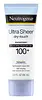
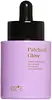
Neutrogena Ultra Sheer Dry-Touch Sunscreen SPF 100+ Versus 82°E Patchouli Glow Sunscreen Drops SPF 40
This chemical sunscreen covers most of the UV range, lighter on the deep UVA that drives aging.
This chemical sunscreen covers the full UV range and blocks ~98% of UVB at SPF 40.


What's inside
What's inside
 Key Ingredients
Benefits
Concerns
Ingredients Side-by-side
Butyl Methoxydibenzoylmethane 3%
UV Absorber
Homosalate 15%
Skin Conditioning
Ethylhexyl Salicylate 5%
UV Absorber
Octocrylene 10%
UV Absorber

Benzophenone-3 6%
UV Absorber
Water
Skin ConditioningStyrene/Acrylates Copolymer
Silica
Abrasive


Beeswax
Emulsion Stabilising


Cyclopentasiloxane
Emollient
Ethylhexylglycerin
Skin ConditioningGlyceryl Stearate
Emollient
PEG-100 Stearate
Surfactant
Acrylates/Dimethicone Copolymer
Skin Conditioning
Acrylates/C10-30 Alkyl Acrylate Crosspolymer
Emulsion StabilisingParfum
Masking

Chlorphenesin
Antimicrobial
Triethanolamine
BufferingDiethylhexyl 2,6-Naphthalate
EmollientDipotassium Glycyrrhizate
Humectant

Disodium EDTA
ChelatingBHT
Antioxidant
Methylisothiazolinone
Preservative
Butyl Methoxydibenzoylmethane 3%, Homosalate 15%, Ethylhexyl Salicylate 5%, Octocrylene 10%, Benzophenone-3 6%, Water, Styrene/Acrylates Copolymer, Silica, Beeswax, Cyclopentasiloxane, Ethylhexylglycerin, Glyceryl Stearate, PEG-100 Stearate, Acrylates/Dimethicone Copolymer, Acrylates/C10-30 Alkyl Acrylate Crosspolymer, Parfum, Chlorphenesin, Triethanolamine, Diethylhexyl 2,6-Naphthalate, Dipotassium Glycyrrhizate, Disodium EDTA, BHT, Methylisothiazolinone
C12-15 Alkyl Benzoate
AntimicrobialCoconut Alkanes
Emollient
Homosalate
Skin Conditioning
Caprylyl Methicone
Skin Conditioning
Diethylamino Hydroxybenzoyl Hexyl Benzoate
UV Filter
Bis-Ethylhexyloxyphenol Methoxyphenyl Triazine
UV Absorber
Crambe Abyssinica Seed Oil
Skin Conditioning
Neopentyl Glycol Diheptanoate
EmollientSqualane
Emollient


Isododecane
EmollientPolyester-7
Skin ConditioningPhytosteryl/Octyldodecyl Lauroyl Glutamate
Skin ConditioningOctyldodecanol
Emollient
Pogostemon Cablin Leaf Extract
Perfuming
Beta-Carotene
Skin ConditioningXanthophylls
Skin ConditioningTocopherol
Antioxidant


Helianthus Annuus Seed Oil
Emollient
Rosmarinus Officinalis Leaf Extract
AntimicrobialTocopheryl Acetate
Antioxidant
C12-15 Alkyl Benzoate, Coconut Alkanes, Homosalate, Caprylyl Methicone, Diethylamino Hydroxybenzoyl Hexyl Benzoate, Bis-Ethylhexyloxyphenol Methoxyphenyl Triazine, Crambe Abyssinica Seed Oil, Neopentyl Glycol Diheptanoate, Squalane, Isododecane, Polyester-7, Phytosteryl/Octyldodecyl Lauroyl Glutamate, Octyldodecanol, Pogostemon Cablin Leaf Extract, Beta-Carotene, Xanthophylls, Tocopherol, Helianthus Annuus Seed Oil, Rosmarinus Officinalis Leaf Extract, Tocopheryl Acetate
Reviews
Ingredients Explained
These ingredients are found in both products.
Ingredients higher up in an ingredient list are typically present in a larger amount.
Homosalate is an oil-soluble organic UVB filter that has been a sunscreen staple for decades. Its job is to absorb UVB rays (~295-315 nm) and protect your skin against sunburn,
This is one of the more photostable organic UV filters; it holds up pretty well under UV and a 2022 quantum-chemistry study found it stays stable in sunlight.
It's actually so reliable that formulators often pair it with shakier ingredients like oxybenzone and avobenzone. Formulators also use it to help dissolve the other UV filters into the oil phase.
One thing to keep in mind: "stable" isn't the same as "strong". On its own, homosalate is actually a pretty weak UV filter so it's better off as a helpful team player that helps boost overall SPF protection.
The safety picture is a bit nuanced but not scary.
This ingredient has a long track record of being gentle and regulators agree it isn't an irritant; EU's Scientific Committee on Consumer Safety found that homosalate is not considered a skin irritant and doesn't raise eye-irritation flags either.
There's talk about homosalate because your skin absorbs a little bit of it into your bloodstream. A 2020 FDA-backed study found homosalate showed up in people's blood levels at the level where the FDA decides to double check.
The EU's Scientific Committee on Consumer Safety (SCCS) also found small amounts in blood and breast milk. They estimated that about 5% of what you apply gets absorbed through the skin.
Due to the debate about whether it might mess with hormones, the SCCS recommended a maximum limit of 0.5% in most products of 7.3% in face creams/pump sprays.
One important thing to keep in mind: in the US, Homosalate is currently labeled "non-GRASE" by the FDA. This sounds alarming but really just means the FDA wants more data to confirm it's safe. It's not confidently saying this ingredient is harmful.
As of now, homosalate is still completely legal and widely used while that research gets done.
The current maximum limits are:
Learn more about Homosalate

