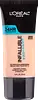
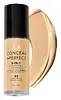
L'Oreal Infallible Pro-Glow Foundation Versus Milani Conceal + Perfect 2-In-1 Foundation And Concealer


What's inside
What's inside
 Key Ingredients
Benefits
Concerns
Ingredients Side-by-side
Water
Skin ConditioningCyclopentasiloxane
Emollient
Alcohol Denat.
Antimicrobial




Phenyl Trimethicone
Skin Conditioning
Glycerin
Humectant


PEG-10 Dimethicone
Skin Conditioning
Bis-PEG/PPG-14/14 Dimethicone
Emollient
Dimethicone
Emollient
Magnesium Sulfate
Ethylhexyl Hydroxystearate
Emollient
Talc
Abrasive
Silica
Abrasive

PEG/PPG/Polybutylene Glycol-8/5/3 Glycerin
HumectantDisodium Stearoyl Glutamate
CleansingDimethicone/Polyglycerin-3 Crosspolymer
Cleansing
Polymethyl Methacrylate
Tocopheryl Acetate
Antioxidant


Aluminum Hydroxide
EmollientMagnesium Stearate
Cosmetic ColorantSilica Silylate
Emollient
Dipropylene Glycol
HumectantAlumina
Abrasive
BHT
Antioxidant
Sodium Citrate
BufferingTocopherol
Antioxidant


Isopropyl Alcohol
Solvent
Titanium Dioxide
Cosmetic Colorant

Iron Oxides
CI 77163
Cosmetic Colorant
Water, Cyclopentasiloxane, Alcohol Denat., Phenyl Trimethicone, Glycerin, PEG-10 Dimethicone, Bis-PEG/PPG-14/14 Dimethicone, Dimethicone, Magnesium Sulfate, Ethylhexyl Hydroxystearate, Talc, Silica, PEG/PPG/Polybutylene Glycol-8/5/3 Glycerin, Disodium Stearoyl Glutamate, Dimethicone/Polyglycerin-3 Crosspolymer, Polymethyl Methacrylate, Tocopheryl Acetate, Aluminum Hydroxide, Magnesium Stearate, Silica Silylate, Dipropylene Glycol, Alumina, BHT, Sodium Citrate, Tocopherol, Isopropyl Alcohol, Titanium Dioxide, Iron Oxides, CI 77163
Water
Skin ConditioningCyclopentasiloxane
Emollient
Isononyl Isononanoate
EmollientCetyl PEG/PPG-10/1 Dimethicone
Emulsifying
Butylene Glycol
Humectant
Glycerin
Humectant
Bis-PEG/PPG-14/14 Dimethicone
Emollient
Vp/Eicosene Copolymer
Ozokerite
Emulsion StabilisingPolymethylsilsesquioxane
Mica
Cosmetic ColorantDisteardimonium Hectorite
StabilisingPropylene Carbonate
SolventPhenoxyethanol
Preservative
Sodium Chloride
MaskingAluminum Dimyristate
Emulsion StabilisingDisodium Stearoyl Glutamate
CleansingTriethoxycaprylylsilane
Silica
Abrasive
Bis-Vinyl Dimethicone/Dimethicone Copolymer
Emulsion Stabilising
Isododecane
EmollientCaprylyl Glycol
Emollient
1,2-Hexanediol
Skin Conditioning
C30-45 Alkyl Cetearyl Dimethicone Crosspolymer
Emollient
Glycereth-18
HumectantGlycereth-18 Ethylhexanoate
Skin ConditioningBeeswax
Emulsion Stabilising
Potassium Sorbate
Preservative
Xanthan Gum
EmulsifyingPrunus Domestica Fruit Extract
MoisturisingC18-21 Alkane
SolventPolyisobutene
Allantoin
Skin Conditioning
Iron Oxides
CI 77891
Cosmetic ColorantWater, Cyclopentasiloxane, Isononyl Isononanoate, Cetyl PEG/PPG-10/1 Dimethicone, Butylene Glycol, Glycerin, Bis-PEG/PPG-14/14 Dimethicone, Vp/Eicosene Copolymer, Ozokerite, Polymethylsilsesquioxane, Mica, Disteardimonium Hectorite, Propylene Carbonate, Phenoxyethanol, Sodium Chloride, Aluminum Dimyristate, Disodium Stearoyl Glutamate, Triethoxycaprylylsilane, Silica, Bis-Vinyl Dimethicone/Dimethicone Copolymer, Isododecane, Caprylyl Glycol, 1,2-Hexanediol, C30-45 Alkyl Cetearyl Dimethicone Crosspolymer, Glycereth-18, Glycereth-18 Ethylhexanoate, Beeswax, Potassium Sorbate, Xanthan Gum, Prunus Domestica Fruit Extract, C18-21 Alkane, Polyisobutene, Allantoin, Iron Oxides, CI 77891
Reviews
Ingredients Explained
These ingredients are found in both products.
Ingredients higher up in an ingredient list are typically present in a larger amount.
Bis-PEG/PPG-14/14 Dimethicone is a silicone + PEG/PPG hybrid that mainly works as an emulsifier.
It helps water and silicone oils play nicely together in water-in-silicone formulas (think primers, silky sunscreens, long-wear makeup).
Chemically, it's basically a dimethicone that's been made more water-friendly by attaching ethylene oxide (PEG) and propylene oxide (PPG) chains. That's why you'll get that classic soft feel from silicone without the formula separating.
It is able to improve stability, spreadability, and add a velvety finish in low amounts.
Learn more about Bis-PEG/PPG-14/14 DimethiconeCyclopentasiloxane (D5) is a lightweight silicone that mostly acts as an emollient and solvent in cosmetics. Its the reason your products feel silky, fast-spreading, and non-greasy.
Since D5 is volatile, it does its thing and then evaporates off the skin quickly.
The safety profile of this ingredient is reassuring; the US CIR Expert Panel concluded D5 is safe as used in cosmetics and Health Canada concluded that D5 is not harmful to human health or the environment as currently used in cosmetics
There's a study that people mention about D5 in a rat study showing tumors. This study is related to long-term inhalation of high D5 levels.
Regulatory bodies have judged this study to be not applicable in topical skincare since skin absorption of D5 is very low and we're not really inhaling huge amounts of D5.
The only restriction for this ingredient is environmental. The European Chemicals Agency (ECHA) restricted D5 in wash-off cosmetics at or above 0.1% due to their persistence in water.
Learn more about CyclopentasiloxaneDSG is used as a surfactant.
Surfactants are cleansing ingredients that help remove oil, dirt, and other impurities from the skin. They work by reducing surface tension between water and oils/dirt to allow them to be easily rinsed away.
Glycerin (or glycerol) is a compound naturally found in your skin. It's a powerhouse humectant that pulls water into the stratum corneum.
Topically, glycerin does several things at once:
Your skin makes glycerin on its own (mostly from sebaceous oil breakdown) and shuttles it to your outermost layer of skin, or your epidermis, via aquaporin-3.
Aquaporin-3 is a transporter that is essential for normal skin hydration, elasticity, and repair. Interestingly, mice lacking in AQP3 have dry and less elastic skin that can be fully corrected with glycerin.
This ingredient is non-irritating, plays well with almost every ingredient, and works across all skin types. Typical use is anywhere between 3-10% but can go up to 79% in some leave-on products.
Just know very high concentrations (>40%) can feel tacky in low humidity.
Glycerin is the name for this ingredient in American English. British English uses Glycerol/Glycerine.
Learn more about GlycerinSilica, also known as silicon dioxide, is a naturally occurring mineral. It is used as a fine, spherical, and porous powder in cosmetics.
Though it has exfoliant properties, the function of silica varies depending on the product.
The unique structure of silica enhances the spreadability and adds smoothness, making it a great texture enhancer.
It is also used as an active carrier, emulsifier, and mattifier due to its ability to absorb excess oil.
In some products, tiny microneedles called spicules are made from silica or hydrolyzed sponge. When you rub them in, they lightly polish away dead skin layers and enhance the penetration of active ingredients.
Learn more about SilicaWater. It's the most common cosmetic ingredient of all. You'll usually see it at the top of ingredient lists, meaning that it makes up the largest part of the product.
So why is it so popular? Water most often acts as a solvent - this means that it helps dissolve other ingredients into the formulation.
You'll also recognize water as that liquid we all need to stay alive. If you see this, drink a glass of water. Remember to stay hydrated!
Learn more about WaterThis ingredient is a combination of red, black, and yellow iron oxide pigments. This combination of colors is usually found in foundation, because it results in a "skin" color.
The EU typically uses CI numbers for colorants when applicable, such as CI 77489. In the US, iron oxides are regulated as color additives and "iron oxides" is the most commonly used name in US cosmetic practice.
A 2021 paper looked at skincare formulations containing iron oxides and found that they reduced transmission of blue light when measured optically. In simple terms, the pigment particles helped block or scatter part of the visible light spectrum in lab testing and the authors suggest this could translate into better protection against blue-light-related skin effects.
There is also clinical and experimental research showing that tinted products containing iron oxides can reduce visible light-induced pigmentation:
Please note, whether a product reduces visible or blue light depends on things like:
In the EU's CosIng database, iron oxides are only listed as a colorant. CosIng groups ingredients by their main cosmetic role, such as colorant, preservative, or UV filter.
Though studies say iron oxides can "attenuate blue light", they're describing an optical property and not an officially recognized cosmetic function.
So CosIng isn’t contradicting the research. It’s just classifying iron oxides by what they officially are: pigments that add color.
Learn more about Iron Oxides
