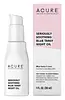
This calming oil is formulated around Argania Spinosa Kernel Oil and Simmondsia Chinensis Seed Oil to calm redness and hydrate skin.
This hydrating oil is formulated around Prunus Amygdalus Dulcis Oil and Vitis Vinifera Seed Oil to hydrate skin and strengthen the skin barrier.

What's inside
What's inside
 Key Ingredients
Benefits
Concerns
Ingredients Side-by-side
Caprylic/Capric Triglyceride
Masking


Prunus Amygdalus Dulcis Oil
Skin Conditioning




Simmondsia Chinensis Seed Oil
Emollient
Ricinus Communis Seed Oil
Masking
Argania Spinosa Kernel Oil
Emollient


Brassica Oleracea Acephala Leaf Extract
HumectantRosmarinus Officinalis Leaf Extract
AntimicrobialTocopherol
Antioxidant




Rosa Damascena Flower Oil
Masking


Vitis Vinifera Seed Oil
Emollient
Aleurites Moluccanus Seed Oil
Skin Conditioning
Tanacetum Annuum Flower Oil
Masking
Achillea Millefolium Oil
Cleansing
Chamomilla Recutita Flower Oil
Masking
Jasminum Grandiflorum Flower Extract
Masking
Caprylic/Capric Triglyceride, Prunus Amygdalus Dulcis Oil, Simmondsia Chinensis Seed Oil, Ricinus Communis Seed Oil, Argania Spinosa Kernel Oil, Brassica Oleracea Acephala Leaf Extract, Rosmarinus Officinalis Leaf Extract, Tocopherol, Rosa Damascena Flower Oil, Vitis Vinifera Seed Oil, Aleurites Moluccanus Seed Oil, Tanacetum Annuum Flower Oil, Achillea Millefolium Oil, Chamomilla Recutita Flower Oil, Jasminum Grandiflorum Flower Extract
Prunus Amygdalus Dulcis Oil
Skin Conditioning
Vitis Vinifera Seed Oil
Emollient
C10-18 Triglycerides
Emollient
Argania Spinosa Kernel Oil
Emollient
Aleurites Moluccanus Seed Oil
Skin Conditioning
Simmondsia Chinensis Seed Oil
Emollient
Hippophae Rhamnoides Oil
Emollient
Adansonia Digitata Seed Oil
Emollient
Prunus Armeniaca Kernel Oil
Masking
Euterpe Oleracea Fruit Oil
Skin Conditioning
Ascorbyl Palmitate
Antioxidant
Caprylic/Capric Triglyceride
Masking
Caprylyl Glycol
Emollient
Ethylhexylglycerin
Skin ConditioningHelianthus Annuus Seed Oil
Emollient
Himanthalia Elongata Extract
Skin Protecting
Passiflora Edulis Seed Oil
Emollient
Punica Granatum Seed Oil
Emollient
Rosmarinus Officinalis Leaf Extract
AntimicrobialTocopherol
Antioxidant
Tocopheryl Acetate
Antioxidant
Prunus Amygdalus Dulcis Oil, Vitis Vinifera Seed Oil, C10-18 Triglycerides, Argania Spinosa Kernel Oil, Aleurites Moluccanus Seed Oil, Simmondsia Chinensis Seed Oil, Hippophae Rhamnoides Oil, Adansonia Digitata Seed Oil, Prunus Armeniaca Kernel Oil, Euterpe Oleracea Fruit Oil, Ascorbyl Palmitate, Caprylic/Capric Triglyceride, Caprylyl Glycol, Ethylhexylglycerin, Helianthus Annuus Seed Oil, Himanthalia Elongata Extract, Passiflora Edulis Seed Oil, Punica Granatum Seed Oil, Rosmarinus Officinalis Leaf Extract, Tocopherol, Tocopheryl Acetate
Ingredients Explained
These ingredients are found in both products.
Ingredients higher up in an ingredient list are typically present in a larger amount.
Aleurites Moluccanus Seed Oil is oil from the Kukui nut and native to Hawaii.
Aleurites Moluccanus Seed Oil helps soften the skin as an emollient. It also provides antioxidants. Antioxidants help fight free-radicals. Free-radicals are molecules that may damage your skin cells, such as pollution.
Aleurites Moluccanus Seed Oil can also help soothe the skin.
This nut has been used by many cultures for curing illnesses, such as headache and fever.
Learn more about Aleurites Moluccanus Seed OilYou may know this ingredient as argan oil. It has emollient and skin conditioning properties that help soften skin and reinforce the lipid barrier.
The fatty acid profile of argan oil is roughly 45-55% oleic acid, 28-36% linoleic acid, 10-15% palmitic acid, and 5-7% stearic acid. It also contains vitamin E, sterols, squalene, and polyphenols like ferulic acid.
Two clinical studies in postmenopausal women found that applying argan oil for 60 days significantly improved skin elasticity and moisturization (reduced transepidermal water loss and increased epidermal water content).
Since it is high in oleic and linoleic acid, this ingredient may not be fungal acne safe. Both of these fall in the C11-C24 range that Malassezia yeast can metabolize.
Learn more about Argania Spinosa Kernel OilCaprylic/Capric Triglyceride (aka MCT Oil) is a lightweight emollient, solvent, and texture enhancer. It is considered a skin-softener by helping to prevent moisture loss.
Though it behaves like an oil, it is not technically one due to its chemical composition. One perk of this ingredient is that it is very stable, resistant to oxidation, and unlikely to go rancid.
In practice, that translates to a long shelf life and a consistently elegant skin feel.
While there is an assumption Caprylic Triglyceride can clog pores due to it being derived from coconut oil, there is no research supporting this. Just patch test if you have concerns.
Fractionated coconut oil and MCT Oil are both listed as Caprylic/Capric Triglyceride according to INCI. This is because INCI names are based on the ingredient’s final chemical composition and not its marketing name or source.
This ingredient is treated as the gold standard fungal acne safe oil. Even though it is coconut derived, the problematic lauric acid is stripped out.
This leaves just caprylic (C8) and capric (C10) acid. These chain lengths actually trend antifungal; a 2020 study found caprylic acid was enough to disrupt Malassezia furfur cell membrane, with a caprylic acid derivative damaging membrane structures at concentrations as low as 0.2%.
Learn more about Caprylic/Capric TriglycerideThis ingredient is also known as sweet almond oil. It is a lightweight, cold-pressed oil from the ripe seeds of the sweet almond tree.
Sweet almond oil is rich in skin-nourishing fatty acids such as oleic acid (55-86%) and linolenic acid (7-35%).
As an emollient, it softens and hydrates skin by forming a thin barrier that locks in moisture.
Clinical studies have found it to be non-irritating and non-sensitizing. The CIR Expert Panel has evaluated the available safety data and concluded it is safe for topical use.
Because of the oleic acid content, this ingredient may not be fungal acne safe.
This ingredient does have a comedogenic rating of 3, but this doesn't mean a formula with this ingredient will clog pores.
Human testing has proved that any finished product with a comedogenic ingredient won't automatically make you break out; it really comes down to concentration, formula, and your skin.
Learn more about Prunus Amygdalus Dulcis OilThis is a botanical extract from the rosemary plant (the same one you cook with). In skincare, it mostly works as a skin conditioning agent.
Its activity comes from a handful of polyphenols, carnosic acid, carnosol, and rosmarinic acid. Almost 90% of the antioxidant activity of this ingredient can be attributed to canosol and carnosic acid.
These compounds protect your skin two ways:
1) They fight off free radicals, or the unstable molecules from things like sun and pollution that age and damage skin.
2) They help calm inflammation by switching off the chemical signals that tell skin to get red and irritated.
Lab studies also suggest that rosmarinic acid may help protect collagen and slow sugar-related damage to it.
The Cosmetic Ingredient Review has concluded rosemary-derived ingredients to be safe when formulated to be non-sensitizing.
Rosemary can occasionally cause allergic contact dermatitis (due to carnosol), so be sure to patch test if you have reactive or fragrance-sensitive skin.
Learn more about Rosmarinus Officinalis Leaf ExtractJojoba oil is one of the most well-studied plant-derived ingredients in cosmetics. It is an emollient with a special structure.
Because it is made up of 97-98% wax esters, it closely mirrors the linear monoesters found in human sebum. This makes it skin compatible, non-greasy, and lightweight.
Unlike other plant oils, jojoba wax doesn't easily penetrate skin. It mostly works in the uppermost layers as an emollient. This just means it forms a light barrier on the skin to help retain moisture.
Formulations with jojoba esters up to 90% reduced transepidermal water loss (TEWL) and increased barrier recovery by 81% (outperforming bisabolol at 47%).
Besides barrier support, the science also suggests jojoba to have anti-inflammatory effects and potential applications for skin infections, aging, and wound healing.
Fun fact: Indigenous cultures have used jojoba as a moisturizer and to help treat burns for centuries.
Fungal acne: The Malassezia yeast is known to metabolize fatty acids in the C11-24 range and jojoba's dominant fatty acid components fall into this range. This ingredient may not be fungal acne safe.
Learn more about Simmondsia Chinensis Seed OilTocopherol is a fat-soluble antioxidant known as Vitamin E.
You'll find this ingredient in the vast majority of skincare (for good reason). It works to neutralize free radicals, or unstable molecules generated by UV exposure, pollution, and other environmental stressors, before they can cause oxidative damage to your skin cells.
Topically applied tocopherol has been shown to protect against UV damage by ramping up the skin's own natural defense enzymes.
It also acts as a skin conditioning agent; some studies show that regular topical use can improve the skin's water-binding capacity over 2-4 weeks.
This ingredient is especially loved for being a team player. When combined with Vitamin C, the photoprotective effect of both ingredients roughly doubles and the combo also helps reduce UV-induced DNA damage.
This ingredient has some brightening potential but it's more of a prevention ingredient than spot-fader. Cell studies show it can slow down melanin production but it's worth noting that it's not the most powerful brightener out there.
In formulations, it also serves as a stabilizer that helps protect other oxidation-prone ingredients from degrading.
Concentrations usually range from 0.1-1% in most leave-on products.
Learn more about TocopherolVitis Vinifera Seed Oil comes from the grape vine. Grape seeds are a byproduct of creating grape juice or wine.
The components of grape seeds have many skin benefits. Research has found it to be antimicrobial and anti-inflammatory. It also contains many potent antioxidants such as Vitamin E , Vitamin C, proanthocyanidins, polyphenols, flavonoids, and anthocyanins. Proanthocyanidin has been shown to help even out skin tone.
Antioxidants help fight free-radical molecules. Free-radical molecules are capable of damaging our cells and other genetic material. Antioxidants help stabilize free-radicals by donating extra electrons. Grape seed extract may help reduce the signs of aging.
The antimicrobial properties of grape seed may help treat acne. However, more research is needed to support this claim.
Grape seed has also been found to help absorb UV rays. Grape seed extract should not replace your sunscreen.
The fatty acids of grape seed oil give it emollient properties. Emollients help soothe and soften your skin by creating a film. This film traps moisture within, keeping your skin hydrated.
Learn more about Vitis Vinifera Seed Oil

