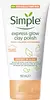
Simple Skincare Protect 'N' Glow Express Glow Clay Polish Versus Simple Skincare Water Boost Micellar Cleansing Facial Gel Wash

What's inside
What's inside
 Key Ingredients
Benefits
Concerns
Ingredients Side-by-side
Water
Skin ConditioningGlyceryl Stearate
Emollient
Glycerin
Humectant


Cetearyl Alcohol
Emollient



Bentonite
Absorbent


Sodium Lauryl Sulfoacetate
CleansingCocamidopropyl Betaine
Cleansing

Cetyl Alcohol
Emollient
Bambusa Arundinacea Stem Extract
Skin ConditioningPEG-100 Stearate
Sodium Chloride
MaskingPhenoxyethanol
Preservative
Carbomer
Emulsion StabilisingTriethanolamine
BufferingSodium Sulfate

Ceteareth-20
CleansingPolysorbate 60
Emulsifying
Disodium EDTA
PEG-4 Dilaurate
Emulsifying
PEG-4 Laurate
Emulsifying
Tocopheryl Acetate
Antioxidant


Sodium Ascorbyl Phosphate
Antioxidant


Iodopropynyl Butylcarbamate
Preservative
PEG-4
HumectantZingiber Officinale Root Juice
Skin ConditioningWater, Glyceryl Stearate, Glycerin, Cetearyl Alcohol, Bentonite, Sodium Lauryl Sulfoacetate, Cocamidopropyl Betaine, Cetyl Alcohol, Bambusa Arundinacea Stem Extract, PEG-100 Stearate, Sodium Chloride, Phenoxyethanol, Carbomer, Triethanolamine, Sodium Sulfate, Ceteareth-20, Polysorbate 60, Disodium EDTA, PEG-4 Dilaurate, PEG-4 Laurate, Tocopheryl Acetate, Sodium Ascorbyl Phosphate, Iodopropynyl Butylcarbamate, PEG-4, Zingiber Officinale Root Juice
Water
Skin ConditioningCocamidopropyl Betaine
Cleansing
Propylene Glycol
Humectant
Hydroxypropyl Methylcellulose
Emulsion StabilisingSodium Chloride
MaskingPanthenol
Skin Conditioning
Citric Acid
Buffering
Disodium EDTA
Glycerin
Humectant
Hydroxypropyl Cyclodextrin
MaskingIodopropynyl Butylcarbamate
Preservative
Pantolactone
Humectant
Phenoxyethanol
Preservative
Potassium Chloride
Saccharide Isomerate
Humectant
Sodium Citrate
BufferingSodium Hydroxide
BufferingTocopheryl Acetate
Antioxidant
Water, Cocamidopropyl Betaine, Propylene Glycol, Hydroxypropyl Methylcellulose, Sodium Chloride, Panthenol, Citric Acid, Disodium EDTA, Glycerin, Hydroxypropyl Cyclodextrin, Iodopropynyl Butylcarbamate, Pantolactone, Phenoxyethanol, Potassium Chloride, Saccharide Isomerate, Sodium Citrate, Sodium Hydroxide, Tocopheryl Acetate
Reviews
Ingredients Explained
These ingredients are found in both products.
Ingredients higher up in an ingredient list are typically present in a larger amount.
Cocamidopropyl Betaine is a fatty acid created by mixing similar compounds in coconut oil and dimethylaminopropylamine, a compound with two amino groups.
This ingredient is a surfactant and cleanser. It helps gather the dirt, pollutants, and other impurities in your skin to be washed away. It also helps thicken a product and make the texture more creamy.
Being created from coconut oil means Cocamidopropyl Betaine is hydrating for the skin.
While Cocamidopropyl Betaine was believed to be an allergen, a study from 2012 disproved this. It found two compounds in unpure Cocamidopropyl Betaine to be the irritants: aminoamide and 3-dimethylaminopropylamine. High-grade and pure Cocamidopropyl Betaine did not induce allergic reactions during this study.
Learn more about Cocamidopropyl BetaineDisodium EDTA is a chelating agent. It grabs onto and deactivates metal ions that sneak into your products from water, packaging, or air.
This ingredient mainly works behind the scenes and helps with:
On top of that, this ingredient can counteract the effects of hard water by binding to the minerals in it.
One thing worth knowing is that Disodium EDTA has been shown to be a mild penetration enhancer. It can help other ingredients absorb into skin more effectively which can be a double-edged sword (great for actives, but can also make the active too strong if you have sensitive skin).
Clinical patch testing showed no significant skin irritation at typical use concentrations and minimal dermal absorption.
You'll most likely see this ingredient near the end of an ingredient list. It's typically found in concentrations less than 1%.
Learn more about Disodium EDTAGlycerin (or glycerol) is a compound naturally found in your skin. It's a powerhouse humectant that pulls water into the stratum corneum.
Topically, glycerin does several things at once:
Your skin makes glycerin on its own (mostly from sebaceous oil breakdown) and shuttles it to your outermost layer of skin, or your epidermis, via aquaporin-3.
Aquaporin-3 is a transporter that is essential for normal skin hydration, elasticity, and repair. Interestingly, mice lacking in AQP3 have dry and less elastic skin that can be fully corrected with glycerin.
This ingredient is non-irritating, plays well with almost every ingredient, and works across all skin types. Typical use is anywhere between 3-10% but can go up to 79% in some leave-on products.
Just know very high concentrations (>40%) can feel tacky in low humidity.
Glycerin is the name for this ingredient in American English. British English uses Glycerol/Glycerine.
Learn more about GlycerinIodopropynyl Butylcarbamate (IPBC) is a preservative that is especially good at getting fungi and mold out of your cosmetics.
IPBC works by leveraging the antimicrobial properties of its iodine containing structure. Iodine has been used as a germicide since the late 1800s and IPBC is a more refined and stable derivative of it.
It is typically used at very low levels in cosmetics, with most formulations using 0.0125% or less (well below its approved maximum).
In the EU, IPBC concentration limits are set at 0.02% in rinse-off products and 0.01% in leave-on products.
Though IPBC is a relatively uncommon contact allergen, patch testing studies show positive reaction rates ranging from 0.3%-0.9% of patients tested. This is still quite low compared to preservatives like methylisothiazolinone which sits at around 4-5%.
Researchers note that existing iodine sensitives or rubber allergies may be the cause of this as IPBC shares a structure with both thiuram (used in rubber) and iodine.
Be sure to patch test if you are unsure and speak with a medical professional about using this ingredient.
Learn more about Iodopropynyl ButylcarbamatePhenoxyethanol is a preservative that has germicide, antimicrobial, and aromatic properties. Studies show that phenoxyethanol can prevent microbial growth. By itself, it has a scent that is similar to that of a rose.
It's often used in formulations along with Caprylyl Glycol to preserve the shelf life of products.
Chances are, you eat sodium chloride every day. Sodium Chloride is also known as table salt. This ingredient has many purposes in skincare: thickener, emulsifier, and exfoliator.
You'll most likely find this ingredient in cleansers where it is used to create a gel-like texture. As an emulsifier, it also prevents ingredients from separating.
You might see people debate whether Sodium Chloride is comedogenic, but there actually haven't been any comedogenic tests done on it. Either way, the overall formulation of a product matters a lot more than any single ingredient.
You might see this ingredient used in scrubs as a primary exfoliating ingredient.
Learn more about Sodium ChlorideTocopheryl Acetate is AKA Vitamin E. It is an antioxidant and protects your skin from free radicals. Free radicals damage the skin by breaking down collagen.
One study found using Tocopheryl Acetate with Vitamin C decreased the number of sunburned cells.
Tocopheryl Acetate is commonly found in both skincare and dietary supplements.
Learn more about Tocopheryl AcetateWater. It's the most common cosmetic ingredient of all. You'll usually see it at the top of ingredient lists, meaning that it makes up the largest part of the product.
So why is it so popular? Water most often acts as a solvent - this means that it helps dissolve other ingredients into the formulation.
You'll also recognize water as that liquid we all need to stay alive. If you see this, drink a glass of water. Remember to stay hydrated!
Learn more about Water
