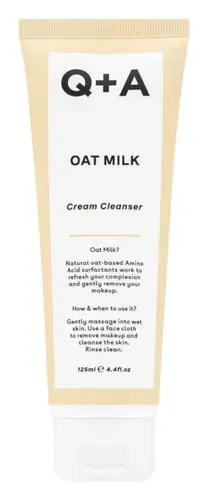
What's inside
What's inside
 Key Ingredients
Benefits
Concerns
Ingredients Side-by-side
Water
Skin ConditioningAloe Barbadensis Leaf Juice
Skin Conditioning


Prunus Amygdalus Dulcis Oil
Skin Conditioning

Cetearyl Alcohol
Emollient



Sodium Stearoyl Glutamate
CleansingButyrospermum Parkii Butter
Skin Conditioning
Glycerin
Humectant
Sodium Lauroyl Oat Amino Acids
CleansingAvena Sativa Kernel Oil
Skin Conditioning
Avena Sativa Kernel Meal
Abrasive
Prunus Armeniaca Kernel Oil
Masking
Theobroma Cacao Seed Butter
Emollient
Helianthus Annuus Seed Oil
Emollient
Linum Usitatissimum Seed Oil
Perfuming
Benzyl Alcohol
Perfuming




Dehydroacetic Acid
Preservative
Potassium Sorbate
Preservative
Xanthan Gum
EmulsifyingSodium Gluconate
Skin ConditioningTocopherol
Antioxidant




Tetrasodium EDTA
Ethylhexylglycerin
Skin ConditioningSodium Benzoate
Masking
Phenoxyethanol
Preservative
Citric Acid
Buffering

Water, Aloe Barbadensis Leaf Juice, Prunus Amygdalus Dulcis Oil, Cetearyl Alcohol, Sodium Stearoyl Glutamate, Butyrospermum Parkii Butter, Glycerin, Sodium Lauroyl Oat Amino Acids, Avena Sativa Kernel Oil, Avena Sativa Kernel Meal, Prunus Armeniaca Kernel Oil, Theobroma Cacao Seed Butter, Helianthus Annuus Seed Oil, Linum Usitatissimum Seed Oil, Benzyl Alcohol, Dehydroacetic Acid, Potassium Sorbate, Xanthan Gum, Sodium Gluconate, Tocopherol, Tetrasodium EDTA, Ethylhexylglycerin, Sodium Benzoate, Phenoxyethanol, Citric Acid
Water
Skin ConditioningCoco-Betaine
Cleansing
Glycerin
Humectant
Propanediol
Solvent
Caprylyl/Capryl Glucoside
CleansingAcrylates/C10-30 Alkyl Acrylate Crosspolymer
Emulsion StabilisingSodium Hyaluronate
Humectant
Sodium Gluconate
Skin ConditioningAloe Barbadensis Leaf Juice Powder
Skin Conditioning
Caprylyl Glycol
Emollient
Phenoxyethanol
Preservative
Sodium Hydroxide
BufferingCocamidopropyl Betaine
Cleansing
Reviews
Ingredients Explained
These ingredients are found in both products.
Ingredients higher up in an ingredient list are typically present in a larger amount.
Glycerin (or glycerol) is a compound naturally found in your skin. It's a powerhouse humectant that pulls water into the stratum corneum.
Topically, glycerin does several things at once:
Your skin makes glycerin on its own (mostly from sebaceous oil breakdown) and shuttles it to your outermost layer of skin, or your epidermis, via aquaporin-3.
Aquaporin-3 is a transporter that is essential for normal skin hydration, elasticity, and repair. Interestingly, mice lacking in AQP3 have dry and less elastic skin that can be fully corrected with glycerin.
This ingredient is non-irritating, plays well with almost every ingredient, and works across all skin types. Typical use is anywhere between 3-10% but can go up to 79% in some leave-on products.
Just know very high concentrations (>40%) can feel tacky in low humidity.
Glycerin is the name for this ingredient in American English. British English uses Glycerol/Glycerine.
Learn more about GlycerinPhenoxyethanol is a preservative that has germicide, antimicrobial, and aromatic properties. Studies show that phenoxyethanol can prevent microbial growth. By itself, it has a scent that is similar to that of a rose.
It's often used in formulations along with Caprylyl Glycol to preserve the shelf life of products.
This is the synthetic salt of gluconic acid, a form of PHA and mild exfoliant.
It is mainly used to stabilize oil and butter formulations from going bad. Sodium gluconate is a humectant, pH regulator, and chelating agent.
Chelating agents help neutralize unwanted metals from affecting the formulation.
Sodium gluconate is water-soluble.
Learn more about Sodium GluconateWater. It's the most common cosmetic ingredient of all. You'll usually see it at the top of ingredient lists, meaning that it makes up the largest part of the product.
So why is it so popular? Water most often acts as a solvent - this means that it helps dissolve other ingredients into the formulation.
You'll also recognize water as that liquid we all need to stay alive. If you see this, drink a glass of water. Remember to stay hydrated!
Learn more about Water