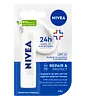
This barrier-repair lip moisturizer is formulated around Butyrospermum Parkii Butter and Panthenol to strengthen the lip barrier and hydrate lips.
This calming lip moisturizer is formulated around Bis-Diglyceryl Polyacyladipate-2 and Punica Granatum Seed Oil to calm redness and hydrate lips.


What's inside
What's inside
 Key Ingredients
Benefits
Concerns
Ingredients Side-by-side
Octyldodecanol
Emollient
Ricinus Communis Seed Oil
Masking




Helianthus Annuus Seed Cera
Emollient
Hydrogenated Rapeseed Oil
Emollient
Butyrospermum Parkii Butter
Skin Conditioning



Butyl Methoxydibenzoylmethane
UV Absorber
Ethylhexyl Triazone
UV Absorber
Polyglyceryl-4 Diisostearate/Polyhydroxystearate/Sebacate
Emulsifying
Panthenol
Skin Conditioning


Glycerin
Humectant
Aroma

Water
Skin ConditioningTocopherol
Antioxidant




Tocopheryl Acetate
Antioxidant
Ascorbyl Palmitate
Antioxidant
Helianthus Annuus Seed Oil
Emollient
Pantolactone
Humectant
CI 77492
Cosmetic ColorantOctyldodecanol, Ricinus Communis Seed Oil, Helianthus Annuus Seed Cera, Hydrogenated Rapeseed Oil, Butyrospermum Parkii Butter, Butyl Methoxydibenzoylmethane, Ethylhexyl Triazone, Polyglyceryl-4 Diisostearate/Polyhydroxystearate/Sebacate, Panthenol, Glycerin, Aroma, Water, Tocopherol, Tocopheryl Acetate, Ascorbyl Palmitate, Helianthus Annuus Seed Oil, Pantolactone, CI 77492
Butyl Methoxydibenzoylmethane 2%
UV Absorber
Ethylhexyl Methoxycinnamate 7.5%
UV Absorber

Benzophenone-3 3%
UV Absorber
Polybutene
Diisostearyl Malate
EmollientIsononyl Isononanoate
EmollientBis-Diglyceryl Polyacyladipate-2
Emollient
Octyldodecyl Neopentanoate
EmollientPolyethylene
Abrasive
Ozokerite
Emulsion StabilisingDiisopropyl Dimer Dilinoleate
Emollient
Beeswax
Emulsion Stabilising
Parfum
Masking
Aroma
Punica Granatum Seed Oil
Emollient
Rubus Idaeus Seed Oil
Emollient
Vitis Vinifera Seed Oil
Emollient
Calcium Aluminum Borosilicate
Euphorbia Cerifera Wax
Cetyl Palmitate
Emollient
Benzoic Acid
Masking
Oxidized Polyethylene
BHT
Antioxidant
Silica
Abrasive

Sodium Saccharin
MaskingBenzyl Benzoate
Antimicrobial
Limonene
Perfuming
Benzyl Alcohol
Perfuming
Citral
Perfuming
Amyl Cinnamal
Perfuming
Hexyl Cinnamal
Perfuming
Hydroxycitronellal
Perfuming
Alpha-Isomethyl Ionone
Perfuming
Linalool
Perfuming
Mica
Cosmetic ColorantCI 77891
Cosmetic ColorantCI 77491
Cosmetic ColorantCI 77492
Cosmetic ColorantCI 77499
Cosmetic ColorantCI 15850
Cosmetic ColorantCI 45410
Cosmetic ColorantCI 17200
Cosmetic ColorantCI 42090
Cosmetic ColorantCI 19140
Cosmetic ColorantCI 15985
Cosmetic ColorantCI 75470
Cosmetic ColorantButyl Methoxydibenzoylmethane 2%, Ethylhexyl Methoxycinnamate 7.5%, Benzophenone-3 3%, Polybutene, Diisostearyl Malate, Isononyl Isononanoate, Bis-Diglyceryl Polyacyladipate-2, Octyldodecyl Neopentanoate, Polyethylene, Ozokerite, Diisopropyl Dimer Dilinoleate, Beeswax, Parfum, Aroma, Punica Granatum Seed Oil, Rubus Idaeus Seed Oil, Vitis Vinifera Seed Oil, Calcium Aluminum Borosilicate, Euphorbia Cerifera Wax, Cetyl Palmitate, Benzoic Acid, Oxidized Polyethylene, BHT, Silica, Sodium Saccharin, Benzyl Benzoate, Limonene, Benzyl Alcohol, Citral, Amyl Cinnamal, Hexyl Cinnamal, Hydroxycitronellal, Alpha-Isomethyl Ionone, Linalool, Mica, CI 77891, CI 77491, CI 77492, CI 77499, CI 15850, CI 45410, CI 17200, CI 42090, CI 19140, CI 15985, CI 75470
Reviews
Ingredients Explained
These ingredients are found in both products.
Ingredients higher up in an ingredient list are typically present in a larger amount.
Aroma refers to an ingredient, or mixture of ingredients, that impart or mask a flavor.
The name is slightly confusing. This is because INCI associates aroma with flavor instead of smell.
Here is the official definition from the The International Cosmetic Ingredient Dictionary and Handbook:
“Aroma is a term for ingredient labeling used to identify that a product contains a material or combination of materials normally added to a cosmetic to produce or to mask a particular flavor.”
INCI shows the only purpose of aroma to be "flavouring".
However, due to regulation differences, some companies may use aroma in place of parfum.
In Canada, this ingredient only has to be listed in concentrations above 1%.
Learn more about AromaAlso known as Avobenzone, this ingredient is an oil-soluble used to absorb the full spectrum of UVA rays (peak 357 nm).
It's one of the most effective UVA filters available but has a major caveat of photostability: avobenzone is susceptible to photodegradation.
This means it can lose efficacy when exposed to sunlight without the help of a stabilizing agent.
Studies show antioxidants (like vitamin E or vitamin C) and some UV filters (like octocrylene and Tinosorb S) can meaningfully improve its stability in a formulation.
The maximum allowable concentration according to regulation is 3% in the US + Canada, and 5% in the EU, Australia, China, Korea, and ASEAN countries.
It has a well-support safety profile: a comprehensive 2025 review found minimal toxicity with no evidence of carcinogenicity.
Overall, avobenzone is a safe and regulated ingredient used in sunscreen for over 40 years.
Learn more about Butyl MethoxydibenzoylmethaneCI 77492 is also hydrated iron III oxide. It's sole purpose is to give a yellow hue to products.
Iron III oxides are classified as inorganic chemicals for coloring.
Synthetically created CI 77492 is considered safer than those naturally found. This is because the synthetically created version may contain less impurities. Iron oxides are generally non-toxic and non-allergenic.
Learn more about CI 77492

