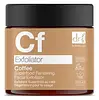
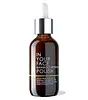
Dr Botanicals Coffee Superfood Renewing Facial Exfoliator Versus In Your Face Bamboo Refining Polish
This oil-control exfoliator is formulated around Kaolin and Coffea Arabica Seed Extract to balance excess oil.
This pore-care exfoliator is formulated around Kaolin and Camellia Sinensis Leaf Extract to refine the look of pores.


What's inside
What's inside
 Key Ingredients
Benefits
Concerns
Ingredients Side-by-side
Water
Skin ConditioningKaolin
Abrasive



Glycerin
Humectant


Juglans Regia Shell Powder
Abrasive
Cetearyl Alcohol
Emollient






Glyceryl Stearate Se
Emulsifying
Caprylic/Capric Triglyceride
Masking
Prunus Amygdalus Dulcis Oil
Skin Conditioning
Coffea Arabica Seed Extract
Masking

Butyrospermum Parkii Butter
Skin Conditioning
Simmondsia Chinensis Seed Oil
Emollient
Vitis Vinifera Seed Oil
Emollient
Benzyl Alcohol
Perfuming




Xanthan Gum
EmulsifyingTheobroma Cacao Seed Butter
Emollient
Sodium Stearoyl Glutamate
CleansingCaramel
Cosmetic ColorantTocopherol
Antioxidant



Arginine
Masking
Salicylic Acid
Masking


Phytic Acid
Chelating
Dehydroacetic Acid
Preservative
Sorbic Acid
Preservative
Citric Acid
Buffering
Water, Kaolin, Glycerin, Juglans Regia Shell Powder, Cetearyl Alcohol, Glyceryl Stearate Se, Caprylic/Capric Triglyceride, Prunus Amygdalus Dulcis Oil, Coffea Arabica Seed Extract, Butyrospermum Parkii Butter, Simmondsia Chinensis Seed Oil, Vitis Vinifera Seed Oil, Benzyl Alcohol, Xanthan Gum, Theobroma Cacao Seed Butter, Sodium Stearoyl Glutamate, Caramel, Tocopherol, Arginine, Salicylic Acid, Phytic Acid, Dehydroacetic Acid, Sorbic Acid, Citric Acid
Water
Skin ConditioningGlycerin
Humectant
Xanthan Gum
EmulsifyingSodium Cocoyl Glutamate
Cleansing
Chondrus Crispus Extract
Skin Conditioning
Pentylene Glycol
Skin Conditioning
Bambusa Arundinacea Stem Powder
Abrasive
Benzyl Alcohol
Perfuming
Xylitol
Humectant
Caprylic Acid
CleansingQuillaja Saponaria Bark Extract
CleansingKaolin
Abrasive
Rosa Canina Seed Powder
Abrasive
Juglans Regia Shell Powder
Abrasive
Camellia Sinensis Leaf Extract
Antimicrobial
Populus Tremuloides Bark Extract
AntiseborrhoeicCaramel
Cosmetic ColorantLavandula Angustifolia Oil
Masking
Geranium Maculatum Oil
Masking
Water, Glycerin, Xanthan Gum, Sodium Cocoyl Glutamate, Chondrus Crispus Extract, Pentylene Glycol, Bambusa Arundinacea Stem Powder, Benzyl Alcohol, Xylitol, Caprylic Acid, Quillaja Saponaria Bark Extract, Kaolin, Rosa Canina Seed Powder, Juglans Regia Shell Powder, Camellia Sinensis Leaf Extract, Populus Tremuloides Bark Extract, Caramel, Lavandula Angustifolia Oil, Geranium Maculatum Oil
Ingredients Explained
These ingredients are found in both products.
Ingredients higher up in an ingredient list are typically present in a larger amount.
Benzyl Alcohol is an aromatic alcohol with several roles: it's a preservative, solvent, and mild fragrance component with a floral scent.
This ingredient has been deemed safe for use in cosmetic formulations at concentrations up to 5%, and up to 10% in hair dyes. You'll typically see 0.5-2% in most rinse-off or leave-on products.
As a preservative, it works by disrupting the membrane of microbial proteins. This helps keep bacteria and fungi from growing in your products.
The sensitization picture is actually quite assuring as well:of nearly 71,000 patients patch tested with benzyl alcohol, only 0.21% showed a positive reaction with most of them being weakly positive.
This led researchers to conclude that benzyl alcohol cannot be regarded as a significant contact allergen.
It is worth noting this ingredient is classified as one of the EU's regulated fragrance allergens and restricted to 1% in finished products.
Labels must also declare it in concentrations above 0.001% in leave-on products and 0.01% in rinse-off products.
At concentrations around 5%, localized redness and itching can appear as a direct irritant response and not as a true allergic reaction.
Learn more about Benzyl AlcoholWe don't have a description for Caramel yet.
Glycerin (or glycerol) is a compound naturally found in your skin. It's a powerhouse humectant that pulls water into the stratum corneum.
Topically, glycerin does several things at once:
Your skin makes glycerin on its own (mostly from sebaceous oil breakdown) and shuttles it to your outermost layer of skin, or your epidermis, via aquaporin-3.
Aquaporin-3 is a transporter that is essential for normal skin hydration, elasticity, and repair. Interestingly, mice lacking in AQP3 have dry and less elastic skin that can be fully corrected with glycerin.
This ingredient is non-irritating, plays well with almost every ingredient, and works across all skin types. Typical use is anywhere between 3-10% but can go up to 79% in some leave-on products.
Just know very high concentrations (>40%) can feel tacky in low humidity.
Glycerin is the name for this ingredient in American English. British English uses Glycerol/Glycerine.
Learn more about GlycerinYou might know this ingredient as walnut shell powder. It is an abrasive used as a physical exfoliator.
Abrasives are physical exfoliants used to get rid of dead cell buildup on your skin. Physical exfoliators have a bad reputation due to the myth that they give your face tiny cuts. This is untrue.
Like any exfoliant, using this ingredient can disrupt your skin barrier. This can lead to breakouts, irritation, and dryness. It is critical to be gentle when using any type of exfoliator.
If you want to use a chemical exfoliator instead, check out glycolic acid.
Learn more about Juglans Regia Shell PowderKaolin is a clay. It is used for oil control and to help minimize pores. Like other clays, kaolin has the ability to absorb excess sebum or oil. This can help clean out pores and mattify the skin.
Some types of kaolin may have exfoliating properties. When water is added to kaolin, it becomes a paste with small abrasive particles.
Most kaolin is a white color, but may be pink/orange/red depending on where it comes from.
The name 'kaolin' comes from a Chinese village named 'Gaoling'. Kaolin clay comes from rocks rich in kaolinite. Kaolinite, the mineral, has a silicate layered structure. Kaolinite is formed from chemical weathering of aluminum siilicate minerals.
Besides skincare, kaolin is commonly used to make glossy paper, in ceramics, toothpaste, and as medicine to soothe stomach issues.
Learn more about KaolinWater. It's the most common cosmetic ingredient of all. You'll usually see it at the top of ingredient lists, meaning that it makes up the largest part of the product.
So why is it so popular? Water most often acts as a solvent - this means that it helps dissolve other ingredients into the formulation.
You'll also recognize water as that liquid we all need to stay alive. If you see this, drink a glass of water. Remember to stay hydrated!
Learn more about WaterXanthan gum is used as a stabilizer and thickener within cosmetic products. It helps give products a sticky, thick feeling - preventing them from being too runny.
On the technical side of things, xanthan gum is a polysaccharide - a combination consisting of multiple sugar molecules bonded together.
Xanthan gum is a pretty common and great ingredient. It is a natural, non-toxic, non-irritating ingredient that is also commonly used in food products.
Learn more about Xanthan Gum

