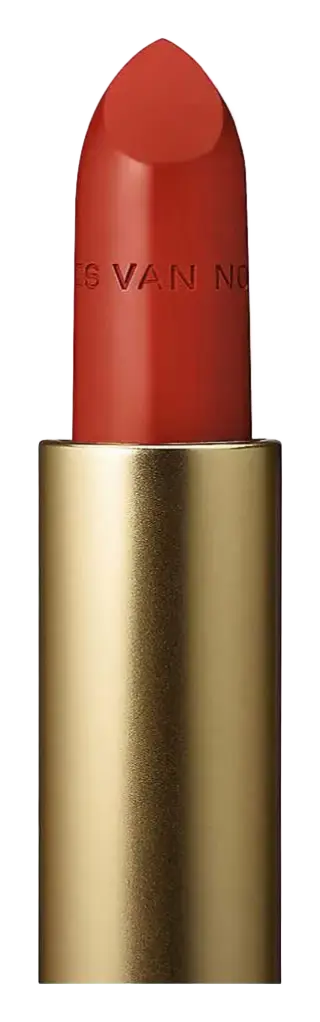
Dries Van Noten Satin Lipstick
A lipstick with 40 ingredients, including vitamin C, exfoliants, and vitamin E.
Lipstick with 40 ingredients that contains exfoliants, Vitamin C and Vitamin E
We independently verify ingredients, backed by peer-reviewed research. Suggest an update.
What's inside
Ingredients List
Pentaerythrityl Tetraisostearate
Emollient

Octyldodecanol
Emollient
Ethylene/Propylene Copolymer
Abrasive
Trioctyldodecyl Citrate
EmollientVp/Hexadecene Copolymer
Mica
Cosmetic ColorantDisteardimonium Hectorite
StabilisingDicalcium Phosphate
Abrasive
Hydrogenated Microcrystalline Wax
Emulsion StabilisingSynthetic Wax
Abrasive
Squalane
Emollient


Polyethylene
Abrasive
Trimethylolpropane Triisostearate
Emollient
Parfum
Masking


Rosa Canina Fruit Oil
Emollient

Butyrospermum Parkii Butter
Skin Conditioning
Propylene Carbonate
SolventTocopherol
Antioxidant




Lecithin
Emollient
Ascorbyl Palmitate
Antioxidant
Glyceryl Stearate
Emollient
Limonene
Perfuming
Citronellol
Perfuming
Linalool
Perfuming
Glyceryl Oleate
Emollient
Geraniol
Perfuming
Benzyl Salicylate
Perfuming
Citric Acid
Buffering
Citral
Perfuming
Eugenol
Perfuming
Tin Oxide
Abrasive
CI 77891
Cosmetic ColorantCI 77491
Cosmetic ColorantCI 77492
Cosmetic ColorantCI 77499
Cosmetic ColorantCI 15850
Cosmetic ColorantCI 42090
Cosmetic ColorantCI 19140
Cosmetic ColorantCI 15985
Cosmetic ColorantCI 45410
Cosmetic Colorant
Pentaerythrityl Tetraisostearate, Octyldodecanol, Ethylene/Propylene Copolymer, Trioctyldodecyl Citrate, Vp/Hexadecene Copolymer, Mica, Disteardimonium Hectorite, Dicalcium Phosphate, Hydrogenated Microcrystalline Wax, Synthetic Wax, Squalane, Polyethylene, Trimethylolpropane Triisostearate, Parfum, Rosa Canina Fruit Oil, Butyrospermum Parkii Butter, Propylene Carbonate, Tocopherol, Lecithin, Ascorbyl Palmitate, Glyceryl Stearate, Limonene, Citronellol, Linalool, Glyceryl Oleate, Geraniol, Benzyl Salicylate, Citric Acid, Citral, Eugenol, Tin Oxide
May Contain:
CI 77891, CI 77491, CI 77492, CI 77499, CI 15850, CI 42090, CI 19140, CI 15985, CI 45410
Key Ingredients
Benefits
Concerns
Ingredients Explained
Pentaerythrityl Tetraisostearate is a synthetic emollient and "skin-feel" ingredient that spreads well and leaves a non-sticky finish with high gloss.
In makeup, it also doubles as a pigment-wetting agent for better color payoff.
It's a well-vetted ingredient for safety and does not penetrate into skin due to its large molecule size.
Because it's a long-chain fatty acid ester, this ingredient may not be fungal acne or Malassezia safe.
Learn more about Pentaerythrityl TetraisostearateOctyldodecanol is a fatty alcohol sourced from plant oils like coconut or palm (or made synthetically).
It is:
You'll likely see this in many BHA products because this is the go-to solvent for salicylic acid.
This ingredient is typically used at levels between 2-20%.
Regarding fungal acne:
In 2019, this ingredient was tested against multiple Malassezia species (the yeast that causes fungal acne) and showed no growth.
Ethylene/Propylene Copolymer is an exfoliant.
We don't have a description for Trioctyldodecyl Citrate yet.
VP/Hexadecene Copolymer is a synthetic film-forming agent. It has both water and oil loving properties, allowing it to create a flexible, even film on the skin.
This ingredient helps enhance texture, smoothness, and wear resistance in makeup products while reducing tackiness.
Mica is a naturally occurring mineral used to add shimmer and color in cosmetics. It can also help improve the texture of a product or give it an opaque, white/silver color.
Serecite is the name for very fine but ragged grains of mica.
This ingredient is often coated with metal oxides like titanium dioxide. Trace amounts of heavy metals may be found in mica, but these metals are not harmful in our personal products.
Mica has been used since prehistoric times throughout the world. Ancient Egyptian, Indian, Greek, Roman, Aztec, and Chinese civilizations have used mica.
Learn more about MicaDisteardimonium Hectorite comes from the clay mineral named hectorite. It is used to add thickness to a product.
It can also help stabilize a product by helping to disperse other ingredients.
Hectorite is a rare, white clay mineral.
Learn more about Disteardimonium HectoriteThis ingredient is a mineral salt of calcium and phosphate. It is mainly used as a mild abrasive and sometimes used to add opacity to a formula.
We don't have a description for Hydrogenated Microcrystalline Wax yet.
Synthetic Wax is a manufactured hydrocarbon wax. In formulas, it works as an occlusive emollient that helps reduce water loss and improves the spreadability of products.
Research comparing synthetic wax to traditional mineral-derived products found that formulas containing it perform as well for skin hydration.
It is considered non-comedogenic and vegan-friendly.
This ingredient has a well-established safety record by the CIR Expert Panel for Cosmetic Ingredient Safety.
Synthetic Waxes are straight/branched-chain hydrocarbons with no ester bond or fatty acids. That means there is nothing for the Malassezia yeast to feed on.
Learn more about Synthetic WaxSqualane is the hydrogenated and shelf-stable form of squalene (a lipid that naturally occurs in human sebum).
It is an emollient and skin conditioning agent that is able to integrate seamlessly into the skin's lipid barrier without clogging pores.
This is due to how structurally similar it is to what your skin already produces.
Though it is mostly an emollient that helps soften and hydrate skin, it also has some humectant and occlusive action. Humectants help the skin retain moisture while occlusives seal it in, making squalane a triple-threat moisturizer.
Research shows it has antioxidant capabilities that help protect against stressors like UV exposure, specifically UVA induced oxidative stress. This study also found that it supports collagen biosynthesis in human dermal fibroblasts.
No clinical study has reported significant adverse effects and irritation reactions are very rare from this ingredient (even at 100% concentration).
Overall, it's a fantastic ingredient for hydration and is suitable for all skin types.
This depends on the source. Squalane can be derived from both plants and animals. Most squalane used in skincare comes from plants.
Please note: the source of squalane is only known if disclosed by the brand. We recommend reaching out to the brand if you have any questions about their squalane.
Read more about squalene with an "e".
Though squalane is often called an oil, it’s technically not one. It is a hydrocarbon, meaning it is only made of carbon and hydrogen. True oils are triglycerides and made of fatty acids and glycerol.
The term “oil-free” isn’t regulated so companies can define it however they want. Some exclude all oils, while others just avoid mineral oil or comedogenic oils.
Squalane has a comedogenic rating of 1 from the original 1972 study that tested raw ingredients under occlusion on rabbit ears. This system is not standardized or peer-reviewed, and using the raw ingredients is very different from how diluted cosmetic formulations are used on human skin.
A comedogenic rating of 1 means it is "unlikely to clog pores" according to the original rating system.
The overall formula of a product matters more than the individual ingredients on whether or not it will cause clogged pores.
Learn more about SqualanePolyethylene is a synthetic ingredient that helps the skin retain moisture. It is a polymer.
It is also typically used within product formulations to help bind solid ingredients together and thicken oil-based ingredients. When added to balms and emulsions, it helps increase the melting point temperature.
This ingredient comes from trimethylolpropane and isostearic acid. It has emollient and skin conditioning properties.
According to a manufacturer, this ingredient provides a non-tacky, light, glossy feeling on the skin.
Due to its isotearic acid base, this ingredient may not be fungal-acne safe.
Learn more about Trimethylolpropane TriisostearateParfum is a catch-all term for an ingredient or more that is used to give a scent to products.
Also called "fragrance", this ingredient can be a blend of hundreds of chemicals or plant oils. This means every product with "fragrance" or "parfum" in the ingredients list is a different mixture.
For instance, Habanolide is a proprietary trade name for a specific aroma chemical. When used as a fragrance ingredient in cosmetics, most aroma chemicals fall under the broad labeling category of “FRAGRANCE” or “PARFUM” according to EU and US regulations.
The term 'parfum' or 'fragrance' is not regulated in many countries. In many cases, it is up to the brand to define this term.
For instance, many brands choose to label themselves as "fragrance-free" because they are not using synthetic fragrances. However, their products may still contain ingredients such as essential oils that are considered a fragrance by INCI standards.
One example is Calendula flower extract. Calendula is an essential oil that still imparts a scent or 'fragrance'.
Depending on the blend, the ingredients in the mixture can cause allergies and sensitivities on the skin. Some ingredients that are known EU allergens include linalool and citronellol.
Parfum can also be used to mask or cover an unpleasant scent.
The bottom line is: not all fragrances/parfum/ingredients are created equally. If you are worried about fragrances, we recommend taking a closer look at an ingredient. And of course, we always recommend speaking with a professional.
Learn more about ParfumRosa Canina Fruit Oil is a non-fragrant plant oil that has earned its skincare reputation through chemistry.
It's dominated by fatty acids like linoleic acid (~35-55%), alpha-linolenic acid (~17-27%), and oleic acid (~14-22%). This is the exact profile that supports skin barrier, locks in hydration, and calms inflammation.
A 2024 review found evidence for the Rosa canina species supports its use for scarring, hyperpigmentation, wrinkles, and atopic dermatitis; this was mostly credited to its vitamin C content and fatty acid composition as the primary active mechanisms.
You might see this ingredient marketed as a "natural retinol". Some rosehip seed oils contains traces of all-trans-retinoic acid but these trace amounts are far below biologically active levels.
The Cosmetic Ingredient Review Panel has deemed this ingredient safe and it's well-tolerated.
Fungal acne: The fatty acids of this oil fall into the C11-24 range that Malassezia yeast can metabolize, so this ingredient may not be fungal acne safe.
Learn more about Rosa Canina Fruit OilThis ingredient is also known as shea butter. It is a plant-derived extract from the nuts of the Africa shea tree and one of the most well-studied emollients.
Because it has a high concentration of fatty acids (primarily oleic, stearic, and linoleic) it is able to form a protective barrier on the skin's surface. This helps seal in moisture and prevents transepidermal water loss (TEWL).
In vitro research found an increase in skin hydration by 58% and a decrease in TEWL by 37.8% after 24 hours of applying this ingredient (pretty impressive for a single ingredient!).
Besides hydration, shea butter also contains triterpenes that have anti-inflammatory potential. In particule, lupeol cinnamate has shown the highest anti-inflammatory activity in vivo.
Shea butter also contains vitamins A and E which may contribute to antioxidant activity.
While Shea Butter has an SPF rating of about 3-4, it is not a sunscreen replacement.
This ingredient may not be fungal acne safe because its fatty acids fall within the C11-C24 range that the Malassezia yeast can metabolize.
This ingredient shows up on a lot of "pore-clogging" lists but there's no real evidence behind that. It doesn't even have a comedogenic rating from an actual study; the numbers you'll find online come from blogs citing other blogs.
Ratings for other ingredients mostly come from a 1980s rabbit ear test. This test doesn't translate well to human skin or to real products because the ingredient sits at a much lower percentage.
Some people still find it breaks them out. So if that's you, definitely trust your skin. Just know this one's based on experience and not evidence.
Learn more about Butyrospermum Parkii ButterThis ingredient is a solvent. It helps dissolve active ingredients and alter the texture of products.
Propylene Carbonate is commonly used in makeup and with clay, such as montmorillonite or bentonite.
Studies show this ingredient to be safe for cosmetics. When it is undiluted, it can cause skin irritation. (It is always diluted in skincare and makeup). This ingredient is water-soluble.
Propylene Carbonate is created from propylene glycol and carbonic acid.
Learn more about Propylene CarbonateTocopherol is a fat-soluble antioxidant known as Vitamin E.
You'll find this ingredient in the vast majority of skincare (for good reason). It works to neutralize free radicals, or unstable molecules generated by UV exposure, pollution, and other environmental stressors, before they can cause oxidative damage to your skin cells.
Topically applied tocopherol has been shown to protect against UV damage by ramping up the skin's own natural defense enzymes.
It also acts as a skin conditioning agent; some studies show that regular topical use can improve the skin's water-binding capacity over 2-4 weeks.
This ingredient is especially loved for being a team player. When combined with Vitamin C, the photoprotective effect of both ingredients roughly doubles and the combo also helps reduce UV-induced DNA damage.
This ingredient has some brightening potential but it's more of a prevention ingredient than spot-fader. Cell studies show it can slow down melanin production but it's worth noting that it's not the most powerful brightener out there.
In formulations, it also serves as a stabilizer that helps protect other oxidation-prone ingredients from degrading.
Concentrations usually range from 0.1-1% in most leave-on products.
Learn more about TocopherolLecithin is a term for a group of substances found in the cell membranes of plants, animals, and humans. They are made up of phospholipids.
Thanks to its amphiphilic structure (water-loving head and oil-loving tail), it is a true multitasker:
It plays well with most ingredients and is typically used at 0.1-1%. However, concentrations up to 50% have been reported in moisturizers.
Learn more about LecithinAscorbyl Palmitate is a fat-soluble form of vitamin C (Ascorbic Acid) made by combining it with palmitic acid.
It is able to blend easily into creams and oil-based formulas because it dissolves in oils rather than water.
As you may know, regular vitamin C is notorious for breaking down when exposed to sunlight and air. Ascorbyl Palmitate is more stable and degrades at a slower rate.
Research on whether it converts efficiently into active vitamin C once it's applied on your skin is still limited.
Some in-vitro studies suggest it may support collagen production, but it is not considered one of the stronger vitamin C derivatives, like:
Due to the palmitic acid base, this ingredient may not be fungal acne safe. Comedogenic studies have also shown this ingredient to have a rating of 2.
It's also worth keeping in mind that comedogenic and irritancy ratings are tested on individual ingredients, not finished formulas. The final product's formulation, concentration, and other ingredients all play a role in how something actually behaves on your skin.
Learn more about Ascorbyl PalmitateGlyceryl Stearate is made by reacting glycerin with stearic acid (typically sourced from plant oils like palm or coconut). It's an emulsifier, emollient, and mild occlusive.
Emulsifiers help ingredients like oil and water stay mixed so your formula stays nicely blended and uniform in texture.
This ingredient is typically used in concentrations between 1-10%. Studies have found it to be non-sensitizing, non-phototoxic, and non-photoallergenic.
A close cousin of this ingredient is Glyceryl Stearate SE ("self-emulsifying"). This just has a small amount of sodium or potassium stearate added so it can emulsify without a co-emulsifier.
Since this ingredient is an ester of a C18 fatty acid, it may not be fungal acne safe. The Malassezia yeast can potentially metabolize within the C11-C24 range.
Fun fact: The human body also creates Glyceryl Stearate naturally.
Learn more about Glyceryl StearateLimonene is the compound that gives citrus peel its smell.
In skincare, it shows up as a standalone fragrance ingredient or as a natural compound of citrus and other essential oils.
You'll typically see this ingredient used in very small amounts; anything above 0.001% in a leave-on product or 0.01% in a rinse-off has to be named on the label in the EU. The citrus oils that carry it sit around 0.5-1% in a finished formula.
Fresh limonene is a weak allergen; the real issue is that it slowly reacts with air and then breaks down from oxidation to create hydroperoxides (which are strong sensitizers). This is why suppliers are required to keep the peroxide value below 20 mmol.
Positive reactions in people being investigated for eczema vary:
It's worth skipping if you have a known fragrance allergy or a compromised barrier, but the risk is low for most people.
Older or long-opened products are also more likely to bother you than fresh ones due to oxidation.
Learn more about LimoneneCitronellol is used to add fragrance/parfum to a product. It is often derived from plants such as roses. In fact, it can be found in many essential oils including geranium, lavender, neroli, and more. The scent of Citronellol is often described as "fresh, grassy, and citrus-like".
Since the Citronellol molecule is already unstable, Citronellol becomes irritating on the skin when exposed to air.
Citronellol is a modified terpene. Terpenes are unsaturated hydrocarbons found in plants. They make up the primary part of essential oils.
Citronellol is not able to be absorbed into deeper layers of the skin. It has low permeability,
Citronellol is also a natural insect repellent.
Learn more about CitronellolLinalool is a small, naturally occurring scent molecule found in plants like lavender, coriander, bergamot, and more.
It is one of the two most-used fragrance ingredients in cosmetics and added purely for smell. Since it's not used for a skin benefit, there's no "effective dose". Concentration depends on the fragrance load of the product.
The EU requires it to be named on the label above 0.001% in leave-on and 0.01% in rinse-off products.
Fresh linalool is a weak sensitizer but air exposure turns some of it into hydroperoxides, which are strong sensitizers. Those oxidation products are the actual allergy concern.
Patch-test clinics see positive reactions to linalool hydroperoxides in about 4% to 12% of dermatitis patients depending on country and test concentration.
Resassuringly, one analytical study found hydroperoxide levels in real fragranced products to be orders of magnitude below what induced sensitization in animal studies with no evidence of oxidation building up during normal storage.
The practical takeaway is that linalool is fine for most people but worth avoiding if you have a confirmed fragrance contact allergy or a badly compromised barrier.
Products stored a long time after opening are also the high-risk scenario since that is when oxidation happens.
The scent of linalool is described as floral, spicy tropical, and citrus-like.
Learn more about LinaloolGlyceryl Oleate is the monoester of glycerin and oleic acid. It is a skin-conditioning emollient that also helps form emulsions.
What makes glyceryl oleate special is its "re-fatting" effect.
When you wash your hair and skin with a surfactant-based cleanser, the surfactants grab onto everything. This includes your skin's natural lipids, or the fats that live in your skin barrier and sebum. Once you rinse these surfactants away, it leaves your skin feeling tight, dry, and clean (in a not-good way).
Re-fatting is essentially putting some of these lipids back. Glyceryl oleate deposits a thin layer of emollient lipids back on the skin or hair surface reduce some of the barrier damage.
Also, glyceryl oleate isn't a foreign molecule to your skin. It's chemically identical to something your skin already produces and manages naturally. This is why it tends to be well-tolerated with low risk of irritation.
Typical use levels range from 0.5-5%.
Glyceryl Oleate has a function of "perfuming" in the CosIng database. This just means that the ingredient has some scent character that can contribute to the product's overall smell.
The scent of this ingredient is described as "waxy".
As an ester of oleic acid, this ingredient may not be fungal acne safe. This is because oleic acid falls into the carbon-chain length that Malassezia can use as a substrate.
Learn more about Glyceryl OleateGeraniol is used to add fragrance/parfum to a product. It is the main component of citronellol. It is a monoterpenoid and an alcohol.
Monoterpenes are naturally found in many parts of different plants.
Geraniol can be found in many essential oils including Rose Oil and Citronella Oil. The scent of Geraniol is often described as "rose-like". Many foods also contain Geraniol for fruit flavoring.
Geraniol can irritate the skin when exposed to air. However, irritation depends on the ability of geraniol to penetrate into the skin. In general, geraniol is not able to penetrate skin easily.
Geraniol is colorless and has low water-solubility. However, it is soluble in common organic solvents.
Like citronellol, it is a natural insect repellent.
2,6-Octadien-1-ol, 3,7-dimethyl-, (2E)-
Learn more about GeraniolBenzyl Salicylate is a solvent and fragrance additive. It is an ester of benzyl alcohol and salicylic acid. This ingredient can be naturally found in some plants and plant extracts.
In fragrances, Benzyl Salicylate may be a solvent or a fragrance component. In synthetic musk scents, it is used as a solvent. For floral fragrances such as lilac and jasmine, it is used as a fragrance component. The natural scent of Benzyl Salicylate is described as "lightly-sweet, slightly balsamic".
While Benzyl Salicylate has been associated with contact dermatitis and allergies, emerging studies show it may not be caused by this ingredient alone.
However, this ingredient is often used with fragrances and other components that may cause allergies. It is still listed as a known allergen in the EU. We recommend speaking with a professional if you have concerns.
Another study from 2021 shows Benzyl Salicylate may have anti-inflammatory properties.
Learn more about Benzyl SalicylateCitric Acid is an alpha hydroxy acid (AHA) naturally found in citrus fruits like oranges, lemons, and limes.
Like other AHAs, citric acid can exfoliate skin by breaking down the bonds that hold dead skin cells together. This helps reveal smoother and brighter skin underneath.
However, this exfoliating effect only happens at high concentrations (20%) which can be hard to find in cosmetic products.
Due to this, citric acid is usually included in small amounts as a pH adjuster. This helps keep products slightly more acidic and compatible with skin's natural pH.
In skincare formulas, citric acid can:
While it can provide some skin benefits, research shows lactic acid and glycolic acid are generally more effective and less irritating exfoliants.
Most citric acid used in skincare today is made by fermenting sugars (usually from molasses). This synthetic version is identical to the natural citrus form but easier to stabilize and use in formulations.
Rosacea skin has a lower threshold for acids generally, with 62.5% of rosacea subjects in one study reacting to lactic acid in a sting test. This is why we mark citric acid as a potential rosacea trigger.
However, this ingredient shows up as a pH adjuster or chelator at roughly 0.1-1% in many products. These low levels are unlikely to be an issue for rosacea skin and becomes a potential trigger at exfoliating concentrations (20%). Because everybody's skin is unique, we recommend a patch test if you are unsure.
Learn more about Citric AcidCitral is the molecule responsible for the fresh lemon scent in lemon, lime, and lemongrass. It is a fragrance ingredient that can be created from plant essential oils or synthetically.
Though Citral has documented antimicrobial activity against acne bacteria (which is where the marketing claims about it being good for acne-prone skin originate), real formulas use it at fragrance-level concentrations under 1% so there's likely no skin benefit.
You should know this ingredient is a known EU fragrance allergen.
Animal studies classifies this ingredient as a weak-to-moderate skin sensitizer and clinical patch testing on eczema patients confirmed it to be both a contact allergen and irritant.
The term 'citral' is a collective term for two geometric isomers: geranial/Citral A and neral/Citral B.
The term 'fragrance' is not regulated in many countries. In many cases, it is up to the brand to define this term. For instance, many brands choose to label themselves as "fragrance-free" because they are not using synthetic fragrances. However, their products may still contain ingredients such as essential oils that are considered a fragrance.
Learn more about CitralEugenol is naturally found in cloves, basil, and bay leaves. It is an aromatic oil used to add fragrance to a product. The scent of eugenol is described as "clove-like". Eugenol is a known EU allergen, meaning it causes contact allergies.
Studies show eugenol possesses antibacterial and antioxidant properties.
Besides cosmetics, eugenol is also added as a flavor in teas and cakes.
Learn more about EugenolTin Oxide is an inorganic oxide used to add opacity and volume to a product. In nature, it is already found in mineral form. The main ore of tin is an opaque and shiny mineral called casseterite.
Tin Oxide helps remove translucency in a product, or make it more opaque. Besides adding opacity, tin oxide is used for bulking to add volume.
Ci 77891 is a white pigment from Titanium dioxide. It is naturally found in minerals such as rutile and ilmenite.
It's main function is to add a white color to cosmetics. It can also be mixed with other colors to create different shades.
Ci 77891 is commonly found in sunscreens due to its ability to block UV rays.
Learn more about CI 77891Ci 77491 is also hydrated iron III oxide. It's sole purpose is to give a red/pink hue to products.
Iron III oxides are classified as inorganic chemicals for coloring.
Synthetically created Ci 77491 is considered safer than those naturally found. This is because the synthetically created version may contain less impurities. Iron oxides are generally non-toxic and non-allergenic.
Learn more about CI 77491CI 77492 is also hydrated iron III oxide. It's sole purpose is to give a yellow hue to products.
Iron III oxides are classified as inorganic chemicals for coloring.
Synthetically created CI 77492 is considered safer than those naturally found. This is because the synthetically created version may contain less impurities. Iron oxides are generally non-toxic and non-allergenic.
Learn more about CI 77492Ci 77499 is also hydrated iron III oxide. It is created from mixing red and black iron oxides. This helps give shades of darkness to a product.
Iron III oxides are classified as inorganic chemicals for coloring.
Ci 15850 is the pigment color red. It is an azo dye and created synthetically.
Azo dyes need to be thoroughly purified before use. This allows them to be more stable and longer-lasting.
This ingredient is common in foundations, lipsticks, and blushes. This color is described as brown/orangey red.
It has many secondary names such as Red 6 and Red 7. According to a manufacturer, Red 6 usually contains aluminum.
Learn more about CI 15850Ci 42090 is a synthetic dye created from petroleum. It is used to give a bright blue color to cosmetics, medicine, and food.
CI 19140 is also known as Tartrazine. Tartrazine is a synthetic dye used in cosmetics, foods, and medicine to add a yellow color.
Tartrazine is created from petroleum and is water-soluble.
Some people may experience allergies from this dye, especially asthmatics and those with an aspirin intolerance.
Learn more about CI 19140Ci 15985 is a dye made from petroleum. It is synthetically created and approved by the FDA for use in foods and cosmetics.
The color of this dye is orange/yellow.
This ingredient can be found in makeup, sun care, and skincare.
Learn more about CI 15985CI 45410 is a synthetic red-pigment and dye.
It often goes by both Red 28 or Red 27; manufacturers label both ingredients as CI 45410.
This dye is commonly found in makeup because it imparts a vivid color. Some types of this dye change color based on pH level and interaction with moisture:
Your skin has a natural pH of around 4.5 - 5.5.
According to the FDA, CI 45410 is not permitted for use in eye products.
Red 27 is a flourescein dye and commonly used as a fluorescent tracer in medicine.
Learn more about CI 45410Reviews
No written reviews yet. Be the first to review this product.
Recent searches
Search reviews by skin type, ingredient, or keyword.
Where it's from
Dries Van Noten is a Belgian brand


We're dedicated to providing you with the most up-to-date and science-backed ingredient info out there.
The data we've presented on this page has been verified by a member of the SkinSort Team.
Read more about us· Updated August 28, 2026 • Added by chianyikato


