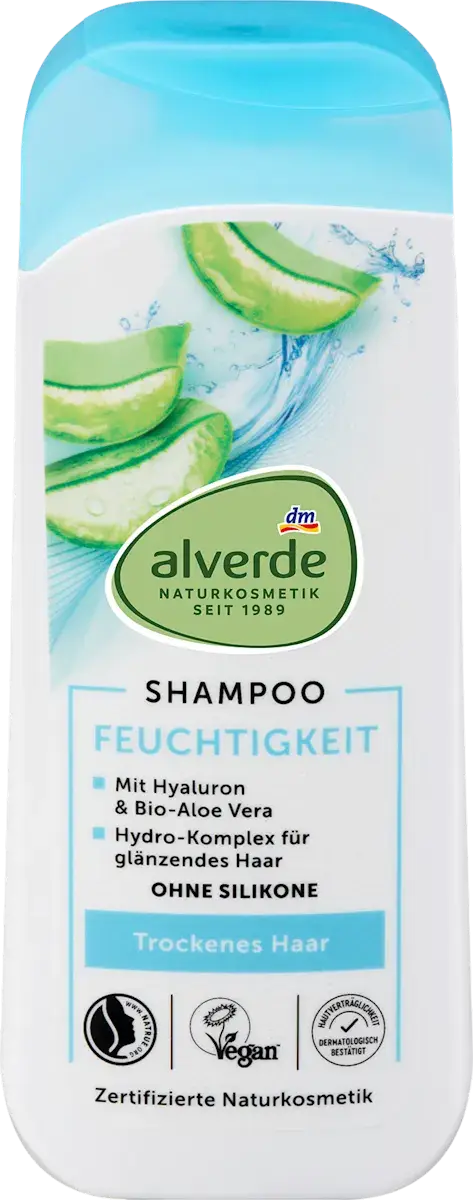
Alverde Naturkosmetik Shampoo Feuchtigkeit
A shampoo with 30 ingredients, including AHA, vitamin E, and hyaluronic acid.
Shampoo with 30 ingredients that contains AHA, hyaluronic acid and Vitamin E
We independently verify ingredients, backed by peer-reviewed research. Suggest an update.
What's inside
Ingredients List
Water
Skin ConditioningLauryl Glucoside
CleansingSodium Coco-Sulfate
Cleansing

Glycerin
Humectant


Betaine
Humectant
Polyglyceryl-3 Betainate Acetate
Citric Acid
Buffering


Sodium Chloride
MaskingParfum
Masking



Disodium Cocoyl Glutamate
Cleansing
Levulinic Acid
Perfuming
Sodium Levulinate
Skin ConditioningSodium PCA
Humectant
Hydrolyzed Wheat Protein
Skin ConditioningCoco-Glucoside
Cleansing
Glyceryl Oleate
Emollient
Sodium Cocoyl Glutamate
Cleansing
Aloe Barbadensis Leaf Juice Powder
Skin Conditioning
Sodium Phytate
ChelatingBenzyl Alcohol
Perfuming


Citronellol
Perfuming
Cedrus Atlantica Bark Oil
Masking

Menthol
Masking
Sodium Hyaluronate
Humectant

Vanillin
Masking
CI 77231
Cosmetic ColorantMagnesium Sulfate
Alcohol
Antimicrobial
Tocopherol
Antioxidant


Hydrogenated Vegetable Glycerides Citrate
EmollientWater, Lauryl Glucoside, Sodium Coco-Sulfate, Glycerin, Betaine, Polyglyceryl-3 Betainate Acetate, Citric Acid, Sodium Chloride, Parfum, Disodium Cocoyl Glutamate, Levulinic Acid, Sodium Levulinate, Sodium PCA, Hydrolyzed Wheat Protein, Coco-Glucoside, Glyceryl Oleate, Sodium Cocoyl Glutamate, Aloe Barbadensis Leaf Juice Powder, Sodium Phytate, Benzyl Alcohol, Citronellol, Cedrus Atlantica Bark Oil, Menthol, Sodium Hyaluronate, Vanillin, CI 77231, Magnesium Sulfate, Alcohol, Tocopherol, Hydrogenated Vegetable Glycerides Citrate
Key Ingredients
Benefits
Concerns
Ingredients Explained
Water. It's the most common cosmetic ingredient of all. You'll usually see it at the top of ingredient lists, meaning that it makes up the largest part of the product.
So why is it so popular? Water most often acts as a solvent - this means that it helps dissolve other ingredients into the formulation.
You'll also recognize water as that liquid we all need to stay alive. If you see this, drink a glass of water. Remember to stay hydrated!
Learn more about WaterLauryl Glucoside sugar- and lipid-based cleansing agent. It is created from glucose and lauryl alcohol.
This ingredient is a surfactant, making it easier to rinse oil, dirt, and other pollutants away.
A British study found lauryl glucoside to cause skin sensitivity for some people. We recommend speaking with a professional if you have concerns.
Other names for this ingredient include "Lauryl Polyglucose", "Lauryl glycoside", and "D-Glucopyranoside".
Learn more about Lauryl GlucosideSodium Coco-Sulfate (SCS) is an anionic cleanser made by sulfating coconut-derived fatty alcohols and neutralizing them into a sodium salt. It's a strong and bubbly cleanser and closely realted to SLS.
This ingredient works by grabbing onto oil, dirt, and grime so they can be rinsed away. It also helps add foam for a big-lather feel.
Like other members of the alkyl sulfate family, these surfactants can be drying or irritating. This is especially true if your skin barrier is already stressed, the product is very concentrated, or if you leave the ingredient on for too long.
One research paper comparing SCS vs SLS found SCS may score a bit more on the "milder" side for irritation measures, but it still interacts strongly with skin lipids which can cause barrier disruption.
SCS tends to be the best in rinse-off products.
Learn more about Sodium Coco-SulfateGlycerin (or glycerol) is a compound naturally found in your skin. It's a powerhouse humectant that pulls water into the stratum corneum.
Topically, glycerin does several things at once:
Your skin makes glycerin on its own (mostly from sebaceous oil breakdown) and shuttles it to your outermost layer of skin, or your epidermis, via aquaporin-3.
Aquaporin-3 is a transporter that is essential for normal skin hydration, elasticity, and repair. Interestingly, mice lacking in AQP3 have dry and less elastic skin that can be fully corrected with glycerin.
This ingredient is non-irritating, plays well with almost every ingredient, and works across all skin types. Typical use is anywhere between 3-10% but can go up to 79% in some leave-on products.
Just know very high concentrations (>40%) can feel tacky in low humidity.
Glycerin is the name for this ingredient in American English. British English uses Glycerol/Glycerine.
Learn more about GlycerinBetaine is a humectant. Like hyaluronic acid, it helps attract and retain moisture in the skin. It’s known for being gentle and for helping the skin maintain balanced hydration.
Betaine is mainly used to improve hydration and support calmer skin. It helps skin cells regulate water balance because it functions as an osmolyte.
Some studies suggest betaine may support making skin tone more even.
Fun fact: Betaine naturally exists in the skin and the body. In cosmetic products, it can be either plant-derived (most commonly from sugar beets) or synthetically produced for consistency and stability.
Betaine is also known as trimethylglycine.
Learn more about BetaineWe don't have a description for Polyglyceryl-3 Betainate Acetate yet.
Citric Acid is an alpha hydroxy acid (AHA) naturally found in citrus fruits like oranges, lemons, and limes.
Like other AHAs, citric acid can exfoliate skin by breaking down the bonds that hold dead skin cells together. This helps reveal smoother and brighter skin underneath.
However, this exfoliating effect only happens at high concentrations (20%) which can be hard to find in cosmetic products.
Due to this, citric acid is usually included in small amounts as a pH adjuster. This helps keep products slightly more acidic and compatible with skin's natural pH.
In skincare formulas, citric acid can:
While it can provide some skin benefits, research shows lactic acid and glycolic acid are generally more effective and less irritating exfoliants.
Most citric acid used in skincare today is made by fermenting sugars (usually from molasses). This synthetic version is identical to the natural citrus form but easier to stabilize and use in formulations.
Rosacea skin has a lower threshold for acids generally, with 62.5% of rosacea subjects in one study reacting to lactic acid in a sting test. This is why we mark citric acid as a potential rosacea trigger.
However, this ingredient shows up as a pH adjuster or chelator at roughly 0.1-1% in many products. These low levels are unlikely to be an issue for rosacea skin and becomes a potential trigger at exfoliating concentrations (20%). Because everybody's skin is unique, we recommend a patch test if you are unsure.
Learn more about Citric AcidChances are, you eat sodium chloride every day. Sodium Chloride is also known as table salt. This ingredient has many purposes in skincare: thickener, emulsifier, and exfoliator.
You'll most likely find this ingredient in cleansers where it is used to create a gel-like texture. As an emulsifier, it also prevents ingredients from separating.
You might see people debate whether Sodium Chloride is comedogenic, but there actually haven't been any comedogenic tests done on it. Either way, the overall formulation of a product matters a lot more than any single ingredient.
You might see this ingredient used in scrubs as a primary exfoliating ingredient.
Learn more about Sodium ChlorideParfum is a catch-all term for an ingredient or more that is used to give a scent to products.
Also called "fragrance", this ingredient can be a blend of hundreds of chemicals or plant oils. This means every product with "fragrance" or "parfum" in the ingredients list is a different mixture.
For instance, Habanolide is a proprietary trade name for a specific aroma chemical. When used as a fragrance ingredient in cosmetics, most aroma chemicals fall under the broad labeling category of “FRAGRANCE” or “PARFUM” according to EU and US regulations.
The term 'parfum' or 'fragrance' is not regulated in many countries. In many cases, it is up to the brand to define this term.
For instance, many brands choose to label themselves as "fragrance-free" because they are not using synthetic fragrances. However, their products may still contain ingredients such as essential oils that are considered a fragrance by INCI standards.
One example is Calendula flower extract. Calendula is an essential oil that still imparts a scent or 'fragrance'.
Depending on the blend, the ingredients in the mixture can cause allergies and sensitivities on the skin. Some ingredients that are known EU allergens include linalool and citronellol.
Parfum can also be used to mask or cover an unpleasant scent.
The bottom line is: not all fragrances/parfum/ingredients are created equally. If you are worried about fragrances, we recommend taking a closer look at an ingredient. And of course, we always recommend speaking with a professional.
Learn more about ParfumWe don't have a description for Disodium Cocoyl Glutamate yet.
Levulinic Acid is a fragrance that comes from the degradation of cellulose. It is a saturated fatty acid.
This ingredient is often used a building block for other compounds, such as in pharmaceuticals.
According to a manufacturer, this ingredient smells like caramel.
Learn more about Levulinic AcidSodium levulinate is the a sodium salt of Levulinic Acid. Oncedissolved in an aqueous solution, the two ingredients become identical. It is usually derived from renewable plant sources like corn starch or sugarcane.
In skincare, it mostly acts as a skin conditioning agent that keeps skin soft and hydrated. It also acts as a preservative booster by inhibiting the growth of mold, yeast, and bacteria.
It's often paired with Sodium Anisate as the two create a broad-spectrum preservative system that is popular in "natural" formulations.
This ingredient is water-soluble.
The CIR Expert Panel for Cosmetic Ingredient Safety has concluded this ingredient to be non-irritated and there are no restrictions for use in EU cosmetics. The FDA also allows this ingredient to be used as a food-grade flavoring agent.
Learn more about Sodium LevulinateSodium PCA (the salt of PCA) is one of the most well-established humectants in skincare.
Why is it so special? Your skin already makes it naturally; it's a natural component of your skin's Natural Moisturizing Factor (NMF), or the mix of water-binding compounds inside your skin cells that keeps things soft and hydrated.
As a cosmetic ingredient, it grabs water and holds it in the upper layers of skin to smooth roughness and ease dehydration.
There's some clinical support for the NMF approach with a study showing that a cream built to mimic the skin's NMF significantly boosted hydration.
Safety-wise, this ingredient non-irritating, non-comedogenic, and non-phototoxic in testing, with minimal skin absorption.
It also works really well with other hydrators like glycerin or hyaluronic acid, and typical usage is somewhere between 0.2-4%.
Learn more about Sodium PCAThis ingredient is a plant-derived protein made by breaking down wheat proteins into smaller amino acids and peptides. It has skin and hair conditioning properties.
People with known wheat allergy or a history of immediate reactions should be cautious with leave-on products containing hydrolyzed wheat proteins.
Coco-Glucoside is a surfactant, or a cleansing ingredient. It is made from glucose and coconut oil.
Surfactants help gather dirt, oil, and other pollutants from your skin to be rinsed away.
This ingredient is considered gentle and non-comedogenic. However, it may still be irritating for some.
Learn more about Coco-GlucosideGlyceryl Oleate is the monoester of glycerin and oleic acid. It is a skin-conditioning emollient that also helps form emulsions.
What makes glyceryl oleate special is its "re-fatting" effect.
When you wash your hair and skin with a surfactant-based cleanser, the surfactants grab onto everything. This includes your skin's natural lipids, or the fats that live in your skin barrier and sebum. Once you rinse these surfactants away, it leaves your skin feeling tight, dry, and clean (in a not-good way).
Re-fatting is essentially putting some of these lipids back. Glyceryl oleate deposits a thin layer of emollient lipids back on the skin or hair surface reduce some of the barrier damage.
Also, glyceryl oleate isn't a foreign molecule to your skin. It's chemically identical to something your skin already produces and manages naturally. This is why it tends to be well-tolerated with low risk of irritation.
Typical use levels range from 0.5-5%.
Glyceryl Oleate has a function of "perfuming" in the CosIng database. This just means that the ingredient has some scent character that can contribute to the product's overall smell.
The scent of this ingredient is described as "waxy".
As an ester of oleic acid, this ingredient may not be fungal acne safe. This is because oleic acid falls into the carbon-chain length that Malassezia can use as a substrate.
Learn more about Glyceryl OleateSodium Cocoyl Glutamate is a gentle cleanser and surfactant. It is the sodium salt of the Cocoyl Glutamic Acid and comes from coconut oil. As a surfactant, it helps lift dirt and oil to be washed away.
Sodium Cocoyl Glutamate also has an emolliating effect and can help leave the skin feeling soft.
Aloe Barbadensis Leaf Juice Powder comes from the aloe plant.
You may know Aloe to be a good sunburn reliever and inflammation reducer. This is because it contains many components that are known to help reduce irritation and itchiness.
Aloe leaves are also great moisturizers. They are naturally rich in polysaccharides, a carbohydrate made of sugars. Polysaccharides are able to mimic the carbs found in the top layer of your skin. This can help keep your skin hydrated.
Aloe contains the antioxidants Vitamins A, C, and E. These vitamins neutralize free radicals. Free-radicals are molecules that may damage your skin cells, such as pollution.
Aloe does not protect against UV rays, despite it soothing sunburns.
Learn more about Aloe Barbadensis Leaf Juice PowderSodium Phytate is the sodium salt of Phytic acid, a compound that plants store phosphorus in. It's the plant-derived alternative to ingredients like Disodium EDTA.
In skincare, this ingredient is a chelator that grabs onto trace metal ions like iron and copper that sneak into formulas through water/raw materials.
Those metals speed up oxidation so binding them keeps oils, fragrance, and actives from going off, stops color changes, and helps the preservative system work harder.
Survey data shows usage levels range from 0.0099%-0.5% in leave-on products, 0.025%-0.3% in rinse-off, and up to 0.05% in eye-area products. Suppliers typically recommend a range between 0.05-0.5%.
Learn more about Sodium PhytateBenzyl Alcohol is an aromatic alcohol with several roles: it's a preservative, solvent, and mild fragrance component with a floral scent.
This ingredient has been deemed safe for use in cosmetic formulations at concentrations up to 5%, and up to 10% in hair dyes. You'll typically see 0.5-2% in most rinse-off or leave-on products.
As a preservative, it works by disrupting the membrane of microbial proteins. This helps keep bacteria and fungi from growing in your products.
The sensitization picture is actually quite assuring as well:of nearly 71,000 patients patch tested with benzyl alcohol, only 0.21% showed a positive reaction with most of them being weakly positive.
This led researchers to conclude that benzyl alcohol cannot be regarded as a significant contact allergen.
It is worth noting this ingredient is classified as one of the EU's regulated fragrance allergens and restricted to 1% in finished products.
Labels must also declare it in concentrations above 0.001% in leave-on products and 0.01% in rinse-off products.
At concentrations around 5%, localized redness and itching can appear as a direct irritant response and not as a true allergic reaction.
Learn more about Benzyl AlcoholCitronellol is used to add fragrance/parfum to a product. It is often derived from plants such as roses. In fact, it can be found in many essential oils including geranium, lavender, neroli, and more. The scent of Citronellol is often described as "fresh, grassy, and citrus-like".
Since the Citronellol molecule is already unstable, Citronellol becomes irritating on the skin when exposed to air.
Citronellol is a modified terpene. Terpenes are unsaturated hydrocarbons found in plants. They make up the primary part of essential oils.
Citronellol is not able to be absorbed into deeper layers of the skin. It has low permeability,
Citronellol is also a natural insect repellent.
Learn more about CitronellolThis ingredient comes from the bark of the Cedarwood tree.
Though this oil exhibits antibacterial and antioxidant activity, it is also contains skin-irritating fragrances such as limonene.
In 2023, it was listed as an EU known-allergen.
Learn more about Cedrus Atlantica Bark OilMenthol is a compound found in mint plants, such as peppermint. In its pure form, it is a clear crystalline substance.
Menthol is known for its cooling sensation; however, the cooling is actually from your skin being sensitized. Menthol can worsen rosacea. We recommend speaking with a professional if you have concerns.
Menthol also has antimicrobial properties.
Learn more about MentholSodium Hyaluronate is the salt form of hyaluronic acid. It is a long sugar chain that is naturally found in your skin, joints, and connective tissue that maintains hydration and elasticity.
In skincare, it works as a humectant. It pulls water from the environment and deeper layers of skin and binds it to the surface.
Interestingly, the size of the molecule affects its behavior:
Some clinical evidence links low molecular weight versions to improved wrinkle depth, elasticity, anti-inflammatory effects, and barrier repair.
Many serums use a blend of both weights so you can get surface hydration plus longer-lasting and deeper effects.
You'll typically see concentrations between 0.1-2% for this ingredient.
Learn more about Sodium HyaluronateVanillin is the main compound of the vanilla bean. It is naturally occuring but can also be artificially created.
This ingredient exhibits antioxidant properties but is also a known skin-irritant.
Vanillism is the term of contact-dermatitis associated with the vanilla plant. The sap of the vanilla plant triggers skin irritation, swelling, and redness.
Learn more about VanillinWe don't have a description for CI 77231 yet.
Magnesium Sulfate is a salt. More specifically, it is an epsom salt, or the bath salt used to help relieve muscle aches.
Despite having ‘sulfate’ in the name, it isn’t a surfactant or cleansing agent like sodium lauryl sulfate. Unlike those sulfates, magnesium sulfate doesn’t have the same cleansing or foaming properties (it's simply a type of salt).
In cosmetics, Magnesium Sulfate is used to thicken a product or help dilute other solids. It is a non-reactive and non-irritating ingredient.
One study shows magnesium deficiency may lead to inflammation of the skin. Applying magnesium topically may help reduce inflammation.
You can find this ingredient in sea water or mineral deposits.
Learn more about Magnesium SulfateThis ingredient is also called ethanol or ethyl alcohol. It is denatured, meaning made undrinkable for cosmetic use.
In formulas, it:
Is it bad for your skin?
The answer comes down to concentration. Patch and wash studies have found highly concentrated alcohol-based hand rubs (60-100%) cause less barrier disruption than washing with a basic detergent like SLS. The only measurable effect in these studies was a temporary dip in skin hydration.
Concentrations below 12-15% in leave-on cosmetics is generally well-tolerated. Concentrations above start to see increased transepidermal water loss (TEWL) and reduced hydration.
In concentrations about 58%, it creates temporary channels in your skin's lipid layers to become more permeable and allow other ingredients to slip through easily.
This ingredient can be up to 80% of the formula in alcohol-based perfumes.
Overall, this ingredient is probably harmless if found lower down an ingredients list but worth side-eyeing if it's high up (especially if your barrier is already struggling).
Alcohol can worsen dry skin, eczema, and oily skin, especially at higher concentrations. This is because it can increase transepidermal water loss and decrease hydration to disrupt the skin barrier.
According to the National Rosacea Society based in the US, you should be mindful of products with these alcohols in the top half of ingredients.
True allergic contact dermatitis to ethanol is uncommon, but be sure to patch test if you have dry or sensitive skin.
Learn more about AlcoholTocopherol is a fat-soluble antioxidant known as Vitamin E.
You'll find this ingredient in the vast majority of skincare (for good reason). It works to neutralize free radicals, or unstable molecules generated by UV exposure, pollution, and other environmental stressors, before they can cause oxidative damage to your skin cells.
Topically applied tocopherol has been shown to protect against UV damage by ramping up the skin's own natural defense enzymes.
It also acts as a skin conditioning agent; some studies show that regular topical use can improve the skin's water-binding capacity over 2-4 weeks.
This ingredient is especially loved for being a team player. When combined with Vitamin C, the photoprotective effect of both ingredients roughly doubles and the combo also helps reduce UV-induced DNA damage.
This ingredient has some brightening potential but it's more of a prevention ingredient than spot-fader. Cell studies show it can slow down melanin production but it's worth noting that it's not the most powerful brightener out there.
In formulations, it also serves as a stabilizer that helps protect other oxidation-prone ingredients from degrading.
Concentrations usually range from 0.1-1% in most leave-on products.
Learn more about TocopherolWe don't have a description for Hydrogenated Vegetable Glycerides Citrate yet.
Reviews
No written reviews yet. Be the first to review this product.
Recent searches
Search reviews by skin type, ingredient, or keyword.
Where it's from
Alverde Naturkosmetik is a German brand


We're dedicated to providing you with the most up-to-date and science-backed ingredient info out there.
The data we've presented on this page has been verified by a member of the SkinSort Team.
Read more about us· Updated September 12, 2026 • Added by christianelink


