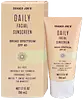
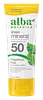
Trader Joe's Daily Facial Sunscreen SPF 40 Versus Alba Botanica Sheer Mineral Fragrance Free Sunscreen Lotion SPF 50
This chemical sunscreen covers most of the UV range, lighter on the deep UVA that drives aging.
This hybrid sunscreen covers the full UV range and blocks ~98% of UVB at SPF 50.

What's inside
What's inside
 Key Ingredients
Benefits
Concerns
Ingredients Side-by-side
Butyl Methoxydibenzoylmethane 3%
UV Absorber
Homosalate 12%
Skin Conditioning
Ethylhexyl Salicylate 5%
UV Absorber
Octocrylene 6%
UV Absorber

Isododecane
EmollientDimethicone Crosspolymer
Emulsion Stabilising
Polymethylsilsesquioxane
Dimethicone/Bis-Isobutyl PPG-20 Crosspolymer
Emollient
Neopentyl Glycol Diheptanoate
EmollientPolyester-7
Skin ConditioningIsohexadecane
EmollientJojoba Esters
Emollient

Silica
Abrasive


Butyrospermum Parkii Butter
Skin Conditioning



Dicaprylyl Carbonate
EmollientTocopheryl Acetate
Antioxidant


Caprylic/Capric Triglyceride
Masking
Tocopherol
Antioxidant


Butyl Methoxydibenzoylmethane 3%, Homosalate 12%, Ethylhexyl Salicylate 5%, Octocrylene 6%, Isododecane, Dimethicone Crosspolymer, Polymethylsilsesquioxane, Dimethicone/Bis-Isobutyl PPG-20 Crosspolymer, Neopentyl Glycol Diheptanoate, Polyester-7, Isohexadecane, Jojoba Esters, Silica, Butyrospermum Parkii Butter, Dicaprylyl Carbonate, Tocopheryl Acetate, Caprylic/Capric Triglyceride, Tocopherol
Zinc Oxide 24.1%
Cosmetic Colorant
Water
Skin ConditioningCaprylic/Capric Triglyceride
Masking
Ethylhexyl Olivate
Skin Conditioning
Butyloctyl Salicylate
Skin Conditioning
Isoamyl Laurate
Emollient
Glyceryl Stearate Se
Emulsifying
Niacinamide
Smoothing




Vp/Hexadecene Copolymer
Triethoxycaprylylsilane
Tocopheryl Acetate
Antioxidant
Glycerin
Humectant
Polyhydroxystearic Acid
Emulsifying
Potassium Cetyl Phosphate
EmulsifyingSodium Phytate
ChelatingSqualane
Emollient
Xanthan Gum
EmulsifyingAlcohol
Antimicrobial

Ethylhexylglycerin
Skin ConditioningPhenoxyethanol
Preservative
Zinc Oxide 24.1%, Water, Caprylic/Capric Triglyceride, Ethylhexyl Olivate, Butyloctyl Salicylate, Isoamyl Laurate, Glyceryl Stearate Se, Niacinamide, Vp/Hexadecene Copolymer, Triethoxycaprylylsilane, Tocopheryl Acetate, Glycerin, Polyhydroxystearic Acid, Potassium Cetyl Phosphate, Sodium Phytate, Squalane, Xanthan Gum, Alcohol, Ethylhexylglycerin, Phenoxyethanol
Reviews
Ingredients Explained
These ingredients are found in both products.
Ingredients higher up in an ingredient list are typically present in a larger amount.
Caprylic/Capric Triglyceride (aka MCT Oil) is a lightweight emollient, solvent, and texture enhancer. It is considered a skin-softener by helping to prevent moisture loss.
Though it behaves like an oil, it is not technically one due to its chemical composition. One perk of this ingredient is that it is very stable, resistant to oxidation, and unlikely to go rancid.
In practice, that translates to a long shelf life and a consistently elegant skin feel.
While there is an assumption Caprylic Triglyceride can clog pores due to it being derived from coconut oil, there is no research supporting this. Just patch test if you have concerns.
Fractionated coconut oil and MCT Oil are both listed as Caprylic/Capric Triglyceride according to INCI. This is because INCI names are based on the ingredient’s final chemical composition and not its marketing name or source.
This ingredient is treated as the gold standard fungal acne safe oil. Even though it is coconut derived, the problematic lauric acid is stripped out.
This leaves just caprylic (C8) and capric (C10) acid. These chain lengths actually trend antifungal; a 2020 study found caprylic acid was enough to disrupt Malassezia furfur cell membrane, with a caprylic acid derivative damaging membrane structures at concentrations as low as 0.2%.
Learn more about Caprylic/Capric TriglycerideTocopheryl Acetate is a stable, shelf-friendly form of vitamin E.
Formulators love it because plain vitamin E oxidizes quickly once it hits air. This acetate version stays stable and resists going off, helping to extend a product's shelf life.
It's actually inactive on its own and works like a slow-release "storage" form; the enzymes in your skin called esterases gradually convert it into active vitamin E over time.
One in vivo study showed 5% of the acetate in the living layer of the epidermis converted to vitamin E after 5 days of application. This study also found the skin gained protection against UV damage even though the conversion was slow and small.
Once converted, vitamin E acts as a skin's main fat-soluble antioxidant that fights free radicals to protect skin from damage.
Topical vitamin E generally boosts the skin's photoprotection, and it reduced UV-damage in animal models.
This ingredient has some brightening potential but it's more of a prevention ingredient than spot-fader. Cell studies show it can slow down melanin production but it's worth noting that it's not the most powerful brightener out there.
Overall, it has a pretty solid safety profile and has been found to be non-irritating and non-comedogenic. Allergic reactions may happen but stay rare due to how widely the ingredient gets used.
The concentration will vary depending on the formula; industry data shows 0.1% in baby lotions, 3% in lipsticks, and 5% in foot powders. You can also find this ingredient at 100% in a pure vitamin E oil.
Most leave-on skincare keeps it at the lower end, often between 0.5-1%.
Learn more about Tocopheryl Acetate

