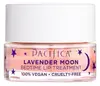
This hydrating lip mask is formulated around Prunus Amygdalus Dulcis Oil and Simmondsia Chinensis Seed Oil to hydrate lips and strengthen the lip barrier.
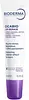
This lip moisturizer is formulated around Ricinus Communis Seed Oil and Butyrospermum Parkii Oil to hydrate lips.


What's inside
What's inside
 Key Ingredients
Benefits
Concerns
Ingredients Side-by-side
Prunus Amygdalus Dulcis Oil
Skin Conditioning





Simmondsia Chinensis Seed Oil
Emollient

Butyrospermum Parkii Butter
Skin Conditioning
Jojoba Esters
Emollient
Euphorbia Cerifera Wax
Trihydroxystearin
Skin Conditioning
Soybean Glycerides
EmollientHelianthus Annuus Seed Wax
Skin Conditioning
Water
Skin ConditioningAroma


Butyrospermum Parkii Butter Unsaponifiables
Skin Conditioning
Behenyl Behenate
EmollientGlycerin
Humectant
Stevia Rebaudiana Extract
Rosa Centifolia Flower Extract
Astringent
Acacia Decurrens Flower Wax
Emollient
Sodium Hyaluronate
Humectant


Mica
Cosmetic ColorantIron Oxides
Tocopherol
Antioxidant



Titanium Dioxide
Cosmetic Colorant

Polyglycerin-3
Humectant
Caprylhydroxamic Acid
ChelatingCaprylyl Glycol
Emollient
Prunus Amygdalus Dulcis Oil, Simmondsia Chinensis Seed Oil, Butyrospermum Parkii Butter, Jojoba Esters, Euphorbia Cerifera Wax, Trihydroxystearin, Soybean Glycerides, Helianthus Annuus Seed Wax, Water, Aroma, Butyrospermum Parkii Butter Unsaponifiables, Behenyl Behenate, Glycerin, Stevia Rebaudiana Extract, Rosa Centifolia Flower Extract, Acacia Decurrens Flower Wax, Sodium Hyaluronate, Mica, Iron Oxides, Tocopherol, Titanium Dioxide, Polyglycerin-3, Caprylhydroxamic Acid, Caprylyl Glycol
Ricinus Communis Seed Oil
Masking
Caprylic/Capric Triglyceride
Masking
Butyrospermum Parkii Oil
Emollient
Glycerin
Humectant
Trihydroxystearin
Skin Conditioning
Water
Skin ConditioningCetyl Palmitate
Emollient
Butylene Glycol
Humectant
Jojoba Esters
Emollient
Xylose
HumectantSimmondsia Chinensis Seed Oil
Emollient
Helianthus Annuus Seed Wax
Skin Conditioning
Pentylene Glycol
Skin Conditioning
Squalane
Emollient
Sodium Polyglutamate
HumectantPentaerythrityl Tetra-Di-T-Butyl Hydroxyhydrocinnamate
Antioxidant
Pongamia Glabra Seed Oil
Skin Conditioning
Sodium Hyaluronate
Humectant
Polyglycerin-3
Humectant
Acacia Decurrens Flower Wax
Emollient
Mannitol
Humectant
Rhamnose
HumectantXylitol
Humectant
Acetyl Dipeptide-1 Cetyl Ester
Skin Conditioning

Fructooligosaccharides
Humectant
Tocopherol
Antioxidant
Ricinus Communis Seed Oil, Caprylic/Capric Triglyceride, Butyrospermum Parkii Oil, Glycerin, Trihydroxystearin, Water, Cetyl Palmitate, Butylene Glycol, Jojoba Esters, Xylose, Simmondsia Chinensis Seed Oil, Helianthus Annuus Seed Wax, Pentylene Glycol, Squalane, Sodium Polyglutamate, Pentaerythrityl Tetra-Di-T-Butyl Hydroxyhydrocinnamate, Pongamia Glabra Seed Oil, Sodium Hyaluronate, Polyglycerin-3, Acacia Decurrens Flower Wax, Mannitol, Rhamnose, Xylitol, Acetyl Dipeptide-1 Cetyl Ester, Fructooligosaccharides, Tocopherol
Reviews
Ingredients Explained
These ingredients are found in both products.
Ingredients higher up in an ingredient list are typically present in a larger amount.
Also known as mimosa wax, this ingredient is a plant-derived wax from the flowers of the Acacia decurrens tree.
The wax has a profile that gives it skin benefits, including lipids that offer a skin conditioning effect. In a formula, it forms a breathable film on the skin's surface that reduces water loss, lock in moisture, and soften the skin.
One manufacturer study using a trade blend (jojoba esters + sunflower seed wax + this ingredient + polyglycerin 3) found it to perform equal to or better than lanolin in skin hydration.
On its own, typical usage concentrations run from 0.5-10% with 1-5% the most common in creams and up to 10% in lip balms.
Learn more about Acacia Decurrens Flower WaxGlycerin (or glycerol) is a compound naturally found in your skin. It's a powerhouse humectant that pulls water into the stratum corneum.
Topically, glycerin does several things at once:
Your skin makes glycerin on its own (mostly from sebaceous oil breakdown) and shuttles it to your outermost layer of skin, or your epidermis, via aquaporin-3.
Aquaporin-3 is a transporter that is essential for normal skin hydration, elasticity, and repair. Interestingly, mice lacking in AQP3 have dry and less elastic skin that can be fully corrected with glycerin.
This ingredient is non-irritating, plays well with almost every ingredient, and works across all skin types. Typical use is anywhere between 3-10% but can go up to 79% in some leave-on products.
Just know very high concentrations (>40%) can feel tacky in low humidity.
Glycerin is the name for this ingredient in American English. British English uses Glycerol/Glycerine.
Learn more about GlycerinHelianthus Annuus Seed Wax is created from the common sunflower.
Sunflower seed wax is made up of long chain non-glyceride esters, a small amount of fatty alcohols, and fatty acids.
This ingredient is often used to enhance the texture of products. The fatty acid properties also help hydrate the skin.
Learn more about Helianthus Annuus Seed WaxJojoba Esters is a wax created from Jojoba oil. It is an emollient and film-forming ingredient. In bead form, it is an exfoliator.
This ingredient has high oxidative stability, meaning it doesn't break down when exposed to oxygen.
Its similarity to our skin's natural oils makes it a great emollient. Emollients help soften and soothe our skin by creating a barrier on top. This barrier helps trap moisture in, keeping skin hydrated.
It is created using either the hydrogenation or transesterification processes on jojoba oil.
Learn more about Jojoba EstersPolyglycerin-3 is a 3-unit glycerin polymer.
Like glycerin, this ingredient is a humectant. Humectants help hydrate your skin by drawing water to it.
Having moisturized skin helps improve the skin barrier. Your skin barrier helps protect against irritants and bacteria.
Learn more about Polyglycerin-3Jojoba oil is one of the most well-studied plant-derived ingredients in cosmetics. It is an emollient with a special structure.
Because it is made up of 97-98% wax esters, it closely mirrors the linear monoesters found in human sebum. This makes it skin compatible, non-greasy, and lightweight.
Unlike other plant oils, jojoba wax doesn't easily penetrate skin. It mostly works in the uppermost layers as an emollient. This just means it forms a light barrier on the skin to help retain moisture.
Formulations with jojoba esters up to 90% reduced transepidermal water loss (TEWL) and increased barrier recovery by 81% (outperforming bisabolol at 47%).
Besides barrier support, the science also suggests jojoba to have anti-inflammatory effects and potential applications for skin infections, aging, and wound healing.
Fun fact: Indigenous cultures have used jojoba as a moisturizer and to help treat burns for centuries.
Fungal acne: The Malassezia yeast is known to metabolize fatty acids in the C11-24 range and jojoba's dominant fatty acid components fall into this range. This ingredient may not be fungal acne safe.
Learn more about Simmondsia Chinensis Seed OilSodium Hyaluronate is the salt form of hyaluronic acid. It is a long sugar chain that is naturally found in your skin, joints, and connective tissue that maintains hydration and elasticity.
In skincare, it works as a humectant. It pulls water from the environment and deeper layers of skin and binds it to the surface.
Interestingly, the size of the molecule affects its behavior:
Some clinical evidence links low molecular weight versions to improved wrinkle depth, elasticity, anti-inflammatory effects, and barrier repair.
Many serums use a blend of both weights so you can get surface hydration plus longer-lasting and deeper effects.
You'll typically see concentrations between 0.1-2% for this ingredient.
Learn more about Sodium HyaluronateTocopherol is a fat-soluble antioxidant known as Vitamin E.
You'll find this ingredient in the vast majority of skincare (for good reason). It works to neutralize free radicals, or unstable molecules generated by UV exposure, pollution, and other environmental stressors, before they can cause oxidative damage to your skin cells.
Topically applied tocopherol has been shown to protect against UV damage by ramping up the skin's own natural defense enzymes.
It also acts as a skin conditioning agent; some studies show that regular topical use can improve the skin's water-binding capacity over 2-4 weeks.
This ingredient is especially loved for being a team player. When combined with Vitamin C, the photoprotective effect of both ingredients roughly doubles and the combo also helps reduce UV-induced DNA damage.
This ingredient has some brightening potential but it's more of a prevention ingredient than spot-fader. Cell studies show it can slow down melanin production but it's worth noting that it's not the most powerful brightener out there.
In formulations, it also serves as a stabilizer that helps protect other oxidation-prone ingredients from degrading.
Concentrations usually range from 0.1-1% in most leave-on products.
Learn more about TocopherolTrihydroxystearin is what you get when you fully hydrogenate castor oil into a waxy, fine powder.
It's mostly a behind-the-scenes texture enhancer that's especially good at "thixotropic" thing where the product stays thick but applies nicely.
Because of its structure, it also acts as a mild skin conditioning emollient that helps soften skin while preventing moisture loss.
Safety studies show it to be safe and non-irritation in clinical tests. It's typically used in concentrations up to 5%.
Since its an ester of a C18 fatty acid, it falls into the C11-24 range that Malassezia can potentially feed on. This makes it not fungal-acne safe.
Learn more about TrihydroxystearinWater. It's the most common cosmetic ingredient of all. You'll usually see it at the top of ingredient lists, meaning that it makes up the largest part of the product.
So why is it so popular? Water most often acts as a solvent - this means that it helps dissolve other ingredients into the formulation.
You'll also recognize water as that liquid we all need to stay alive. If you see this, drink a glass of water. Remember to stay hydrated!
Learn more about Water

