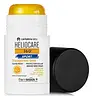
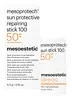
HELIOCARE 360º Sport Transparent Stick SPF 50+ Versus Mesoestetic Mesoprotech Sun Protective Repairing Stick SPF 50
This chemical sunscreen covers the full UV range and blocks ~98% of UVB at SPF 50.
This hybrid sunscreen covers the full UV range and blocks ~98% of UVB at SPF 50.

What's inside
What's inside
 Key Ingredients
Benefits
Concerns
Ingredients Side-by-side
Coco-Caprylate/Caprate
Emollient
Dicaprylyl Carbonate
EmollientBis-Ethylhexyloxyphenol Methoxyphenyl Triazine
UV Absorber
Diethylamino Hydroxybenzoyl Hexyl Benzoate
UV Filter
Dibutyl Lauroyl Glutamide
Skin ConditioningDiethylhexyl Butamido Triazone
UV Absorber
Ethylhexyl Triazone
UV Absorber
Dibutyl Ethylhexanoyl Glutamide
Skin ConditioningTocopherol
Antioxidant







Diethylhexyl Syringylidenemalonate
Skin Protecting
Parfum
Masking




Silica
Abrasive


Propylene Glycol
Humectant
Polypodium Leucotomos Leaf Extract
Skin Protecting
Caprylic/Capric Triglyceride
Masking
Linalool
Perfuming
Limonene
Perfuming
Coco-Caprylate/Caprate, Dicaprylyl Carbonate, Bis-Ethylhexyloxyphenol Methoxyphenyl Triazine, Diethylamino Hydroxybenzoyl Hexyl Benzoate, Dibutyl Lauroyl Glutamide, Diethylhexyl Butamido Triazone, Ethylhexyl Triazone, Dibutyl Ethylhexanoyl Glutamide, Tocopherol, Diethylhexyl Syringylidenemalonate, Parfum, Silica, Propylene Glycol, Polypodium Leucotomos Leaf Extract, Caprylic/Capric Triglyceride, Linalool, Limonene
Octyldodecanol
Emollient
C12-15 Alkyl Benzoate
AntimicrobialSilica
Abrasive
Bis-Ethylhexyloxyphenol Methoxyphenyl Triazine
UV Absorber
Ethylhexyl Methoxycinnamate
UV Absorber
Ethylhexyl Triazone
UV Absorber
Euphorbia Cerifera Cera
Astringent
Homosalate
Skin Conditioning
Octocrylene
UV Absorber
Ozokerite
Emulsion StabilisingButyl Methoxydibenzoylmethane
UV Absorber
Copernicia Cerifera Cera
Emollient
Titanium Dioxide
Cosmetic Colorant
Dipropylene Glycol Dibenzoate
EmollientHydrogenated Coco-Glycerides
Emollient
Cera Microcristallina
Emulsion StabilisingPolysilicone-15
UV Filter
Rhus Verniciflua Peel Cera
EmollientWater
Skin ConditioningBis-Ethylhexyl Hydroxydimethoxy Benzylmalonate
Antioxidant
Rosa Canina Fruit Oil
Emollient

Helianthus Annuus Seed Oil
Emollient
PPG-15 Stearyl Ether Benzoate
EmollientDimethicone
Emollient
Zingiber Officinale Root Extract
Masking
Lupinus Albus Seed Extract
Skin ConditioningEthylhexylglycerin
Skin ConditioningVp/Hexadecene Copolymer
Hydrolyzed Wheat Protein/Pvp Crosspolymer
Tocopheryl Acetate
Antioxidant
Disodium EDTA
ChelatingPhenoxyethanol
Preservative
Potassium Sorbate
Preservative
Octyldodecanol, C12-15 Alkyl Benzoate, Silica, Bis-Ethylhexyloxyphenol Methoxyphenyl Triazine, Ethylhexyl Methoxycinnamate, Ethylhexyl Triazone, Euphorbia Cerifera Cera, Homosalate, Octocrylene, Ozokerite, Butyl Methoxydibenzoylmethane, Copernicia Cerifera Cera, Titanium Dioxide, Dipropylene Glycol Dibenzoate, Hydrogenated Coco-Glycerides, Cera Microcristallina, Polysilicone-15, Rhus Verniciflua Peel Cera, Water, Bis-Ethylhexyl Hydroxydimethoxy Benzylmalonate, Rosa Canina Fruit Oil, Helianthus Annuus Seed Oil, PPG-15 Stearyl Ether Benzoate, Dimethicone, Zingiber Officinale Root Extract, Lupinus Albus Seed Extract, Ethylhexylglycerin, Vp/Hexadecene Copolymer, Hydrolyzed Wheat Protein/Pvp Crosspolymer, Tocopheryl Acetate, Disodium EDTA, Phenoxyethanol, Potassium Sorbate
Ingredients Explained
These ingredients are found in both products.
Ingredients higher up in an ingredient list are typically present in a larger amount.
This ingredient is better known as bemotrizinol or Tinosorb S and is one of the best broad-spectrum UV filters in modern sunscreen.
It works by absorbing UV light across a whole range (280-400 nm) with peaks around 310 nm (UVB) and 340-345 nm (UVA). This means it covers UVB plus the deeper UVA wavelengths that drive photoaging and pigmentation.
Another pro?
It's exceptionally photostable, barely degrades in sunlight, and acts as a "bodyguard" for less stable filters.
That's why you'll see it paired with avobenzone or octinoxate; this team up ensures they keep working through sun exposure.
Safety reviews have been reassuring across the board. This ingredient shows low absorption through the skin, rarely irritates, and lab studies found it doesn't act like a hormone in the body (a concern that's been raised about some older sunscreen filters).
On maximum concentrations:
In 2026, the US F.D.A finally added it as an OTC sunscreen ingredient at concentrations up to 6% for adults / children 6 months and older
Learn more about Bis-Ethylhexyloxyphenol Methoxyphenyl TriazineEthylhexyl Triazone (aka Octyl Triazone) is an oil-soluble organic UVB filter. It has peak absorption around 314 nm, right in the middle of the UVB range.
This ingredient is described as one of the most effective UVB filters available and small concentrations are enough to deliver a high SPF thanks to its strong UV absorbing power.
Formulators love it for its stability; its ability to filter UV stays practically unchanged even under intense radiation and it can also help boost the photostability of less stable filters like avobenzone.
It's also a great pick for water resistant products because it's insoluble in water and has a good affinity for keratin.
Because it's a big, heavy molecule, the European Scientific Committee has found to to have very low dermal penetration and negative results for allergenicity.
In vitro testing also showed a low absorption rate and clean results on irritation.
Typical use levels are 1-5% with 5% being the maximum in the EU, Japan, and other markets that allow it. However, this ingredient is not approved yet in the US or Canada.
Learn more about Ethylhexyl TriazoneSilica, also known as silicon dioxide, is a naturally occurring mineral. It is used as a fine, spherical, and porous powder in cosmetics.
Though it has exfoliant properties, the function of silica varies depending on the product.
The unique structure of silica enhances the spreadability and adds smoothness, making it a great texture enhancer.
It is also used as an active carrier, emulsifier, and mattifier due to its ability to absorb excess oil.
In some products, tiny microneedles called spicules are made from silica or hydrolyzed sponge. When you rub them in, they lightly polish away dead skin layers and enhance the penetration of active ingredients.
Learn more about Silica

