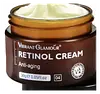
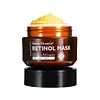
Vibrant Glamour Natural Retinol Anti Aging Whitening Face Cream Versus Vibrant Glamour Retinol Mask 2% Retinol+ 5X Ceramide
This anti-aging moisturizer is formulated around Ascorbic Acid and Retinol to soften the look of wrinkles and fade the look of dark spots.
This anti-aging overnight mask is formulated around Niacinamide and Hydroxypinacolone Retinoate to soften the look of wrinkles and strengthen the skin barrier.

What's inside
What's inside
 Key Ingredients
Benefits
Concerns
Ingredients Side-by-side
Glycerin
Humectant


Aloe Barbadensis Leaf Extract
Emollient

Tremella Fuciformis Polysaccharide
Emulsion Stabilising
Butyrospermum Parkii Butter
Skin Conditioning




Ascorbic Acid
Antioxidant





Retinol
Skin Conditioning




Acetyl Hexapeptide-8
Humectant
Arbutin
Antioxidant
Aminopropyl Ascorbyl Phosphate
Antioxidant
Glycyrrhiza Glabra Root Extract
Bleaching
Collageneer
Trehalose
Humectant
Avena Sativa Bran
Abrasive
Citrus Aurantium Dulcis Fruit Extract
MaskingCeramide EOP
Skin Conditioning
Paeonia Albiflora Root Extract
Skin ConditioningTocopherol
Antioxidant
Sodium Hyaluronate
Humectant
Glycerin, Aloe Barbadensis Leaf Extract, Tremella Fuciformis Polysaccharide, Butyrospermum Parkii Butter, Ascorbic Acid, Retinol, Acetyl Hexapeptide-8, Arbutin, Aminopropyl Ascorbyl Phosphate, Glycyrrhiza Glabra Root Extract, Collageneer, Trehalose, Avena Sativa Bran, Citrus Aurantium Dulcis Fruit Extract, Ceramide EOP, Paeonia Albiflora Root Extract, Tocopherol, Sodium Hyaluronate
Water
Skin ConditioningGlycerin
Humectant
Niacinamide
Smoothing
Hydroxypinacolone Retinoate
Skin Conditioning
Caprylic/Capric Triglyceride
Masking
Squalane
Emollient
Simmondsia Chinensis Seed Oil
Emollient
Dimethicone
Emollient
Aloe Barbadensis Leaf Extract
Emollient
Centella Asiatica Extract
Cleansing
Ceramide NP
Skin Conditioning
Hydroxyacetophenone
Antioxidant
1,2-Hexanediol
Skin Conditioning
Ammonium Acryloyldimethyltaurate/Vp Copolymer
Sodium Hyaluronate
Humectant
Allantoin
Skin Conditioning
Disodium EDTA
ChelatingCeramide EOP
Skin Conditioning
Ceramide Ns
Skin Conditioning
Ceramide Ng
Skin Conditioning
Ceramide As
Skin Conditioning
Ceramide AP
Skin Conditioning
Water, Glycerin, Niacinamide, Hydroxypinacolone Retinoate, Caprylic/Capric Triglyceride, Squalane, Simmondsia Chinensis Seed Oil, Dimethicone, Aloe Barbadensis Leaf Extract, Centella Asiatica Extract, Ceramide NP, Hydroxyacetophenone, 1,2-Hexanediol, Ammonium Acryloyldimethyltaurate/Vp Copolymer, Sodium Hyaluronate, Allantoin, Disodium EDTA, Ceramide EOP, Ceramide Ns, Ceramide Ng, Ceramide As, Ceramide AP
Alternatives
Ingredients Explained
These ingredients are found in both products.
Ingredients higher up in an ingredient list are typically present in a larger amount.
Aloe Barbadensis Leaf Extract is a botanical extract pulled from the leaves of aloe vera and one of the most studied plant ingredients in cosmetics.
The inner leaf gel it comes from is mostly water (~99-99.5%) and the remaining fraction is made up of pretty good stuff: polysaccharides, vitamins, phenolics, and enzymes.
Its headline job is hydration.
The star polysaccharide in aloe, acemannan, is a humectant that retains moisture and helps reduce trans-epidermal water loss.
Aloe also has real soothing credentials; it contains anti-inflammatory compounds like bradykinase and C-glucosyl chromone that help calm irritation and redness.
On the repair side, lab work shows that acemannan wakes up your skin's repair cells (fibroblasts), prompting them to multiply and speed up healing.
There's some human data for cosmetic benefit too: a cream containing 10% Aloe Barbadensis leaf extract improved skin hydration and elasticity in a real-use study.
Safety-wise, this ingredient is well-regarded with just one rare downside; there have been some case reports of acute eczema, contact urticaria, and dermatitis in people who applied aloe-derived ingredients topically. Those with a known aloe or Liliaceae sensitivity should patch test.
Typical use levels range widely, from under 1% up to 90%+ depending on the format and the effect you are after.
Learn more about Aloe Barbadensis Leaf ExtractCeramide EOP is formally known as Ceramide 1.
It is naturally found in skin and part of the intercellular "mortar" holding everything together in your outermost layer.
EOP stands for a linked Ester fatty acid, a linked Omega hydroxy fatty acid, and the Phytosphingosine base.
What makes Ceramide EOP special is its ultra-long fatty acid chain; this unique structure allows it to bridge the lipid layers in your skin barrier to prevent water loss (something no other ceramide can do).
Low levels of Ceramide EOP have been found in people with eczema and psoriasis.
Using it together with other ceramides, cholesterol, and linoleic acid have been shown to meaningfully improve hydration and reduce water loss.
In one clinical study, a regimen using Ceramide EOP, NP, and AP led to significant symptom improvements in patients with eczema, psoriasis, and dry skin in just 4 weeks.
You'll usually see concentrations between 0.1-0.5% in formulations. Overall, this is a well-tolerated and safe ingredient for cosmetic use.
Learn more about Ceramide EOPGlycerin (or glycerol) is a compound naturally found in your skin. It's a powerhouse humectant that pulls water into the stratum corneum.
Topically, glycerin does several things at once:
Your skin makes glycerin on its own (mostly from sebaceous oil breakdown) and shuttles it to your outermost layer of skin, or your epidermis, via aquaporin-3.
Aquaporin-3 is a transporter that is essential for normal skin hydration, elasticity, and repair. Interestingly, mice lacking in AQP3 have dry and less elastic skin that can be fully corrected with glycerin.
This ingredient is non-irritating, plays well with almost every ingredient, and works across all skin types. Typical use is anywhere between 3-10% but can go up to 79% in some leave-on products.
Just know very high concentrations (>40%) can feel tacky in low humidity.
Glycerin is the name for this ingredient in American English. British English uses Glycerol/Glycerine.
Learn more about GlycerinSodium Hyaluronate is the salt form of hyaluronic acid. It is a long sugar chain that is naturally found in your skin, joints, and connective tissue that maintains hydration and elasticity.
In skincare, it works as a humectant. It pulls water from the environment and deeper layers of skin and binds it to the surface.
Interestingly, the size of the molecule affects its behavior:
Some clinical evidence links low molecular weight versions to improved wrinkle depth, elasticity, anti-inflammatory effects, and barrier repair.
Many serums use a blend of both weights so you can get surface hydration plus longer-lasting and deeper effects.
You'll typically see concentrations between 0.1-2% for this ingredient.
Learn more about Sodium Hyaluronate

