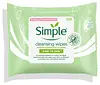
This cleansing wipe is mild enough to cleanse without leaving skin feeling tight or stripped.
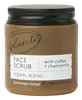
This hydrating exfoliator is formulated around Sucrose and Butyrospermum Parkii Butter to hydrate skin.

What's inside
What's inside
 Key Ingredients
Benefits
Concerns
Ingredients Side-by-side
Water
Skin ConditioningCetearyl Isononanoate
Emollient
Benzoic Acid
Masking

Ceteareth-12
EmulsifyingCeteareth-20
Cleansing
Cetearyl Alcohol
Emollient



Citric Acid
Buffering

Dehydroacetic Acid
Preservative
Disodium EDTA
ChelatingGlycerin
Humectant


Glyceryl Stearate
Emollient
Panthenol
Skin Conditioning

Pantolactone
Humectant
Phenoxyethanol
Preservative
Sodium Citrate
BufferingTocopheryl Acetate
Antioxidant

Coffea Arabica Seed Powder
Abrasive
Sucrose
Humectant
Butyrospermum Parkii Butter
Skin Conditioning
Cocos Nucifera Oil
Masking

Simmondsia Chinensis Seed Oil
Emollient
Prunus Armeniaca Kernel Oil
Masking
Rosa Canina Fruit Oil
Emollient
Citrus Aurantium Dulcis Peel Oil
Masking
Pelargonium Graveolens Flower Oil
Masking

Rosmarinus Officinalis Leaf Oil
Masking
Citrus Aurantium Bergamia Fruit Oil
Masking
Pogostemon Cablin Leaf Oil
Masking
Citrus Aurantium Amara Leaf/Twig Oil
Masking
Anthemis Nobilis Flower Oil
Masking
Benzyl Alcohol
Perfuming

Dehydroacetic Acid
Preservative
Benzoic Acid
Masking
Sorbic Acid
Preservative
Limonene
Perfuming
Citronellol
Perfuming
Geraniol
Perfuming
Linalool
Perfuming
Coffea Arabica Seed Powder, Sucrose, Butyrospermum Parkii Butter, Cocos Nucifera Oil, Simmondsia Chinensis Seed Oil, Prunus Armeniaca Kernel Oil, Rosa Canina Fruit Oil, Citrus Aurantium Dulcis Peel Oil, Pelargonium Graveolens Flower Oil, Rosmarinus Officinalis Leaf Oil, Citrus Aurantium Bergamia Fruit Oil, Pogostemon Cablin Leaf Oil, Citrus Aurantium Amara Leaf/Twig Oil, Anthemis Nobilis Flower Oil, Benzyl Alcohol, Dehydroacetic Acid, Benzoic Acid, Sorbic Acid, Limonene, Citronellol, Geraniol, Linalool
Reviews
Alternatives
Ingredients Explained
These ingredients are found in both products.
Ingredients higher up in an ingredient list are typically present in a larger amount.
Benzoic Acid is an organic acid that shows up in cosmetics as a preservative. It helps keep a product from spoiling by holding back the growth of yeast, mold, and some bacteria.
This ingredient also functions as a fragrance ingredient that helps mask the unpleasant scent of other ingredients.
The way it works is worth understanding; benzoic acid works when the formula is acidic. It is able to sneak into a microbe's cell and mess up how it functions to stop it from growing in an acidic product.
However, the acid switches to an inactive form and stops working if a product isn't acidic enough (above ~5 pH). This is why you'll often see it in low pH products or teamed up with other preservatives to cover the gap.
Safety wise, it's one of the better studied preservatives out there.
The Cosmetic Ingredient Review Expert Panel has concluded this ingredient to be safe for use in cosmetic formulations at concentrations up to 5%.
A large international review found this ingredient had no effects on the human body and had low irritation potential.
Just so you know, real world use is usually much lower than the 5% ceiling (usually 1% of less).
The EU caps it at 2.5% in rinse-off products, 1.7% in oral care, and 0.5% in leave-on products.
One thing worth mentioning (it's nothing to worry about): some people get a little stinging or flushing where they apply it. This isn't a true allergy; it's a temporary and harmless reaction. This is the same kind of mild tingle you might notice from sorbic acid.
Learn more about Benzoic AcidDehydroacetic Acid is a synthetic preservative that keeps your products safe from microbes.
As an organic acid, it penetrates microbial cell walls and disrupts cellular metabolism. This makes it effective against bacteria, yeast, and mold.
It is effective at low concentrations (<0.6%). Clinical studies have found it to be non-irritating, non-sensitizing, and non-photosensitizing.
Learn more about Dehydroacetic Acid

