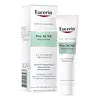
Eucerin Pro Acne Solution A.I. Clearing Treatment Versus Eucerin Dermopure Clinical Hydra Repair Soothing Cream
This acne treatment is formulated around Glycolic Acid and Salicylic Acid to clear breakouts and refine skin texture.
This calming moisturizer is formulated around Panthenol and Glycyrrhiza Inflata Root Extract to calm redness and strengthen the skin barrier.

What's inside
What's inside
 Key Ingredients
Benefits
Concerns
Ingredients Side-by-side
Water
Skin ConditioningGlycolic Acid
Buffering











Dimethicone
Emollient
Tapioca Starch
Cetearyl Alcohol
Emollient





Glyceryl Stearate
Emollient
Sodium Hydroxide
BufferingGluconolactone
Chelating
PEG-40 Stearate
Emulsifying
Salicylic Acid
Masking


PEG-150 Distearate
Emulsifying
Glycyrrhiza Inflata Root Extract
Skin Conditioning
Panthenol
Skin Conditioning


Xanthan Gum
EmulsifyingTrisodium EDTA
ChelatingPhenoxyethanol
Preservative
Parfum
Masking

Water
Skin ConditioningGlycerin
Humectant
Isopropyl Palmitate
Emollient
Panthenol
Skin Conditioning
Squalane
Emollient
Glyceryl Stearate Citrate
Emollient
Myristyl Alcohol
Emollient
Tapioca Starch
Behenyl Alcohol
Emollient
Cetyl Alcohol
Emollient
Hydrogenated Coco-Glycerides
Emollient
Hydroxypropyl Starch Phosphate
Glycyrrhiza Inflata Root Extract
Skin Conditioning
Ceramide NP
Skin Conditioning
4-T-Butylcyclohexanol
Masking
Pantolactone
Humectant
Xanthan Gum
EmulsifyingEthylhexylglycerin
Skin ConditioningPentylene Glycol
Skin Conditioning
Citric Acid
Buffering
Phenoxyethanol
Preservative
Hydroxyacetophenone
Antioxidant
Trisodium Ethylenediamine Disuccinate
ChelatingWater, Glycerin, Isopropyl Palmitate, Panthenol, Squalane, Glyceryl Stearate Citrate, Myristyl Alcohol, Tapioca Starch, Behenyl Alcohol, Cetyl Alcohol, Hydrogenated Coco-Glycerides, Hydroxypropyl Starch Phosphate, Glycyrrhiza Inflata Root Extract, Ceramide NP, 4-T-Butylcyclohexanol, Pantolactone, Xanthan Gum, Ethylhexylglycerin, Pentylene Glycol, Citric Acid, Phenoxyethanol, Hydroxyacetophenone, Trisodium Ethylenediamine Disuccinate
Reviews
Ingredients Explained
These ingredients are found in both products.
Ingredients higher up in an ingredient list are typically present in a larger amount.
This ingredient comes from the Chinese licorice species, Glycyrrhiza Inflata. It has skin conditioning, soothing, and antioxidant properties.
The flavonoids in this ingredient show anti-inflammatory and antioxidant activities in lab studies. These compounds may also play a role in supporting a more even skin tone and helping to control microbial activity on acne-prone skin.
Panthenol is a common ingredient that helps hydrate and soothe the skin. It is found naturally in our skin and hair.
There are two forms of panthenol: D and L.
D-panthenol is also known as dexpanthenol. Most cosmetics use dexpanthenol or a mixture of D and L-panthenol.
Panthenol is famous due to its ability to go deeper into the skin's layers. Using this ingredient has numerous pros (and no cons):
Like hyaluronic acid, panthenol is a humectant. Humectants are able to bind and hold large amounts of water to keep skin hydrated.
This ingredient works well for wound healing. It works by increasing tissue in the wound and helps close open wounds.
Once oxidized, panthenol converts to pantothenic acid. Panthothenic acid is found in all living cells.
This ingredient is also referred to as pro-vitamin B5.
Learn more about PanthenolPhenoxyethanol is one of the most widely used preservatives in skincare (and for good reason!).
It has a large spectrum of antimicrobial activity and especially effective bacteria, yeast, and mold while only having a weak effect on your skin's natural microbiome.
On a cellular level, it disrupts the cell membranes of microbes by poking holes that make the cell leak. This shuts down the chemical reactions the microbe needs to make energy so it can no longer survive.
Another perk of this ingredient is that it stays functional across a wide pH range (3-10).
You'll often see it paired with boosters like Ethylhexylglycerin; one study showed that a 1:9 ratio of Ethylhexylglycerin to Phenoxyethanol damages bacterial membranes as effectively as doubling the Phenoxyethanol concentration on its own.
Typical use concentrations range from 0.3-1% depending on the formula, and this ingredient is capped at 1% int the EU.
Safety-wise, the fear mongering does not hold up to the evidence. The EU's Scientific Committee on Consumer Safety and FDA consider it safe as a preservative at up to 1%, including for children of all ages.
Adverse systemic effects only showed up in animal studies at exposures roughly 200x higher than what people get from cosmetics. And despite its very widespread use, this ingredient is a rare sensitizer and allergic reactions are uncommon.
Learn more about PhenoxyethanolTapioca starch is a thickening agent and is made from the cassava root, also known as yucca.
According to a manufacturer, it is an excellent talc replacement.
It is gluten-free.
Learn more about Tapioca StarchWater. It's the most common cosmetic ingredient of all. You'll usually see it at the top of ingredient lists, meaning that it makes up the largest part of the product.
So why is it so popular? Water most often acts as a solvent - this means that it helps dissolve other ingredients into the formulation.
You'll also recognize water as that liquid we all need to stay alive. If you see this, drink a glass of water. Remember to stay hydrated!
Learn more about WaterXanthan gum is used as a stabilizer and thickener within cosmetic products. It helps give products a sticky, thick feeling - preventing them from being too runny.
On the technical side of things, xanthan gum is a polysaccharide - a combination consisting of multiple sugar molecules bonded together.
Xanthan gum is a pretty common and great ingredient. It is a natural, non-toxic, non-irritating ingredient that is also commonly used in food products.
Learn more about Xanthan Gum

