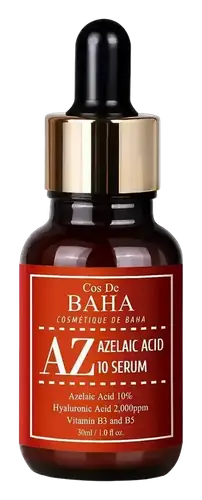
This acne serum is formulated around Azelaic Acid and Salicylic Acid to clear breakouts and calm redness.
This calming serum is formulated around Azelaic Acid and Zinc PCA to calm redness and clear breakouts.


What's inside
What's inside
 Key Ingredients
Benefits
Concerns
Ingredients Side-by-side
Water
Skin ConditioningAzelaic Acid
Buffering









Potassium Hydroxide
BufferingGlycerin
Humectant

Dicaprylyl Ether
Emollient
Betaine
Humectant
Methyl Glucose Sesquistearate
Emollient

Cetearyl Alcohol
Emollient




Salicylic Acid
Masking



Simmondsia Chinensis Seed Oil
Emollient
Vitis Vinifera Seed Oil
Emollient
Acacia Senegal Gum
MaskingXanthan Gum
EmulsifyingCaprylyl Glycol
Emollient
Tocopherol
Antioxidant


Helianthus Annuus Seed Oil
Emollient
Water
Skin ConditioningAloe Barbadensis Leaf Juice
Skin Conditioning
Propylene Glycol
Humectant
Azelaic Acid
Buffering
Betaine
Humectant
Zinc PCA
Humectant
Biosaccharide Gum-1
Humectant
Glycerin
Humectant
Triticum Aestivum Seed Extract
Perfuming
Triticum Turgidum Durum Seed Extract
Skin ConditioningEragrostis Tef Seed Extract
EmollientChenopodium Quinoa Seed Extract
Skin Conditioning
Xanthan Gum
EmulsifyingSodium Levulinate
Skin ConditioningGlyceryl Caprylate
EmollientSodium Anisate
AntimicrobialCaprylyl Glycol
Emollient
Sodium Gluconate
Skin ConditioningBenzyl Alcohol
Perfuming


Dehydroacetic Acid
Preservative
Sodium Benzoate
Masking
Phenoxyethanol
Preservative
Sodium Hydroxide
BufferingCitric Acid
Buffering
Water, Aloe Barbadensis Leaf Juice, Propylene Glycol, Azelaic Acid, Betaine, Zinc PCA, Biosaccharide Gum-1, Glycerin, Triticum Aestivum Seed Extract, Triticum Turgidum Durum Seed Extract, Eragrostis Tef Seed Extract, Chenopodium Quinoa Seed Extract, Xanthan Gum, Sodium Levulinate, Glyceryl Caprylate, Sodium Anisate, Caprylyl Glycol, Sodium Gluconate, Benzyl Alcohol, Dehydroacetic Acid, Sodium Benzoate, Phenoxyethanol, Sodium Hydroxide, Citric Acid
Reviews
Ingredients Explained
These ingredients are found in both products.
Ingredients higher up in an ingredient list are typically present in a larger amount.
Azelaic acid is a multitasker ingredient that helps treat acne, pigmentation, and irritation. It is a great option for sensitive skin.
What makes it special?
OTC Azelaic acid is usually available in concentrations from 10-15% and anything over requires a prescription.
Here's what each tier does best:
Unlike other acids, azelaic acid will not make your skin more photosensitive/sun sensitive.
Though this ingredient is naturally occurring in grains like wheat, rye, and barley, it is usually synthetically created for cosmetics to ensure stability and effectiveness.
Learn more about Azelaic AcidBetaine is a humectant. Like hyaluronic acid, it helps attract and retain moisture in the skin. It’s known for being gentle and for helping the skin maintain balanced hydration.
Betaine is mainly used to improve hydration and support calmer skin. It helps skin cells regulate water balance because it functions as an osmolyte.
Some studies suggest betaine may support making skin tone more even.
Fun fact: Betaine naturally exists in the skin and the body. In cosmetic products, it can be either plant-derived (most commonly from sugar beets) or synthetically produced for consistency and stability.
Betaine is also known as trimethylglycine.
Learn more about BetaineCaprylyl Glycol is a humectant, skin conditioner, emollient, and preservative booster derived from either caprylic acid or synthetically created.
Typical use levels vary from 0.3-1% as a preservative booster and go up to 2% to condition skin.
Because it is not a free-fatty acid, this ingredient is fungal acne safe (there's nothing for Malassezia to feed on).
Learn more about Caprylyl GlycolGlycerin (or glycerol) is a compound naturally found in your skin. It's a powerhouse humectant that pulls water into the stratum corneum.
Topically, glycerin does several things at once:
Your skin makes glycerin on its own (mostly from sebaceous oil breakdown) and shuttles it to your outermost layer of skin, or your epidermis, via aquaporin-3.
Aquaporin-3 is a transporter that is essential for normal skin hydration, elasticity, and repair. Interestingly, mice lacking in AQP3 have dry and less elastic skin that can be fully corrected with glycerin.
This ingredient is non-irritating, plays well with almost every ingredient, and works across all skin types. Typical use is anywhere between 3-10% but can go up to 79% in some leave-on products.
Just know very high concentrations (>40%) can feel tacky in low humidity.
Glycerin is the name for this ingredient in American English. British English uses Glycerol/Glycerine.
Learn more about GlycerinWater. It's the most common cosmetic ingredient of all. You'll usually see it at the top of ingredient lists, meaning that it makes up the largest part of the product.
So why is it so popular? Water most often acts as a solvent - this means that it helps dissolve other ingredients into the formulation.
You'll also recognize water as that liquid we all need to stay alive. If you see this, drink a glass of water. Remember to stay hydrated!
Learn more about WaterXanthan gum is used as a stabilizer and thickener within cosmetic products. It helps give products a sticky, thick feeling - preventing them from being too runny.
On the technical side of things, xanthan gum is a polysaccharide - a combination consisting of multiple sugar molecules bonded together.
Xanthan gum is a pretty common and great ingredient. It is a natural, non-toxic, non-irritating ingredient that is also commonly used in food products.
Learn more about Xanthan Gum